This is the article about the Luxor hot air balloon morning that changed the scale of how we understood everything else we saw in Egypt.
The alarm was set for 4:30 AM on February 25, 2022.
This was Day 8 of our Egypt trip and the final full day of the Nile cruise. The balloon was included in the cruise package at no extra charge. The departure was before the sun: a short boat crossing of the Nile in the dark, from the cruise ship’s East Bank position to the West Bank launch site, with the lights of Luxor reflected in the water behind us and the hills of the Valley of the Kings invisible in the dark ahead.
We had seen the Giza Pyramids from the ground. We had crawled through the Red Pyramid’s internal passage in Dahshur. We had stood in front of the four colossal statues at Abu Simbel. We had descended into tombs in the Valley of the Kings the previous day and looked up at astronomical ceilings painted three thousand years ago. In every case, the experience was intimate: close to the stone, inside the architecture, understanding each monument at human scale.
The balloon put us above all of it. And the scale of ancient Egypt, seen from above at sunrise, is the scale the monuments were designed to be read at. Not by visitors. By the gods.
“At eye level, the monuments of Egypt demand awe; from six hundred feet above, they reveal their architecture. The balloon did not make the temples smaller… it made the minds of the ancient builders visible.”
Before the Flight: The Crossing
The boat crossing of the Nile before dawn is the first experience of the balloon morning. The river at 4:30 AM is quiet in a way that it is not at any other hour. No feluccas. No tourist boats. The water is flat. The opposite bank is dark. You sit in the small motorboat with other cruise passengers and the crew moves you across in fifteen minutes and you step out on the West Bank into the dark before sunrise.
The West Bank is where the ancient Egyptians buried their dead. The East Bank is where they built their temples for the living gods. The Nile between them was not merely a river. It was the boundary between the world of the living and the world of the dead. Crossing it before dawn, in the dark, to ascend above the Valley of the Kings… the timing is not incidental. The balloon operators who schedule the launch for first light have placed the experience exactly where it belongs in the geography of ancient Egyptian belief.
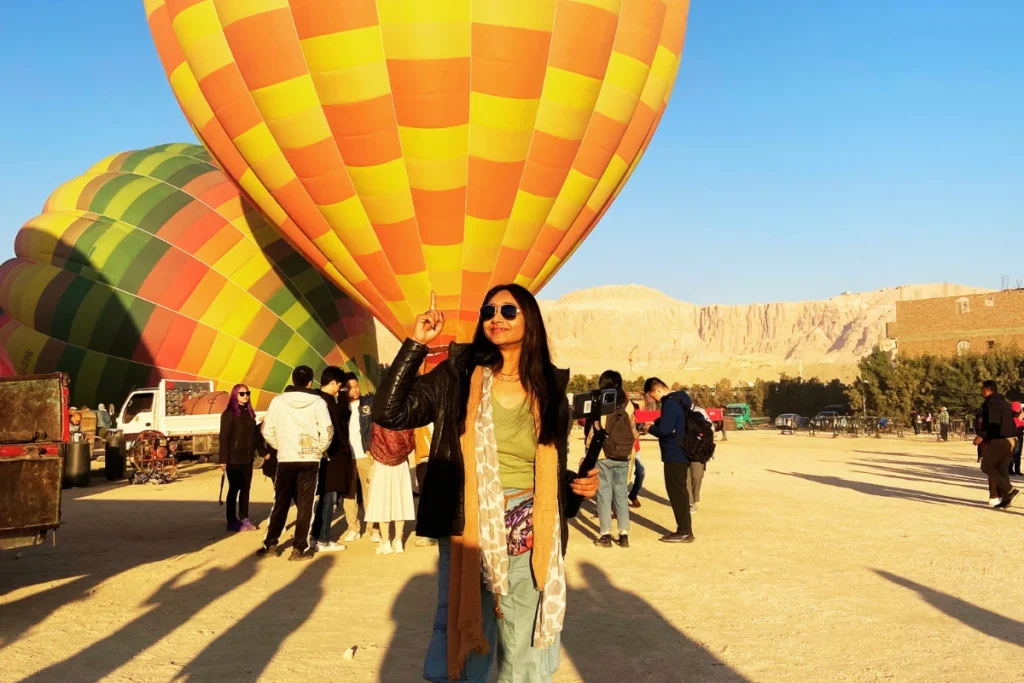
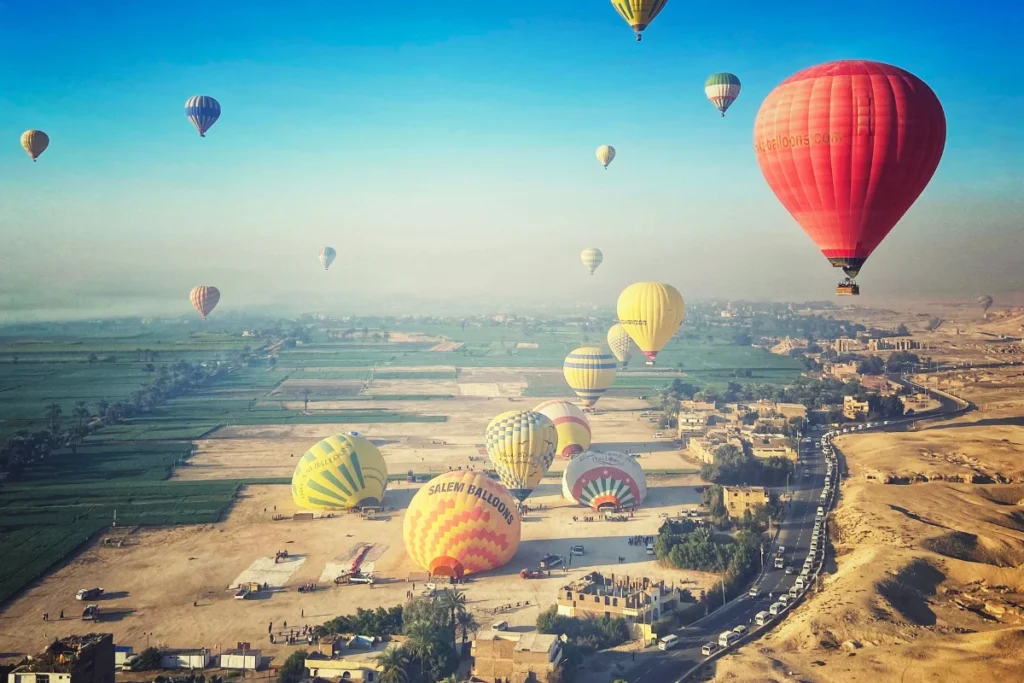
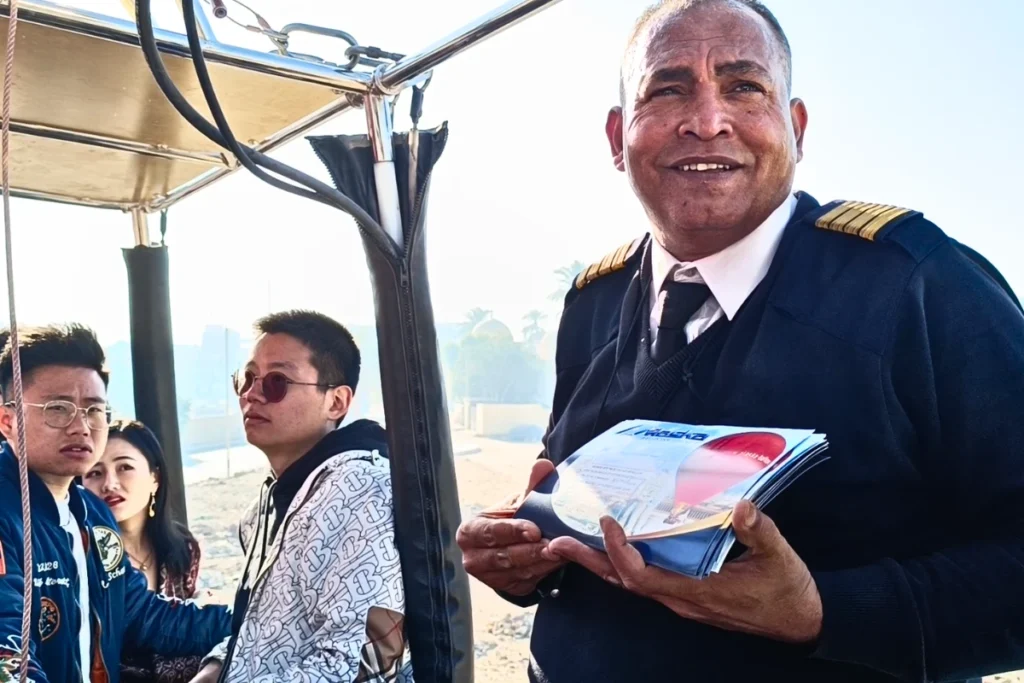
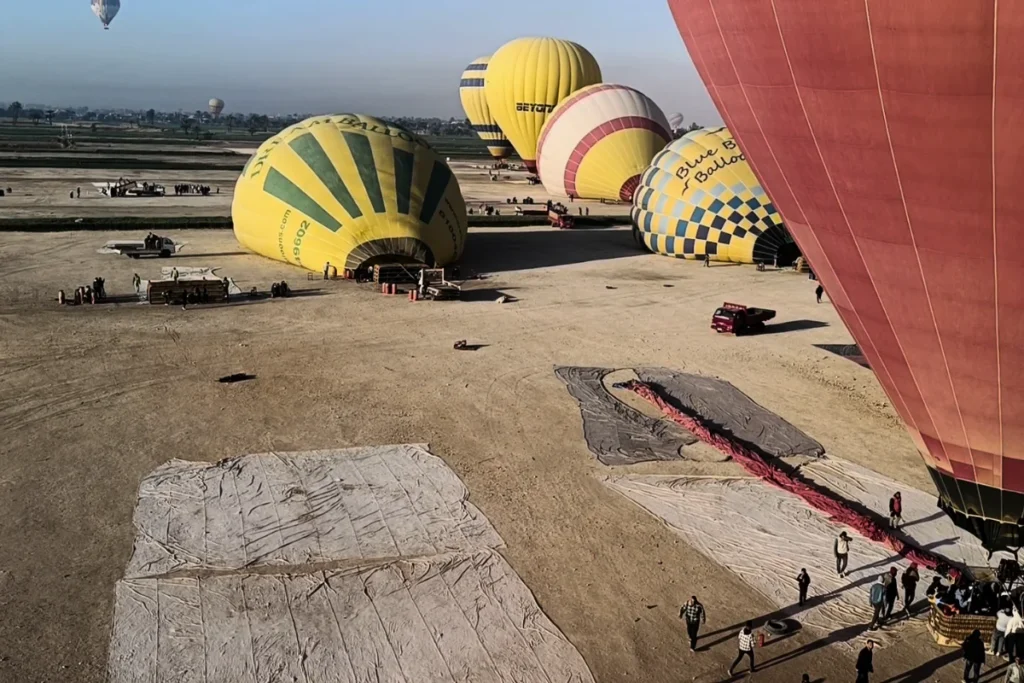
The launch site was a flat open area near the edge of the cultivated land. The balloon envelopes were already laid out, being filled with hot air by the crews. The baskets were upright. The captain introduced himself and gave the safety briefing: how to stand in the basket, what to hold, how to prepare for landing. His manner was professional and warm. He had made this flight before. The warmth was not performed. This was a person who loved the work he was doing.
The Ascent
The ascent was the first surprise.
We had imagined that rising in a balloon would feel like being lifted. It does not. The basket rises and the ground recedes and the experience is not of going up but of the world getting smaller and quieter below you. The moment of departure is so smooth that it takes a few seconds to register that the ground is no longer close.
The balloon rose above the cultivated land of the West Bank. The green strip of the Nile valley was visible on both sides: the narrow band of fertility that the river sustains against the desert on either side. From the ground, this green strip is simply where you are. From the balloon, it is a line drawn through an enormous desert by a single river. Everything alive in this landscape is alive because of that line. Everything outside it is not.
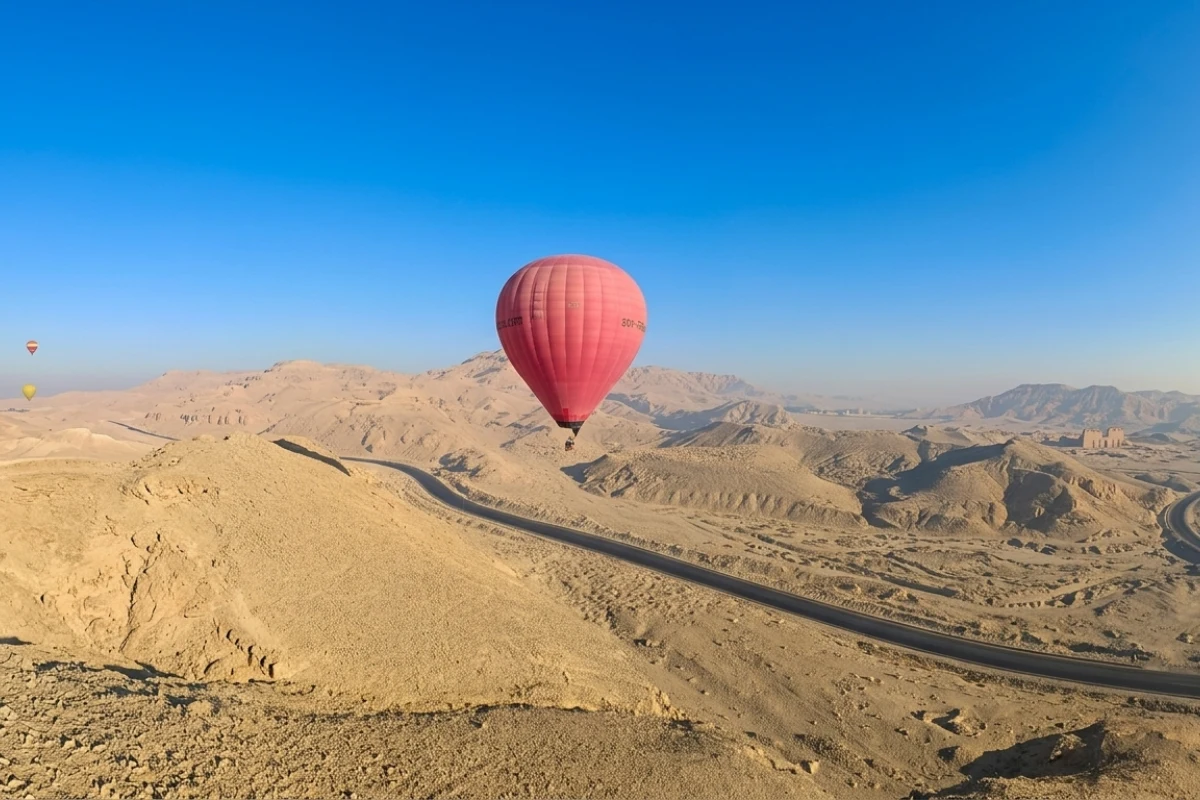
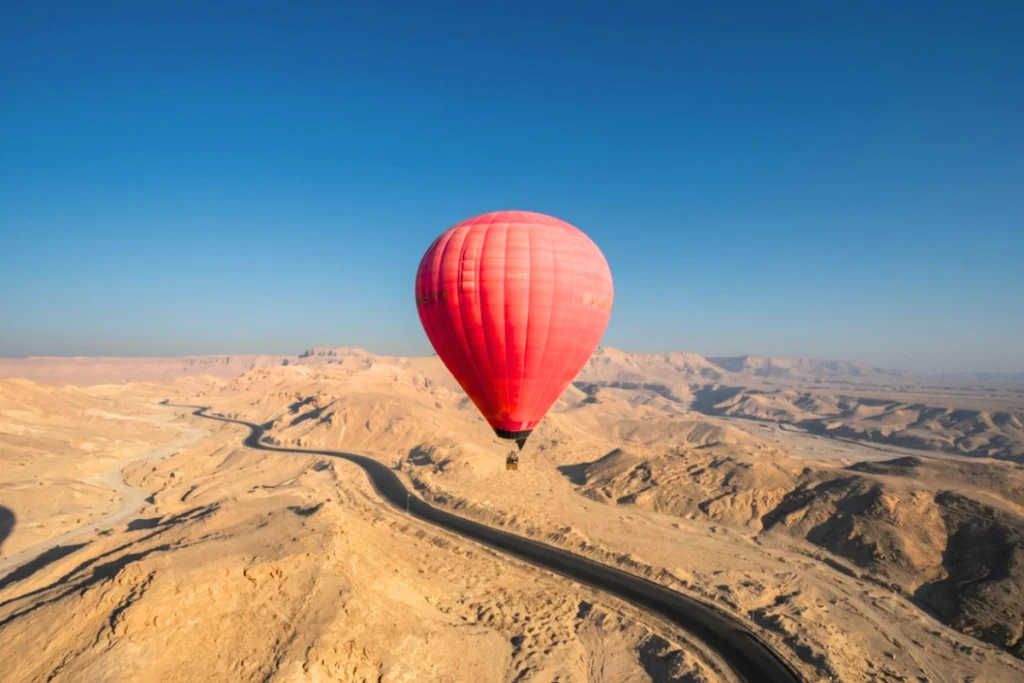
The Valley of the Kings appeared below us as a series of pale hillsides cut with entrances. The valley that contains the royal tombs is not dramatic from the ground… it is a dry, rocky gulch between limestone hills, and the tombs themselves are openings in the hillside rather than visible structures. From the balloon, the valley became comprehensible as a landscape choice: the Egyptians placed their royal burial ground in the driest, most remote, most naturally concealed valley accessible from the river. The geography of concealment is only visible from above.
“Between the verdant, life-giving ribbon of the Nile and the stark infinity of the Libyan desert lies a single razor-thin boundary… the precise line where living Egypt ends, and the realm of the dead begins.”
Hatshepsut’s temple came into view next: the great terraced structure built into the cliff face at Deir el-Bahari, its colonnades catching the first direct sunlight of the day. From the balloon, the relationship between the temple and the cliff is immediate… the building is not in front of the cliff; it is part of it. The architects who designed it understood the cliff as the back wall of a temple they had not yet built. From eye level, looking at the colonnades, this integration is felt but not fully visible. From the balloon, it is a single composition.
Other balloons were visible nearby: coloured envelopes drifting across the same sector of sky, carrying other passengers looking at the same landscape from slightly different angles. We had not expected the company of other balloons to feel harmonious rather than intrusive. It did. The balloons were part of the scene: slow, silent, coloured shapes moving above ancient monuments in the morning light. They belonged to the landscape in that hour.
What the View Does
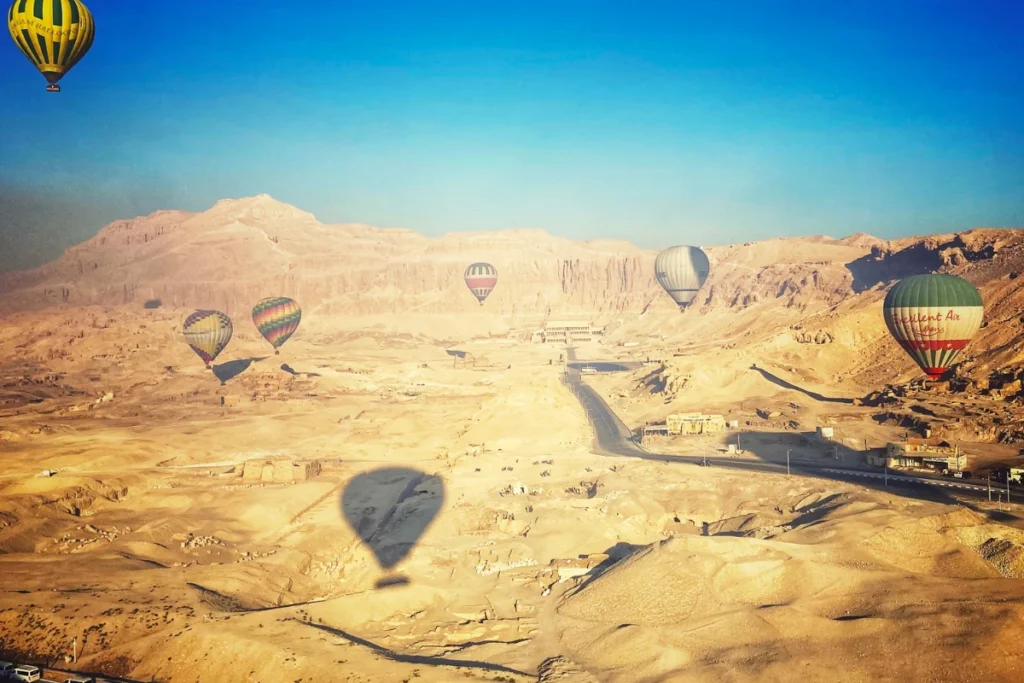
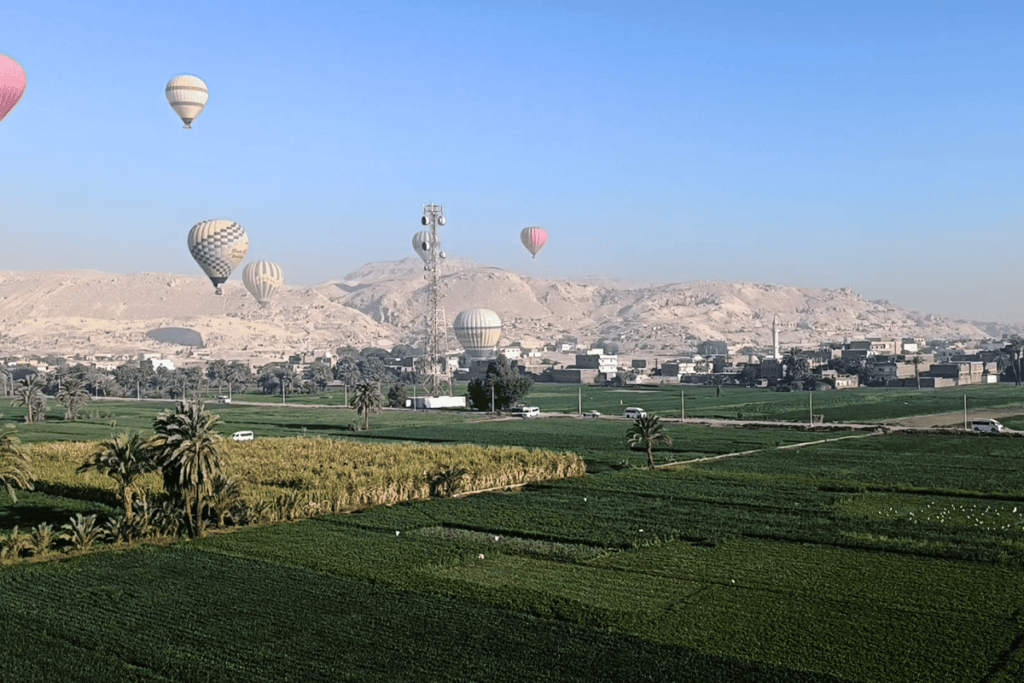
The experience of viewing a landscape from above is not simply the experience of seeing more of it. It is the experience of understanding the relationships between the parts of it: the relationship between the river and the desert, the valley and the plain, the temple and its cliff, the tomb entrance and the stone that conceals it.
Before the balloon, we had visited each site in sequence: the Karnak temple on the East Bank, the Luxor temple, the Valley of the Kings, and Hatshepsut. Each one was the full reality in that moment. From the balloon, all of them were simultaneously visible… not just visible but visibly related. The Karnak temple complex is enormous on the ground. From the balloon, it is the largest structure in the landscape, and its enormous scale relative to everything around it becomes immediately clear. The Nile that connected all of these sites is, from above, the organising spine of the entire civilisation. Every significant structure was built within reach of the river because the river was the source of everything.
This is what the view does. It shows you the logic of a civilisation’s choices: where to build, where to bury, where to place the boundary between the sacred and the everyday. The individual monuments are impressive. The system they form is extraordinary. The balloon is the only platform from which the system is fully visible.
The Landing and the Boys
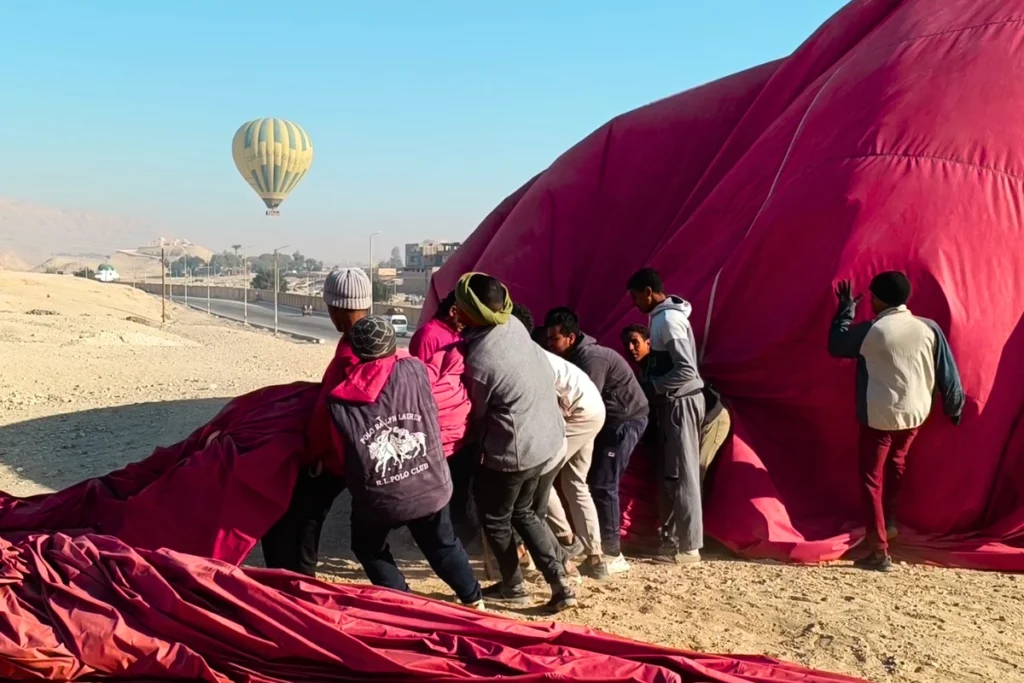
Landing a hot air balloon is physically demanding in a way that the flight itself is not.
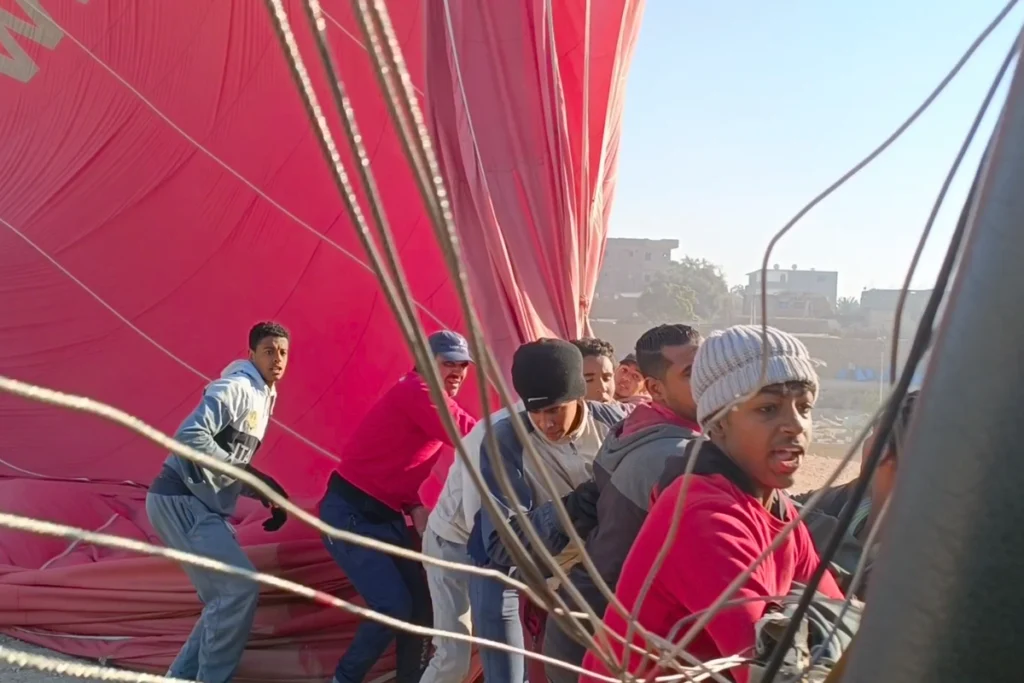
The balloon descends gradually and the captain manoeuvres toward the designated landing area. At low altitude, the basket grazes the ground and the captain fires the burner to adjust. The touchdown is not hard but the basket can drag before coming to rest. At Luxor, a team of young local men runs alongside the balloon in its final approach, grabbing the landing ropes and using their collective weight and strength to bring the envelope down and the basket stable.
We watched this from inside the basket. The boys… some of them clearly teenagers… were pulling hard on ropes attached to a large canvas balloon with the physical commitment that the task required. The balloon resisted. They persisted. They were fully coordinated and clearly experienced. They were also doing exhausting physical work in the morning heat to bring down a balloon full of tourists who had paid nothing for the labour that was about to plant them safely on the ground.
Our trip notes record the observation directly: ‘We saw how hard it is to land. Local boys usually help to land those hot air balloons. And that’s too tough for those young boys. Real hard work to make happy people like us. After ride it’s recommended to give some tips for those poor boys. They really work very hard.’
This is not a side note. It is the correct conclusion to the experience. The balloon flight is the product of multiple people’s work: the captain’s expertise, the ground crew’s labour, and the physical effort of the landing team, whose contribution is the most demanding and the least visible in the promotional material. Tip them. Specifically. The amounts that matter to them are not large amounts. The gesture of acknowledgement is the more important element.
“The silence of floating over ancient tombs ends in an explosion of human effort. Landing a balloon is not a soft drift onto sand; it is a muscular tug-of-war between hot air and a dozen young men anchored to the earth.”
The Certificates
After landing, the captain gave each passenger a certificate.
The certificate was printed on card stock, stated that the flight had taken place over the temples and monuments of ancient Thebes, Egypt, on February 25, 2022, and was signed by the captain. On the back, in English and Arabic, a few sentences about the history of ballooning in Luxor.
We kept the certificates. They travelled back to Bengaluru with us. They are still here.
This is a small detail and also not a small detail. We have been to many places and brought back many objects. The Luxor balloon certificates are among the things we have not lost and not considered losing. They are the physical record of a first… the first time we have been in the air with no engine, in a basket, above a place we had been reading about our whole lives. The certificate itself is a printed card. What it marks is permanent.
The captain whose name is on the certificate was warm and professional throughout. He answered questions during the flight, named the landmarks as they came into view, and managed the balloon with the specific competence of someone who has been doing this for years and has not stopped finding it worth doing. His name is on the certificate. He should be credited with the experience he provided.
How This Fits Into the Egypt Trip
The balloon was the final full morning of the Nile cruise. After landing and the certificate ceremony, the day continued: the Valley of the Kings (at the time of our trip in 2022, a 260 EGP / 14 USD basic ticket for three tombs, plus 100 EGP / 5.50 USD for the Ramesses V/VI tomb; rates have since adjusted higher alongside currency shifts), followed by Hatshepsut’s temple and Karnak. The day that began high above the valley ended deep inside it.
The visit to the Valley of the Kings after the balloon is the correct sequence. You have seen the valley from above: the concealed gulch in the pale hills, the tomb entrances as small marks on the hillside. You descend into it with that aerial knowledge in your memory. The same landscape at two scales in one morning. The tombs are more significant because you have already seen where they are placed in the larger geography.
The White Desert camping breakfast is still the most memorable meal of the Egypt trip. The balloon is the most memorable experience. Not the most beautiful… the temples are more beautiful. Not the most historically significant… the tombs carry more civilisational weight. The most memorable because it changed the scale at which we understood everything we had seen before and would see after.
Viewing ancient Egypt from the ground is seeing one monument at a time. Viewing it from the balloon is seeing that the monuments are a system: positioned deliberately, in relationship to the river and each other, readable as a single civilisational statement only from above. We had been visitors. For the duration of the flight, we were something closer to readers.
What It Costs and What to Know
- The Luxor hot air balloon is included in the standard Nile cruise package at no additional charge. If you are visiting Luxor independently, balloon flights are bookable through your hotel or directly through the balloon companies. Prices for independent bookings range from approximately USD 80 to 150 per person depending on the operator and season.
- The departure is before dawn. The balloon companies wake you, organise the boat crossing of the Nile, and manage the logistics. Your job is to be ready at the designated departure time, which is typically between 4:30 and 5:30 AM depending on the season and the operator.
- The flight duration is approximately 45 minutes to one hour. Weather is the primary variable: balloon flights are cancelled or rescheduled when wind conditions are unsuitable. This happens. If your balloon day is cancelled, the company will typically reschedule or refund. There is no guarantee of exact timing in an activity that depends entirely on atmospheric conditions.
- The captain we flew with was professional, warm, and communicative throughout the flight. The quality of the captain significantly affects the experience: they identify landmarks, manage the altitude, and either add to or detract from the flight by their presence. Ask about your captain before booking if flying independently.
- Tip the landing crew. Specifically. This is the single most important practical note from our experience. The young men who bring the balloon down with ropes and physical effort are doing demanding work for minimal compensation. The amount that represents a meaningful tip for them is not a large amount for most balloon passengers. This is one of the clearest and most direct opportunities to distribute tourism income to the people whose labour makes the experience possible.
- Bring a camera. The aerial view of the Valley of the Kings, the Nile, the Karnak temple complex, and Hatshepsut’s temple from above at sunrise is not reproducible from the ground or from any other platform. Photograph extensively. The morning light on the monuments from the balloon lasts approximately 20 to 30 minutes before the sun is high enough to change the quality of the light.
- You will receive a certificate. Keep it.
“We came to Egypt expecting to study ancient stone up close. We left realising that the true wonder wasn’t just how they built the monuments, but how seamlessly they wove an entire empire into the geography of the Nile.”