This Egypt White Desert camping experience guide is about a single night on the sand…what we saw, what we heard, what the cold did, what the sky did, and what we have not been able to stop thinking about since.
There is a version of the desert that you see from a car window. The formations pass. The sand stretches. You take photographs. You move on.
Then there is the version where the car stops, the engine goes quiet, the driver starts building a fire, and you realise you are not passing through this time. You are staying. The desert is no longer a landscape you are looking at. It is the place where you will sleep tonight.
The shift between those two versions is the difference between visiting the White Desert and camping in it. We did both on the same day. The visiting was extraordinary. The camping was something else entirely.
This White Desert camping experience guide tells you what happens after the route ends and the night begins.
This is about a single night on the sand.
“There is a version of the desert that you see from a car window. Then there is the version where the car stops and you realise you are staying. The desert is no longer a landscape you are looking at. It is the place where you will sleep tonight.”
What the Camp Looks Like
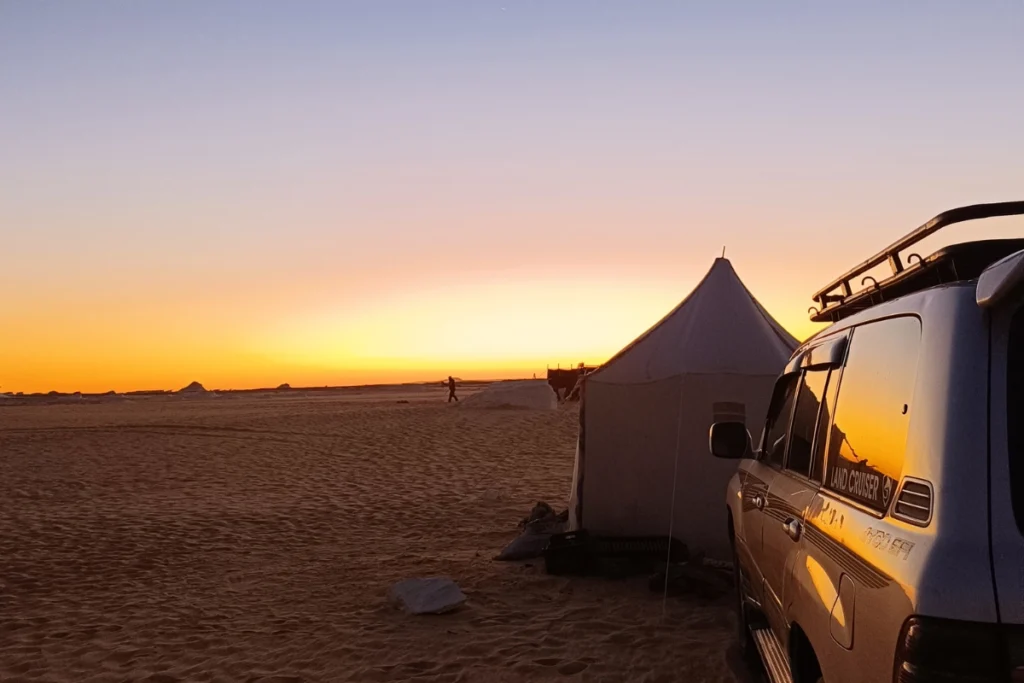
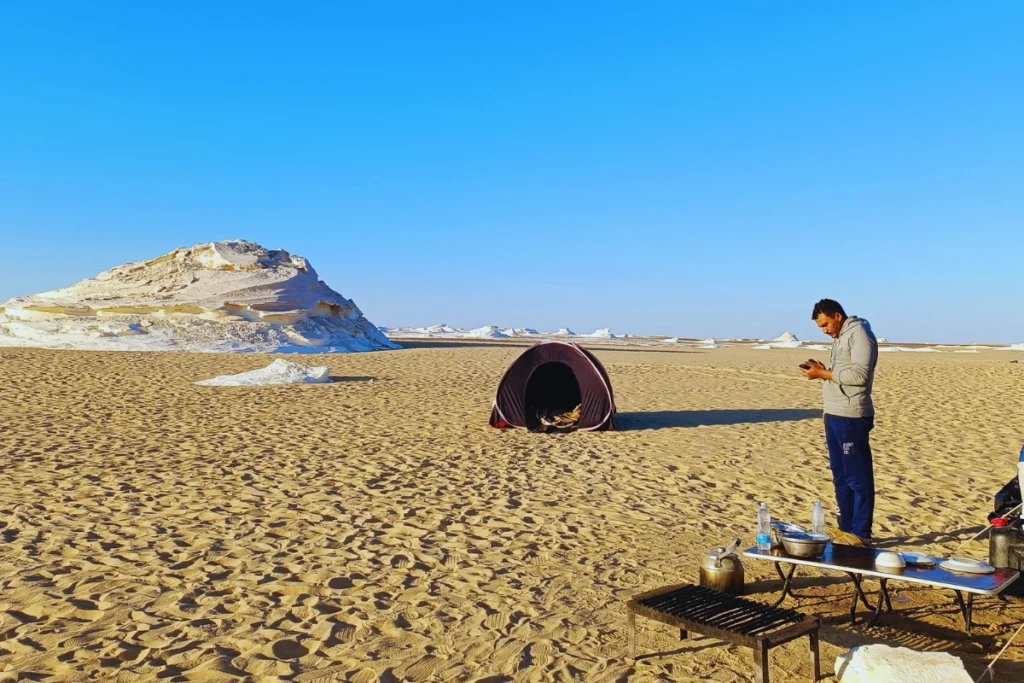
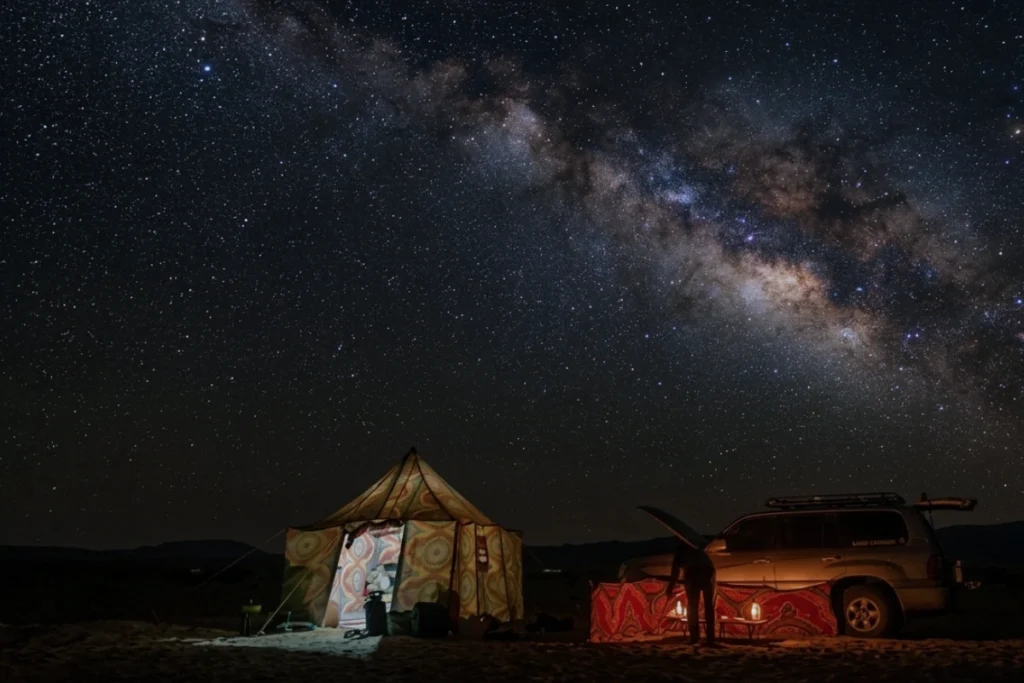
There is just one small tent for us to sleep.
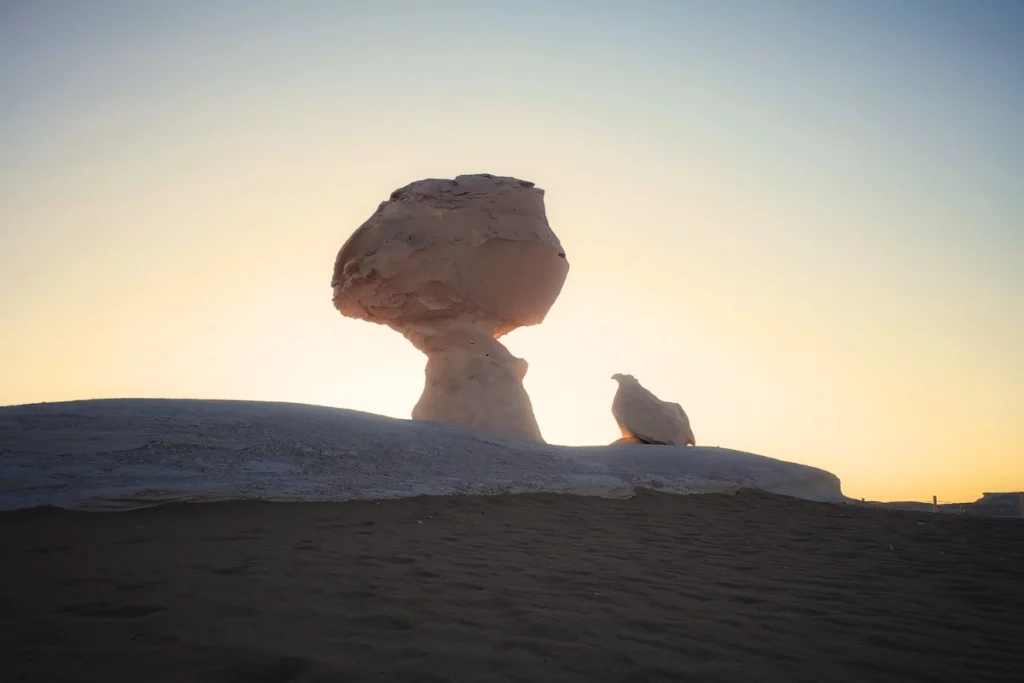
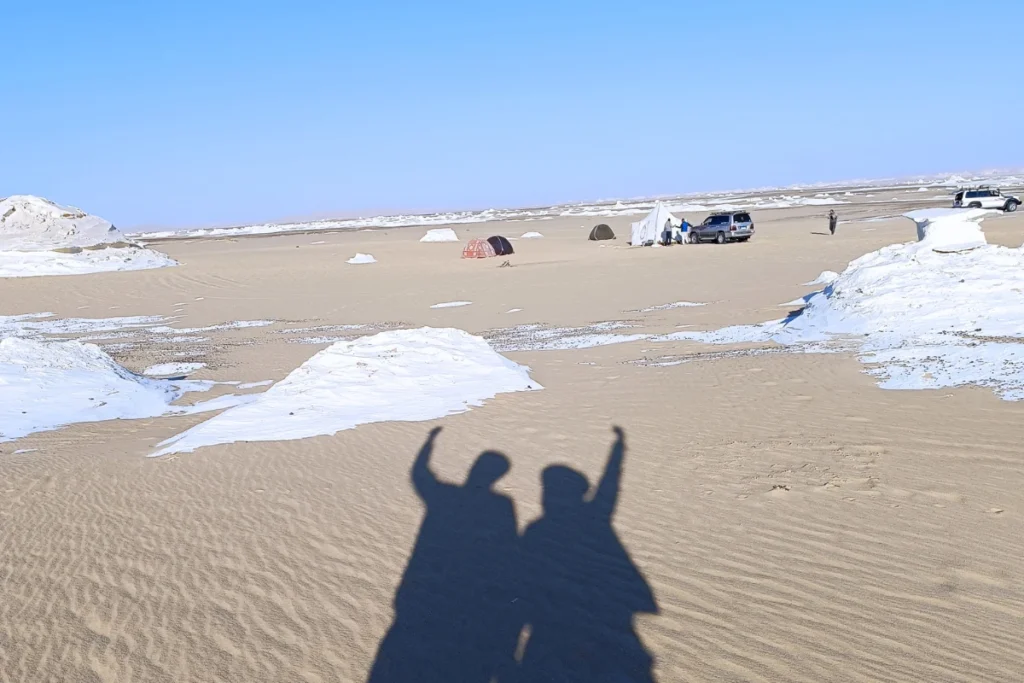
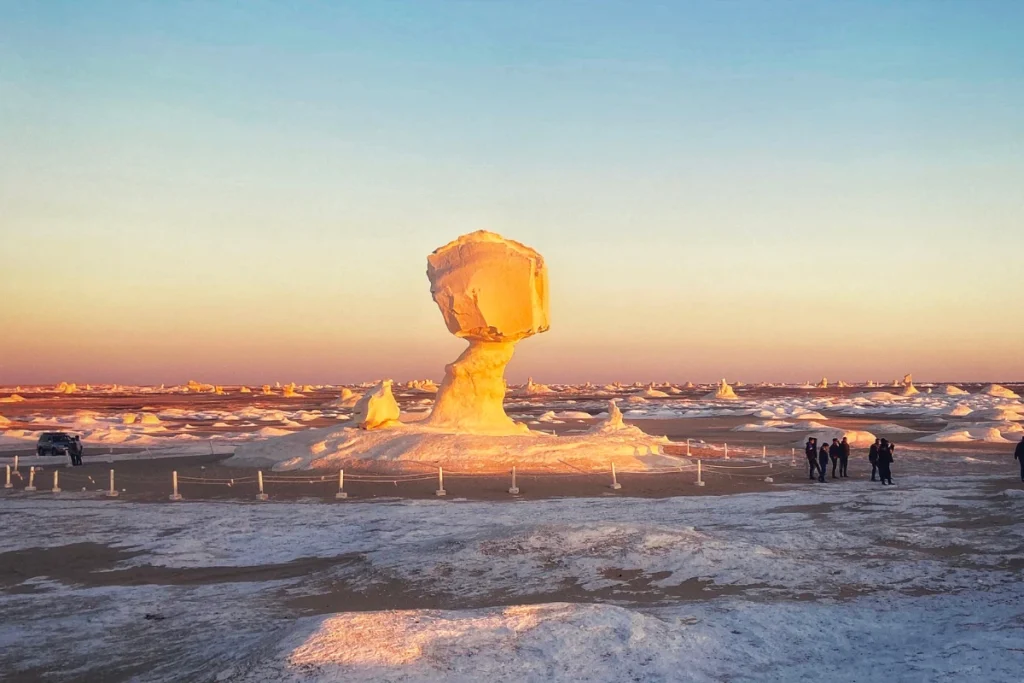
This is the first thing to know, and the thing that changes everything about the experience. When Mahmood stopped the vehicle near the mushroom formation, unloaded the supplies, and began setting up, what emerged was a minimal, intimate setup. It was a patch of flat sand with a single small sleeping tent, a few blankets, a sleeping bag, a cooking area behind the vehicle, and a circle of stones marking the fire pit.
That was it. That was the camp.
Though thin walls separated us from the cool night air, the vast sky and the millions-of-years-old geological formations loomed right outside the zipper. The sleeping bag rested on the tent floor, the tent sat on the sand, and the sand blended directly into the open desert.
The simplicity is not an inconvenience. It is the architecture of the experience. Everything that happens over the next twelve hours happens because there is nothing between you and it.
What the Fire Does
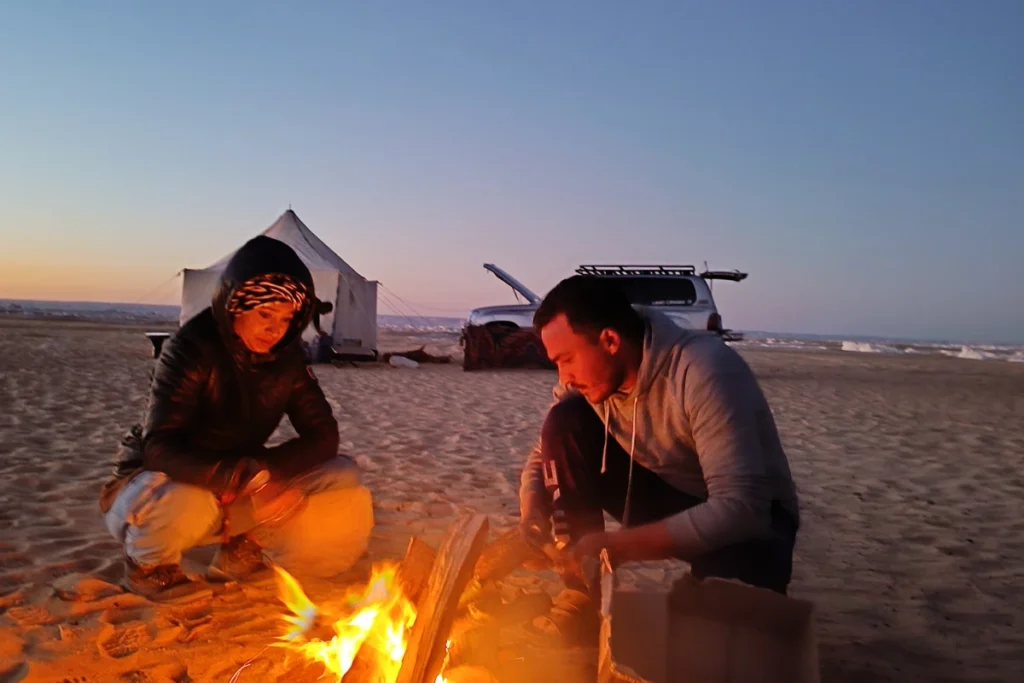
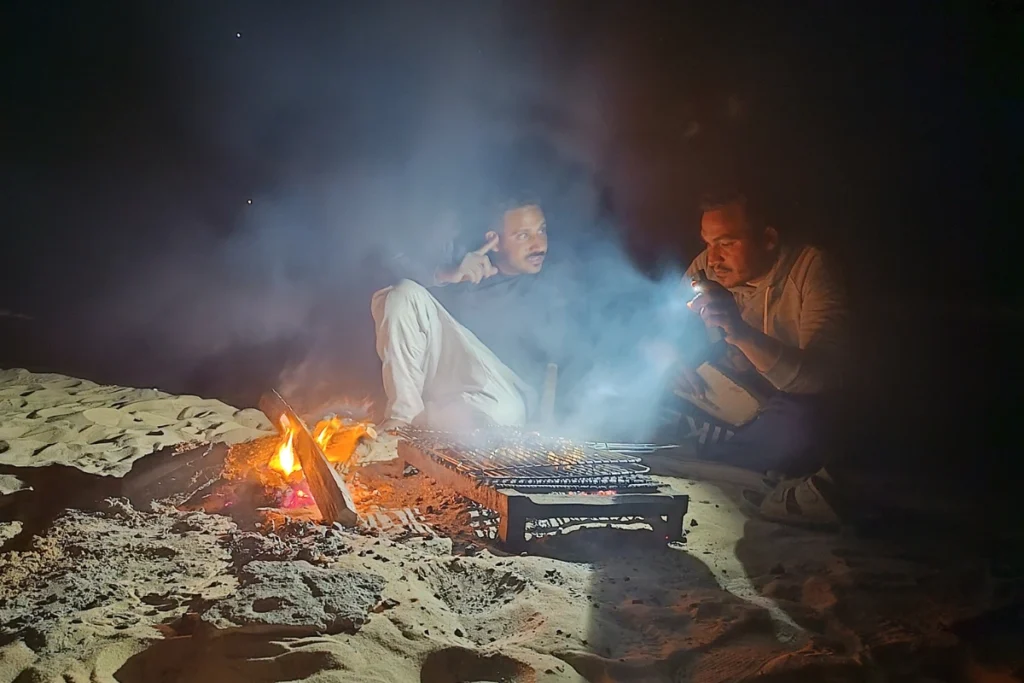
Mahmood built the fire with the patience of someone who has negotiated with the Saharan wind a thousand times and knows that the wind always starts with the advantage.
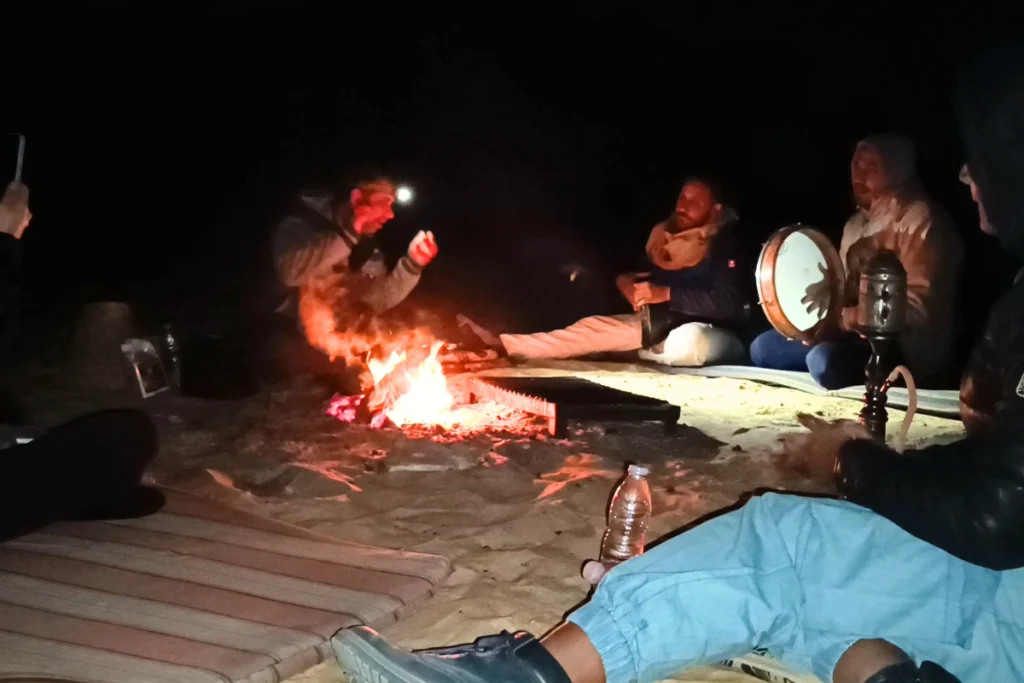
In February, the desert wind is persistent, cold, and entirely indifferent to your plans. It treats fire as a personal challenge. Mahmood arranged the wood, lit the kindling, watched the wind pull the flame sideways, adjusted, rebuilt, and started again. We tried to help. Our help was mostly the kind that requires someone else to redo the work afterward.
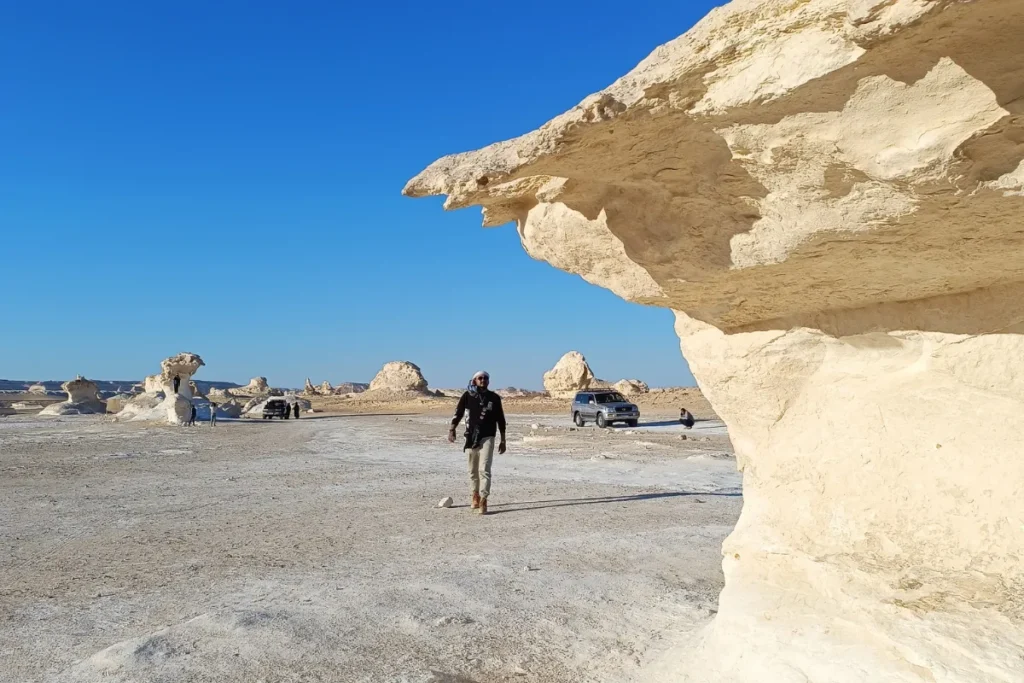
When the fire finally held, it changed the landscape. The White Desert formations, which in the fading daylight had been cool grey shapes against a darkening sky, suddenly had a warm side. The fire cast orange light across the nearest chalk pillars, and the formations split into two: a lit face toward us and a dark face toward the desert beyond. The effect was theatrical in a way that no theatre can replicate, because the stage was real and the audience was two people and a few Bedouin guides sitting on sand.
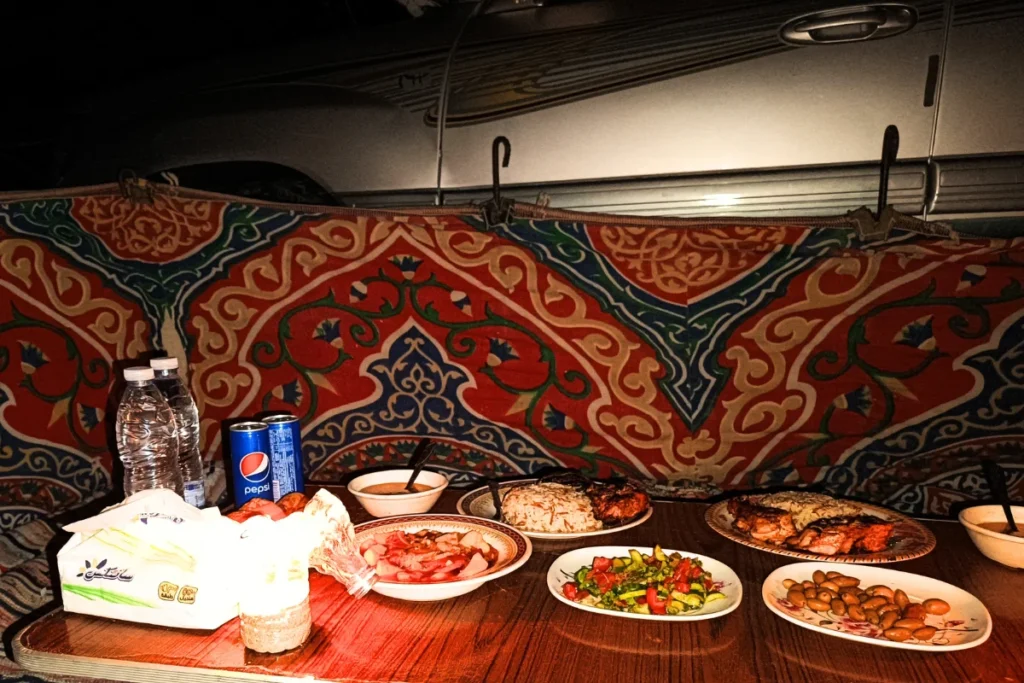
Mahmood cooked on the fire. The food arrived. We ate sitting on blankets, cross-legged, in the glow, surrounded by formations that had not moved since before human beings existed.
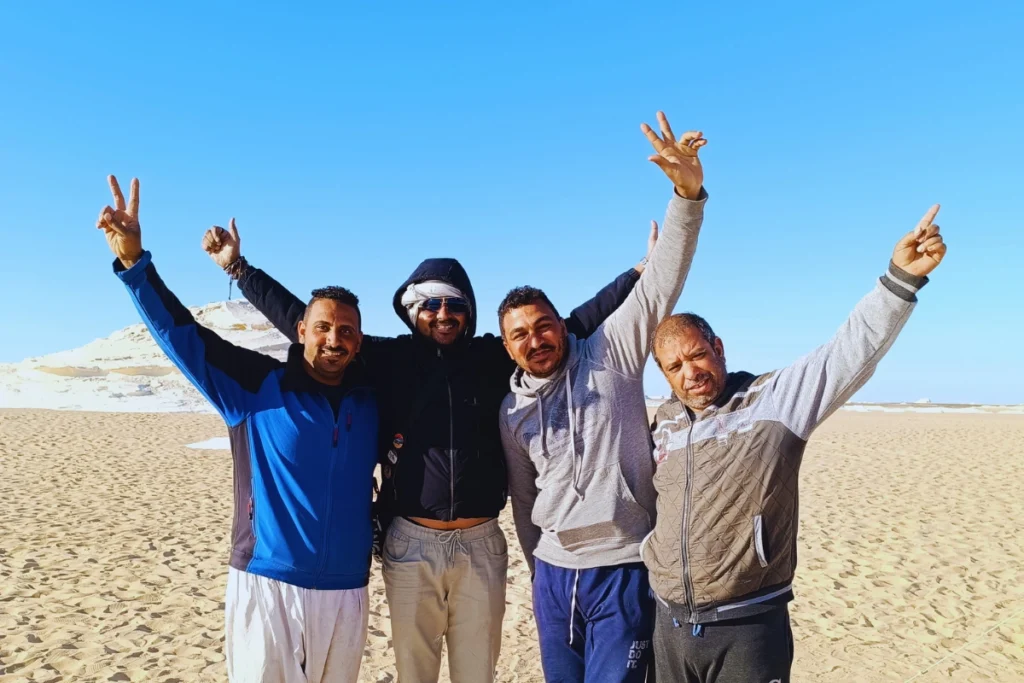
The fire is the social centre of the camp. Without it, the night is too cold, too dark, and too large to face comfortably. With it, the night is manageable. The fire creates a small circle of warmth and light, and within that circle, conversation happens naturally. Mahmood and the other guides talked with us in whatever sign language we could manage. We talked. The wind pushed at the edge of the light. The darkness pushed back.
What the Cold Does
The temperature in the White Desert in February drops after sunset with the efficiency of a system that was designed to expel warmth. The sand, which held the sun’s heat during the afternoon, releases it within the first hour of darkness. By 9 PM, the cold is noticeable. By midnight, the cold is beyond what the word communicates.
We were wearing every layer we had brought. It was not enough. The sleeping bags provided by Mahmood were adequate but not luxurious. The blankets helped. The cold got through anyway.
Here is what the cold actually does, beyond making you uncomfortable: it makes you present. When you are cold, your mind stops wandering. The mental chatter that fills every normal evening, the plans, the worries, the replaying of conversations, goes quiet. The cold simplifies your awareness to a single channel: you are here, you are cold, the fire is warm, the sky is above you. There is nothing else.
This is not a metaphor. It is a physical process. The desert strips away the insulation that modern life provides, not just thermal insulation but mental insulation, the layers of distraction between you and the fact of where you actually are. In a hotel room, you are in a hotel room. In a sleeping bag, inside a small tent on the Saharan sand, you are lying on the raw surface of a planet.
The cold is the price. What you receive in exchange is the sky.
“The cold is the price. The sky is what you receive. In a sleeping bag on Saharan sand, you are not in a place. You are on a planet.”
What the Sky Does
We lay on our backs on the sand, side by side, and looked up.
The nearest artificial light was hundreds of kilometres away. No city glow. No ambient brightness. No diffusion. There was the sand beneath us, the cold around us, and the sky above us.
The sky was not what we had ever seen before.
The Milky Way was not a faint smear. It was a physical structure across the sky, a dense, luminous band that looked like someone had torn a strip out of the darkness and revealed what was behind it. The density was so extreme that the familiar constellations, which in city skies stand out as recognisable patterns, were here nearly impossible to identify because there were too many stars filling every gap.
We did not speak for a long time.
This is not the kind of silence where you have nothing to say. It is the kind where speaking would damage something. The sky at zero light pollution demands a response, and the only response that fits is attention. Pure, undivided, sustained attention to something so large and so old that language does not improve it.
What the sky does, specifically, is restore a sense of proportion. In a city, your problems are the biggest things in the room. In the White Desert at 2 AM, the room is the universe, and you are a warm dot on a cold surface of a small planet at the edge of one galaxy among billions. This is not a depressing realisation. It is a relieving one. The weight of your own importance lifts. What replaces it is not emptiness. It is something closer to participation. You are part of this. Small, temporary, aware, and part of it.
We have travelled to several countries since that night. We have seen remarkable things. Nothing has replicated what the sky looked like from the floor of the White Desert.
What the Silence Does
The silence in the White Desert is not the absence of sound. It is the presence of a different kind of sound.
When the fire dies down and the wind drops to a pause, the desert is quiet in a way that urban ears interpret as total silence. But if you stay still long enough, other sounds arrive. The sand shifting. The faint creak of a limestone formation cooling in the night air. Your own breathing, which in a quiet room is inaudible but in the desert becomes the loudest thing within a hundred metres.
The silence does something to time. In a city, time is measured by noise: alarms, notifications, traffic, the rhythm of other people’s schedules pressing against yours. In the desert, those markers disappear. Without them, time stretches. A minute feels longer. An hour feels different. You lose track, not because you are distracted but because the thing you usually use to track time has been removed.
We do not know how long we lay on the sand looking at the stars. It felt like a long time. It may have been thirty minutes. It may have been two hours. The desert does not tell you, and you stop needing to know.
What Waking Up Does
We woke before sunrise. Not from an alarm. From the light.
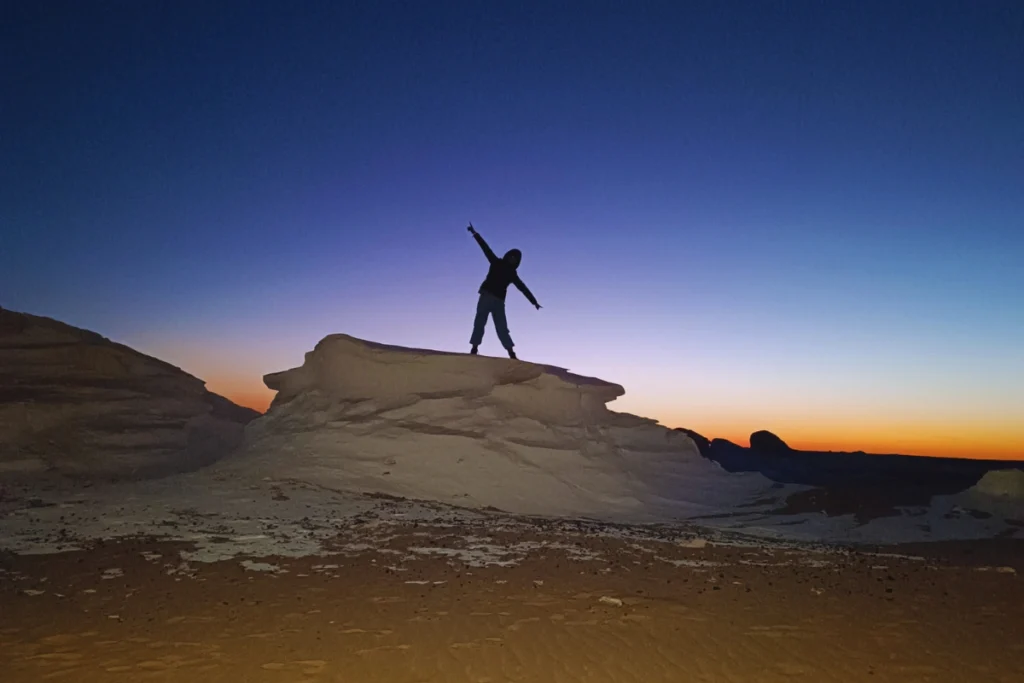
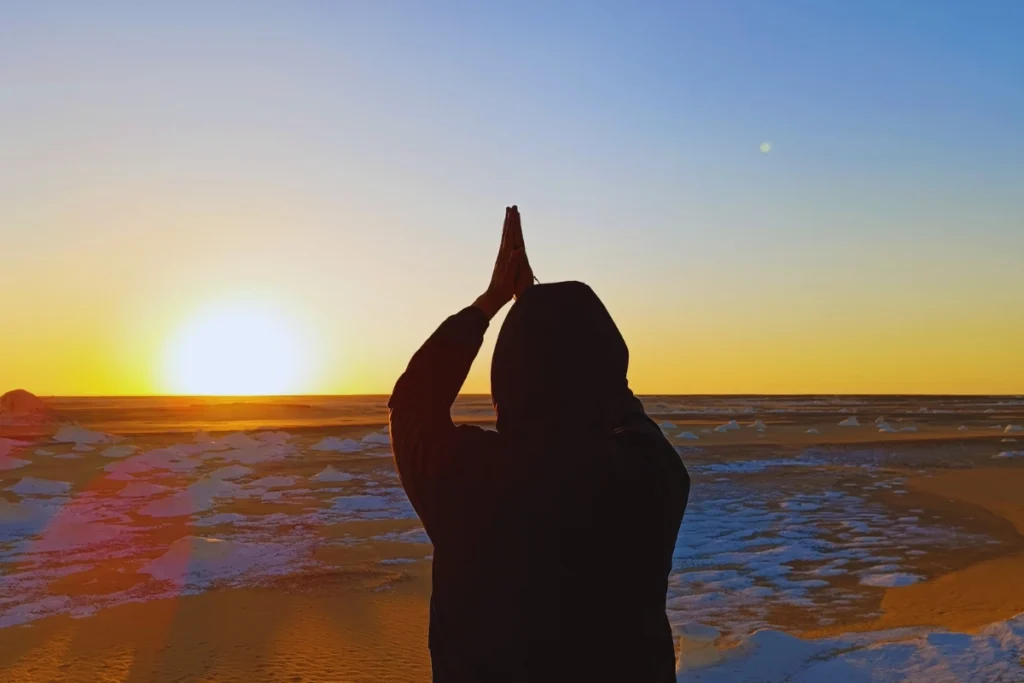
The White Desert at dawn undergoes a colour transformation that takes approximately forty minutes and is worth every second of the cold night that precedes it. The chalk formations, which in the dark were grey silhouettes, begin to turn blue in the pre-dawn light. Then pink. Then gold. The shadows lengthen, deepen, and sharpen as the sun appears at the horizon. The golden sand, which in the afternoon had been uniformly bright, now carries long amber stripes between the formations.
The transition from night to morning in the desert is not gradual. It is a series of distinct stages, each with its own colour palette, each lasting a few minutes before shifting to the next. If you sleep through it, you miss the entire sequence.
Mahmood was already awake. He had restarted the fire and begun preparing breakfast.
What Breakfast Does
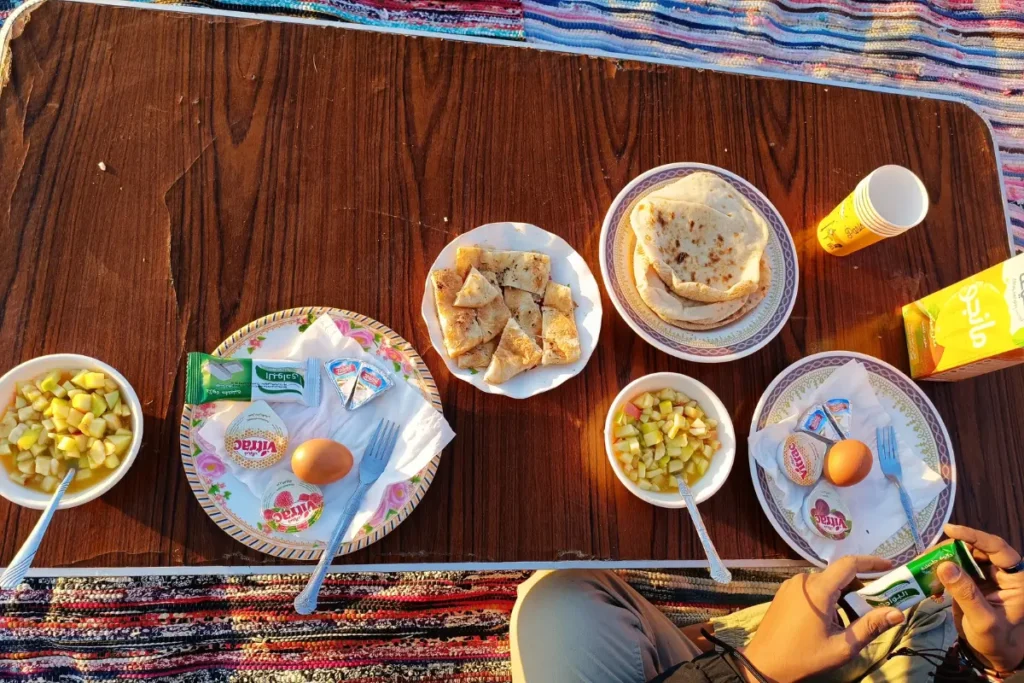
Egyptian flatbread baked on the campfire flames. Tahini in a small bowl. Olives. Scrambled eggs. Fruit.
We sat on a blanket on the sand. The White Desert formations, now fully lit in early morning gold, cast long shadows around us. The fire crackled. The food was warm.
There is a specific quality to eating a massive meal in a place where the grand, freezing landscape matches the scale of the food. In a restaurant, food competes with the menu, the décor, the service, the other diners. On a blanket in the Sahara, a huge spread competes with nothing, forcing you into a race against the elements as the desert chill quickly saps the heat from every dish. Your attention is entirely on the flatbread in your hand, the bowls of tahini, the vanishing warmth of the food, and the extraordinary fact that you are feasting in a place where the formations around you were shaped by wind and water over millions of years.
We have not eaten a more memorable breakfast anywhere.
Not at hotel rooftops with pyramid views. Not at Turkish pensions with seventeen-plate spreads. Not at any restaurant in any city in any country. This breakfast, eaten on sand, in the cold morning air, with Mahmood calling us “brother” and meaning it, is the breakfast against which every breakfast since has been measured. Nothing has come close.
The food is not the reason. The accumulation is the reason. The Black Desert’s Jurassic volcanoes. The Crystal Mountain’s meteorite crystals. The Agabat Valley’s ancient seabed. The sandboarding. The formations. The fire. The cold. The sky. The silence. All of it happened in the previous twenty-four hours. The breakfast was the moment where the accumulation arrived and we sat quietly inside it.
“The food is not the reason. The accumulation is the reason. The breakfast was the moment where everything from the previous twenty-four hours arrived and we sat quietly inside it.”
What You Carry Home
We packed the camp. Mahmood loaded the vehicle. We drove back toward Cairo through the desert, stopped for lunch at a Bedouin village, and by late afternoon we were in the noise and traffic of the city, heading for Ramses Station to catch the sleeper train to Aswan.
The transition from the desert to the city is abrupt and slightly painful. Not physically. Perceptually. After a night where the loudest sound was your own breathing, the honking of Cairo traffic feels like an assault. After a sky with no light pollution, the city’s glow feels like a ceiling pressed too low.
This sensation faded within a day. What did not fade, and has not faded in the years since, is the specific memory of lying on sand and looking up.
We have a theory about this. Some experiences are memorable because they are exciting. Some are memorable because they are beautiful. The White Desert camping is memorable because it is honest. There is nothing between you and the sky, nothing between you and the cold, nothing between you and the sand. The experience has no packaging, no presentation, no mediating layer. It is you, the earth, and the universe. That directness is what stays.
We are IT professionals from India. We spend our days in air-conditioned offices looking at screens. The gap between that life and the life of a single night on Saharan sand is so wide that it should feel like a different species’ experience. It does not. It feels like the most natural thing we have ever done. Sleeping on the thin tent on the desert sand, under the sky, beside a fire, next to someone you trust: this is what human beings did for two hundred thousand years before we invented walls and roofs and electric light.
The desert does not give you something new. It gives you something back.
Practical Notes for the Overnight Camping Experience
The full logistics, route details, booking information, and costs for the 2-day Black and White Desert safari are covered in our complete safari guide. This section covers the specific bits of our overnight camping experience.What is provided: Sleeping bags, blankets, a cooking setup, all food and water, and fire materials. Mahmood handled everything. You bring yourself and your layers.
- What to bring: Every warm layer you own. A hat. A scarf. A phone with manual camera settings if you want to photograph the stars…automatic mode cannot capture the Milky Way. A small torch. A power bank, as your phone drains faster in cold.
- What not to bring: Expectations of comfort. This is not glamping. This is sand, fire, and sky. The discomfort is not a flaw. It is the mechanism through which the experience works.
- When to go: November through April. February was perfect for us. Cold enough at night for the full star experience. Warm enough during the day for the route.
- How long: One night is usually enough to catch the magic, but opting for a two- or three-night stay to visit more interior sections of the desert is even better. While the first night delivers an unforgettable initial thrill, extra time out here allows the true scale of the Sahara to sink in, proving that when it comes to the deep desert, the more time you have, the better.
- Do not look at your phone after the fire dies…there is no network out here anyway. Besides, the screen destroys your night vision for twenty minutes. Let your eyes adjust fully. The sky rewards patience.
“The desert does not give you something new. It gives you something back. Our Egypt Travel Guide holds the complete picture of the nine days. This page is about the experience of camping on the desert. If you are building an Egypt itinerary and trying to decide whether to include the desert overnight, the answer is yes. The pyramids will show you what humans built. The desert will show you what humans have always been: small, warm, curious, looking up.”