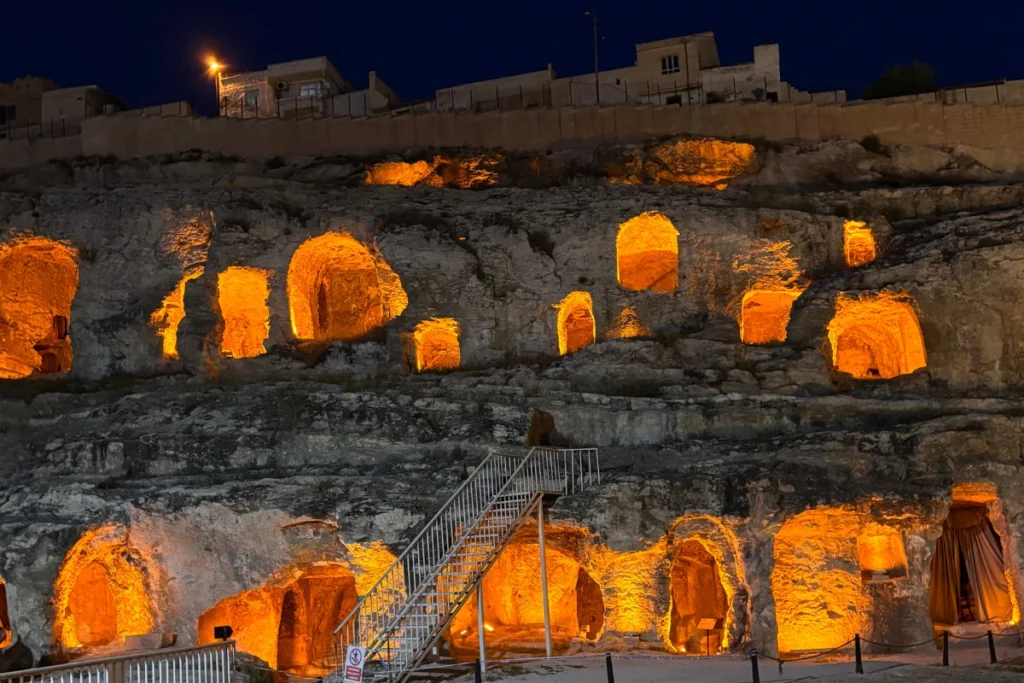
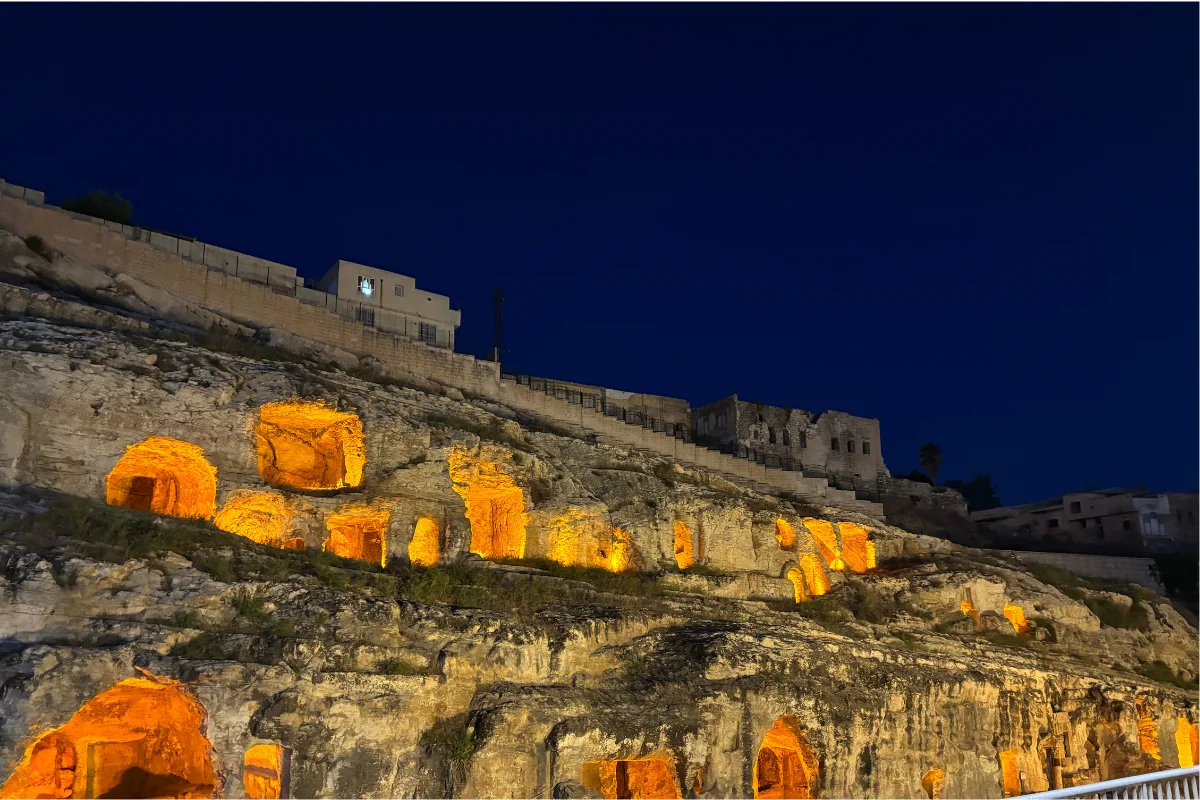
Visiting the Kızılkoyun Necropolis at night was never part of our original itinerary for Şanlıurfa. We were simply walking back from the sacred pools after a long day of exploring ancient sites, completely unprepared for the sight of 2,000-year-old Roman cliff tombs glowing above a bustling modern city street.
We were walking to the sacred pools.
The walk from Ramin Hotel to Balıklıgöl takes about fifteen minutes through Şanlıurfa’s old town. You follow streets where kebab shops are winding down for the night, and the evening air carries that distinct mixture of grilled meat and stone dust common to southeastern Turkish cities after dark. We were exhausted, Day 10 of our road trip. Earlier that day, we had visited Karahan Tepe and Göbekli Tepe. Our minds were saturated with T-shaped pillars, ancient shamanic chambers, and stone-carved faces. We were not looking for more archaeology.
The archaeology, however, was not interested in our fatigue.
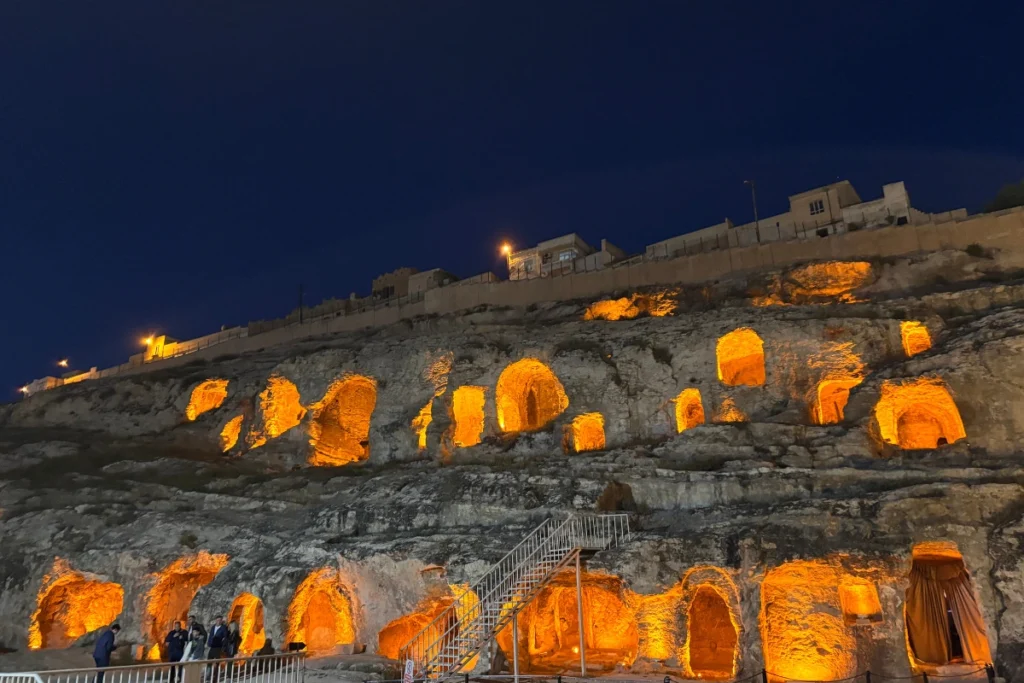
On the cliff face rising above the street, a row of illuminated cave openings glowed against the dark rock. Dozens of them. Cut straight into the limestone and arranged across the cliff in tiers, floodlights lit each opening from below, turning them into warm yellow rectangles against the grey-brown stone. Encountered without preparation on a quiet street, the effect was like stumbling into a conversation that had been happening for two thousand years and had only just become audible.
We didn’t climb the hill that night. We stood on the pavement, looked up, and tried to process the fact that we were standing beneath a Roman-era cemetery carved into a cliff, while people were ordering lahmacun (TRY 90–150 / INR 220–360 / USD 2.60–4.30) from a cart thirty metres away.
“On the walk back from Balıklıgöl, we stopped again. The tombs were still glowing. They had been glowing for a while. Two thousand years, give or take.”
What Kızılkoyun Actually Is
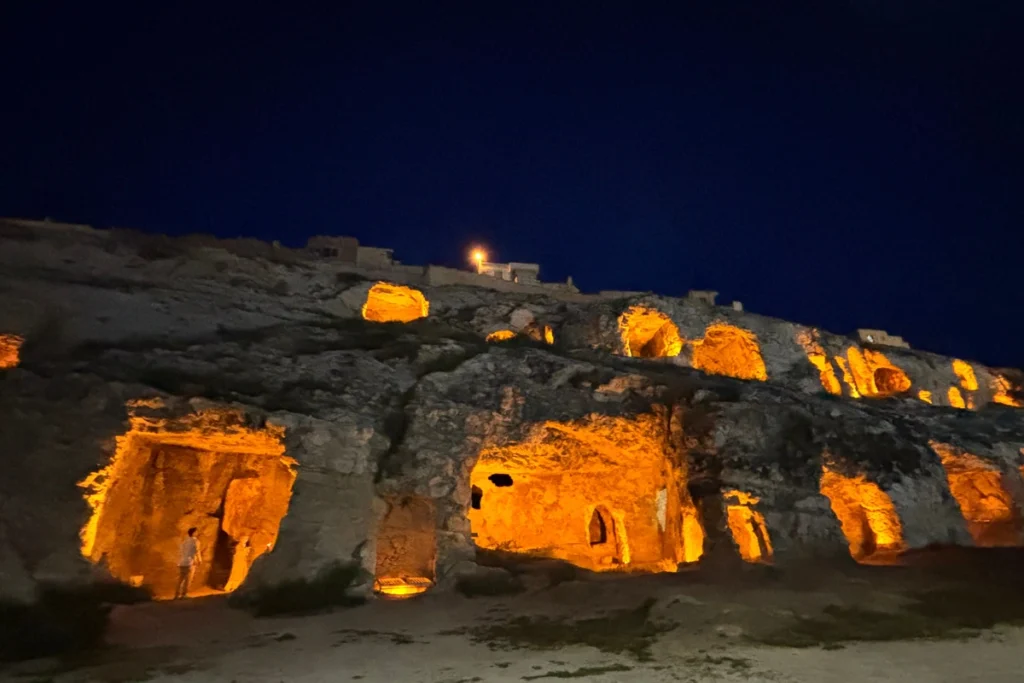
Kızılkoyun Necropolis is a rock-cut burial complex carved into the limestone hills on the southern edge of Şanlıurfa’s old town. The tombs date primarily to the Roman and Late Antique periods (2nd to 4th centuries CE), when the city was known as Edessa, a vital urban centre on the eastern frontier of the Roman Empire.
The site contains over 60 documented rock-cut tombs spread across the cliff face. The chambers vary in scale:
- Loculi & Niches: Simple rectangular rooms featuring cut burial niches along the walls.
- Family Crypts: Multi-room chambers with carved sarcophagi, stone benches (klinai), and architectural accents.
- Decorative Art: Traces of painted plaster, carved reliefs, and inscriptions in Greek and Syriac.
Edessa’s importance in the Roman period was significant. The city sat at the crossroads of trade routes connecting the Mediterranean to Mesopotamia and Persia. It was one of the earliest centres of Christianity in the region and the seat of the famous School of Edessa, a major theological and philosophical academy. The people buried in these cliffs were citizens of a city that was producing scholars, traders, and administrators while much of northern Europe was still working out the logistics of permanent settlement.
The necropolis was rediscovered during urban renovation projects in the early 2000s. A modern neighbourhood had been built directly adjacent to the cliff, and in some cases partially on top of the burial chambers. The restoration and illumination project, which lights the tomb openings at night, transformed the site from an archaeological footnote into one of the most atmospherically striking things in a city that already contains the world’s largest Neolithic collection and the oldest human sculpture on Earth.
Why the Night Version Is the Version That Stays
Archaeological sites in daylight present themselves as information. You see the stone. You read the panel. You understand the date, the function, the cultural context. The mind processes.
Archaeological sites at night present themselves as atmosphere. The information retreats into shadow. What remains is shape, light, and the specific feeling of looking at something that was made by people who are no longer present in any form except the holes they cut into the rock.
Kızılkoyun at night reduces the cliff to its essentials: dark stone punctuated by warm rectangles of light, each rectangle the entrance to a chamber where someone was placed after dying, in a city that was important enough to carve their resting place into a cliff rather than digging a hole in the ground. The effort implied by rock-cut burial, compared to simple earth burial, communicates something about how Edessa valued its dead. The illumination communicates something about how modern Şanlıurfa values its dead’s architecture. The combination, ancient tomb plus modern floodlight, produces a visual that neither element provides alone.
We saw this from the street. From below. The angle was steep, looking upward at the glowing openings. The city was around us. The tombs were above us. The temporal gap between the kebab cart and the burial chamber was approximately 1,800 years and approximately 30 metres of elevation.
“The daytime version gives you history; the nighttime version gives you the hair on the back of your neck standing up. Some places need sunlight to be understood, but Kızılkoyun needs the dark.”
What We Missed
We did not enter the necropolis. We did not climb the paths that lead to the tomb chambers. We did not examine the loculi or the carved details. We saw the illuminated exterior from the street twice, and that is the honest extent of our experience.
Visitors who do enter report carved chambers of varying complexity, stone benches where bodies were laid, niches cut into walls for individual burials, and occasional fragments of inscriptions in Greek and Syriac. Some tombs show evidence of reuse across multiple periods, with Roman-era burials overlaid by later Christian or Islamic modifications. The layering is characteristic of Şanlıurfa, a city that has been continuously inhabited for over 11,000 years and where each era builds on top of the previous one with the casual efficiency of someone adding a floor to a house rather than building a new one.
We are including what we missed because the articles on this site do not pretend that passing a place twice on foot constitutes a visit. We saw the exterior at night. It was extraordinary. The interior is, by all accounts, worth the climb. We will do it properly when we return to Şanlıurfa, which is a city that gave us Göbekli Tepe, the Şanlıurfa Museum, the sacred pools at Balıklıgöl, and this necropolis, and still has more to show.
How to Visit Properly
Location: Southern edge of the Şanlıurfa old town, directly adjacent to the Balıklıgöl complex. If you are walking from the old bazaar to the sacred pools, you will pass it. The cliff face is visible from the street. Missing it requires deliberate effort or a phone screen absorbing your attention, which in a city containing 11,000 years of human history is a use of the phone that the phone itself would probably object to if it had opinions.
When to go: Night. Specifically, dusk onward. The illumination transforms the cliff from a geological surface into an archaeological stage set. The daytime version is informative. The nighttime version is unforgettable.
Entry: Verify current access status locally. The exterior and the cliff face are visible at all times from the adjacent streets and paths. Access to the individual tomb chambers may require climbing paths on the hillside.
Combine with: Balıklıgöl sacred pools (walking distance, same evening). The museum (the following morning). The sequence we followed, Balıklıgöl at sunset, Kızılkoyun glowing on the walk back, museum the next morning, covers three of the city’s most significant attractions within a twelve-hour window.
Time needed: From the street, ten minutes of looking up produces the emotional impact. For the full necropolis visit (climbing, entering chambers, examining details), allocate 30 to 45 minutes.
“You come to Şanlıurfa expecting the deep, ancient past of Göbekli Tepe, but you leave remembering a glowing cliff face you passed on a quiet walk after dinner. The best discoveries are always the ones you never planned for.”