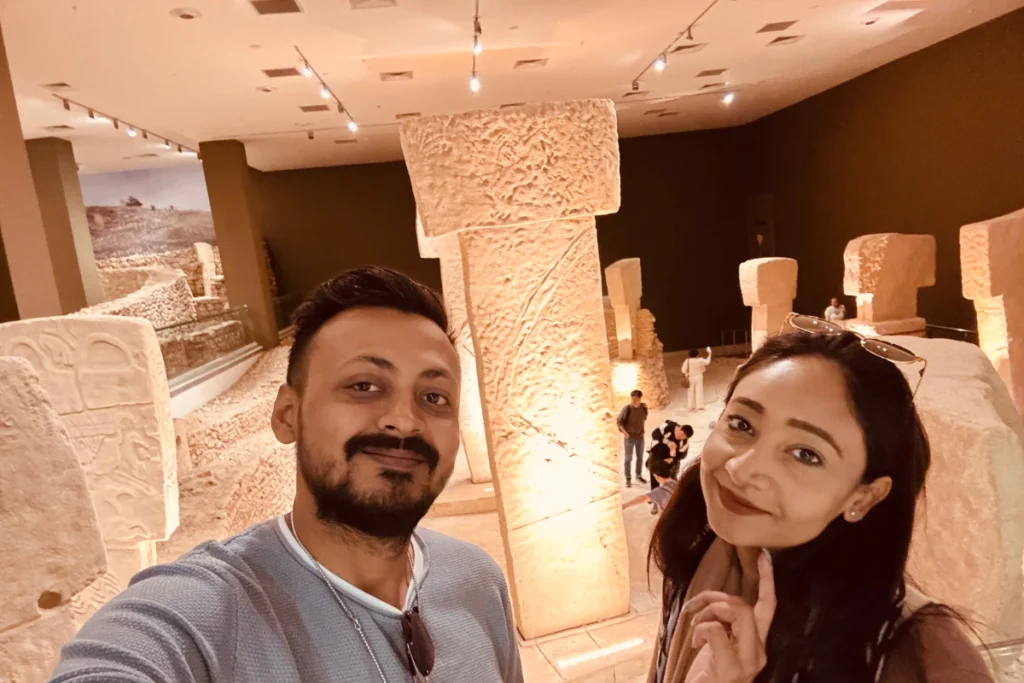
This Şanlıurfa Archaeology Museum guide is built from our visit on Day 11 of our 17-day Turkey trip, April 27th 2025, the morning after Göbekli Tepe and before the drive to Halfeti. We visited the museum before the Göbekli Tepe complex… a sequence we recommend for reasons the article explains.
Everyone in the eastern Turkey itinerary tells you to go to Göbekli Tepe. Almost nobody tells you to go to the Şanlıurfa Archaeology Museum first.
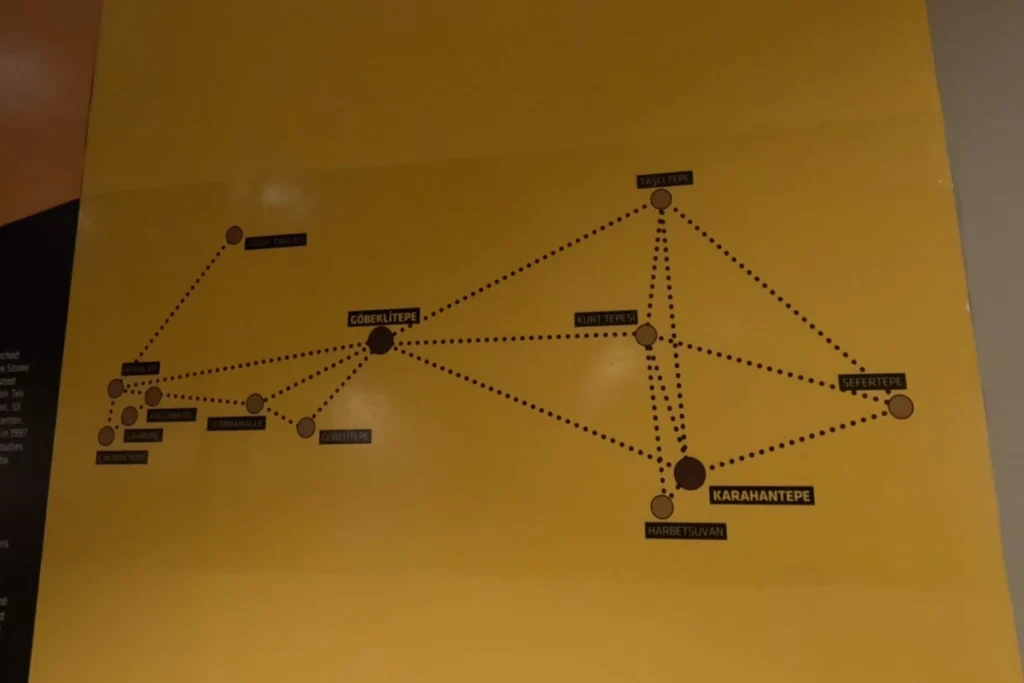
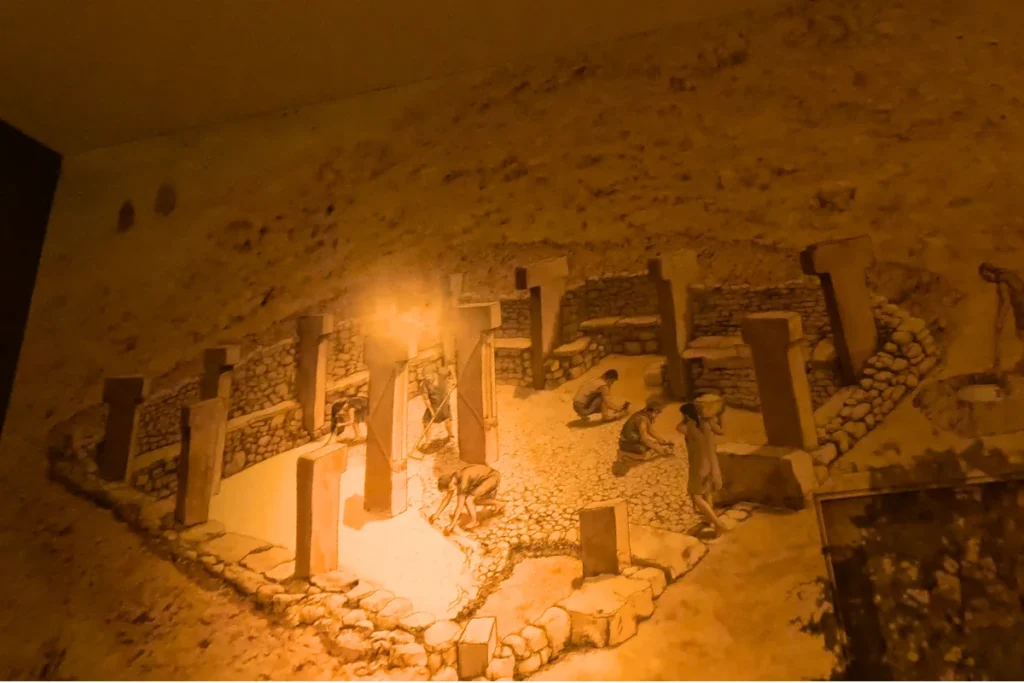
This is a significant omission. The museum is where the original artifacts from Göbekli Tepe, Karahan Tepe, and the surrounding Neolithic sites are displayed. When you stand on the Göbekli Tepe boardwalk looking down at the excavated enclosures, the T-shaped pillars are impressive but contextless: you are seeing stone shapes in the ground. When you have already walked through the museum’s Pre-Pottery Neolithic Hall, you have seen the animal carvings that came off those pillars, the tools that carved them, the Urfa Man who came from the same culture, and a full-scale replica of the most famous enclosure at eye level. The boardwalk at Göbekli Tepe then becomes a second visit to something you already partially understand.
We visited the museum first, then the Göbekli Tepe complex. This is the correct sequence and the one we recommend without qualification.
The museum is in Şanlıurfa city, approximately 18 km from the Göbekli Tepe entrance. The Ramin Hotel, where we stayed in Şanlıurfa, had provided a generous complimentary breakfast that morning. We lreft after eating, drove to the museum, and spent the morning inside before the midday drive to the site. Entry: 871 Lira for two people. Approximately INR 2,000 (Prices change frequently due to inflation; check current rates before visiting). For a museum of this scale, containing objects of this significance, this is the most efficient cultural expenditure available in southeastern Turkey.
“The Göbekli Tepe boardwalk gives you the scale of the ancient world; the Şanlıurfa Museum gives you its soul. They are two halves of the same brilliant story, and you haven’t truly seen one until you’ve stood in front of the other.”
What the Museum Is
The Şanlıurfa Archaeology Museum is the largest museum complex in Turkey. It is not a regional history museum in the typical sense. It is a complete chronological loop through human civilisation in the Mesopotamian region, beginning 12,000 years ago in the Pre-Pottery Neolithic period and continuing through the Bronze Age, Assyrian and Babylonian empires, Roman and Byzantine Edessa, and into the Islamic era.
The museum is organised as a walking circuit. You enter at one end and walk forward in time. The sequence is not arbitrary. Each section builds on the previous one. By the time you reach the Roman marble statues, you have already walked through the Stone Age flint tools that the people who eventually built Edessa’s predecessor were using eleven thousand years earlier. The distance from obsidian arrowheads to marble sarcophagi, walked in a single morning, covers more of human civilisational development than most people encounter in a lifetime of education.
The Haleplibahçe Mosaic Museum is a separate structure within the same complex, covered under the same ticket, reached through a door at the end of the main museum circuit. It contains a collection of 5th-century Roman floor mosaics discovered by accident during urban construction in the city. Both are included in the 871 Lira entry.
The Pre-Pottery Neolithic Hall: Where the Visit Actually Begins
The first major hall is the one the museum was effectively built to contain. The Pre-Pottery Neolithic Hall houses the original artifacts brought from Göbekli Tepe, Karahan Tepe, and related sites in the region. This is the collection that makes the Şanlıurfa Museum unlike any other museum in Turkey or the world.
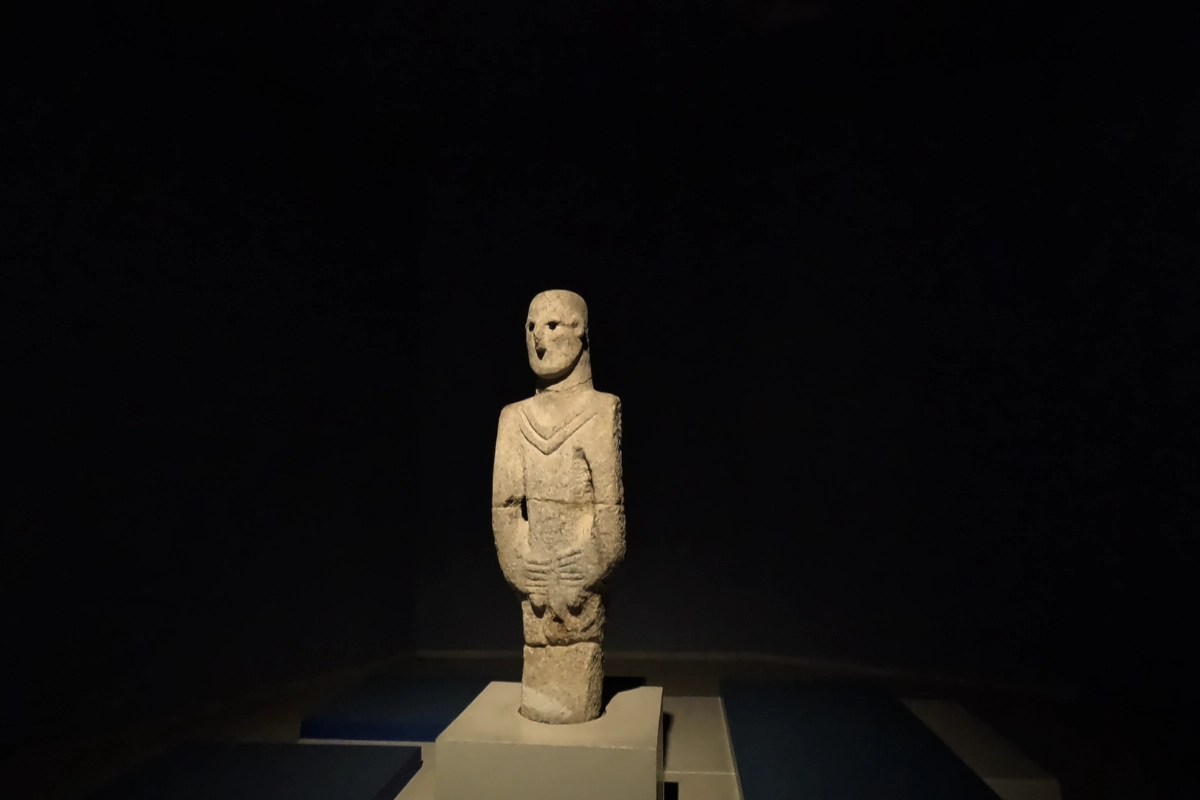
The Urfa Man
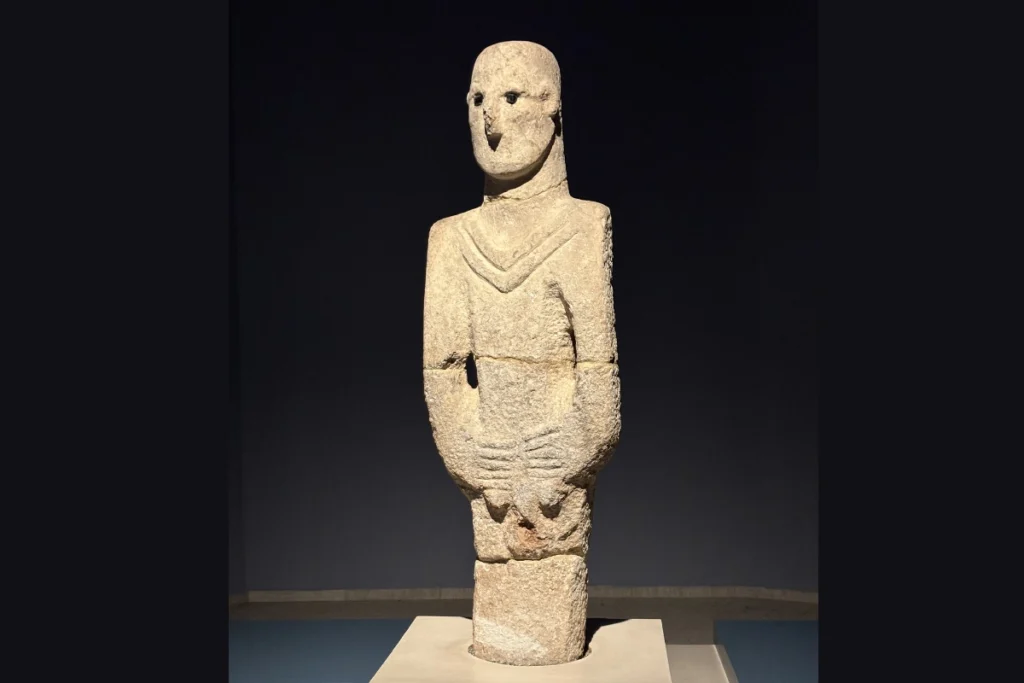
He is six feet tall. He is made of limestone. He has deep black obsidian stones for eyes. His hands are clasped over his front. Around his neck, two vertical lines form a V-shaped carved necklace. He is dated to approximately 9,000 BCE, making him the oldest life-sized human statue ever found anywhere on Earth.
The Urfa Man was discovered in 1993 during construction work in the Balıklıgöl area of Şanlıurfa city, approximately 7 km from Göbekli Tepe. He predates the site by about a thousand years. He predates the Egyptian pyramids by more than 6,000 years. He predates writing.
What makes him disorienting is not his age. It is his appearance. He does not look ancient. He looks like a person. The proportions are human. The posture is human. The obsidian eyes catch the light in a way that produces an involuntary response in every visitor who stands in front of him for long enough: the sense that something is looking back.
We stood in front of the Urfa Man for significantly longer than we stood in front of any other single object in the museum. We had seen his photograph before the trip. The photograph does not prepare you for the obsidian eyes.
“Standing before a human face carved 11,000 years ago forces a strange realization: our ancestors weren’t just primitive survivalists; they looked out at the world exactly as we do.”
The Enclosure D Replica
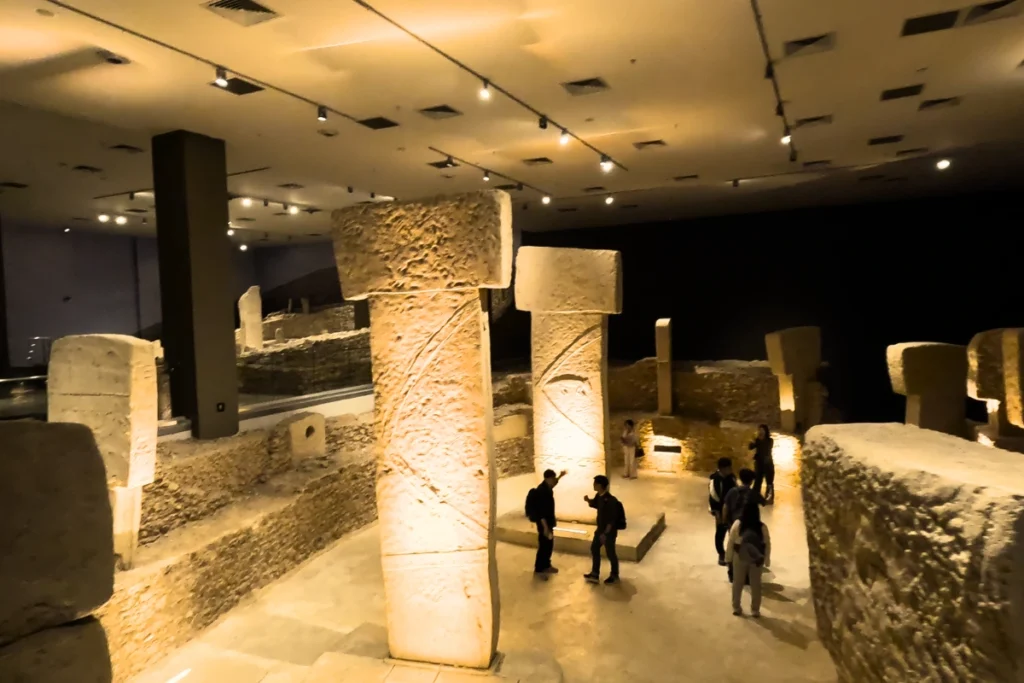
At the Göbekli Tepe site itself, visitors stand on an elevated boardwalk and look down at the excavated enclosures from above. This perspective conveys the scale and the layout, but it distances you from the pillars. The belt carvings, the arm reliefs, and the animal panels on the T-shaped pillars are visible from the boardwalk as shapes, not as craftsmanship.
The museum contains a full-scale, eye-level replica of Göbekli Tepe’s Enclosure D, the most famous circular ring. You walk inside it. You stand at the base of the central pillars and look up. The T-shaped form towers above you. The belt carvings are at your eye level. The arm reliefs, which show that the builders conceived of these pillars as stylised human figures… with arms, hands, belts, and implied heads… are visible as intended. The replica reframes the site. After standing inside the museum enclosure, the elevated boardwalk at Göbekli Tepe becomes a bird’s-eye view of something you have already been inside. The sequence matters. Museum first, site second.
The Totem Pole and the 3D Animals
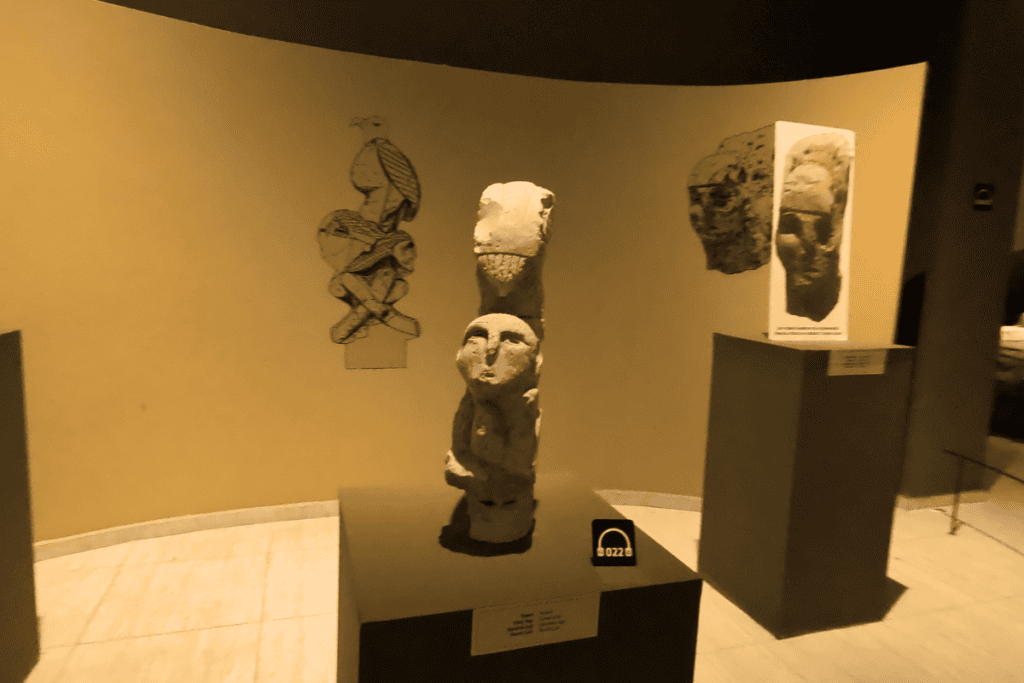
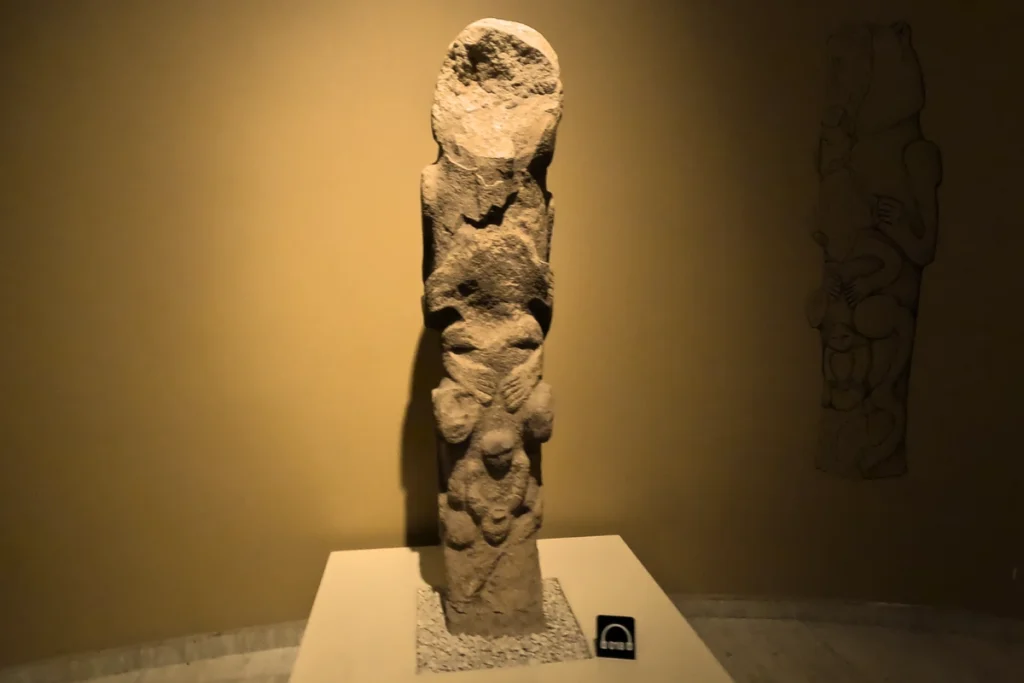
A two-metre-tall stone totem pole stands near the Urfa Man. Three figures are stacked vertically: a predator at the apex, apparently gripping a human head. A human figure emerging at the base. Between them, a second figure in transition. The visual vocabulary is startling in its familiarity: the stacked figures, the predator-human relationship, the vertical orientation. The same organisational principle appears in the totem poles of Pacific Northwest Indigenous cultures, carved millennia later and on the opposite side of the earth. Whether this represents convergent human intuition about spiritual hierarchy, or something more connected, is a question the museum does not answer. It simply displays both the question and the object that raises it.
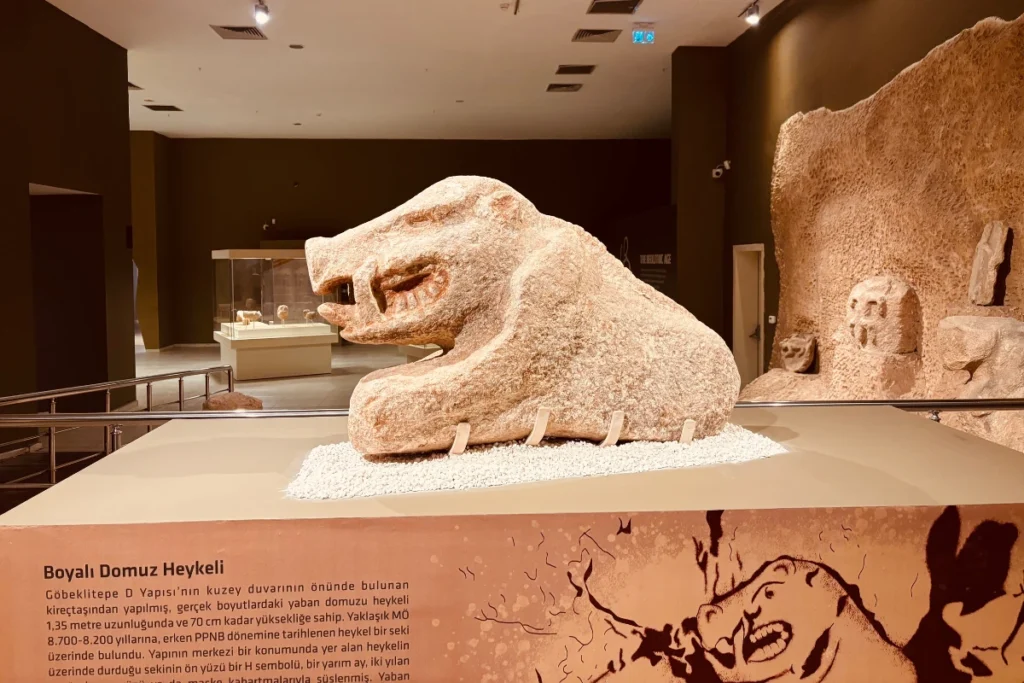
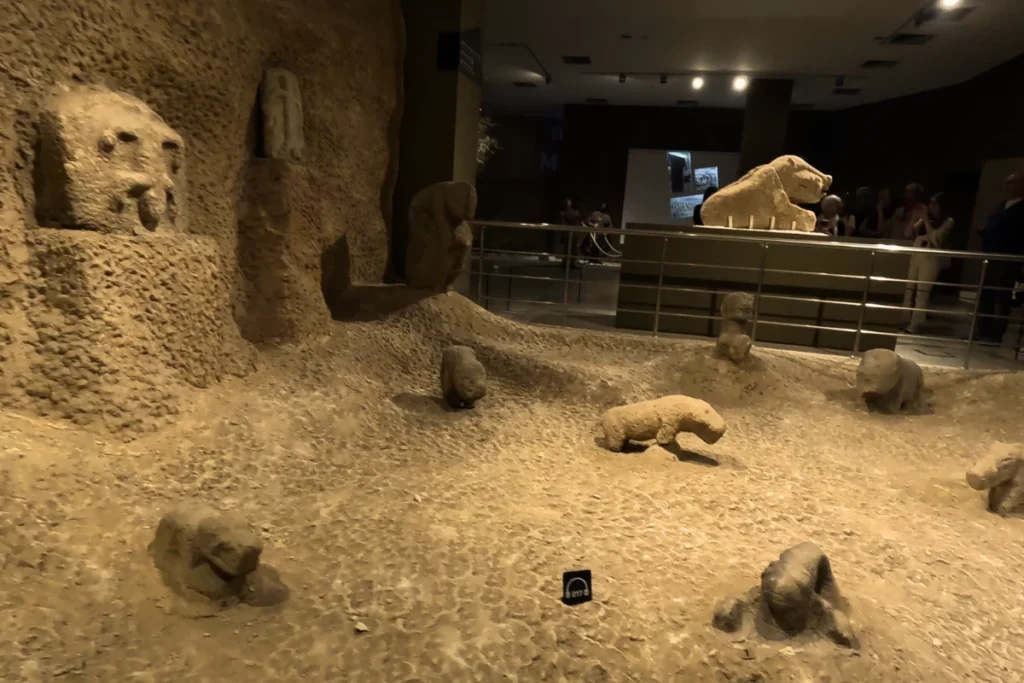
Around the hall, three-dimensional animal sculptures found buried in the soil at Göbekli Tepe are displayed: wild boars with massive tusks, snarling predators, vultures with detailed feather textures. These are not relief carvings. They are fully three-dimensional, carved in the round, and placed in the dirt of the enclosures — apparently as guardians or ritual presences rather than decorative elements. The aggression in their postures is deliberate and preserved.
The Nevalı Çori Temple
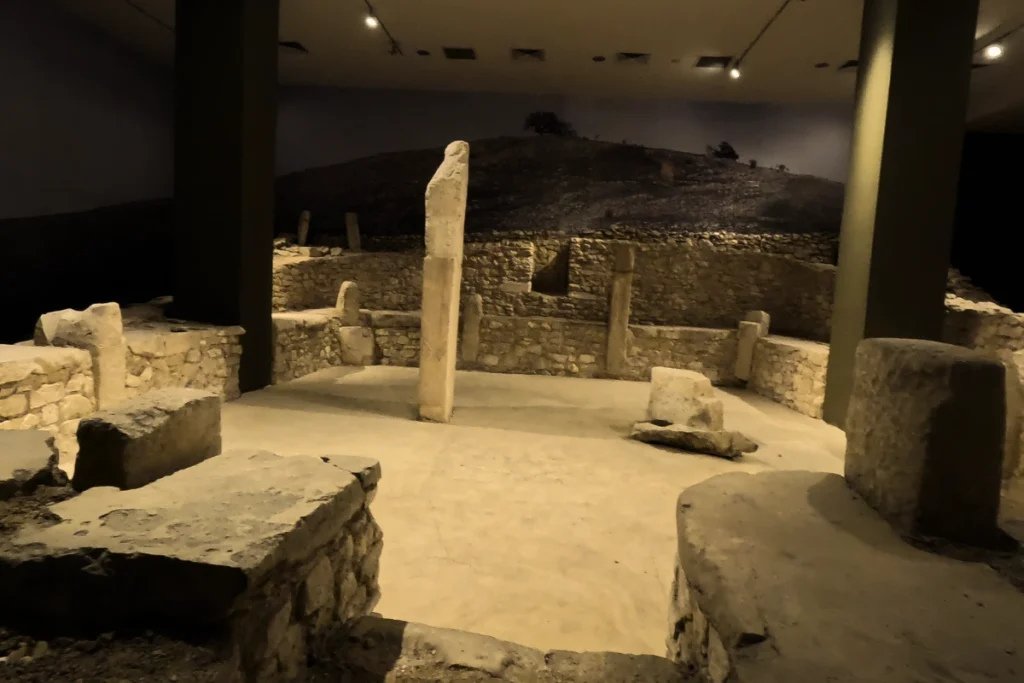
In a separate section of the Pre-Pottery Neolithic Hall, a complete temple has been rebuilt. Not a replica. The original stones, removed from the Nevalı Çori archaeological site before the Atatürk Dam’s rising waters flooded the valley permanently in 1992, reassembled here in their original configuration.
Nevalı Çori was a sister settlement to Göbekli Tepe, built by the same culture, approximately 10,000 years old. When the dam project began, Turkish archaeologists conducted an emergency excavation and removed the temple’s stones, piece by piece, before the water arrived. The temple now stands in the Şanlıurfa Museum. You walk inside a 10,000-year-old stone space that was underwater until it was moved here. The original valley where it stood is now at the bottom of a reservoir.
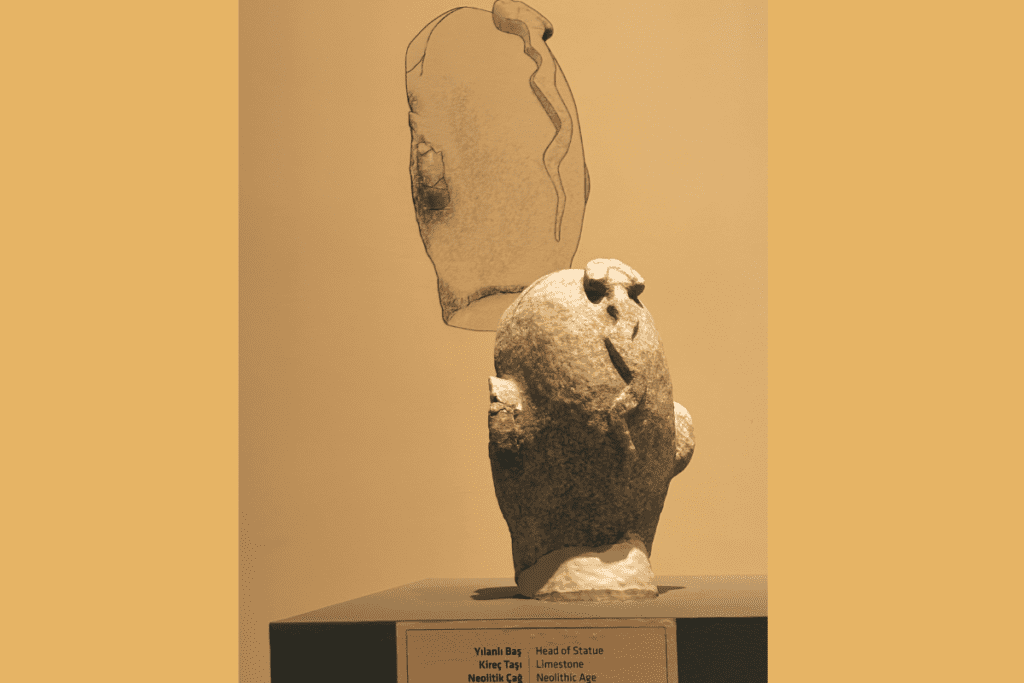
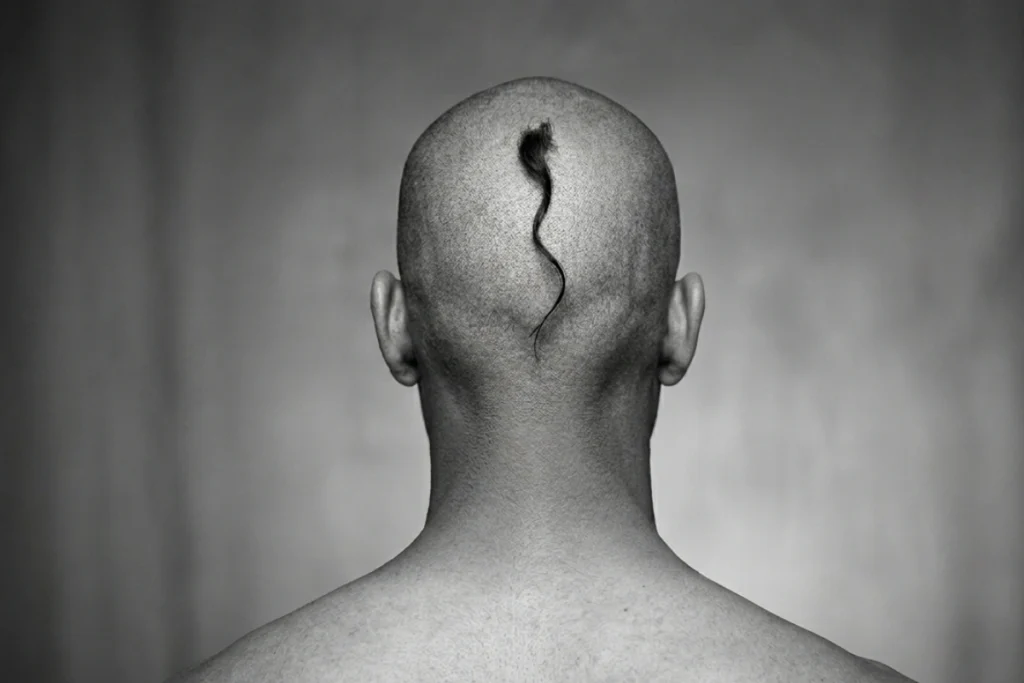
Among the finds at Nevalı Çori: a stone head featuring a completely shaved skull except for a single, long braided tuft of hair at the back. This hairstyle, the sikha, is the traditional haircut worn by Vedic Brahmin priests in India to the present day. Whether this represents direct cultural connection, parallel spiritual practice, or convergent grooming custom is debated. That it exists, here, 10,000 years ago, in southeastern Turkey, is not debated.
The Daily Life Collections
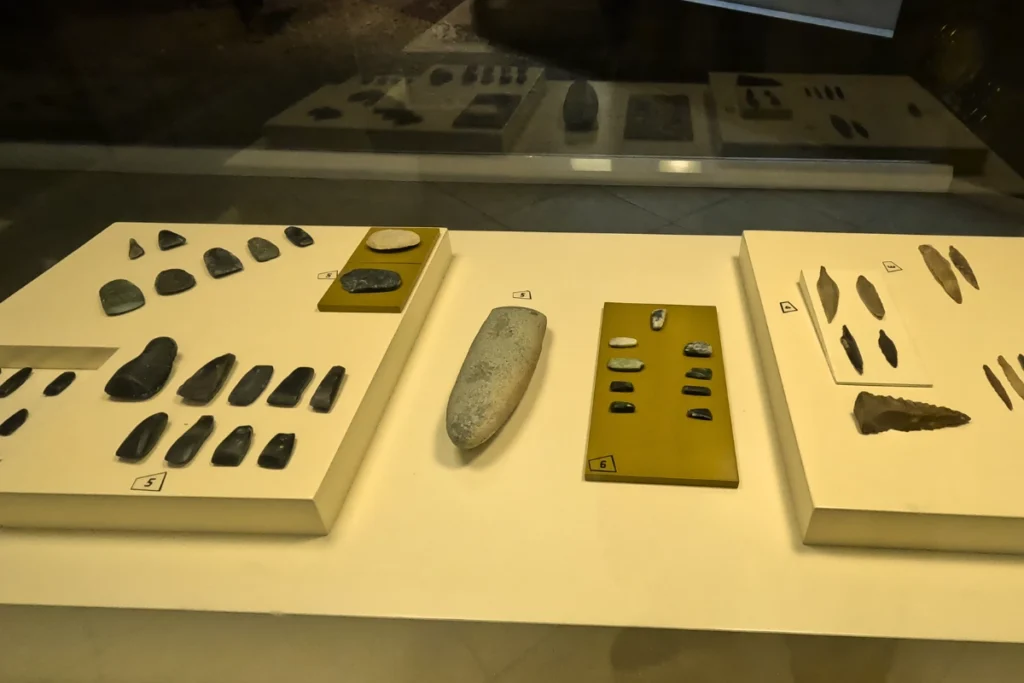
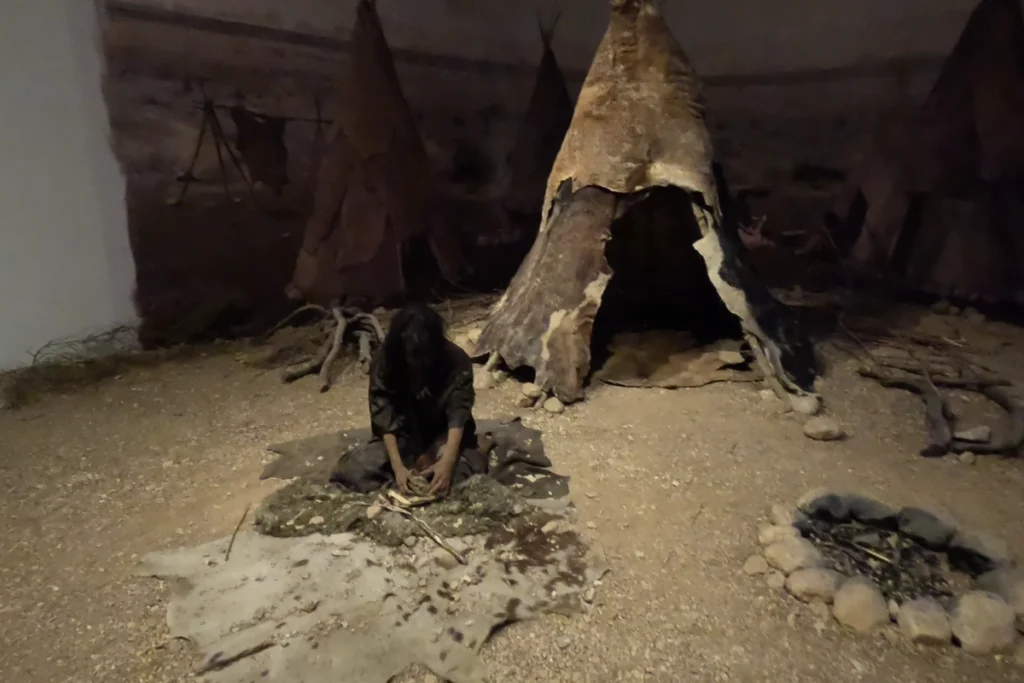
The Pre-Pottery Neolithic Hall transitions into cases dedicated to the material of daily life in the same period. Thousands of flint and obsidian arrowheads, blades, and scrapers: each one a small, sharp, deliberately shaped tool. Massive limestone bowls, some large enough to serve dozens of people, used for communal feasting at the enclosures. Delicate needles made from polished animal bone, which implies the production of sewn clothing… by people who also built 10-tonne stone pillars and a circular enclosure complex.
The scale contrast is part of the museum’s argument. The people who built Göbekli Tepe were not primitive. They were skilled in an extraordinary range of materials, at an extraordinary range of scales, from objects smaller than a thumbnail to T-shaped limestone pillars 6 metres tall. The museum’s daily life collection is the evidence.
Forward Through Time: Bronze Age to Byzantium
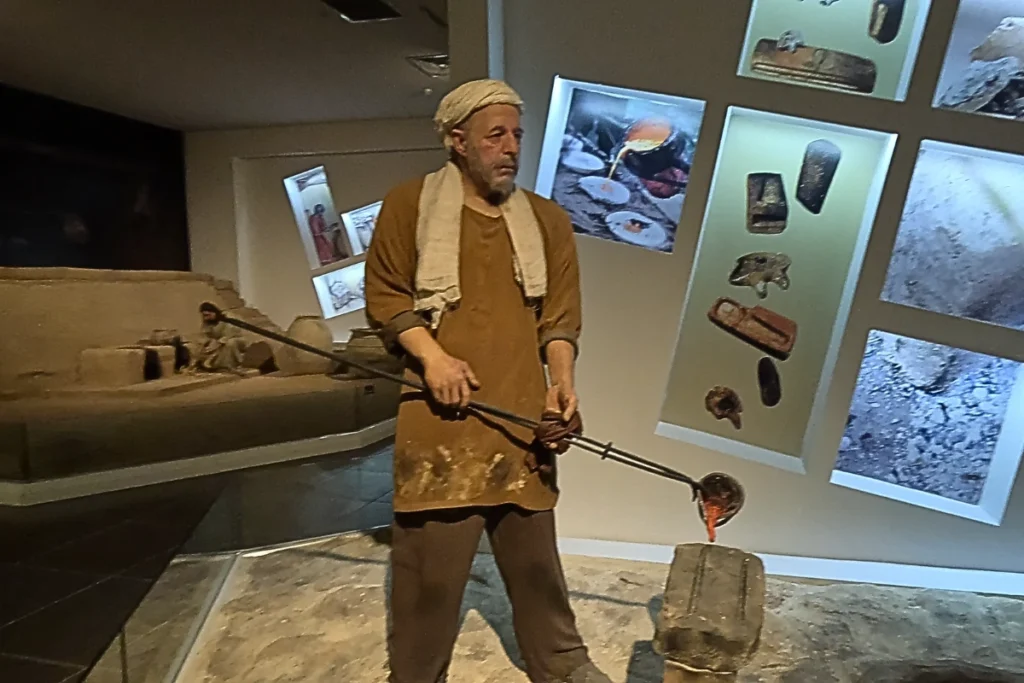
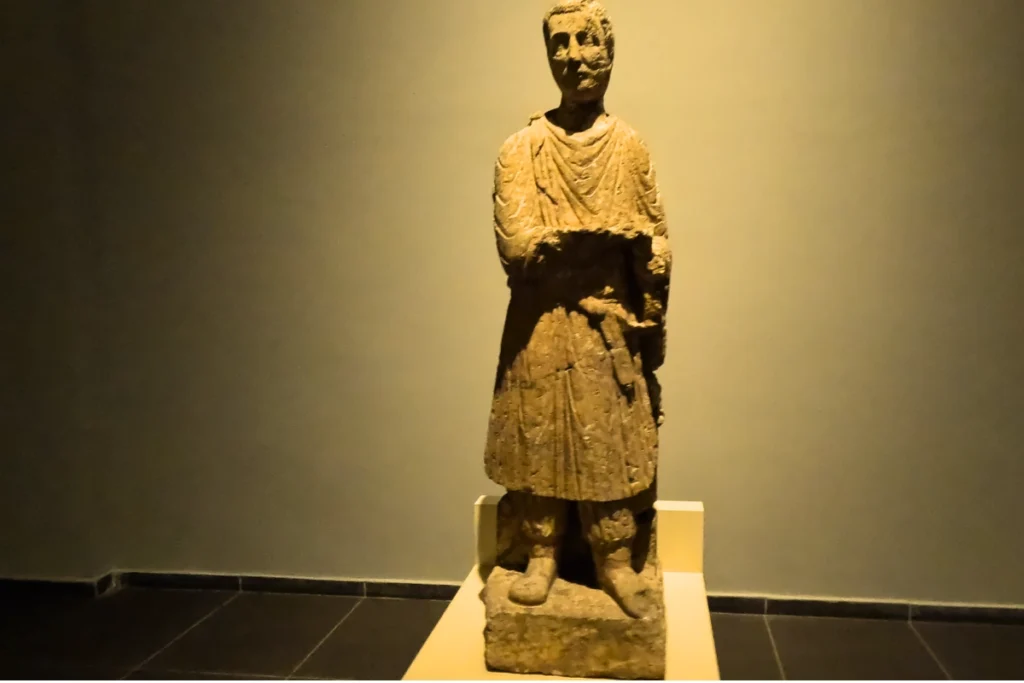
The middle sections of the museum’s chronological loop walk through the Bronze Age, the Assyrian and Babylonian periods, and the classical era. The transition is visible in the materials: from worked stone and bone to cast bronze and then to clay tablets.
The cuneiform tablets on display… small rectangles of fired clay impressed with wedge-shaped symbols… represent the bureaucratic infrastructure of the Assyrian and Babylonian empires: trade agreements, royal correspondence, legal codes. The cylinder seals, tiny carved stone cylinders rolled across wet clay to leave a merchant’s personal signature on a trade document, are among the most intimate objects in the museum: the 3,000-year-old equivalent of a personal signature.
The Roman section contains marble statuary and stone sarcophagi from the era when Şanlıurfa was known as Edessa, a major city of the eastern Roman and later Byzantine world. The Islamic section, which closes the loop, contains medieval scientific instruments, astrolabe fragments, astronomical tools, and manuscripts from the period of the Anatolian madrasas that made Urfa a centre of learning.
One historical note that stopped us in this section: Saint Thomas the Apostle, according to ancient church tradition, left Mesopotamia and travelled to Kerala, India, in 52 CE, establishing the Saint Thomas Christian community that still exists on the Malabar Coast. After his death in India, his relics were returned to the city of Edessa… this city, this place… in the 4th century. For centuries, pilgrims from across the Mediterranean travelled to Şanlıurfa specifically to venerate relics that had come from India. The same city where the world’s oldest human statue stands in a museum also once held the bones of an apostle who had died in Kerala. We noted this and moved on. The museum did not let us stop thinking about it.
The Haleplibahçe Mosaic Museum
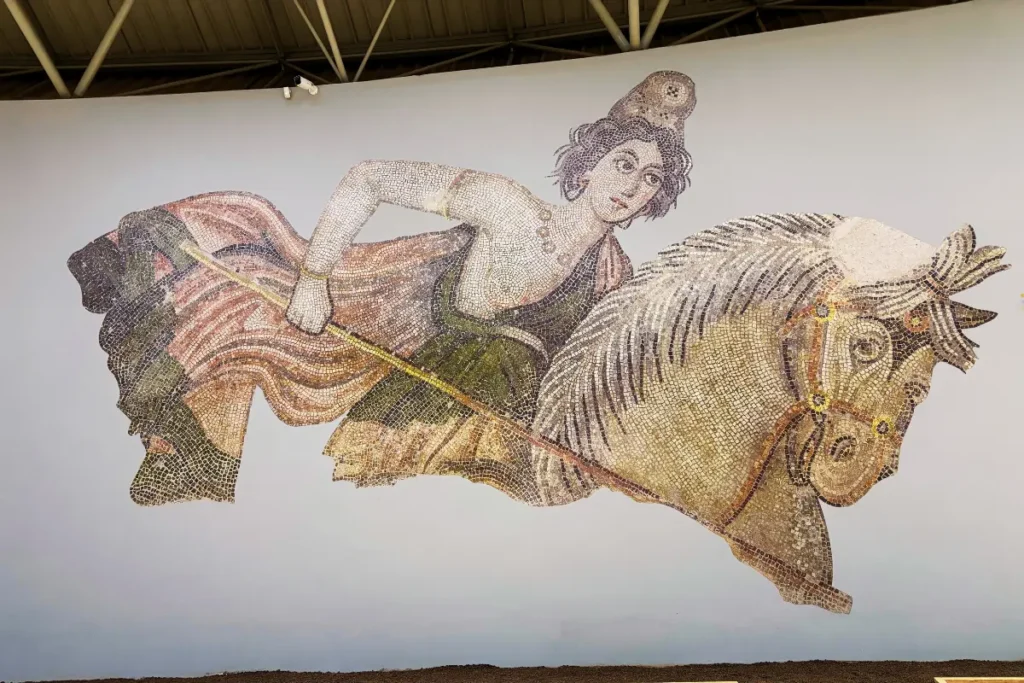
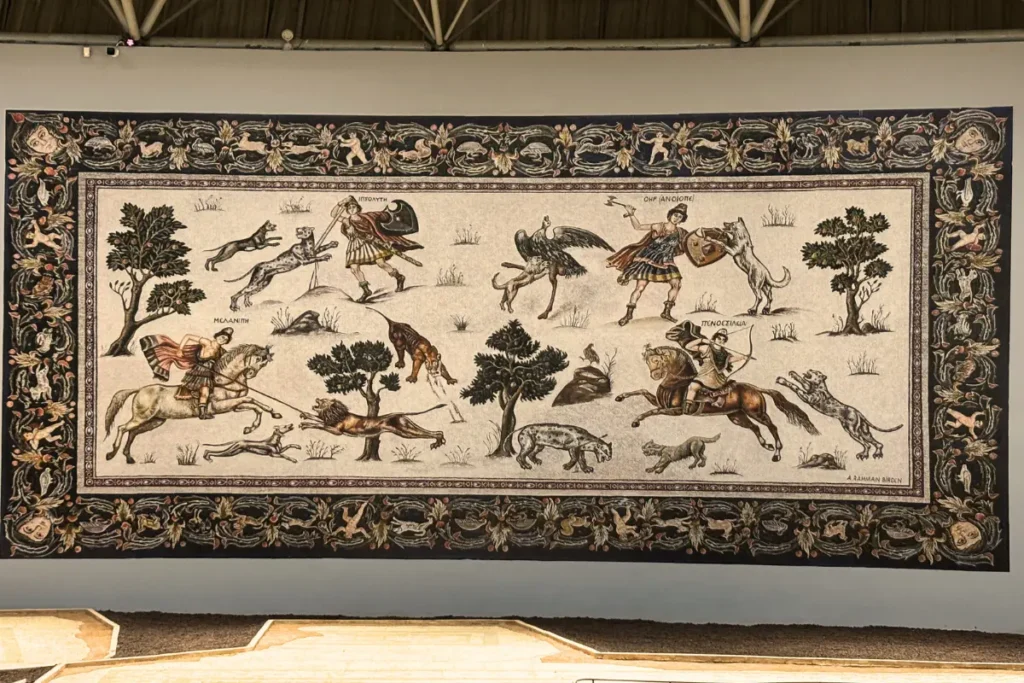
Next door under a massive spanning architectural dome, the Haleplibahçe Mosaic Museum holds a collection of 5th-century Roman floor mosaics discovered during urban construction work in Şanlıurfa city. The floors were beneath a modern neighbourhood. When the municipality began clearance work, the mosaics appeared beneath the foundations of houses that had been built, unknowingly, on top of a Roman villa complex.
The Warrior Amazon Queens
The central and most striking mosaic in the collection depicts the Warrior Amazon Queens: mythological female warriors from Greek and Roman tradition, shown hunting lions and leopards. The figures are made from tiny, naturally coloured river stones from the Euphrates, tessellated at a scale and precision that requires close observation to appreciate. At a distance, the figures look like paintings. At knee level, looking down at the surface, the individual stones are visible… each one selected for its specific hue and size, placed by hand, in the 5th century CE.
The Amazon Queens were hunting with spears and bows. The animals they pursued were rendered with the same precision as the hunters. The mosaic is not decorative in the way a pattern is decorative. It is narrative: a scene, rendered in stone, with the same compositional intention as a painting.
The Orpheus Mosaic
The Orpheus Mosaic depicts the mythological musician Orpheus charming wild animals with his lyre. This is a well-documented theme in Roman mosaic art… Orpheus as the figure who reconciles the natural world through music. What makes the Şanlıurfa version notable is its history outside Turkey.
The mosaic was smuggled out of Turkey and appeared in the United States, where it remained for years in private hands before Turkish authorities tracked it down and initiated a repatriation process. It has since been returned to its correct home in Şanlıurfa. The mosaic that you look at in the Haleplibahçe Museum is the same object that spent years in another country before being brought back to the city where it was made. Knowing this while looking at it adds a layer to what is already a beautiful object.
“To look at Orpheus charming the wild animals with his lyre is to realize that the human desire to tame chaos through art isn’t a modern concept… it was being laid down stone by tiny stone in Urfa 1,500 years ago.”
What It Means to Visit as Indians
We want to be precise about how we are framing this section. The connections below are observations and documented parallels, not academic claims. Some are well-established historical facts. Some are contested theories. We are sharing them as what they were for us: things we noticed while walking through a museum in southeastern Turkey that made us feel unexpectedly at home.
The Sikha
The stone head from Nevalı Çori with the shaved skull and the single braided tuft at the back has been noted by researchers and lay observers alike for its resemblance to the sikha… the traditional Brahmin hairstyle worn by Vedic priests and maintained in the practice to the present day. Mainstream archaeology treats this as a cultural coincidence or convergent practice. It may well be. What it felt like, standing in front of the display case, was specific: the recognition of something familiar in something 10,000 years old.
The Sacred Fish Ponds
The Balıklıgöl pools, a short walk from the museum, hold thousands of fish that Islamic tradition says were created when God turned Nimrod’s fire into water to save the Prophet Abraham. The fish are sacred and cannot be harmed. The impulse… a body of water, sacred fish, the prohibition on harm, the act of feeding them as devotion… felt immediately recognisable to us from the sacred tank fish found at Hindu temples across South India. The theology is entirely different. The instinct is shared.
The Geometric Sanctuaries
The circular enclosures at Göbekli Tepe and Karahan Tepe, with their T-shaped pillars arranged in precise geometric configurations, have led some researchers to draw comparisons to the Vedic Sulba Sutras… ancient Indian texts specifying the mathematical and geometric layout of sacred fire altars. Mainstream archaeology does not endorse a direct connection. What is observable is this: 11,500 years ago, in southeastern Turkey, people were building circular ritual spaces with geometric precision and symbolic orientation. Whatever the shared impulse is behind that practice and the geometric sacred spaces of ancient India, it is a question worth sitting with.
We are not claiming a direct cultural connection. We are sharing what it felt like, as two people from Bengaluru who grew up in a culture built around temple geometry and sacred tanks and braided priests, to walk through a museum in Turkey and find these echoes. The museum did not produce certainty. It produced questions. That is, perhaps, the most honest thing a museum can do.
Practical Information
- Entry: 871 Lira for two people (April 2025). Covers both the main Archaeology Museum and the Haleplibahçe Mosaic Museum.
- Time required: minimum two to three hours for both sections. The Pre-Pottery Neolithic Hall alone warrants ninety minutes if you are moving carefully.
- Sequence: visit the museum before the Göbekli Tepe complex, not after. The context transforms the site visit.
- Location: Şanlıurfa city centre, approximately 18 km from the Göbekli Tepe entrance.
- Photography: generally permitted in the main halls. Flash restrictions may apply near sensitive surfaces. Check at the entrance.
- The Balıklıgöl sacred fish pools and the Kızılkoyun Necropolis are both within walking distance of the museum and make a natural continuation of the day. The necropolis, discovered beneath the floors of a modern neighbourhood during urban renovation, holds over 70 Roman rock-carved tombs and is illuminated dramatically at dusk.
What It Costs
| Item | Cost (April 2025) |
| Şanlıurfa Archaeology Museum + Haleplibahçe, two people | 871 Lira / ~INR 2,003 |
| Ramin Hotel, Şanlıurfa (per night) | INR 3,647 / USD 38 |
| Göbekli Tepe entry, two people (same day) | 1,840 Lira / INR 4,230 |
| Balıklıgöl (sacred fish ponds) | Free |
| Kızılkoyun Necropolis | Free |
The Şanlıurfa Museum-Göbekli Tepe-Karahan Tepe day, including all three sites and the Balıklıgöl pools, is one of the densest cultural days available anywhere in Turkey.
Note: Prices change frequently due to inflation; check current rates before visiting)
“To walk through the Şanlıurfa Museum is to realise that the deep roots of human spirit, ritual, and ingenuity are far more connected than our geographies suggest. You do not leave this place with neat answers; you leave with an expanded sense of wonder for the ancient world… and a sudden, quiet flash of home.”