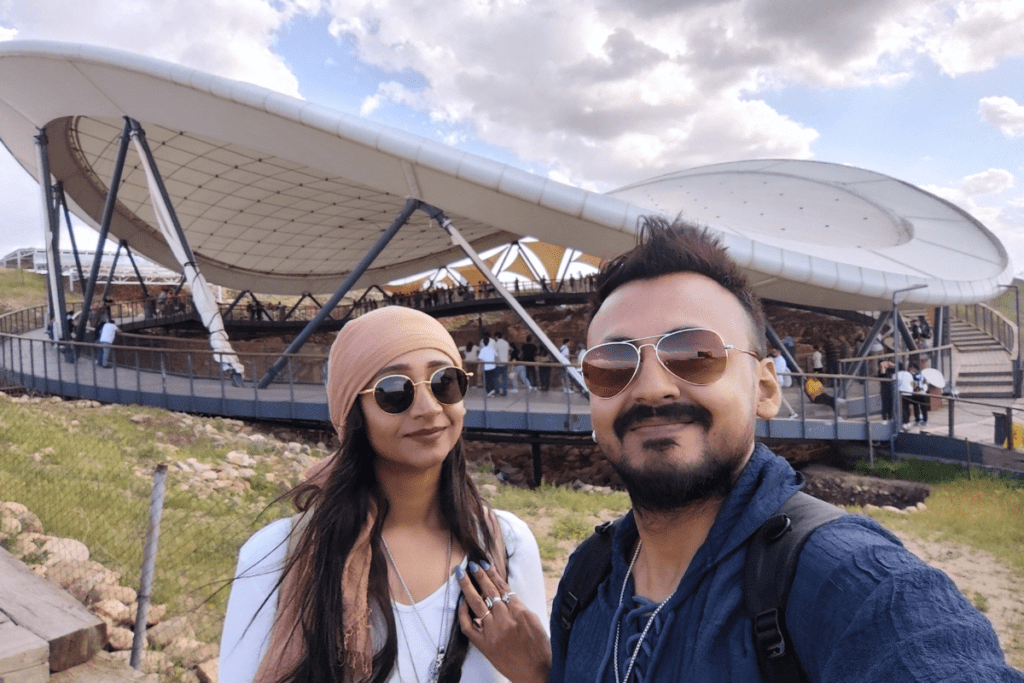
This Göbekli Tepe Visitor Guide is built from a day that started before dawn in Mardin, wound through a 11,000-year-old shamanic chamber, and ended in a city where a prophet’s fire became a pool of sacred fish…with a few hours in between spent looking down at the oldest question humanity ever carved into stone.
What were they doing here?
Eleven thousand five hundred years ago…before they knew how to grow wheat, before pottery, before the wheel, before anyone had written a single word…a group of hunter-gatherers in southeastern Turkey dragged 10-ton limestone blocks across a hilltop and arranged them in precise circles. They carved these blocks into abstract human forms with folded arms and decorated belts. They covered every surface with snarling leopards, striking scorpions, slithering snakes, wild boars, cranes, and vultures. They polished the floors to a watertight finish. They used these spaces for something. Then, after centuries of use, they buried the entire complex deliberately and with extraordinary care, so that it would survive underground for over eleven millennia.
The question of what they were doing has not been answered.
We had been reading about Göbekli Tepe for six months before we stood in front of it. The reading did not prepare us. The photographs did not prepare us. The immersive museum animation…which we watched thirty minutes before walking to the boardwalk…did not fully prepare us either.
What prepared us, as much as anything did, was the drive.
We left Mardin at around 9 AM. Drove two and a half hours southeast to Karahan Tepe first, stood over its subterranean chamber longer than we had planned, and continued to Göbekli Tepe in the early afternoon. The landscape between Mardin and Şanlıurfa is sun-drenched, rugged, and quietly enormous. Hills rolling into each other without interruption. Very little signage. The road feels like it is taking you somewhere the modern world forgot to update.
When we parked the car, passed through the security check, and boarded the shuttle bus to the archaeological park, the first thing we noticed was something the photographs never show: the surrounding landscape. The site sits on a hill called Potbelly Hill. From the boardwalk, you can see for kilometres in every direction. The terrain is bare, dry, and ancient. There is nothing modern within sight except the protective canopy over the excavated enclosures.
From guides and fellow visitors, we learned that Indian tourists travelling this far east in Turkey are extremely rare. At Mount Nemrut, two days before, the guesthouse family had not seen an Indian traveller in at least five years. At Göbekli Tepe, the rarity was confirmed again.
We stood on the wooden observation boardwalk and looked down into pits that hold the oldest monumental architecture ever built by human hands. The feeling was not awe at scale. It was gratitude…not for travel, but for being alive in the particular century where this place has been uncovered, and where two people from Bengaluru, working in IT, could drive a rented Citroën across Anatolia to see it.
“Only 5 percent of the site has been excavated. When you look at the unexcavated mound, you are looking at 11,500 years of buried intention.”
- What Is Göbekli Tepe?
- Why the Museum Comes First
- What the Archaeological Site Looks Like in Person
- Why Hunter-Gatherers Built a Temple Before They Learned to Farm
- What the Carvings Mean
- Why Göbekli Tepe Was Intentionally Buried
- Are There Connections Between Göbekli Tepe and Ancient India?
- Göbekli Tepe and Karahan Tepe: Visit Both, in This Order
- How to Get to Göbekli Tepe
- What It Costs to Visit
- Before You Go: What Actually Matters
- Frequently Asked Questions About Göbekli Tepe
What Is Göbekli Tepe?
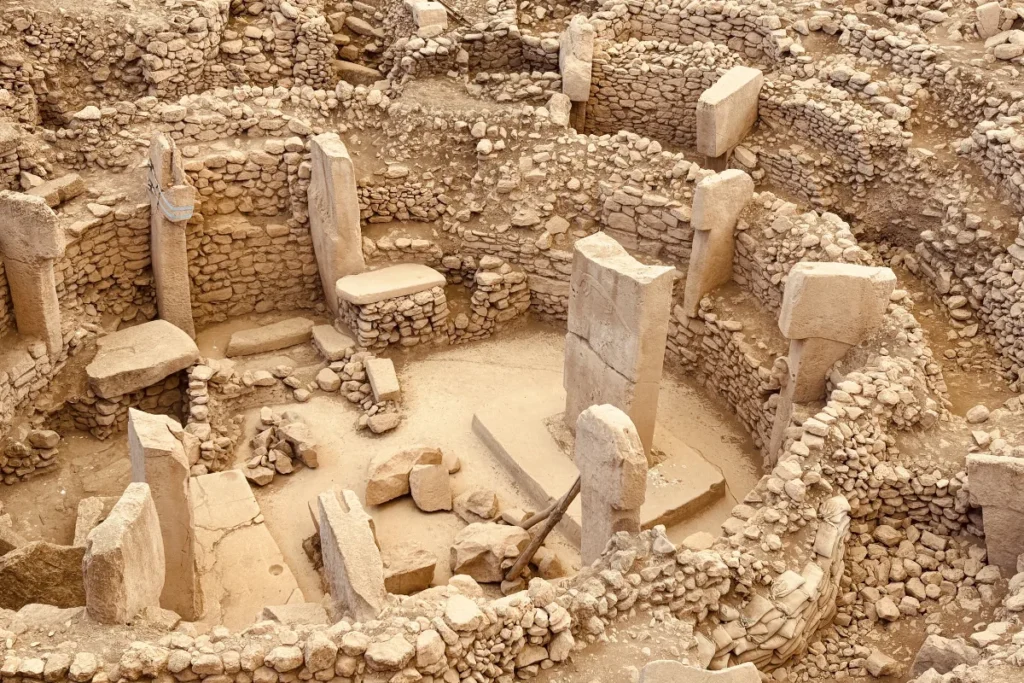
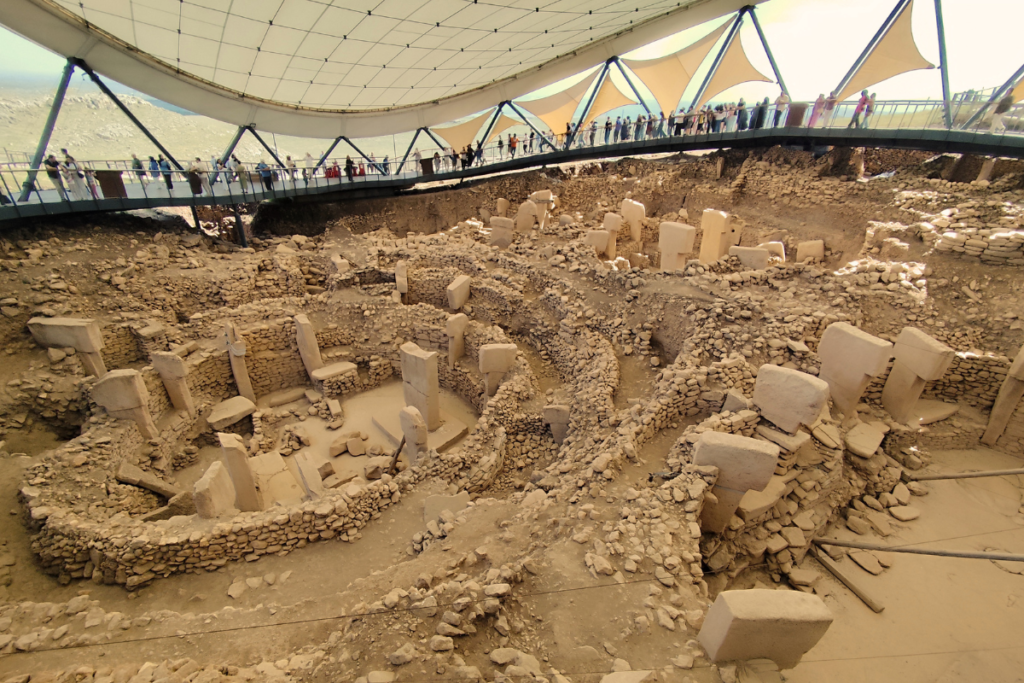
Göbekli Tepe is a Pre-Pottery Neolithic sanctuary approximately 15 kilometres northeast of Şanlıurfa in southeastern Turkey. Dating to roughly 9600 to 8200 BCE, it is the oldest known monumental structure built by human hands…predating Stonehenge by 6,000 years and the Egyptian pyramids by 7,000 years. Built by nomadic hunter-gatherers before the development of agriculture, the site challenges the conventional understanding of when and why human civilisation began organising itself around permanent sacred architecture.
The site was first surveyed in 1963 by archaeologists from the University of Chicago and Istanbul, who dismissed the hilltop as a medieval cemetery. In 1994, German archaeologist Klaus Schmidt recognised the T-shaped stones protruding from the soil for what they actually were. Systematic excavation began that year and continues today. Only an estimated 5 percent of the site has been uncovered. The rest remains buried beneath the hill.
Göbekli Tepe was designated a UNESCO World Heritage Site in 2018.
Why the Museum Comes First
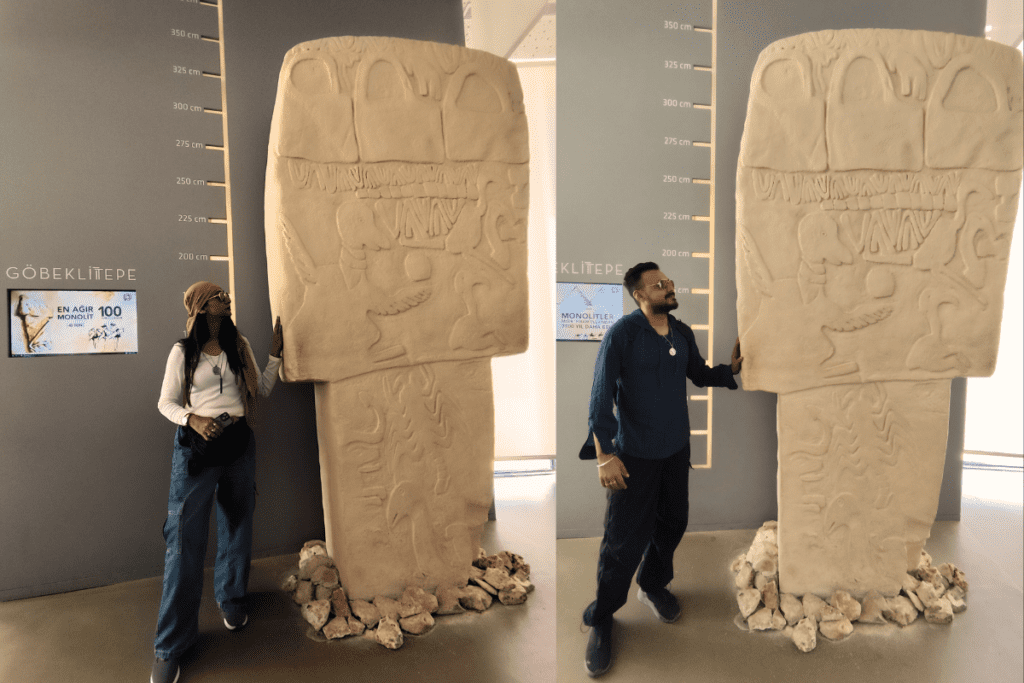
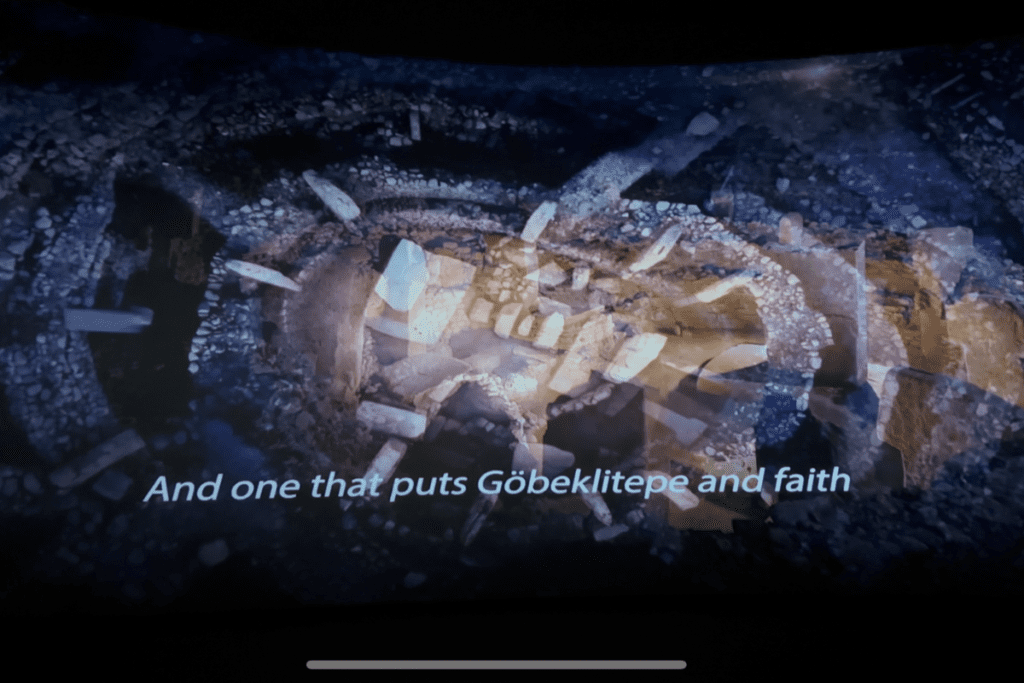
We made a decision at the start of our visit that turned out to be the right one: we went to the museum and visitor centre before walking the boardwalk over the excavation pits.
If you walk the boardwalk first, you are looking down into stone circles with no framework for what you are seeing. The pillars are impressive but abstract. The carvings are visible but unreadable. The museum provides the context that transforms the experience from impressive to genuinely staggering. This is not a suggestion. It is the difference between spending two hours looking at old stones and spending two hours standing inside the oldest question humanity ever carved into rock.
The Immersive Projection Show
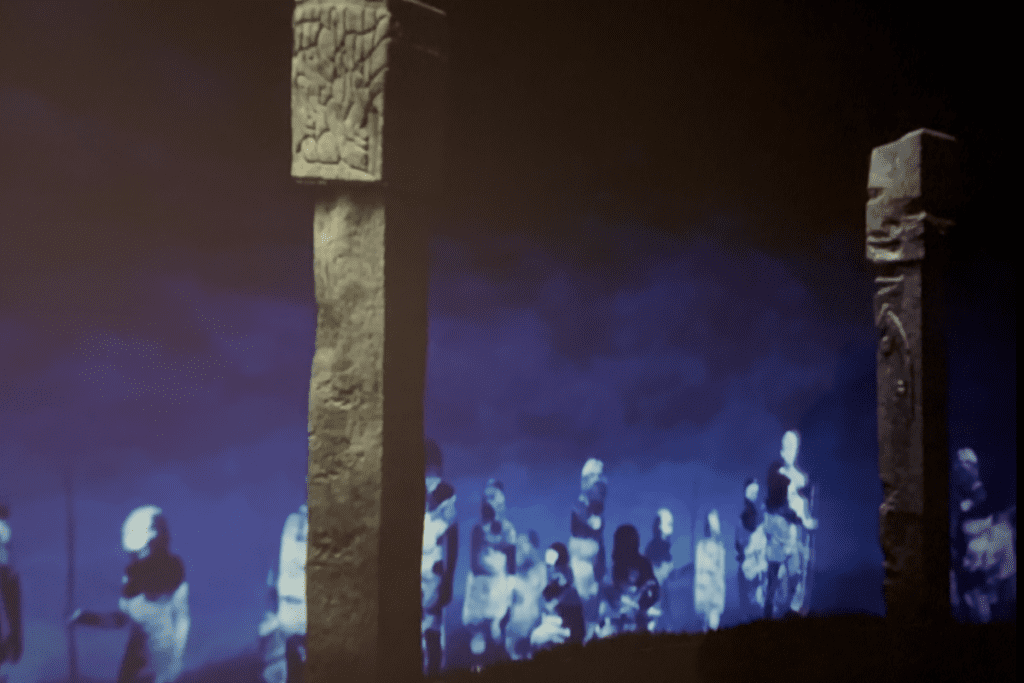
Inside the darkened visitor centre, a multimedia projection show uses animation to reconstruct how the hunter-gatherers quarried the massive limestone pillars from a nearby quarry using nothing but flint tools, dragged them across the hills without wheels or domesticated animals, and erected them inside circular stone walls while ritual fires burned within the completed enclosures.
The animation shows what the site may have looked like when it was alive. It is approximately fifteen minutes. It is worth every second, and it changes what you see when you reach the boardwalk.
The Circular Animation Hall
The heart of the building is a circular hall where the walls function as a continuous projection screen. Three-dimensional animations reconstruct what the temple enclosures looked like 12,000 years ago: the hunter-gatherers quarrying the massive limestone pillars using nothing but flint tools, dragging them across the hills without wheels or domesticated animals, erecting them inside circular stone walls, and lighting fires within the completed enclosures as ritual gatherings take place. This show runs on a loop and takes approximately fifteen minutes. It is worth every second, and it changes what you see when you reach the boardwalk.
Interactive Touchscreens and Storyboards
The centre of the animation hall features interactive touch tables where visitors can pull up detailed timelines, architectural layouts, and close-up views of specific stone pillars. Informational wall panels line the building, detailing the history of the German Archaeological Institute’s excavations and the ongoing discoveries across the broader Taş Tepeler region…the network of related Neolithic sites in southeastern Turkey of which Göbekli Tepe is the most famous.
Documentary Screening Area
A dedicated screening space loops short documentary films explaining the transition from the Ice Age through to Neolithic life, and how these people engineered the site without metal tools, agriculture, or permanent settlement. The combination of the animation hall and the documentary gives you enough mental architecture to make sense of what you are looking at when you step outside.
Note: the Visitor and Animation Centre is not a traditional museum with glass display cases of original excavated artefacts. The original finds…the Urfa Man, the Totem Pole, the 3D animal sculptures, and a full-scale Enclosure D replica…are housed in the Şanlıurfa Archaeology Museum in the city centre, approximately 15 kilometres from the site. We visited that museum the morning after our Göbekli Tepe day. Both are worth the time.
What the Archaeological Site Looks Like in Person
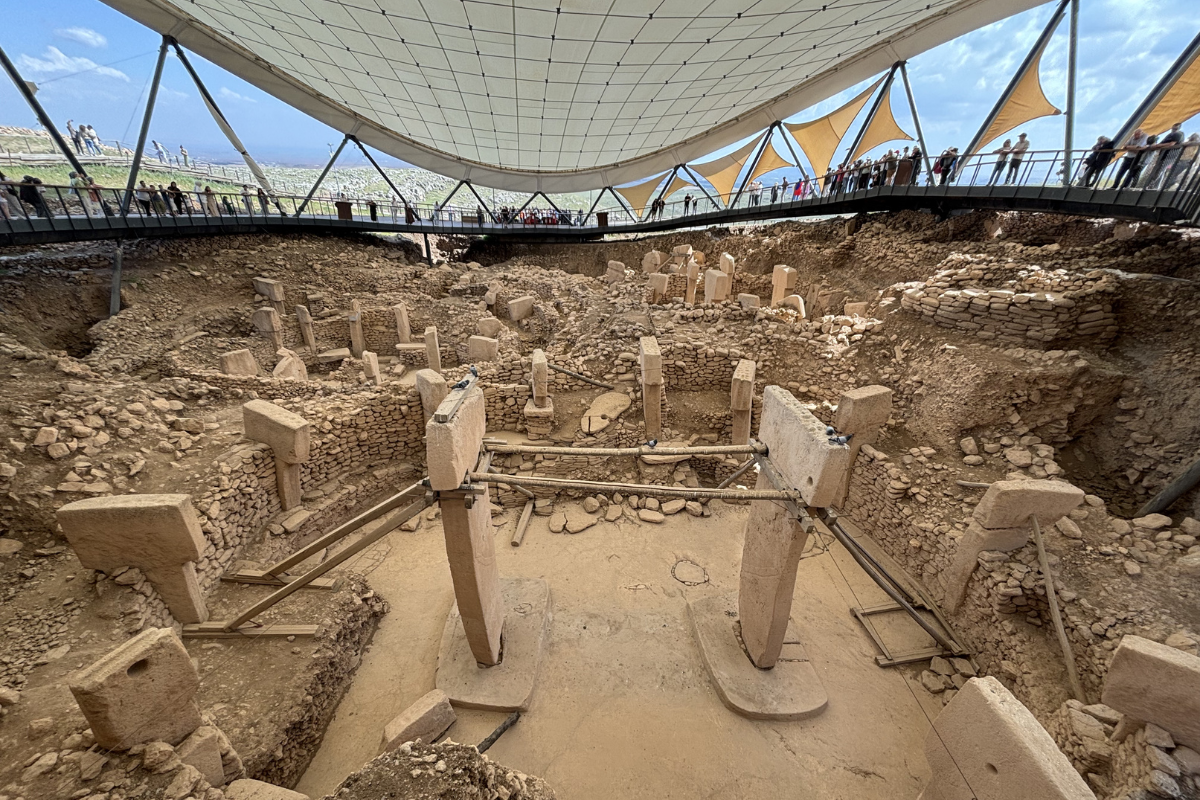
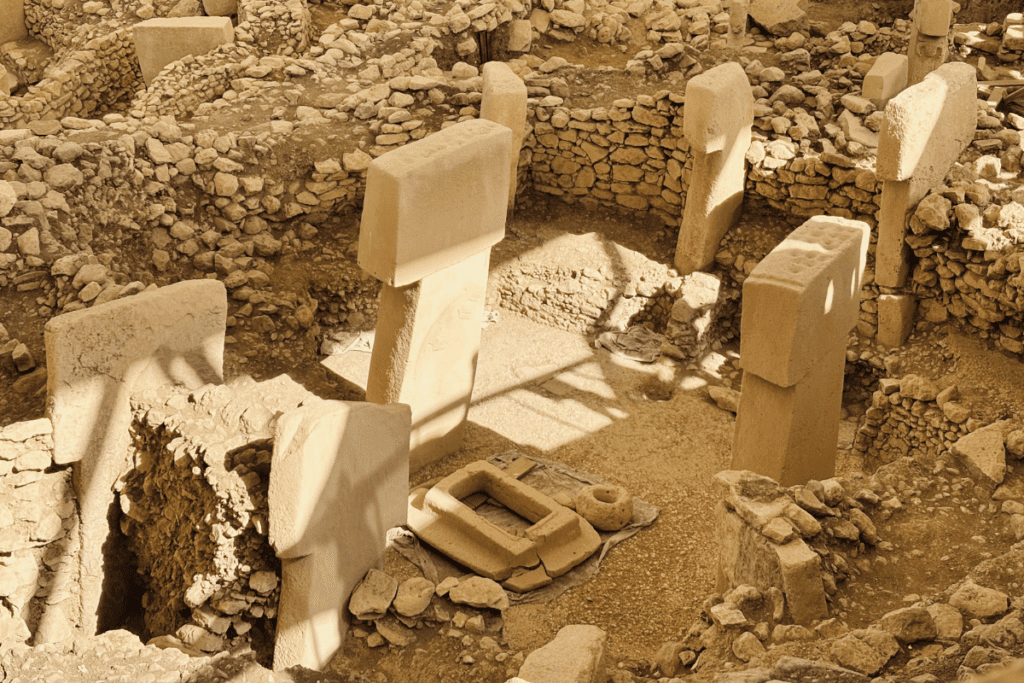
From the museum, the security shuttle takes you to the archaeological park entrance. You walk along wooden observation boardwalks that loop around and above four massive subterranean structures…Enclosures A, B, C, and D…all protected under a modern architectural canopy.
The T-Shaped Pillars: Faceless Beings Between Worlds
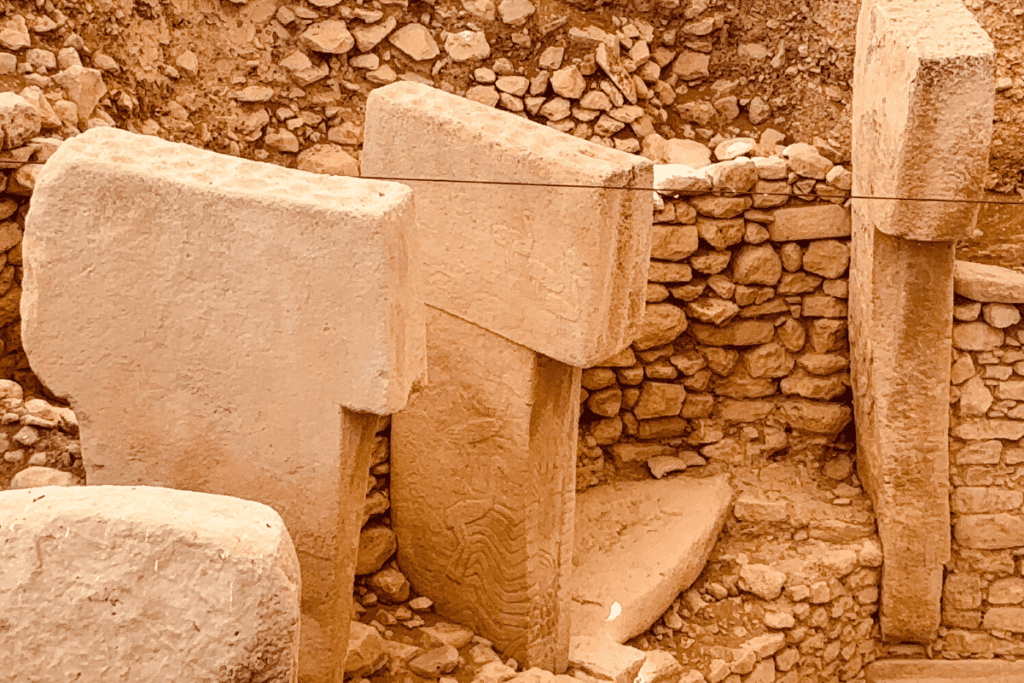
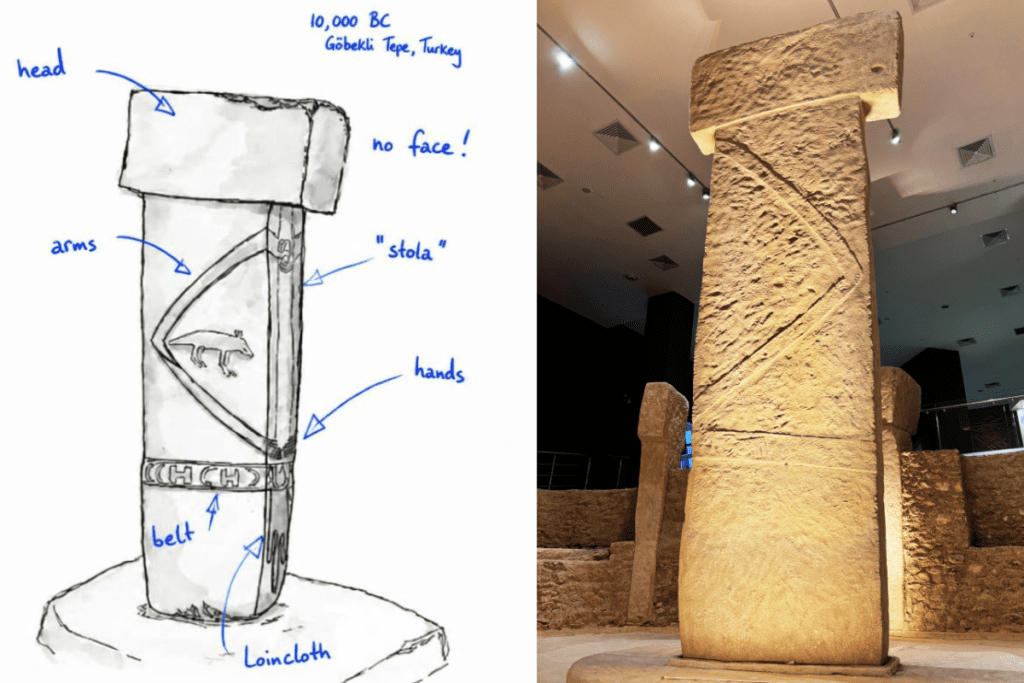
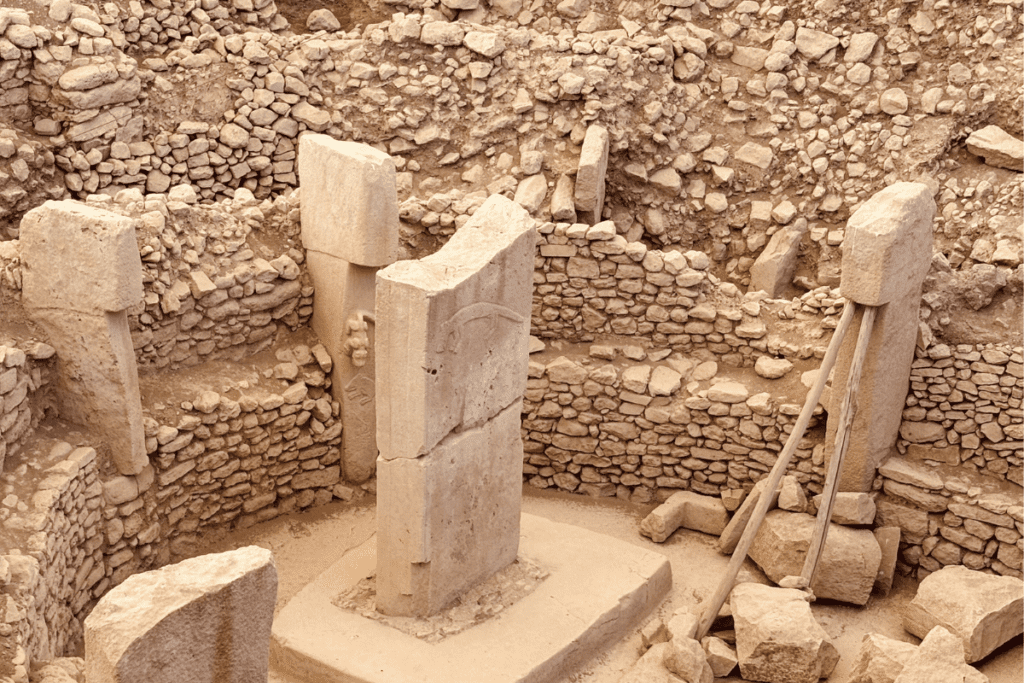
The pillars are the first thing you process. Massive limestone monoliths, some weighing over 10 tons and standing up to 5.5 metres high, pulled from a quarry and transported across the hilltop using no metal tools, no wheels, and no domesticated animals. Each enclosure has two central pillars, taller than the rest, positioned facing each other at the centre.
Look closely at the central pillars and something shifts. The horizontal top of the T represents a human head in profile. Down the vertical shaft, you can make out carved arms with hands folded gently over decorated belts and loincloths. They have no faces. No eyes, no noses, no mouths. They are faceless, silent forms…not human, not divine, something that sits in the space between. The interpretation that resonates most with current research is that they represent divine or cosmic ancestors: beings the community believed mediated between the human world and whatever lay above or beyond it.
The Animal Carvings and the Symbolic Language They Form
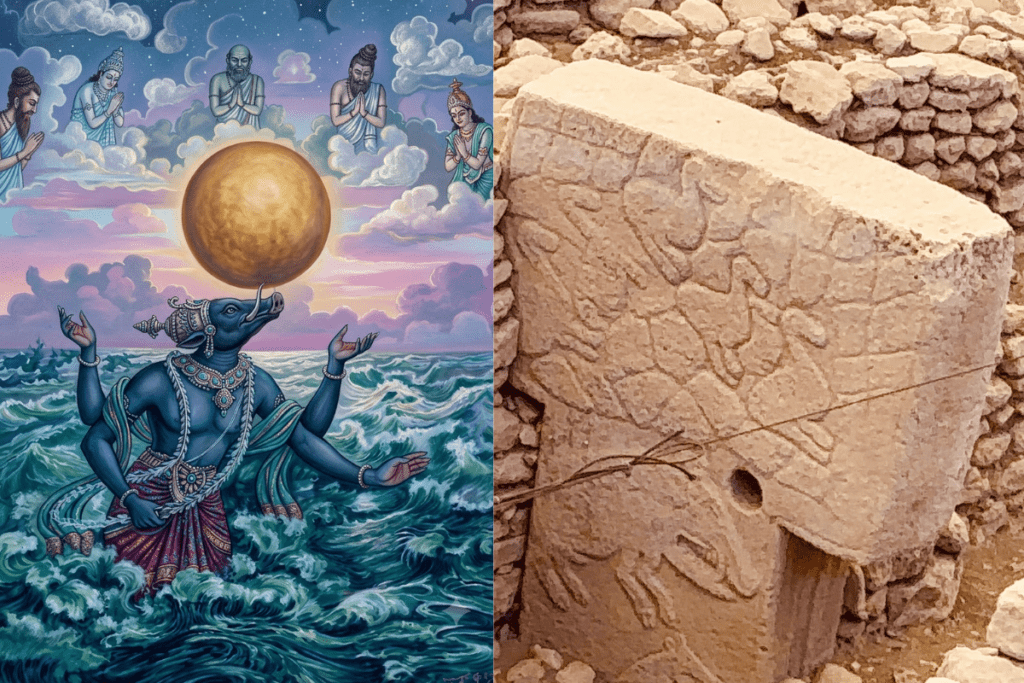
The surfaces of the pillars are covered with low-relief carvings of predatory animals: foxes, snarling leopards, striking scorpions, slithering snakes, wild boars, cranes, and vultures. They appear on specific pillars in specific orientations…not decoratively, but according to a system of meaning that functioned as a symbolic language for a people who had no written one.
The most significant single carving is Pillar 43, the Vulture Stone. A large bird with outstretched wings holds a circular, sun-like disc. Below it, a headless human figure. Below that, a scorpion. Some researchers read this as an astronomical map recording a specific celestial event. Others interpret it as a death narrative: the vulture carrying the soul toward the sun while the body remains on earth. Neither has been confirmed. Both are worth standing in front of that pillar and considering at length.
The Floors and What May Have Been in Them
In Enclosure C, the floor is clearly visible from the boardwalk: burnt lime and clay, polished to a smooth, watertight terrazzo finish. These are engineered surfaces. They were designed to hold liquid.
Research from the German Archaeological Institute has identified chemical residues in the massive stone bowls found at the site consistent with fermented grain beverages. The working theory is that Göbekli Tepe hosted the earliest known communal feasting rituals, and that the need to brew sufficient quantities of grain-based drink for large seasonal gatherings may have been one of the pressures that eventually led humans to begin cultivating grain nearby.
The implication, which Klaus Schmidt spent years developing, is extraordinary: religion may have invented agriculture, not the other way around.
“The need to feed thousands of people gathered at a sacred place may have been what first pushed humans to plant crops. Religion may have invented agriculture.”
Why Hunter-Gatherers Built a Temple Before They Learned to Farm
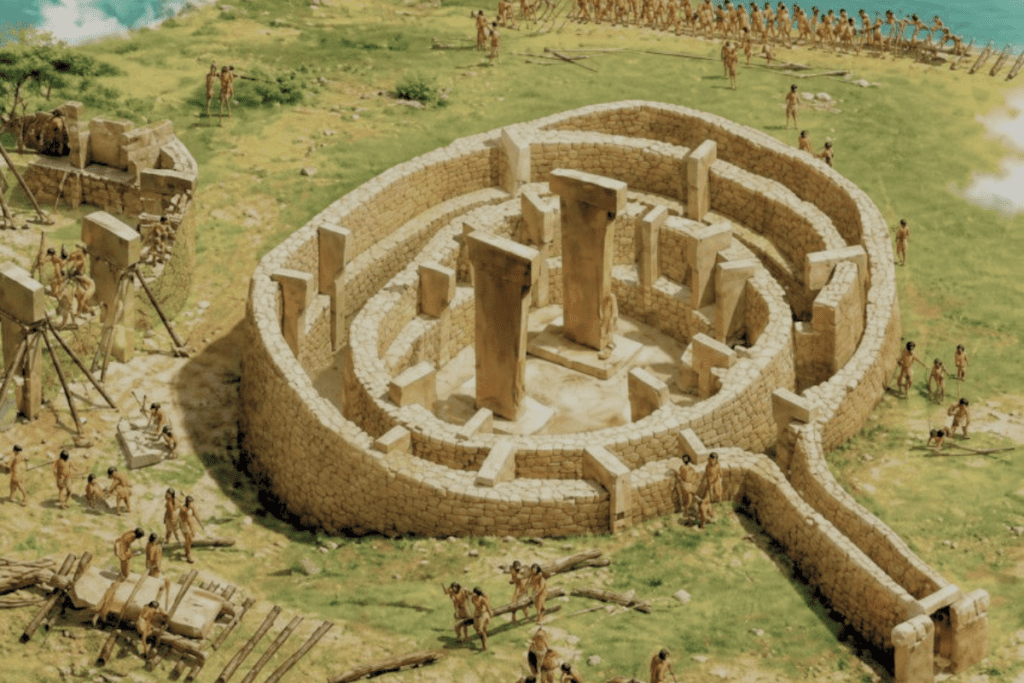
This is the question that makes Göbekli Tepe the most important archaeological site discovered in the modern era.
For generations, the accepted timeline of human civilisation followed a strict sequence: agriculture came first. Farming created surpluses. Surpluses enabled permanent settlements. Settlements produced specialisation. Specialisation generated priests, builders, artists, and eventually monumental architecture. Civilisation arose from practical necessity.
Göbekli Tepe inverts the entire sequence.
The builders were not farmers. They were hunter-gatherers who survived on wild animals and plants. No evidence of domesticated grain or animals has been found in the earliest layers of the site. These people built a monumental stone complex, organised labour forces capable of quarrying and transporting 10-ton blocks, and created a symbolic language carved into those blocks…all before planting a single seed.
The emerging consensus among researchers is that the desire to gather at a sacred place came first. The need to feed the large groups who assembled at Göbekli Tepe for seasonal ceremonies created the pressure to cultivate grain nearby. Agriculture was not the cause of civilisation. It was its consequence.
Humans did not settle down because they farmed. They settled down because something inside them needed to build a place to gather, to mark, to ritualise the relationship between themselves and whatever they believed was watching.
That impulse is 11,500 years old. It is still running.
What the Carvings Mean
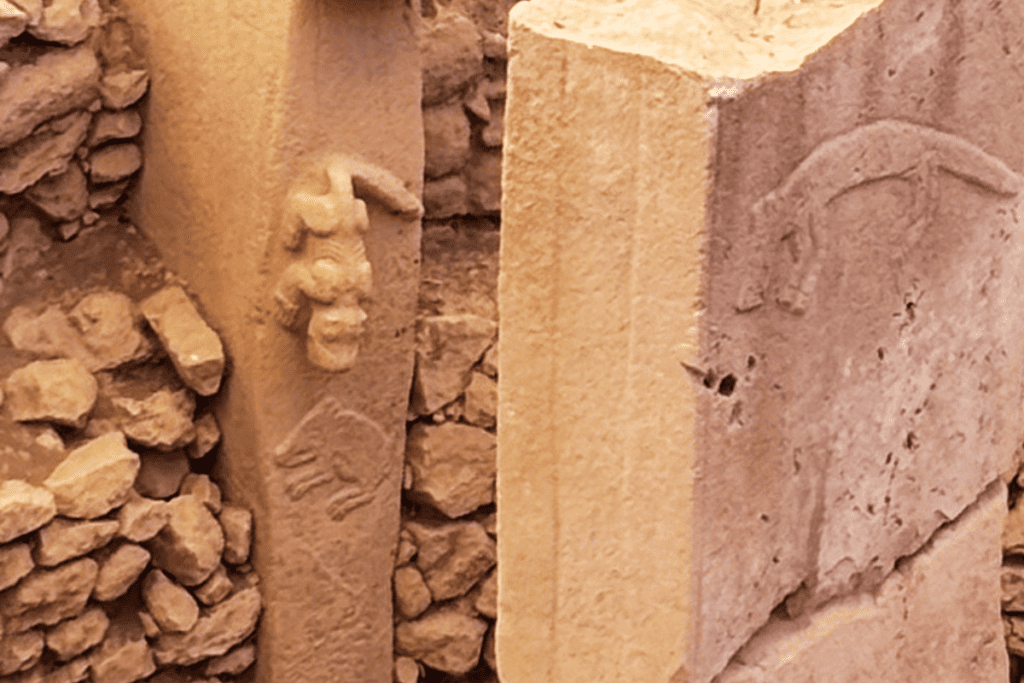
Nobody knows with certainty. But the patterns offer material for careful thought.
The animals are almost exclusively predatory or dangerous: leopards, scorpions, snakes, wild boars, vultures. There are no pastoral scenes, no landscapes, no depictions of daily life. Whatever this place was for, it was not about the ordinary world. It was about the forces that existed beyond it…the dangerous, the powerful, the unseen.
The vulture appears repeatedly and prominently. In many Neolithic cultures across the Near East, excarnation…exposing the dead to vultures before collecting and burying the bones…was the primary death ritual. The vulture was not a scavenger. It was a psychopomp: a being that carried the soul from the body to whatever lay beyond. If this interpretation holds, Göbekli Tepe may not have been a temple in the way we usually mean the word. It may have been a site intimately connected with death, transition, and the certainty…or at least the desperate hope…that something continued after the body was gone.
We stood on the boardwalk for a long time, looking at the Vulture Stone, and what we kept returning to was not the academic interpretation but the question beneath it: what did these people believe happened to them after they died? And how certain were they of the answer…that they carved it into 10-ton stones to last forever?
Why Göbekli Tepe Was Intentionally Buried
This may be the most unsettling aspect of the entire site.
The builders did not abandon Göbekli Tepe because of war, plague, famine, or environmental collapse. After using the sanctuary for centuries, they buried it. Deliberately. With meticulous care, they backfilled the enclosures with soil, gravel, and animal bones, creating a massive artificial mound that preserved the stone structures in near-perfect condition for over eleven thousand years.
They did not destroy it. They sealed it. As though completing a chapter they had finished.
No other Neolithic site exhibits this behaviour at this scale. The intentionality has challenged researchers since excavation began. One theory suggests the burial was itself a ritual act…that the site’s sacredness was believed to persist underground and that sealing it was a form of completing a cosmic cycle. Another proposes that each enclosure was built for a specific generation or clan, used for its allotted time, then deliberately sealed as a new enclosure was constructed alongside it.
What stays with us is this: the burial preserved Göbekli Tepe in a way no other ancient site has been preserved. If the builders had simply walked away, erosion and later civilisations would have dismantled the pillars for building material, as happened to countless other ancient structures. The deliberate burial made the site invisible for millennia…but also made it virtually indestructible.
Did they know that? Did they bury it so that whoever came looking, eventually, would find it exactly as they left it?
There is no evidence for that interpretation. But standing on the boardwalk, looking down at pillars that survived 11,500 years underground because someone chose to seal them rather than leave them exposed, the question does not feel unreasonable.
Are There Connections Between Göbekli Tepe and Ancient India?
This section is the reason we drove 4,150 kilometres across Turkey.
As Indian travellers, we carry a particular lens at ancient sites outside India. We look for echoes. At Göbekli Tepe, the echoes are audible enough that researchers outside mainstream archaeology have written about them at length. Mainstream science attributes the similarities to universal human psychology rather than direct historical connection. We present both positions, because both deserve consideration.
The Vulture Stone and Garuda
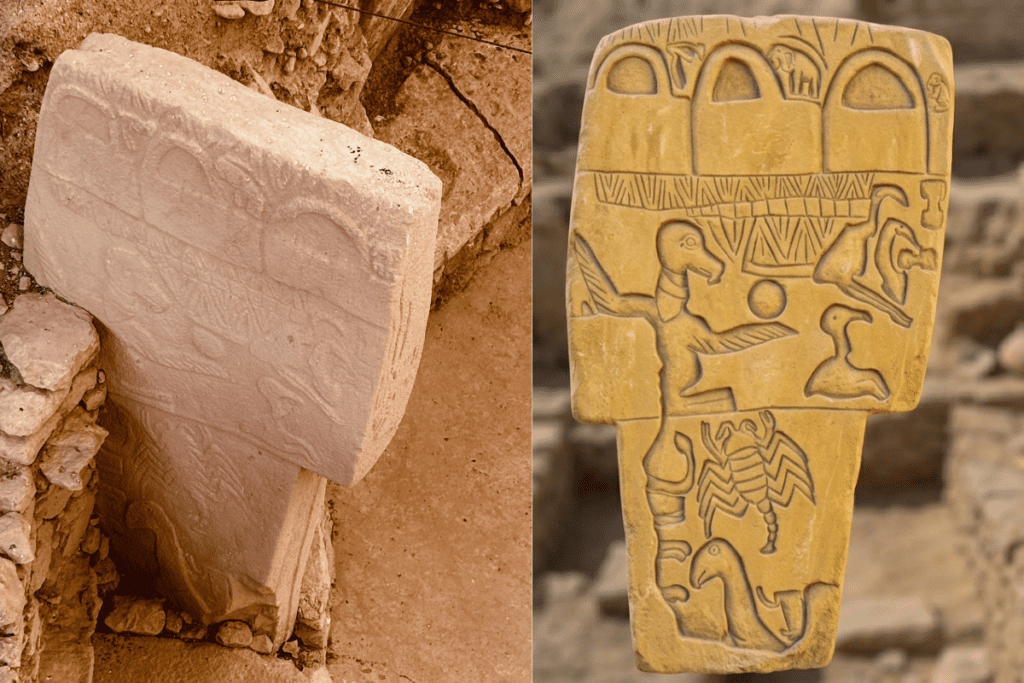
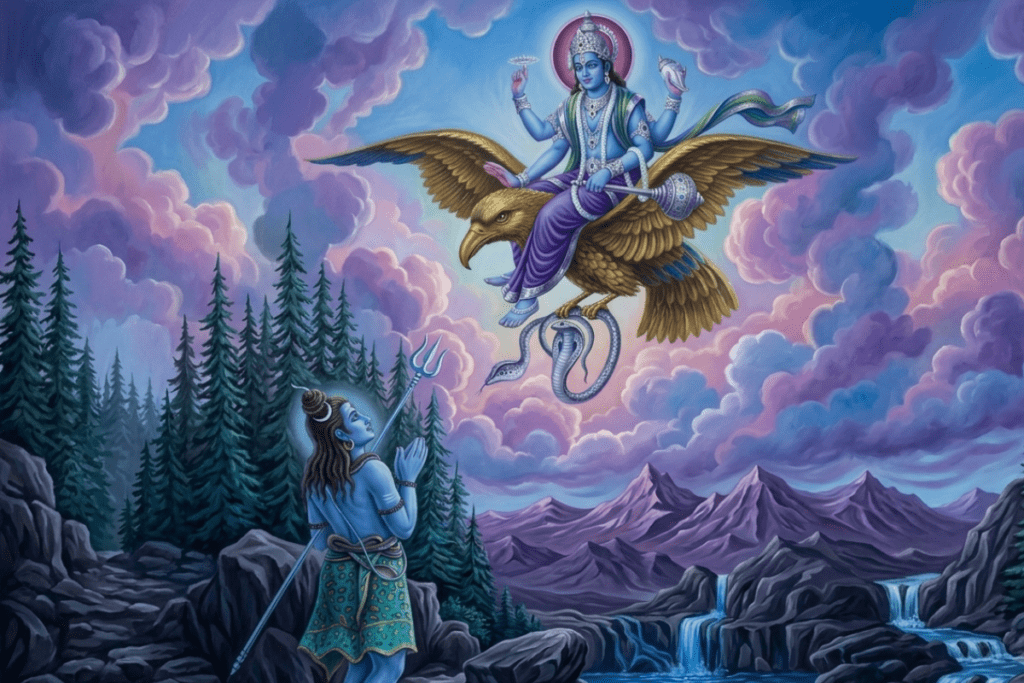
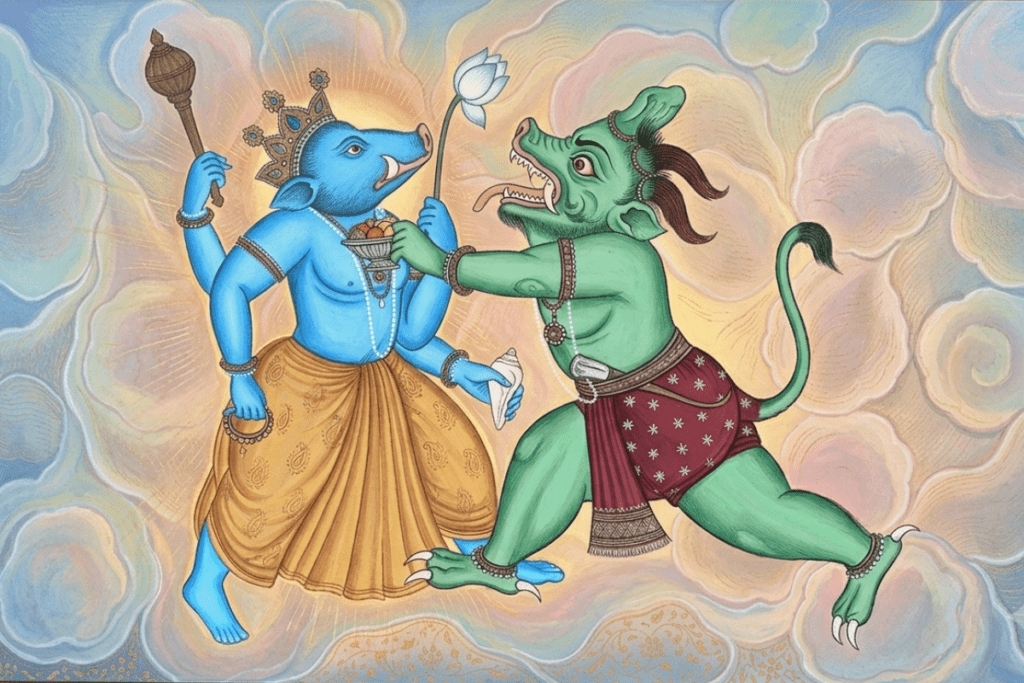
Pillar 43 depicts a large bird with outstretched wings holding a circular, sun-like disc, positioned next to a serpent. In Vedic tradition, Garuda is the divine solar bird, the mount of Vishnu, and the eternal cosmic enemy of the Nagas…the serpent beings. The structural parallel, a solar bird in opposition to a serpent, appears on both sides of the connection. The site also features many aggressive carvings of wild boars, which some researchers have compared to Varaha, the boar avatar of Vishnu. Mainstream archaeology attributes all such parallels to universal human symbolic tendencies. Standing in front of Pillar 43, the parallels are nonetheless striking enough to think about carefully.
The Pillar-in-Circle and the Lingam
The layout of each enclosure…a vertical, abstract, faceless pillar rising from a circular, stone-walled subterranean space…has been compared by some cultural commentators to the geometric architecture of a Shiva Lingam: an upright form within a circular base, representing cosmic creative energy. This comparison is speculative and is not accepted by mainstream archaeology. It was, however, the first thought that entered our minds when we looked down into Enclosure D from the boardwalk. We mention it because honesty about what we saw and felt matters more than appearing appropriately sceptical.
The Nevalı Çori Stone Head: The Sikha
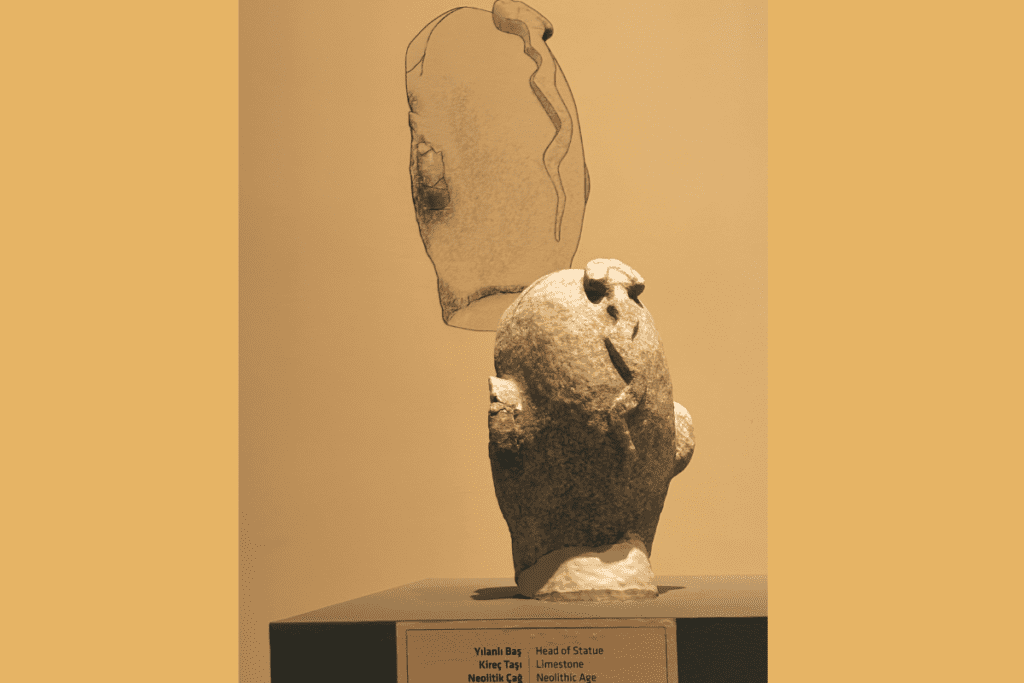

This is the connection that made us stop completely.
At Nevalı Çori, a closely related sister site built by the same culture in the same region, archaeologists found a stone head sculpture featuring a completely shaved skull except for a single, long, braided tuft of hair cascading down the back. We saw this artefact in the museum before walking the boardwalk.
This hairstyle mirrors, with remarkable precision, the traditional Sikha (also called Choti) worn by Vedic priests and Brahmins for thousands of years. The Sikha is not a casual cultural detail. It is a specifically prescribed feature of Vedic priestly identity, maintained across millennia and across regions where Indian religious tradition spread. To see it on a stone head carved approximately 10,000 years ago in southeastern Turkey…by a culture that predates the Vedas by at least eight thousand years…is either a coincidence driven by the finite ways humans style hair, or a thread of continuity so ancient that it predates every civilisation that claims it.
The Mainstream Position and the Open Question
The timeline gap is significant. Göbekli Tepe dates to approximately 9600 BCE. The Indus Valley Civilisation begins around 3300 BCE. The Rigveda is dated to roughly 1500 BCE. The mainstream position is that these parallels reflect universal human tendencies…that cultures worldwide independently develop similar sacred geometries, solar-bird mythologies, and priestly hairstyles because the human mind processes the world through recurring patterns regardless of geography.
The alternative position points to a geographic chain. Göbekli Tepe sits in Anatolia. The Mitanni Kingdom, which existed in the same broader region several thousand years later, explicitly worshipped Vedic gods…Indra, Varuna, Mitra…documented on clay tablets found at Hattusa. Some researchers suggest that the spiritual ideas that emerged at Göbekli Tepe may have migrated eastward across millennia, eventually contributing to the formal Vedic traditions of India.
We are not archaeologists. We are two people from India who stood in front of these carvings and felt something we had not expected. Whether that feeling constitutes evidence of anything is a question we leave with you.
Göbekli Tepe and Karahan Tepe: Visit Both, in This Order
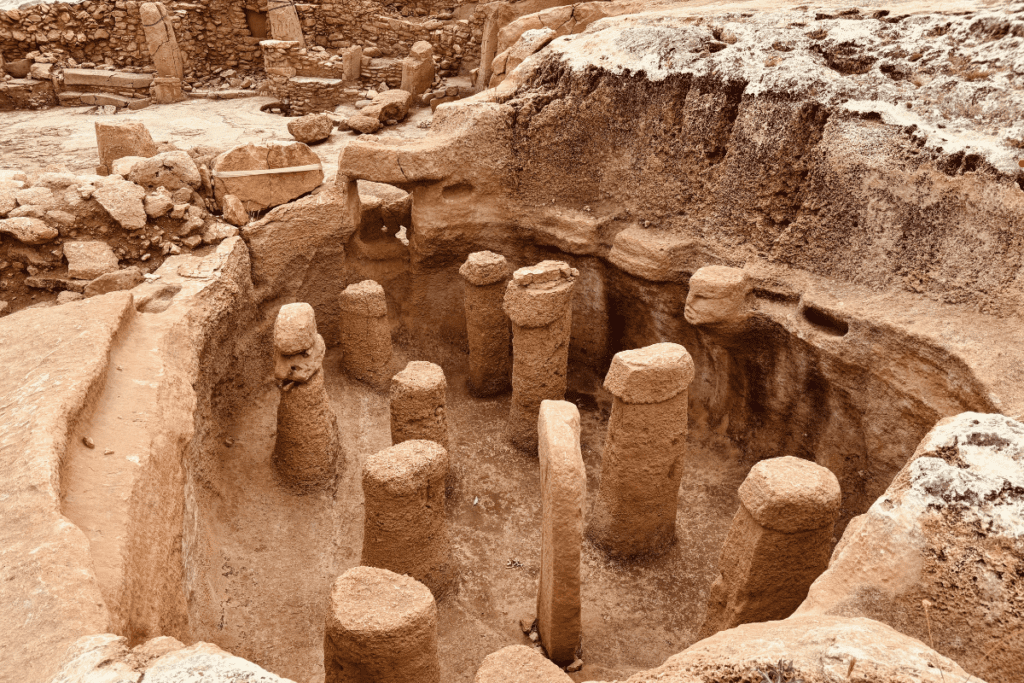
We visited Karahan Tepe that morning, before driving to Göbekli Tepe. The two sites are approximately 35 kilometres apart and belong to the same cultural tradition, but they are profoundly different in character.
Göbekli Tepe is monumental, public-facing, dominated by animal symbolism, and oriented outward…toward the sky and the surrounding landscape. The T-shaped pillars face each other at the centre of circular enclosures. The imagery is of things that soar, sting, strike, and fly.
Karahan Tepe is intimate, inward-facing, dominated by human symbolism, and oriented downward…into the earth. The subterranean chamber holds 11 upright phallic pillars, and from the rock wall above, a lone human face with a sharp, prominent nose gazes down into the darkness. The neck of the figure merges seamlessly with the bedrock, as though a being is rising from the earth itself. The leading archaeological theory is that this chamber functioned as a shamanic womb: initiates entered through one passage, descended among the pillars, and crawled out through a narrow opening on the other side, symbolically born again.
Karahan Tepe is free to enter and receives a fraction of Göbekli Tepe’s visitors. The experience of standing over that chamber and looking at the stone face gazing down into the darkness is, if anything, more viscerally affecting than the boardwalk at Göbekli Tepe.
Visit Karahan Tepe first. It tells you what these people believed about the relationship between humans and the earth. Göbekli Tepe then tells you what they believed about the relationship between humans and the sky. Together, the two sites form a complete cosmology.
How to Get to Göbekli Tepe
The site is approximately 15 kilometres northeast of Şanlıurfa city centre in southeastern Turkey.
By Rental Car (Recommended)
We drove from Mardin (approximately 152 km), stopping at Karahan Tepe en route. From Şanlıurfa city centre, Göbekli Tepe is a 20 to 25 minute drive on well-maintained, clearly signposted roads. A dedicated car park serves the visitor complex. From the car park, a free security shuttle bus takes visitors to the archaeological park entrance.
By Organised Tour from Şanlıurfa
Local operators offer half-day and full-day tours including Göbekli Tepe and sometimes Karahan Tepe. Prices vary by group size and inclusions…expect a range from budget to mid-range per person. If you do not have a rental car, this is the most practical option.
From Istanbul
We drove as part of a 14-day, 4,150 km Turkey road trip. A domestic flight from Istanbul to Şanlıurfa GAP Airport takes approximately two hours and is significantly more practical if Göbekli Tepe is your primary objective rather than one stop on a longer route. You can find our complete Turkey travel guide here.
What It Costs to Visit
All costs from our April 2025 visit. Turkey’s monument entry fees are reviewed periodically…verify current rates before travelling.
| Item | Cost (April 2025) | Notes |
| Göbekli Tepe entry (two people) | TRY 1,840 | Visitor and Animation Centre, shuttle bus, and site boardwalk all included |
| Karahan Tepe entry | Free | 35 km from Göbekli Tepe; free to enter |
| Parking at Göbekli Tepe | Free | Dedicated car park at the visitor complex |
| Security shuttle bus | Free | Included with entry ticket; runs from car park to boardwalk |
Turkey’s monument entry fees are reviewed periodically and have risen significantly in recent years. Verify current rates before visiting.
Before You Go: What Actually Matters
- Visit the Visitor and Animation Centre before the boardwalk. Without it, you are looking at old stones. With it, you are looking at the oldest question humanity ever carved into rock. Then visit the Şanlıurfa Archaeology Museum in the city…ideally the morning after…to see the original Urfa Man, the Totem Pole, the 3D animal sculptures, and the full-scale Enclosure D replica.
- Allow three to four hours minimum. One hour for the museum and visitor centre. One to two hours on the boardwalk, moving slowly. Thirty minutes for the shuttle and logistics. Most group tours spend sixty to ninety minutes total and leave having seen less than half of what the site offers.
- April is the optimal month. The site is fully outdoors. Summer temperatures in southeastern Turkey exceed 40°C, which makes the boardwalk walk genuinely difficult. April is warm, manageable, and not yet crowded. We visited on April 26th and the temperature was hot but tolerable.
- Combine with Karahan Tepe and Şanlıurfa in a single full day. Our sequence: Mardin → Karahan Tepe in the morning → Göbekli Tepe in the early afternoon → Balıklıgöl at sunset → Kızılkoyun Necropolis at night. Şanlıurfa Archaeology Museum the next morning. This sequence works.
- Bring water and snacks from your accommodation. Vendors near the parking area are limited. We carried snacks from home…they sustained us through a full day of driving and walking with no restaurant stops.
- Photography is permitted on the boardwalk. The carvings reward close attention. Move slowly. You will see things on the second and third pass that you missed on the first.
Only 5 percent has been excavated. The hill beneath the boardwalk holds structures, pillars, and carvings no living person has seen. When you look at the unexcavated mound, you are looking at 11,500 years of buried intention.
“If the question of what happens when a civilisation disappears while the stones remain interests you, Hampi is asking the same question from the other side of the world…and from a different era entirely.”