This Mardin travel guide is written from Day 9 of a 14-day, 4,150 km road trip through Turkey…one day and one night in a city that corrected every assumption we had made about how extraordinary this country could be.
The snakes beneath the earth still do not know their queen is dead.
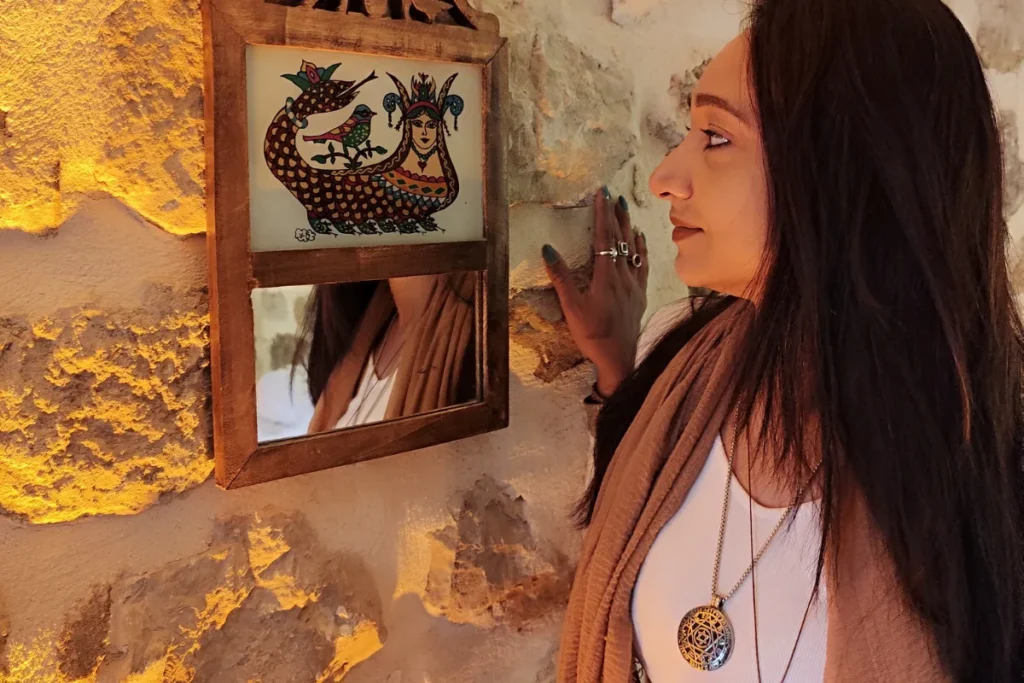
That is what the people of Mardin believe. Not as a figure of speech. Not as a children’s story retold for tourists. As a living part of the city’s identity, carried in the copperplates hammered by artisans in the bazaar, in the silver filigree woven by Telkari masters, in the portraits hung above the doorways of family homes to ward off evil. The Serpent Queen Shahmaran ruled a kingdom beneath the bedrock of this city, and when she was killed, her subjects were told she was merely travelling. If they ever learn the truth, local legend holds, they will rise from the underworld to reclaim the surface.
We arrived in Mardin on the afternoon of April 25th, driving from Mount Nemrut through Viranşehir approximately 270 kilometres of southeastern Anatolian mountains. We had been on the road for nine days. We had stood in 11,500-year-old ceremonial chambers, placed our hands on a stone possibly gifted by a pharaoh, and driven through mountain passes where loose rock fell from the cliffs above. We thought we had seen the most extraordinary things Turkey had to offer.
Mardin corrected that assumption within the first hour.
If Cappadocia is defined by its geology and Göbekli Tepe by its mystery, Mardin is defined by its mythology. Not the mythology of academic textbooks. The mythology of a city where four cultures have coexisted on a golden terraced hillside for centuries, overlooking the edge of Mesopotamia, and where the stories told in the bazaar at dusk are the same stories told a thousand years ago, in the same stone corridors, with the same conviction.
This Mardin travel guide is written from one day and one night in Mardin, which was not enough, and from the hours we spent at the ancient city of Dara beforehand, which was not enough either. Both deserve more time. Both deserve return trips. What we can offer is the honest account of what we found…and the certainty that what we found exceeded everything we expected.
“Mardin is defined by its mythology. Not the mythology of academic textbooks. The mythology of a city where the stories told in the bazaar at dusk are the same stories told a thousand years ago, in the same stone corridors, with the same conviction.”
- What Is Mardin?
- The Serpent Queen: Why Shahmaran Still Rules This City
- Dara: The Ephesus of Mesopotamia
- The Kasımiye Madrasa: A Philosophical Text Written in Stone
- The Zinciriye Madrasa: The View From the Edge of the World
- Old Mardin at Night
- How to Visit Mardin
- What It Costs
- Before You Go: What Actually Matters
- Frequently Asked Questions About Mardin
What Is Mardin?
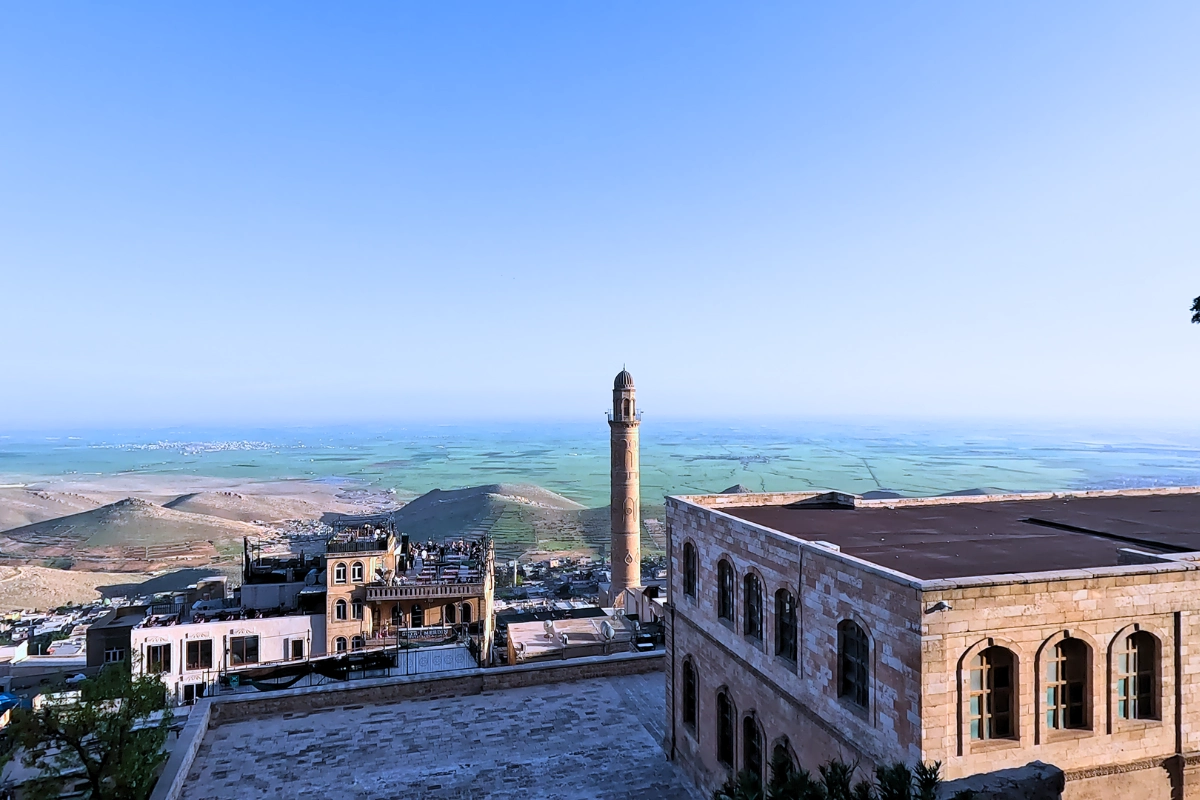
Mardin is a historic city in southeastern Turkey’s Mardin Province, situated on a limestone terrace at approximately 1,000 metres elevation, overlooking the vast Mesopotamian plain that stretches south toward the Syrian border approximately 20 kilometres away. It is a rare, living convergence of Kurdish, Arabic, Syriac Christian, and Turkish cultures, all layered into the same golden stone streets. The old town’s architecture, built almost entirely from local honey-coloured limestone, is protected as a conservation area. Its madrasas, mosques, churches, and monasteries represent centuries of overlapping civilisations, none of which fully displaced the others.
Mardin is not on most Turkey itineraries. It sits in the far southeast, closer to Iraq and Syria than to Istanbul. The travellers who come this far are either following the ancient Silk Road routes or, like us, following a thread of research that led them deeper into Anatolia than any standard guidebook recommends.
How a Music Video Pulled Us to the Edge of Mesopotamia
The Gift (A Netflix Show) showed us Dara and the Kasımiye Madrasa. Shahmaran (Another Netflix Show) gave us the mythology. But the moment Mardin moved from the research list to the non-negotiable list was a music video.
Mahmut Orhan and Colonel Bagshot’s “6 Days.” Three and a half minutes. The camera moves across Mardin’s golden terraced rooftops, the sliced fluted domes of the Zinciriye Madrasa, the endless Mesopotamian plain dissolving into the Syrian border, and stone corridors lit by the kind of light that only exists in places where the architecture was designed to catch it. The song has a melancholy that matches the city: something old carrying something current, neither fully past nor fully present.
We watched it multiple times. We paused on the frames that showed the domes against the flat horizon. We recognised the Zinciriye the moment we climbed to it on our visit, not from a guidebook, but from a music video we had watched on a laptop in Bengaluru months earlier.
If you want to know what Mardin looks like before you read another word of this guide, search “Mahmut Orhan 6 Days” and watch the first thirty seconds. The rest of this article explains what the video does not show you: the mythology beneath the stone, the blood in the walls, and the serpent queen whose subjects still do not know she is gone.
The Serpent Queen: Why Shahmaran Still Rules This City
The legend of Shahmaran is not a footnote in Mardin’s culture. It is the culture.
The Story
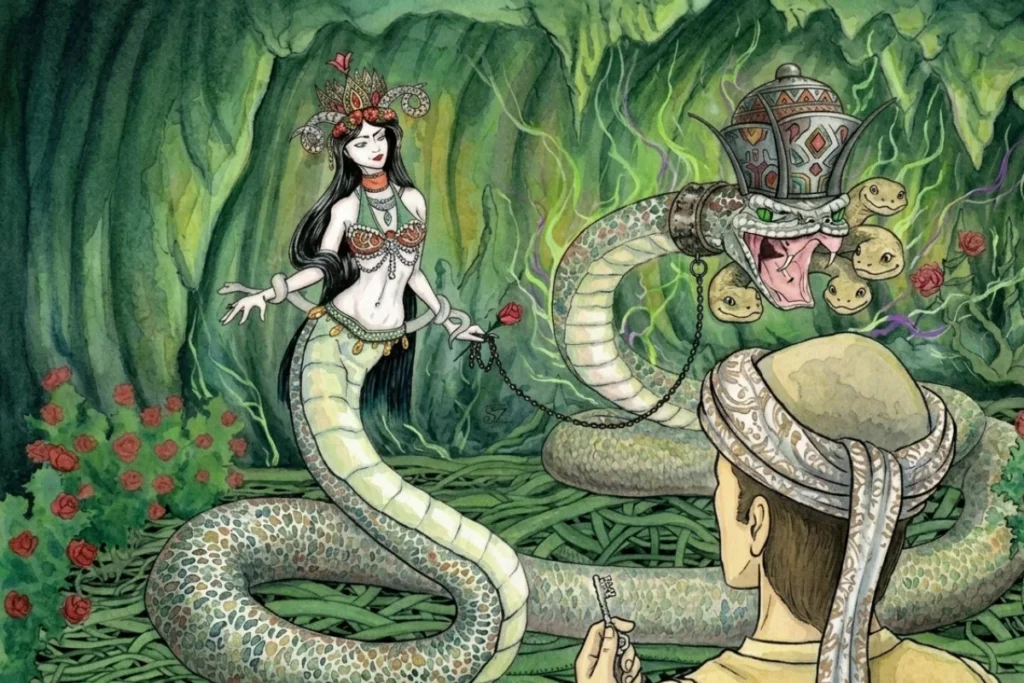
Long ago, deep beneath the bedrock of Mardin, lived the Marans: a kingdom of intelligent, magical snakes ruled by Shahmaran. She was a being of extraordinary beauty from the waist up and a serpent from the waist down, holding all the lost wisdom of the cosmos and cures for every earthly ailment.
A poor young man named Camasb was betrayed by his friends and left stranded at the bottom of a deep well. Searching for an escape, he found a hidden passage leading directly into Shahmaran’s subterranean paradise. Instead of harming him, she welcomed him as a guest. For years, Camasb lived in her underground Eden, spellbound by her beauty and her cosmic tales of the universe.
Eventually, homesickness caught up with him. Shahmaran agreed to let him return to the surface under one strict condition: he must never reveal her location, and he must never enter a public hamam, because anyone who had looked upon the Serpent Queen would sprout shimmering snake scales on their skin when exposed to hot steam.
Camasb kept his promise for years. Then the Sultan fell terminally ill. The wicked Grand Vizier declared that the only cure was to consume the flesh of Shahmaran. Suspecting someone had met her, the Vizier ordered every man in the kingdom thrown into the public baths. When Camasb entered the steam, gleaming scales rippled across his back. He was dragged away and tortured until he revealed the secret well.
When the soldiers captured the Serpent Queen, she showed no anger toward her weeping lover. Instead, she whispered a final instruction: “Boil me in a copper pot. Give the first extraction of my water to the Vizier…it is poison. Take the second extraction and drink it yourself…it contains my universal wisdom. Give my cooked flesh to the Sultan to cure him.”
She reversed the instructions deliberately in front of the Vizier, knowing his greed would make him drink first. The Vizier drank and dropped dead. The Sultan was cured. Camasb, consumed by guilt, drank the second extraction expecting death. Instead, the infinite wisdom of the cosmos flooded his soul, transforming him into Lokman Hekim…the legendary father of herbal medicine.
Why It Matters
This is not just a story. It is the operating mythology of the city.
Coppersmiths in the Mardin bazaar hammer Shahmaran’s likeness into shining plates. Masters of Telkari — the delicate silver filigree jewellery that is Mardin’s most distinctive craft…weave her form into silver threads. Families hang her portrait above their entryways to ward off evil and betrayal. After a full day in Mardin, the question stopped being whether the legend was true and became something more difficult: what does it mean that a city has organised its entire visual identity around a serpent goddess for centuries, and has not stopped?
Local lore adds a postscript that makes the story feel unfinished rather than ancient: the snakes beneath the earth still believe their queen is merely travelling. If they ever discover the truth, they will rise from the underworld to reclaim the city. We saw Shahmaran’s face on the walls of our cave hotel. We saw her in the copperwork in the bazaar. We saw her in the doorways of homes. The eyes follow you through the corridors.
“The snakes beneath Mardin still believe their queen is merely travelling. If they discover the truth, local legend holds, they will rise. The bazaar artisans keep hammering her face into copper anyway.”
Dara: The Ephesus of Mesopotamia
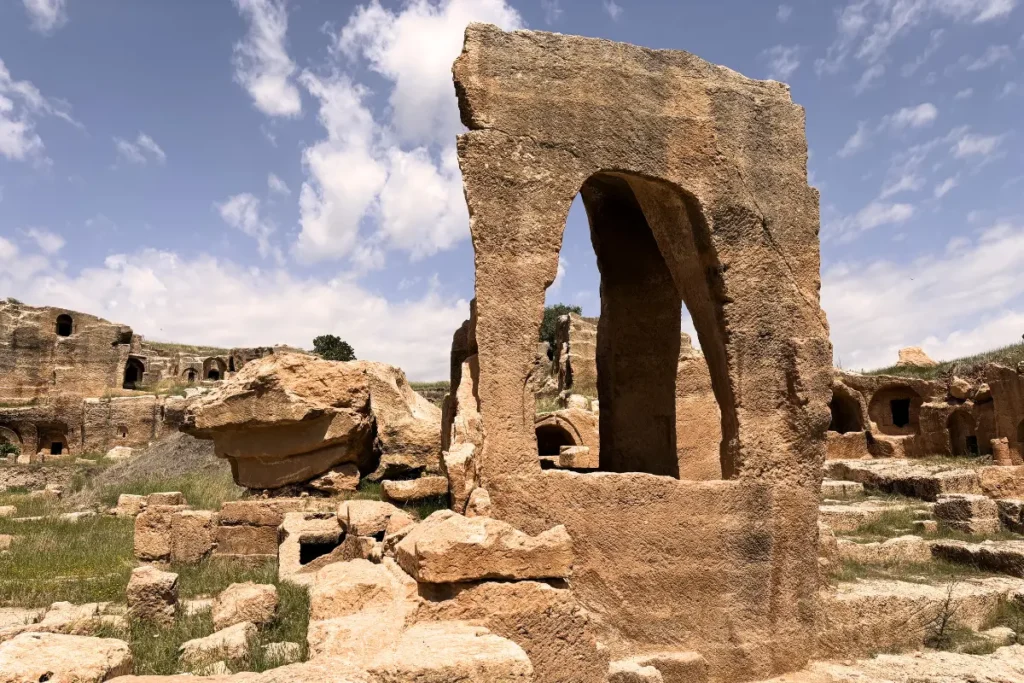
Before entering Mardin, we drove approximately 30 kilometres south to the ancient garrison city of Dara, near the Syrian border. We had recognised its dramatic rock-cut structures from The Gift, and the site had been on our list since the research phase.
Dara is often called the “Ephesus of Mesopotamia,” and the comparison is not hyperbole. An entire city — including massive cisterns, defensive walls, and an immense necropolis…was carved directly from solid limestone bedrock. It sat on the Silk Road at the volatile border where the Eastern Roman (Byzantine) and Persian (Sassanid) Empires fought for control of the world. Local legend claims the city takes its name from the Persian King Darius III, who allegedly fought his final stand against Alexander the Great among these rocky cliffs.
Today, a quiet Kurdish village sits directly on top of these Roman ruins. Modern homes rest on ancient foundations. Children play between structures that are two thousand years old. Walking through Dara is not walking through a preserved site. It is walking through time that has never agreed to stay in one period.
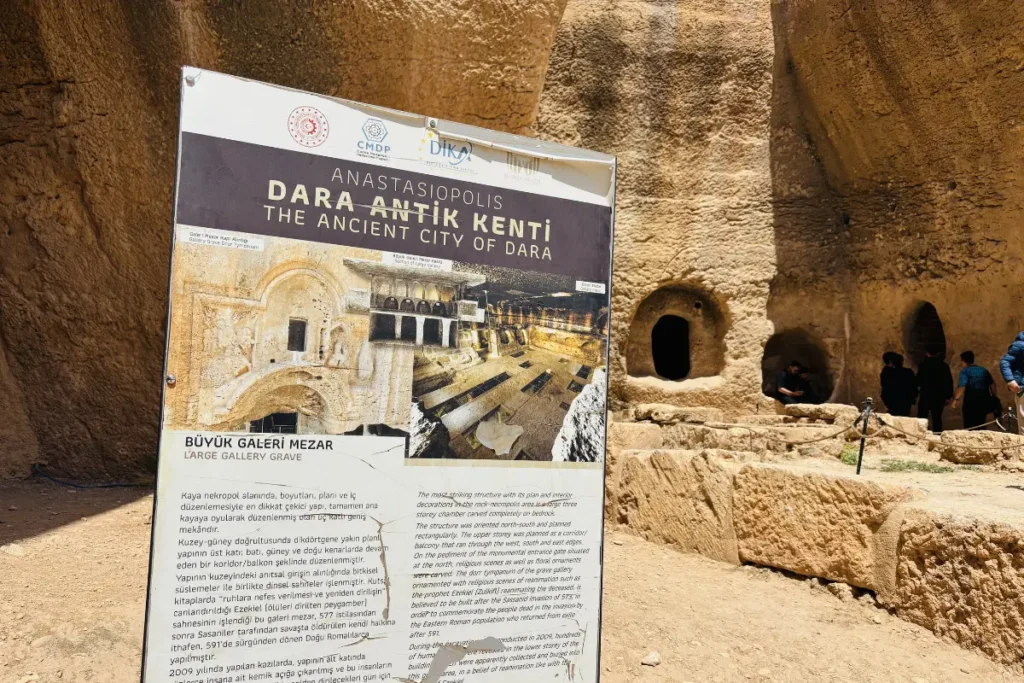
The Multi-Storey Gallery Grave
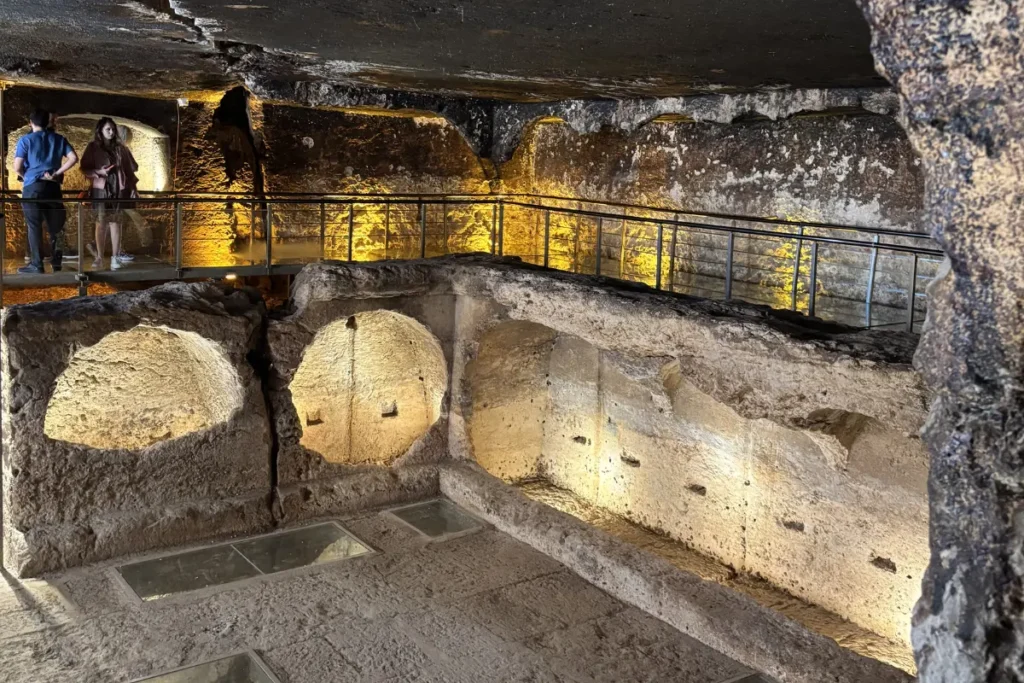
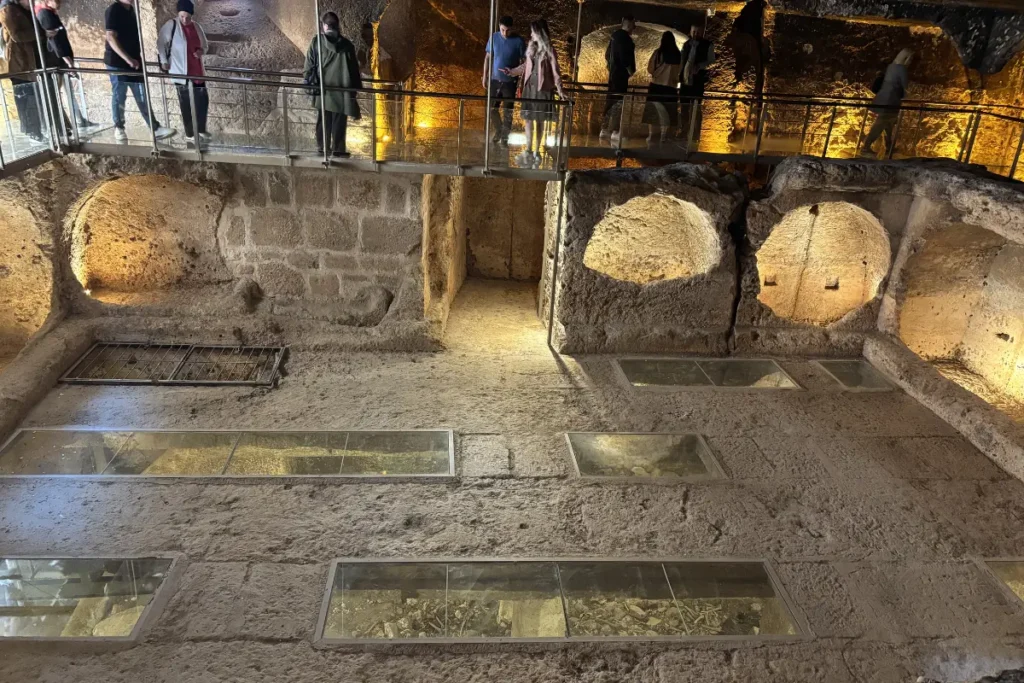
The necropolis holds a massive, three-storey underground gallery grave built by the Eastern Romans to house the bones of hundreds of people. At the limestone entryway, carved into the stone door, is a relief depicting Ezekiel’s Biblical vision of the Resurrection of the Dead: dried bones reassembling, growing flesh, spirits returning to their bodies. The builders believed the bedrock possessed a spiritual energy that served as a launchpad for the soul to transcend dimensions.
Standing inside that three-storey underground space, looking at a relief that depicts resurrection carved above the bones of the dead, is not an experience that sits comfortably in a travel itinerary. It belongs to a different category of human encounter.
The Underground Cisterns
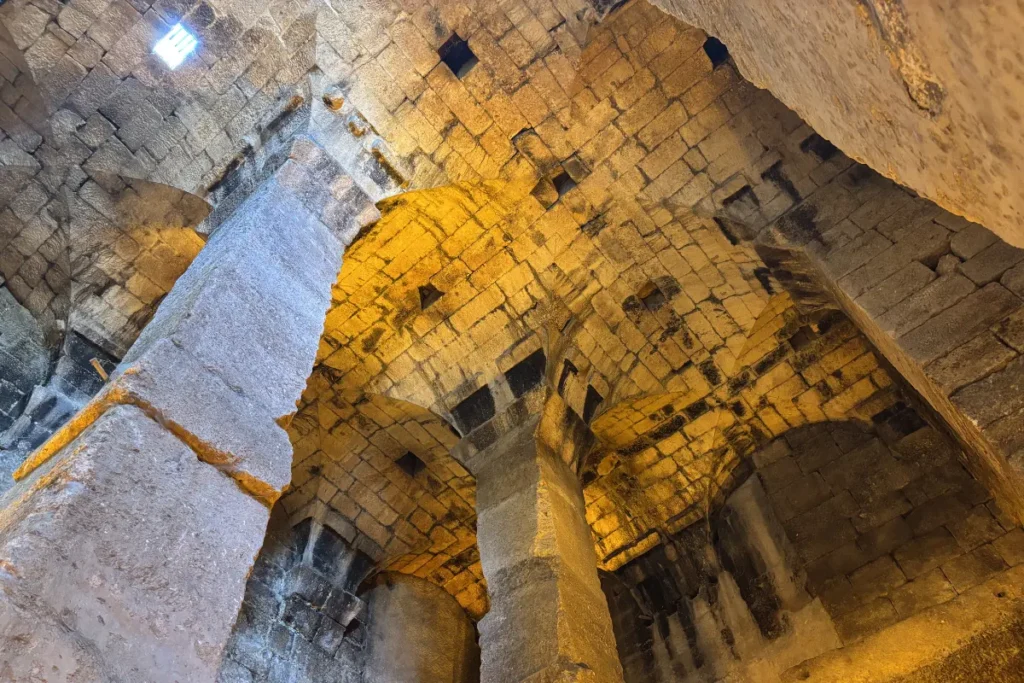
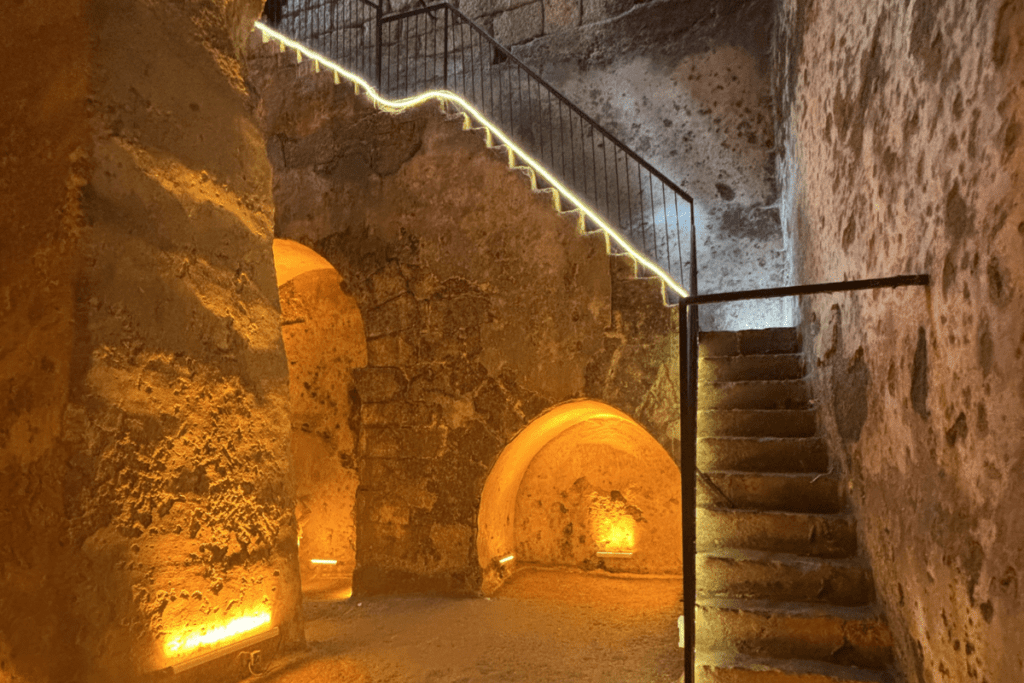
Below the surface, Dara holds what the local village children call “the Dungeons.” In reality, these are gargantuan underground water cisterns supported by massive stone pillars. Roman engineers funnelled water from the northern mountains into these secret subterranean vaults via stone aqueducts. The military strategy was elegant: even if an invading Persian army besieged the city walls completely, the citizens of Dara had enough hidden water to survive for months without the enemy ever knowing it existed.
Descending from the hot Mesopotamian sun into the cool, echoing, pitch-black depths of these cisterns felt like stepping through a portal. The temperature dropped. The sound changed. The light disappeared. Then the pillars appeared in the beam of a phone flashlight, stretching into darkness.
Practical Note: The Lunch Break
Dara closes its gated sections during the 12 to 1 PM lunch break. The open-air village ruins remain accessible, but the cisterns and enclosed tomb areas are locked. Arrive before noon or after 1 PM.
The Kasımiye Madrasa: A Philosophical Text Written in Stone
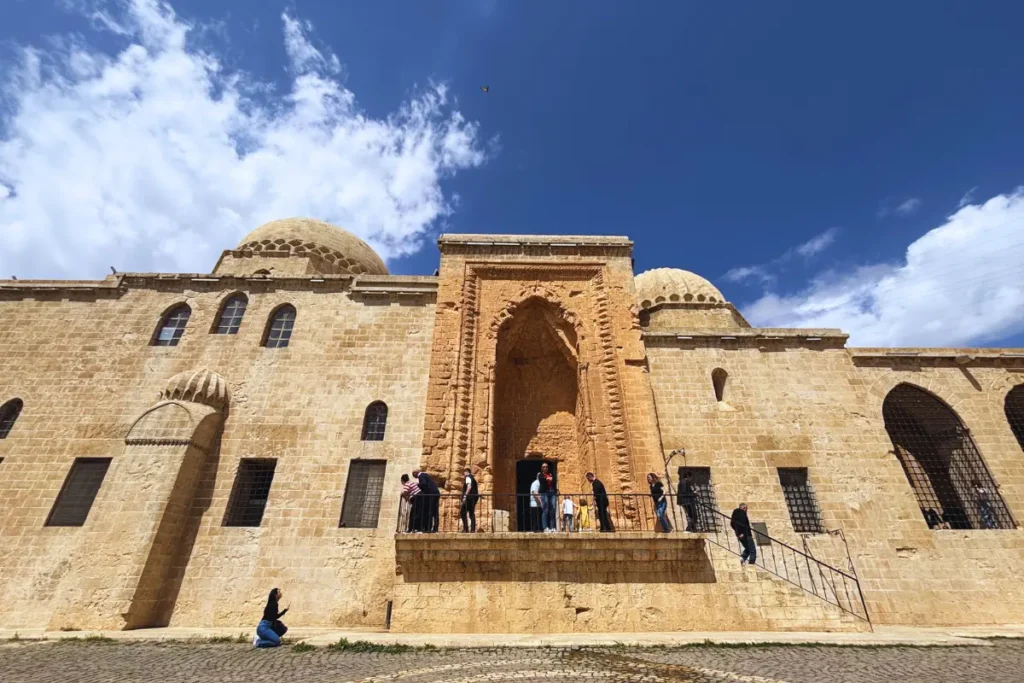
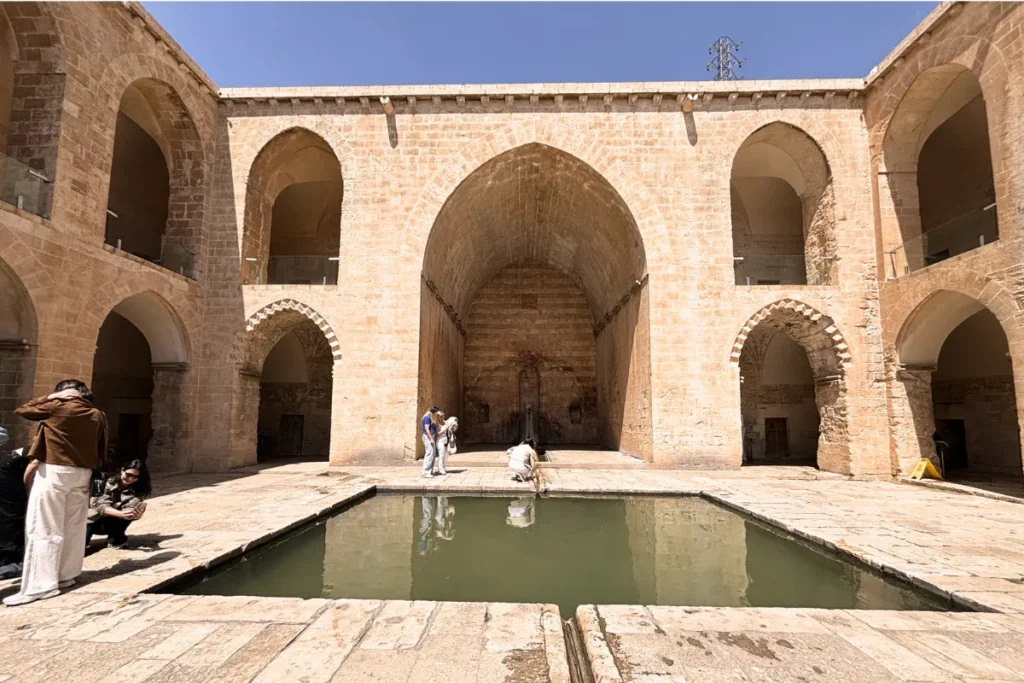
Approaching Mardin from the south, the first major landmark is the Kasımiye Madrasa…a golden limestone structure we recognised immediately from The Gift, overlooking the endless Mesopotamian plains. It was built as both a religious school and a scientific university. It is also a philosophical text written in stone.
The Bloody Wall
Kasım Pasha, the final builder of the madrasa, was assassinated inside the central courtyard, within the deep arched alcove known as the eyvan. His heartbroken sister took his blood-soaked shirt and rubbed it against the porous stone walls while mourning. The people of Mardin believe the blood permanently stained the limestone. Local guides will tell you that even today, centuries later, if you splash water against those specific walls of the eyvan, faint reddish-brown stains emerge from the rock. We were told this as fact by someone who believed it as fact, and in Mardin, the distinction between belief and fact is handled with more care than in most places.
The Fountain That Maps Human Life
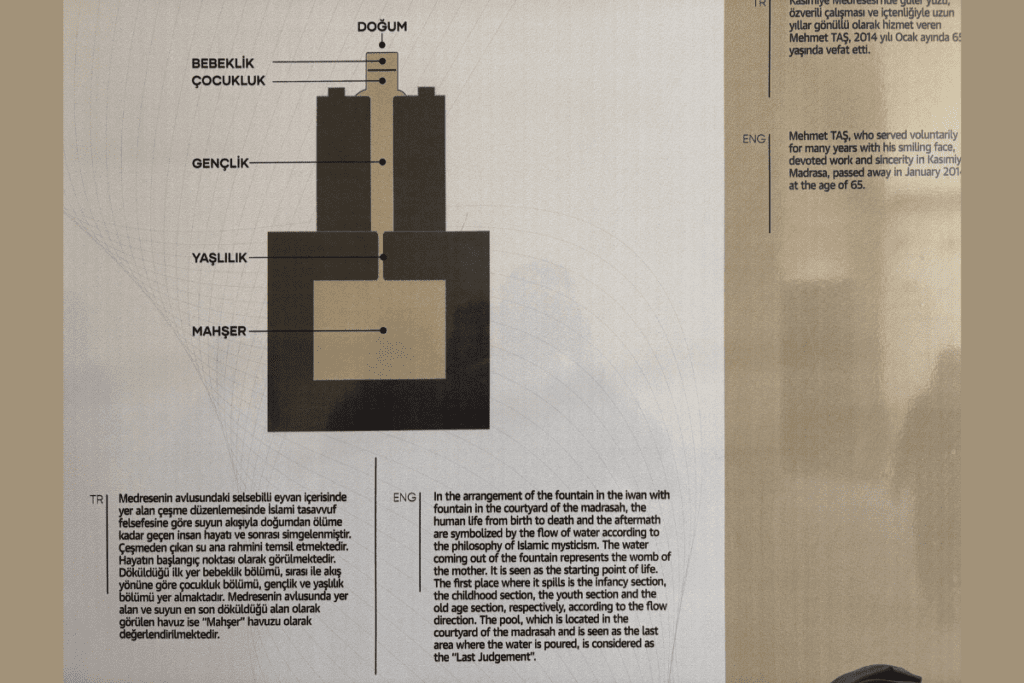
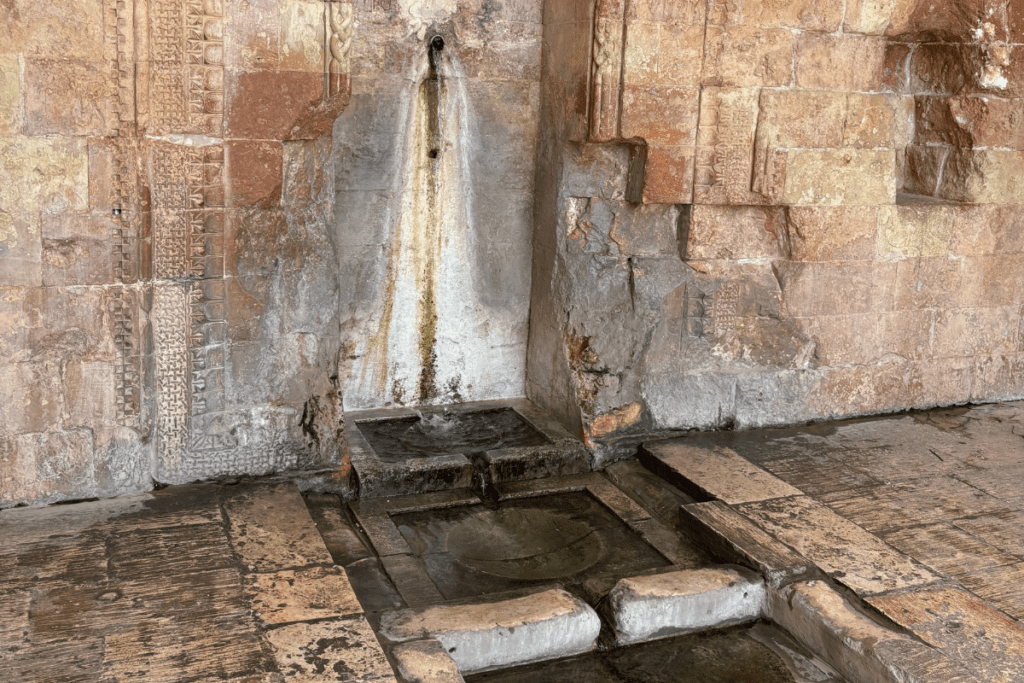
The central courtyard features a fountain engineered as a Sufi metaphor for human existence. Water gushes from a hidden funnel in the stone wall, representing the sudden, chaotic moment of birth. It flows down a smooth, long channel, representing childhood, youth, and maturity. It pours into a wide pool, representing old age and the accumulation of memories. Finally, it drains through a remarkably narrow slit, representing death and the transition across the Sırat…the razor-thin bridge in Islamic and Sufi tradition that leads from this world to eternity.
We stood beside this fountain for a long time. The metaphor is not subtle. It is not trying to be. It is trying to be accurate. Whether it succeeds is a question the fountain asks and the visitor answers.
The Humility Doors and the Scientific Classrooms
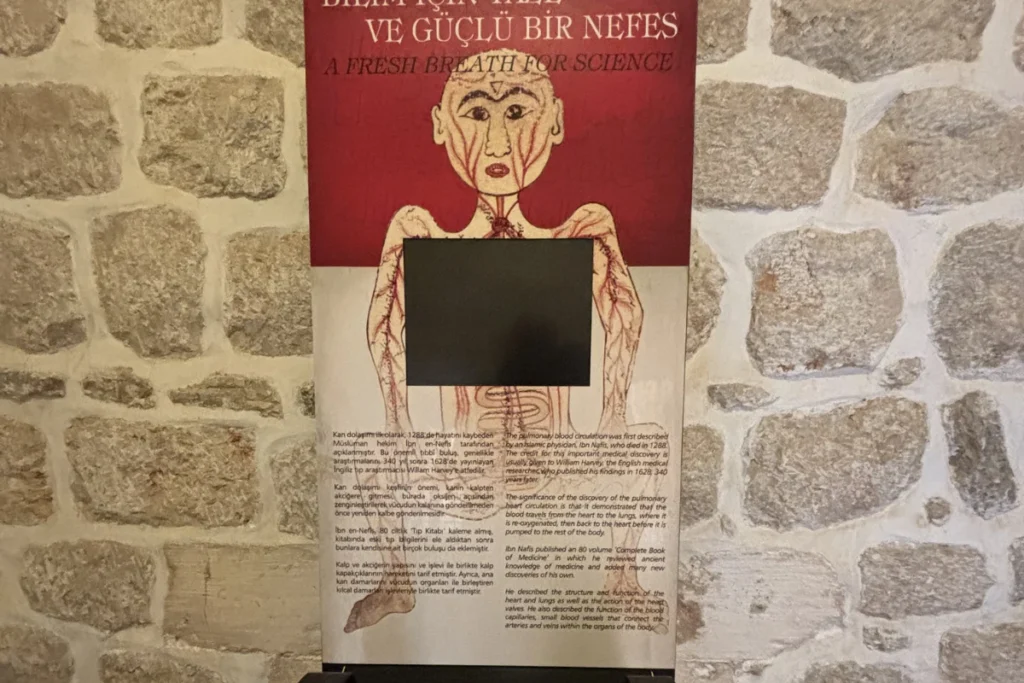
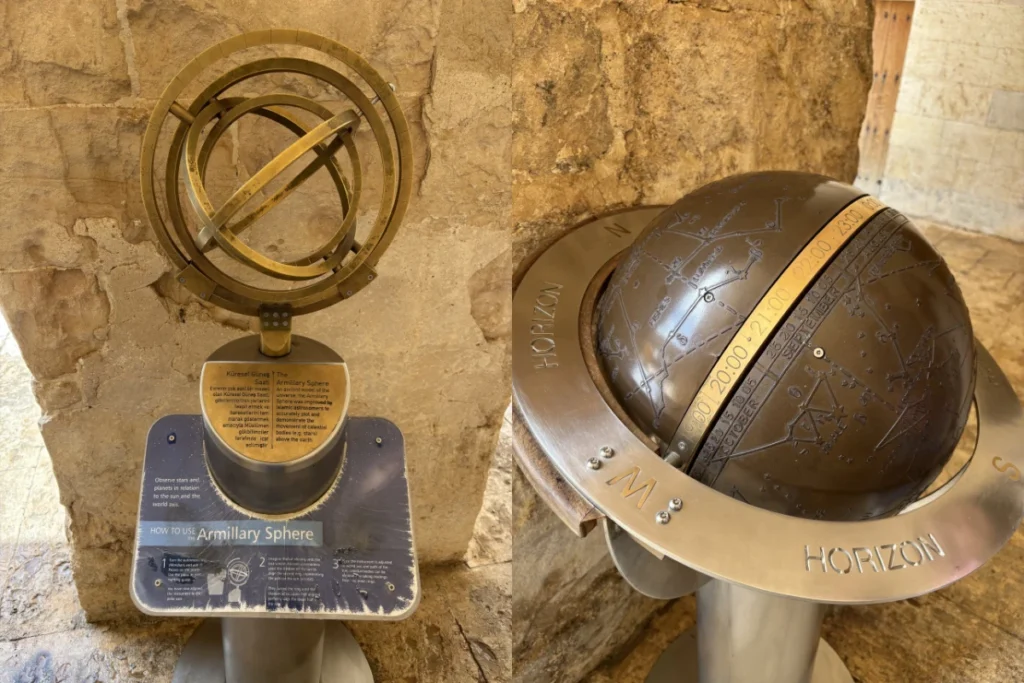
Across the complex’s 23 historic classrooms, the stone doorways are built to just over one metre high. Every student, regardless of wealth, stature, or royal lineage, was forced to bow their head in absolute humility before entering to receive knowledge. Architecture that physically enforces a philosophy.
The symbols carved above each doorway still indicate whether mathematics, chemistry, astronomy, or spiritual sciences were taught inside. Kasımiye was not only a religious school. It was one of the most advanced scientific universities of the medieval Islamic world, built high on the mountain slope to function as an astronomical observatory. The finest minds gathered here to map the stars, practise medicine, and calculate advanced mathematics. The cosmos and the sacred were not separate disciplines.
The Zinciriye Madrasa: The View From the Edge of the World
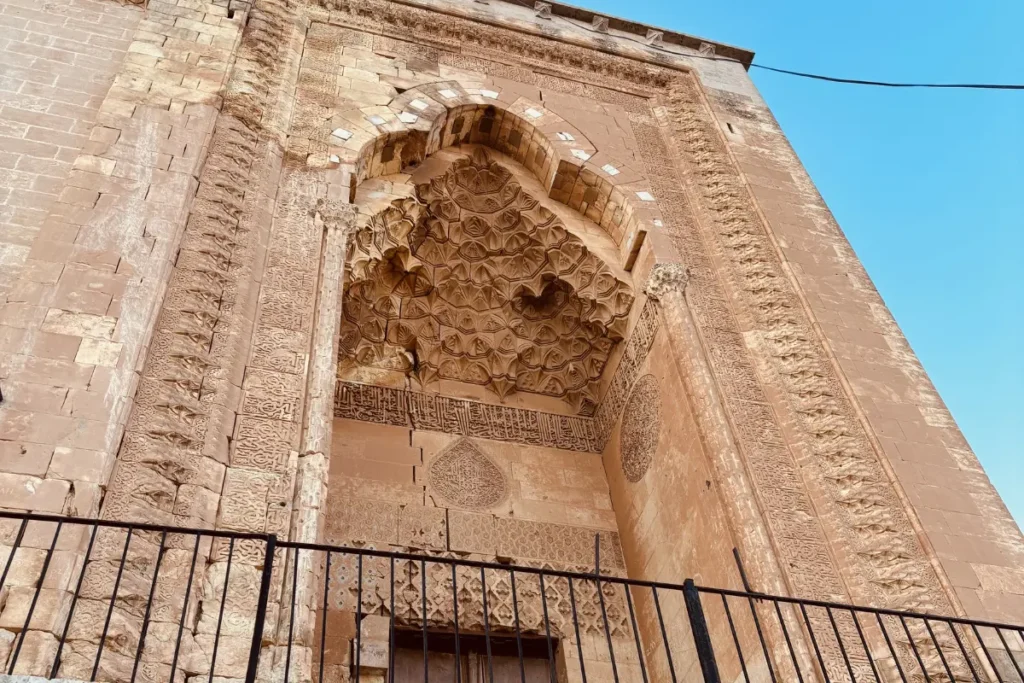
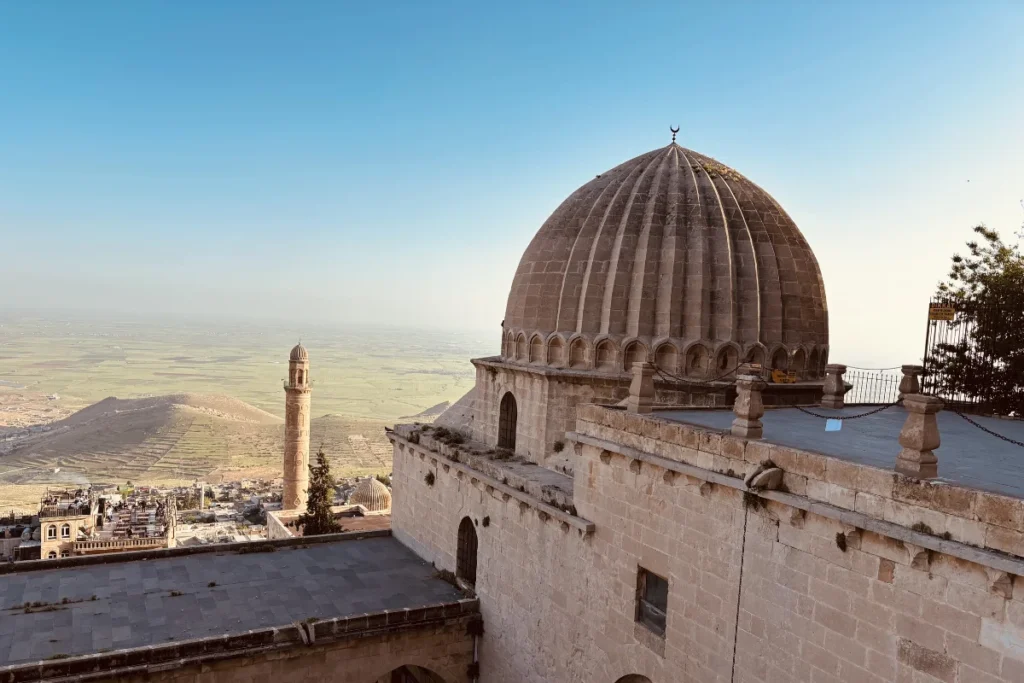
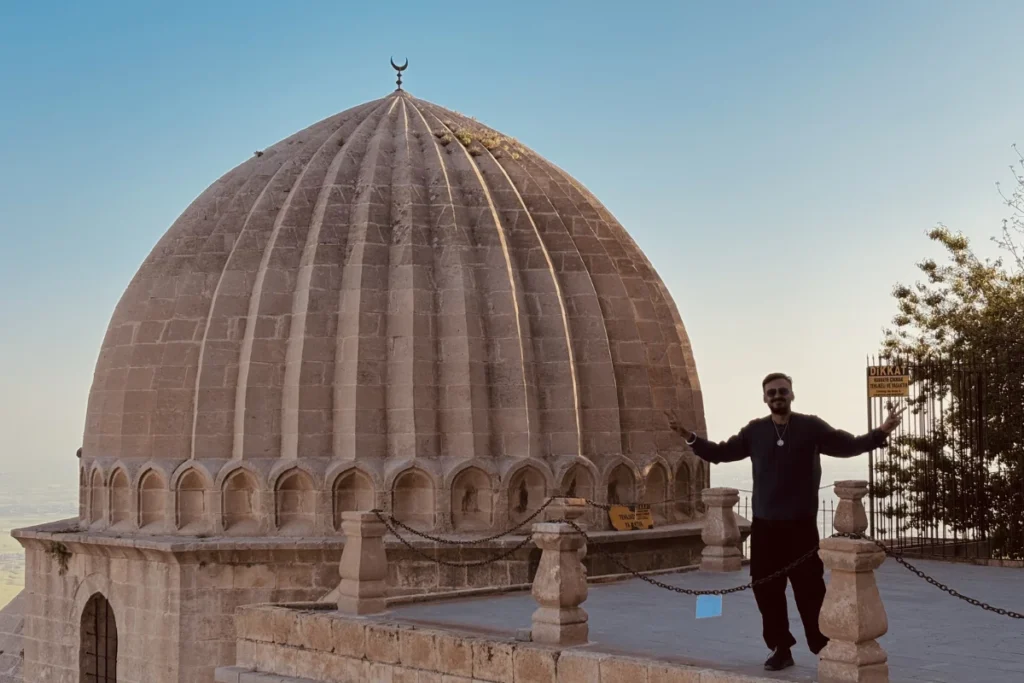
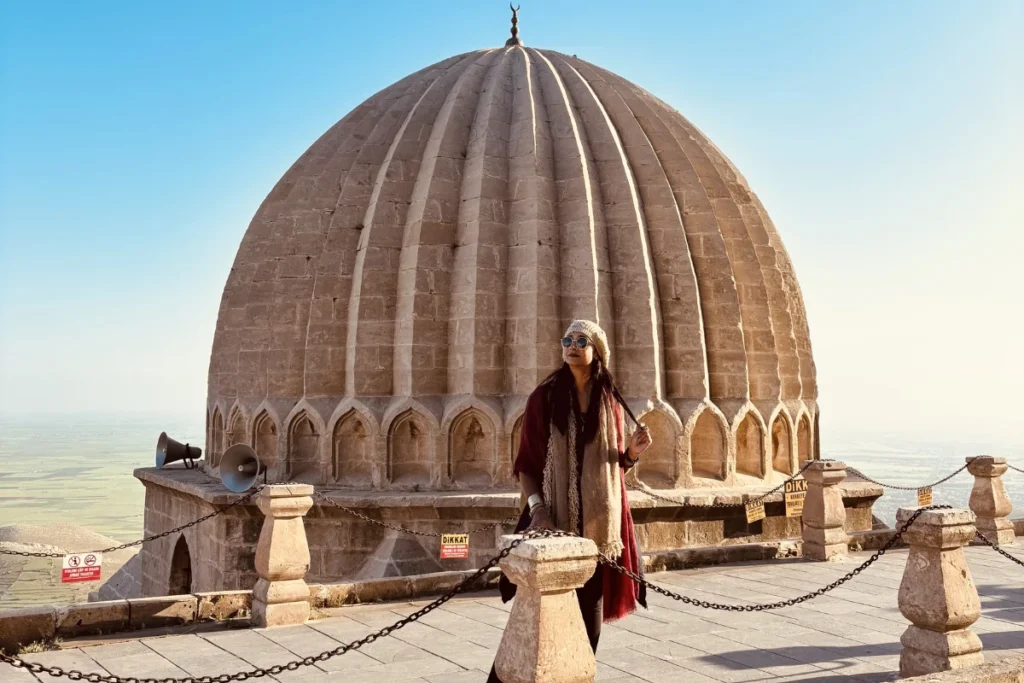
Late in the afternoon, we climbed the steep, winding stone stairs from old Mardin up to the Zinciriye Madrasa, officially the Sultan İsa Medresesi. Completed in 1385, it sits directly beneath the cliffs of Mardin Castle, its sliced, fluted domes visible from across the city.
The name Zinciriye means “Madrasa of the Chain.” Two legends explain it. The first: a massive iron chain once stretched between the two domes, acting as a metaphysical lightning rod to absorb bad luck, negative vibrations, and evil spirits before they could strike the city. An ancient iron ring remains embedded in the western dome — locals say it was the original anchor point. The second: the chain hung over the central courtyard and possessed divine consciousness. It would hang perfectly still for a truthful soul. It would swing violently if a liar walked beneath it.
The Tragedy of Sultan İsa
The history is deeply moving. Sultan İsa commissioned the madrasa as his eternal monument, including a mausoleum chamber where he intended to be buried. In 1401, Timur (Tamerlane) marched his armies into Mesopotamia and captured Sultan İsa. In a cruelty that reads like mythology, Timur imprisoned the Sultan inside the very building he had built, forcing him to look out through the stone arches at the vast plains he no longer ruled.
Sultan İsa was eventually killed elsewhere and never buried in the tomb he designed for himself. Walking through that empty mausoleum chamber today, knowing the builder intended it for his own eternity and was denied it, evokes something that guidebooks do not usually prepare you for.
The Architecture of Heaven
The madrasa is built into a steep mountain cliffside across two terraced levels. The lower level, with heavy star-vaulted ceilings, represents the material world. The upper level, where student cells open directly to the sky, represents the heavens. Students lived on this upper terrace so they could step outside at night to observe the movements of the stars over the Mesopotamian desert.
The View
We climbed to the upper roof terrace just before sunset.
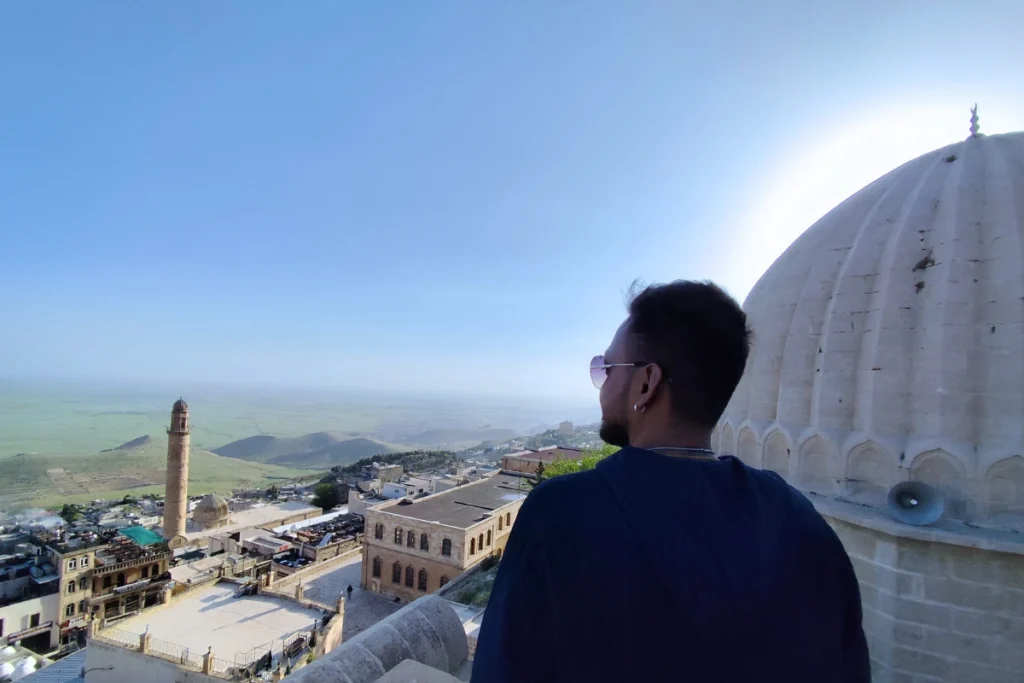
The view was the most dramatic we experienced across 17 days of driving through Turkey. The golden, terraced city dropped away beneath our feet. The Mesopotamian plain stretched endlessly into a flat, shimmering horizon. The Syrian border sat somewhere in that shimmer, approximately 20 kilometres south. The sky was enormous.
It felt like looking over the edge of the world.
Old Mardin at Night
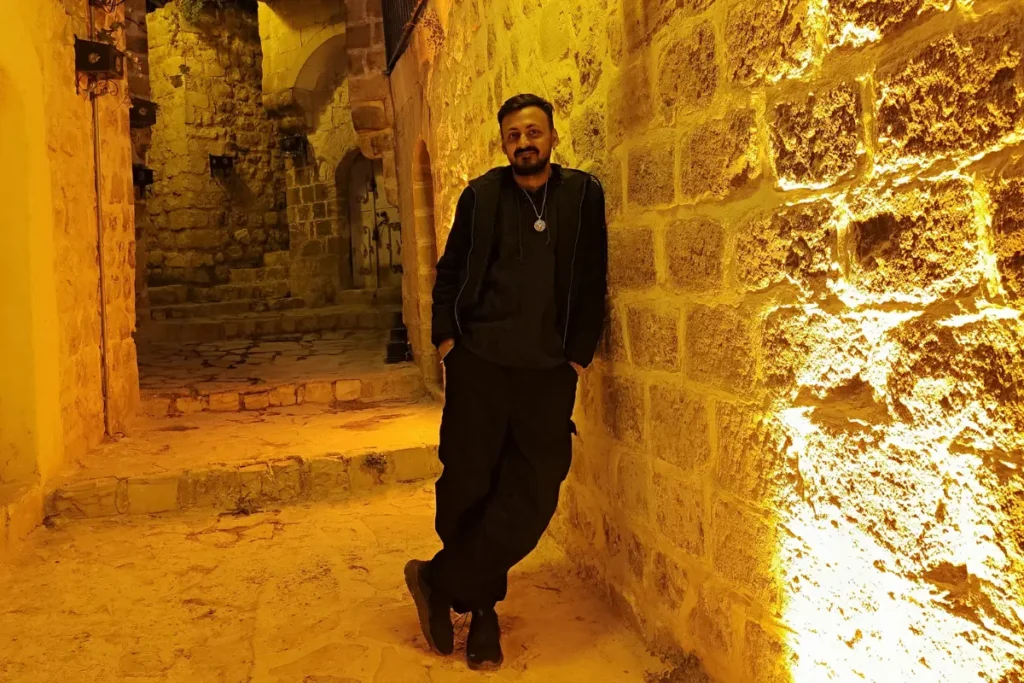
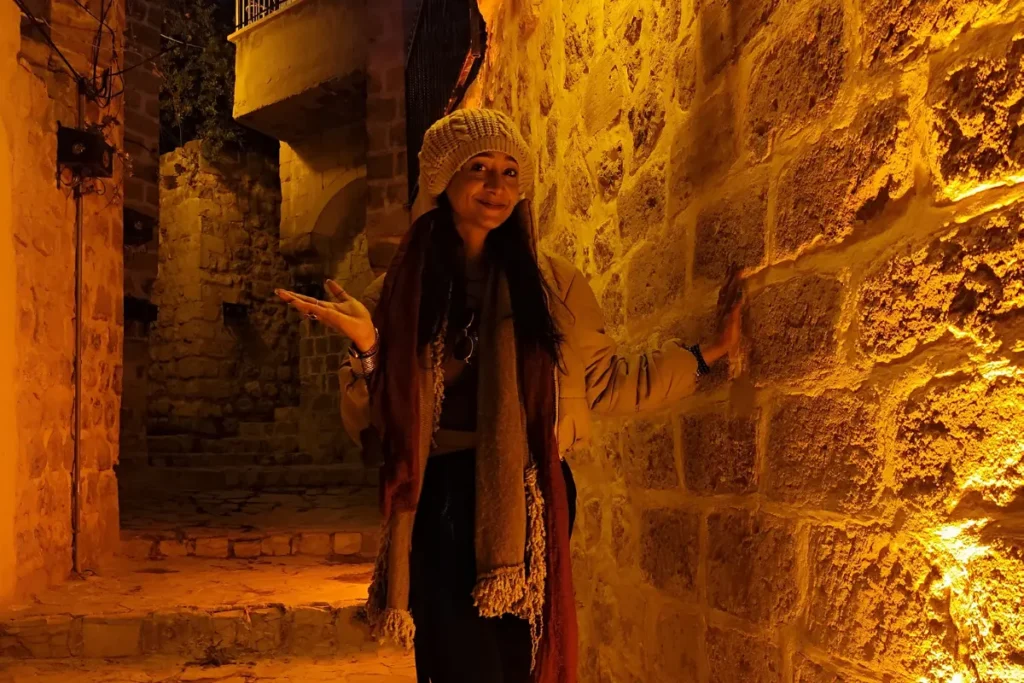
After the Zinciriye sunset, we explored the narrow, bustling streets of the old town centre. Mardin at night carries a different energy from the silent archaeological sites we had spent the previous week exploring. The air fills with scents from the soap shops. Market stalls overflow with silver jewellery, regional chocolates, traditional sweets, spices, and the famous local blue-shelled almonds that are unlike anything we have tasted.
For dinner, we kept things simple: grilled chicken, rice, and fresh flatbread at a local spot. Budget-friendly and exactly what nine days on the road had made us want.
We walked back to Edo Evleri Mardin through the narrow alleys below the main street. Walking through old stone passages at night, with the dim lighting casting shadows on walls that have stood for centuries, was its own kind of experience. The city feels alive in a way that has nothing to do with nightlife and everything to do with accumulated time.
Our cave hotel (TRY 1,190 per night in April 2025) had a historic cave kitchen with ancient utensils still in place, and portraits of Shahmaran on every wall. The architecture, the golden stone, the terraced layout — it reminded us immediately of the heritage look of Rajasthan back home. We mentioned this to each other independently, without prompting. The parallel was that strong.
How to Visit Mardin
From Şanlıurfa: Approximately 180 km, two to two and a half hours by car. The most common pairing in southeastern Turkey itineraries.
From Mount Nemrut (as we drove): Approximately 270 km, three and a half hours. We drove from Karadut Pension through mountain roads, arriving in the early afternoon and stopping at Dara before entering the city. This was a part of our 14 day road trip across Turkey.
From Diyarbakır: Approximately 95 km, one and a half hours by car. Diyarbakır has a domestic airport with regular flights from Istanbul and Ankara.
From Istanbul: Domestic flights to Mardin Airport (approximately two hours). Alternatively, fly to Diyarbakır and drive.
Getting around Mardin: The old town is walkable but built on a steep hillside. Climbing to Zinciriye or Mardin Castle requires genuine physical effort on winding stone stairs. The streets are narrow enough that cars cannot access most of the historic centre.
Combining with Dara: Visit Dara in the morning before the lunch break closes the gated sections, then enter Mardin in the early afternoon. This is what we did and the sequence works perfectly.
What It Costs
All “we paid” figures are from our April 2025 visit. Current estimated prices are provided for planning. Verify all rates before you travel…entry fees and accommodation in Turkey shift regularly.
| Item | We Paid (Apr 2025) | Estimated Now | Notes |
| Dara archaeological site entry | Free | Free – verify | Gated sections close 12–1 PM for lunch; verify current status |
| Kasımiye Madrasa entry | Free | Free – verify | Entry has historically been free; may change |
| Zinciriye Madrasa entry (two people) | ~TRY 100 | TRY 100 – 200 | ~50 TRY per person at time of visit; fees reviewed periodically |
| Accommodation — Edo Evleri cave hotel (per night) | TRY 1,190 | TRY 1,500 – 3,000 | Authentic cave hotel; Shahmaran portraits on the walls; historic cave kitchen |
| Dinner — local restaurant (two people) | ~TRY 200–300 | TRY 300 – 500 | Grilled chicken, rice, flatbread; significantly cheaper than tourist-facing restaurants |
Mardin is one of the most affordable cities in Turkey for the depth of experience it provides. The cave hotel, the madrasas, the ancient city of Dara, and the old town evening walk together cost less than a single observation deck ticket in Dubai. Prices are rising as the city gains visibility…verify before you travel.
Before You Go: What Actually Matters
- One day is not enough, but it is what most travellers have. We covered Dara, Kasımiye, Zinciriye, and the old town evening walk in one day and one night. The Syriac Christian monasteries…Deyrulzafaran and Mor Gabriel…and the full Mardin Castle complex require a second day.
- Reach the Zinciriye roof terrace before 4 PM. The sunset from the upper level is the single most dramatic viewpoint we experienced in 17 days of driving across Turkey. Arrive early enough to explore the interior first, then climb to the roof for the light.
- Dara closes its gated sections at lunch (approximately 12 to 1 PM). The cisterns and tomb areas are locked during this window. Time your visit so you arrive before noon or after 1 PM.
- April is optimal. The days are warm, the evenings are cool, and the light on the golden limestone is extraordinary. Summer brings intense heat to the Mesopotamian plain. Winter can be cold and rainy.
- The Syrian border is close…approximately 20 kilometres from the Zinciriye terrace. At the time of our visit (April 2025), the area was safe and there were no restrictions on tourist access. Verify current security advisories before travelling.
- Mardin is a cultural convergence, not a monoculture. Kurdish, Arabic, Syriac Christian, and Turkish traditions coexist here. The mosques, churches, and monasteries are interspersed. The food reflects multiple cuisines. This multiplicity is Mardin’s distinctive quality and deserves the respect of travellers who recognise they are walking through shared, layered history.
- The Shahmaran imagery is not decoration. It is belief. The copper plates, the silver filigree, the portraits above doorways…treat them with the same respect you would bring to any living spiritual tradition.
“Mardin is the city where mythology has not agreed to become history. The Serpent Queen is still on the doorways. The chain may or may not have swung. And the snakes, according to everyone in the bazaar, are still waiting. If eastern Turkey is not on your itinerary, it should be. Check out our detailed Turkey Travel Guide here.