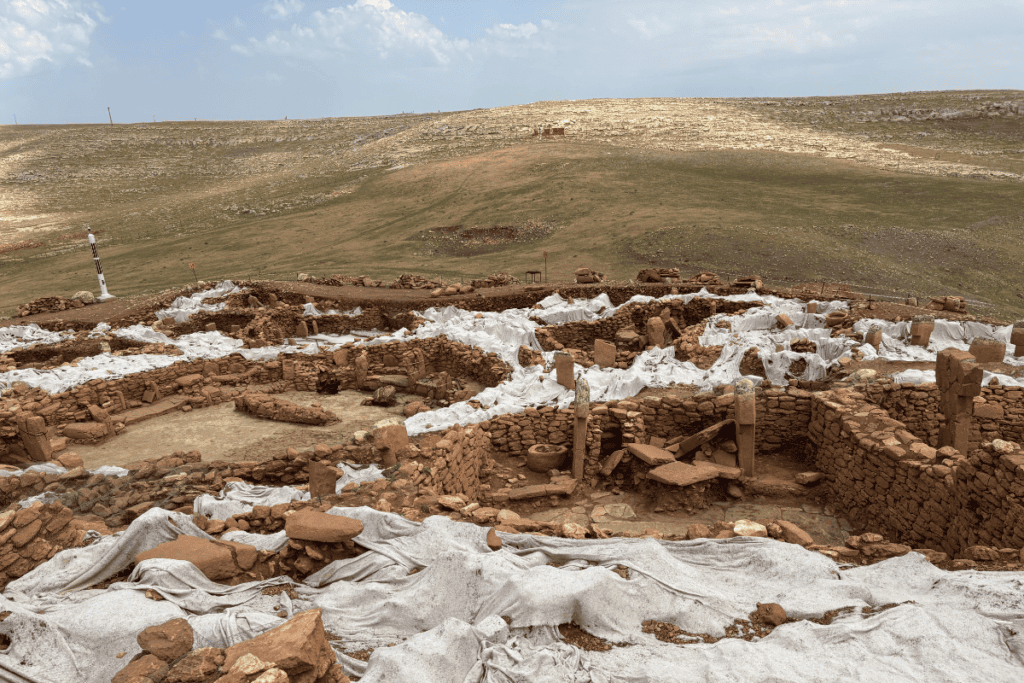
This Karahan Tepe guide is built from our visit on Day 10 of our 17-day Turkey trip, April 26th 2025. We drove from Mardin, stopped at Karahan Tepe first, then continued to Göbekli Tepe and Şanlıurfa.
Everyone in the eastern Turkey circuit tells you to go to Göbekli Tepe. Almost nobody tells you that 46 km to the east, there is another site built by the same culture, containing a chamber unlike anything at Göbekli Tepe, and charging no entry fee.
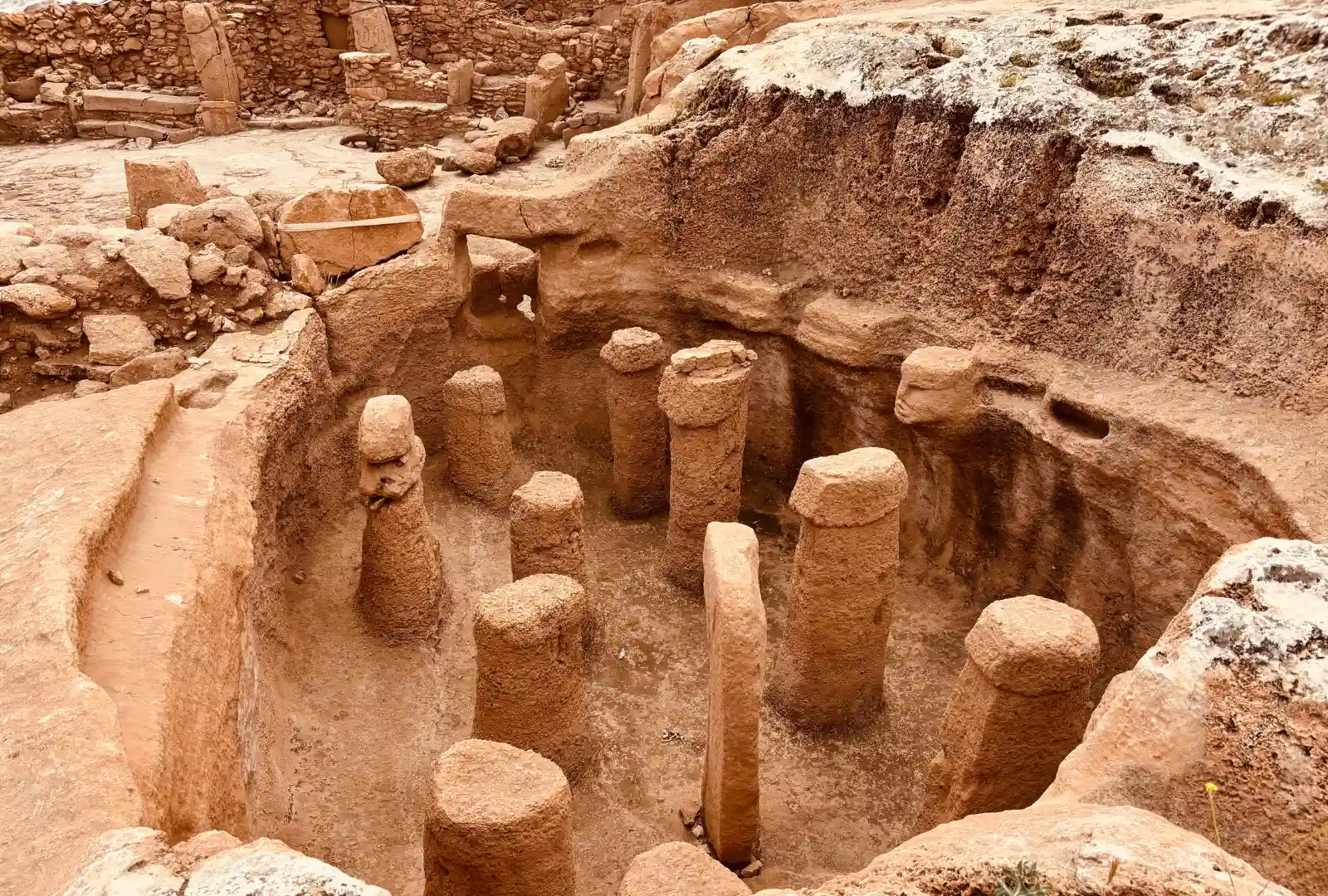
We had read about Karahan Tepe months before the trip. The photographs of its subterranean chamber… the oval depression in the bedrock, the 11 upright pillars, the human face rising from the floor… had stayed with us through all our planning. We chose to visit it before Göbekli Tepe, believing that carrying the context of Karahan Tepe first was the right preparation for a region that rewards prior knowledge.
We were the only people there when we arrived.
No tour buses. No official guide. No visitor centre with a projection show. The site is protected by a low fence and a small ticket booth that was unstaffed during our visit, which is how we know entry was free that morning. The sun was already hot. The landscape… sun-drenched southeastern Anatolian hills, rolling without interruption in every direction… was exactly as ancient as it looked.
We stood at the edge of the chamber and looked down. The photographs had not prepared us for the scale. The human face had not prepared us for the expression. We stayed at Karahan Tepe far longer than we had planned, which is the most accurate thing we can say about it.
“Standing alone on a sun-drenched hill in Anatolia, looking down at stone pillars carved before farming was invented, you realize how much of human history remains unwritten.”
What Is Karahan Tepe?
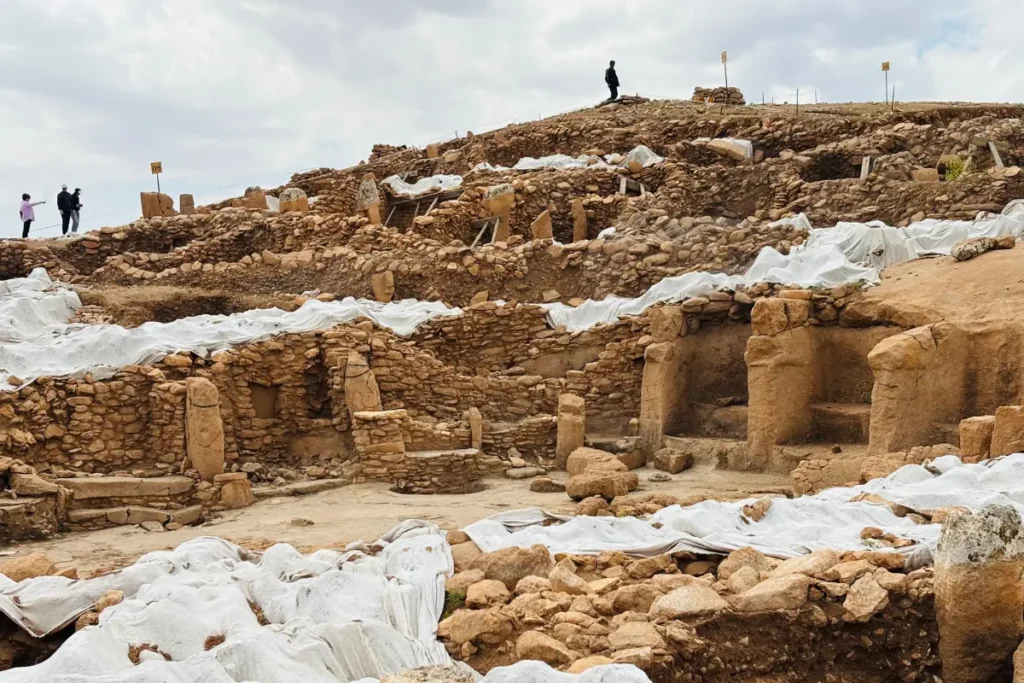
Karahan Tepe is a Pre-Pottery Neolithic archaeological site approximately 46 km east of Göbekli Tepe in the Tektek Mountains (or Tektek Dağları) of Şanlıurfa province. It was identified by archaeologists in 1997 and has been under systematic excavation since 2019, led by Professor Necmi Karul of Istanbul University under the auspices of the Turkish Ministry of Culture.
It is approximately 11,000 years old, placing it in the same period as Göbekli Tepe. It was built by the same culture: nomadic Pre-Pottery Neolithic hunter-gatherers who, contrary to every previous assumption about the preconditions for monument-building, constructed elaborate stone structures before they developed agriculture, pottery, writing, or permanent settled villages.
Karahan Tepe is part of a cluster of related Neolithic sites in the region collectively referred to as the Taş Tepeler (Stone Hills) project. Göbekli Tepe is the most famous. Karahan Tepe is the second most significant in terms of what has been excavated. Sefer Tepe, Harbetsuvan Tepesi, and several other related sites exist in the same landscape. Together they suggest that this region of southeastern Turkey was a centre of Neolithic ritual activity on a scale and for a duration that is still being understood.
What distinguishes Karahan Tepe from Göbekli Tepe is not age or cultural origin… those are shared… but character. Göbekli Tepe is large, famous for its animal carvings, and features a systematic architecture of circular enclosures with T-shaped pillars. Karahan Tepe is smaller and more human-centred. Its most significant feature is not an animal carving or a T-shaped pillar. It is a subterranean oval chamber designed around the human body and the act of spiritual rebirth.
The Timeline That Karahan Tepe Changes
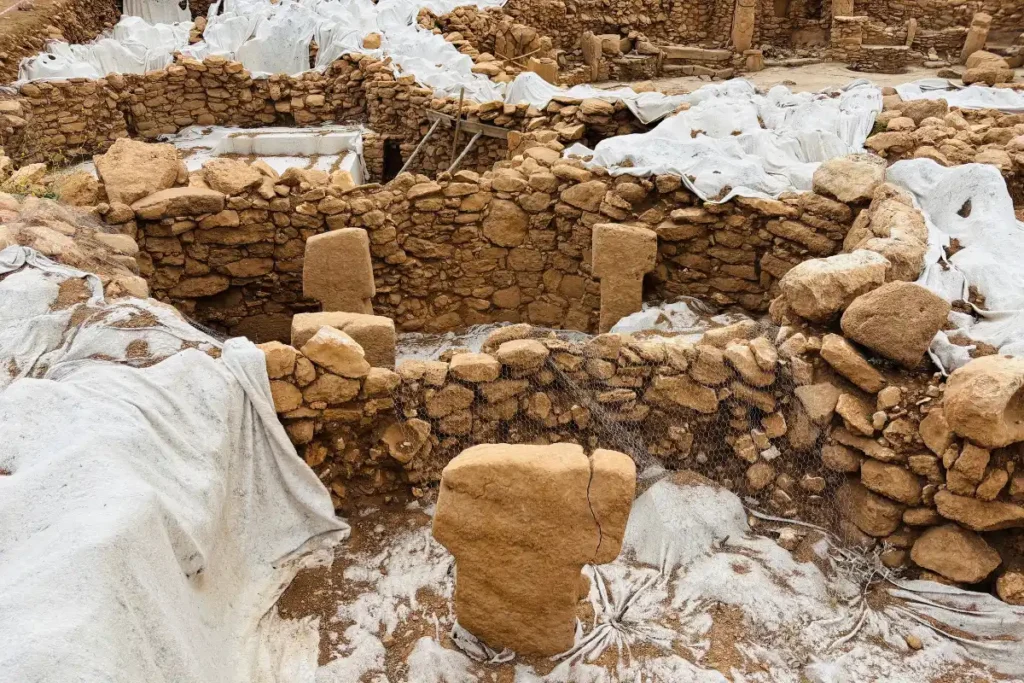
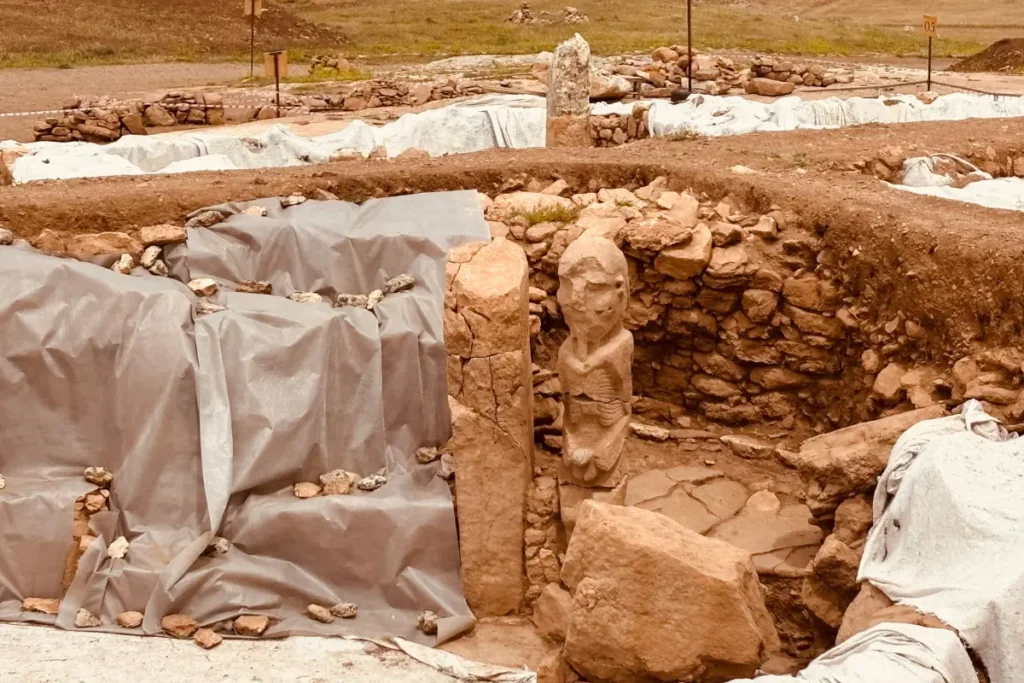
For most of the 20th century, archaeology operated on a clear sequence: humans learned to farm, agriculture created a surplus, the surplus enabled specialisation, and specialisation eventually produced monument-building civilisation. The Neolithic Revolution came first. Everything else followed.
Göbekli Tepe began to challenge this when excavations in the 1990s revealed that the site predated agriculture by at least 1,000 to 2,000 years. The builders were hunter-gatherers. They had no surplus. They had no permanent settlements. They had, apparently, the organisational capacity, the engineering skill, and the spiritual motivation to quarry 10-tonne limestone pillars and arrange them in precise geometric circles on top of a hill, and they did this before anyone in the region had planted a seed.
Karahan Tepe confirms and deepens this revision. The same people. The same period. A different site with a different ritual architecture, suggesting not a single monument but a regional tradition of Neolithic ceremonial construction. The hunter-gatherers of the Harran Plain were not primitive. They were, by any fair measure, architects of the first order, working with materials and at scales that we associate with settled civilisation, without any of the preconditions we thought were necessary.
The question that Karahan Tepe adds to the one Göbekli Tepe already asked: if they built these places without farming, without pottery, without writing… why? The answer the sites themselves suggest, through their architecture, is spiritual. They built these places because they had something they needed to do inside them. Something that required a specific space, specific materials, and specific physical experience.
The chamber at Karahan Tepe is the most direct evidence of what that experience was designed to feel like.
The Chamber: What It Contains and What It Means
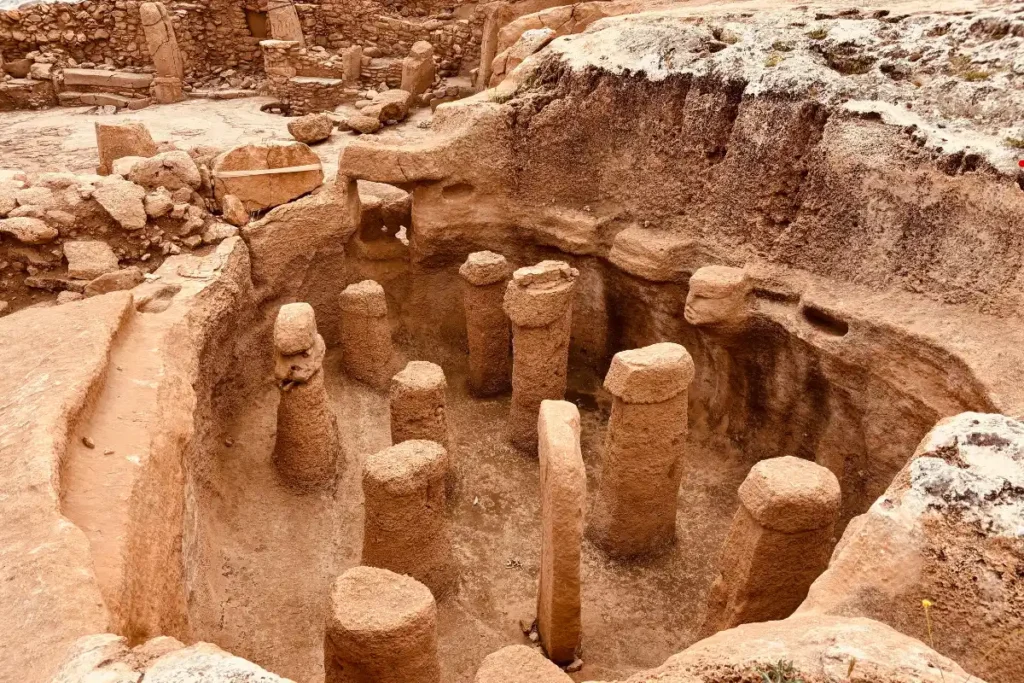
The heart of Karahan Tepe is a subterranean oval chamber carved directly from the living limestone bedrock. It is not built above ground. It is carved downward: an excavation into the earth rather than a construction above it. To enter it, you descend.
Eleven Phallic Pillars
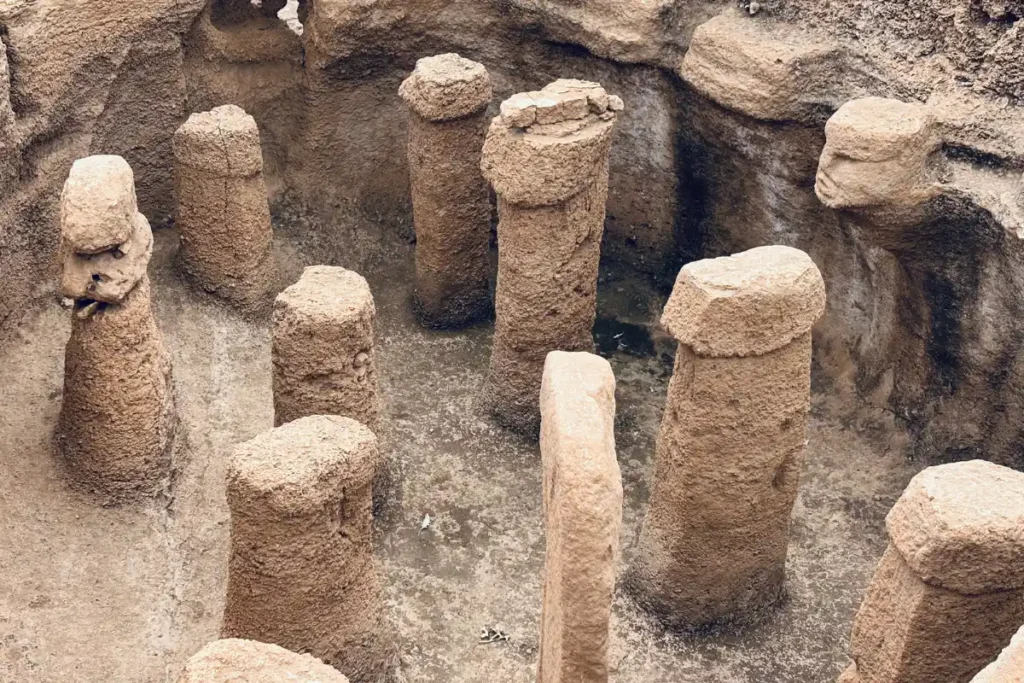
Inside the oval chamber, the builders sculpted eleven upright pillars directly from the bedrock. These pillars are not abstract or T-shaped like the pillars at Göbekli Tepe. They are explicitly phallic: vertical, rounded at the top, and carved to represent masculine generative force.
Eleven of them, arranged in the chamber’s interior. Each one carved from the floor. The number eleven has no obvious structural or mathematical significance. The form is deliberate. The archaeologists who excavated the site classify them as phallic pillars. The builders made them this way with intent.
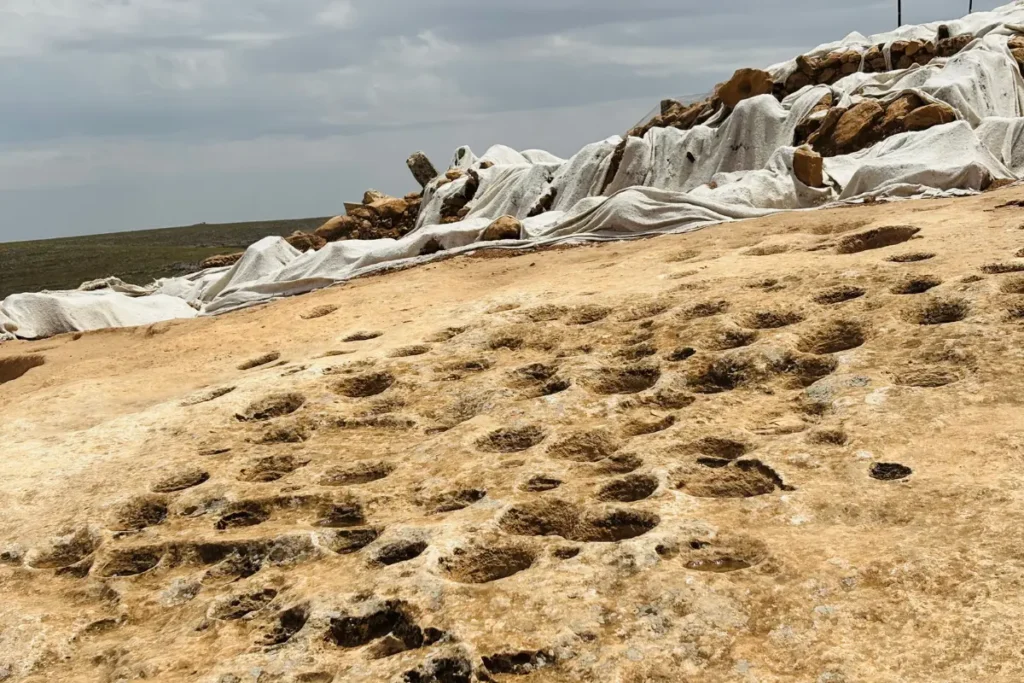
The chamber’s walls show evidence of carved channels in the bedrock floor. These channels are thought to have directed water or a ritual liquid across the stone surface during ceremonies. The chamber, in use, was apparently partially flooded. The initiates who entered it moved through an environment that combined the masculine symbolism of the pillars with the presence of water on the floor.
The Stone Face
At the far edge of the oval chamber, carved into the bedrock wall at floor level, is a human head. Not a T-shaped abstract human figure like the pillars at Göbekli Tepe, which are deliberately faceless. This is a face: a defined nose, a distinct expression, the features of a human being or deity looking out from the stone.
The critical detail is the neck. It does not emerge from a separately placed statue. The neck emerges directly from the bedrock floor, seamlessly, as if the figure is rising out of the earth itself. The head appears to be in the act of emergence: not placed here, but growing from the ground.
Looking down into the chamber from the rock edge, with the eleven pillars surrounding this figure and the carved channels running across the floor, the composition becomes readable. Something is being born. The chamber is the womb. The face is the thing being born. The pillars and the water are the conditions of the birth.
“At Göbekli Tepe, humanity represented itself through abstract, faceless T-shaped pillars. Here at Karahan Tepe, someone carved a visage with eyes, a nose, and intent… the earliest moment in human art where the species stopped looking at animals and turned the chisel on itself.”
The Crawlway
On the far side of the chamber, opposite the main entry, a narrow opening was carved through the rock. Narrow enough that a person must crawl through it. Tight enough that the passage is physically demanding.
Archaeologists interpret this as an intentional design element: the exit from the ritual chamber. Initiates who entered the chamber by descent, moved through the environment of the eleven pillars, the water, and the stone face, and then exited not by the way they came but by crawling through the narrow hole. The crawl physically enacts the act of birth: the tight passage, the darkness, the emergence on the other side.
The sequence was designed as an experience. Descent into darkness. The ritual environment inside. The crawl toward light. Emergence on the other side as something changed. The chamber is not a building in the conventional sense. It is a machine for producing a specific internal experience in the human being who moves through it.
We stood at the rim of the chamber and looked down at this sequence. The chamber, the pillars, the face, the crawlway. We did not go inside. The site is protected and descent into the chamber is not permitted for visitors. But standing above it and reading the sequence was enough to understand what the builders intended. This is the most direct physical evidence of shamanic initiation ritual surviving anywhere in the Neolithic archaeological record.
“Eleven thousand years ago, before cities or written language existed, someone engineered a space designed not to shelter the human body, but to fundamentally alter the mind of the person passing through it.”
The Intentional Burial
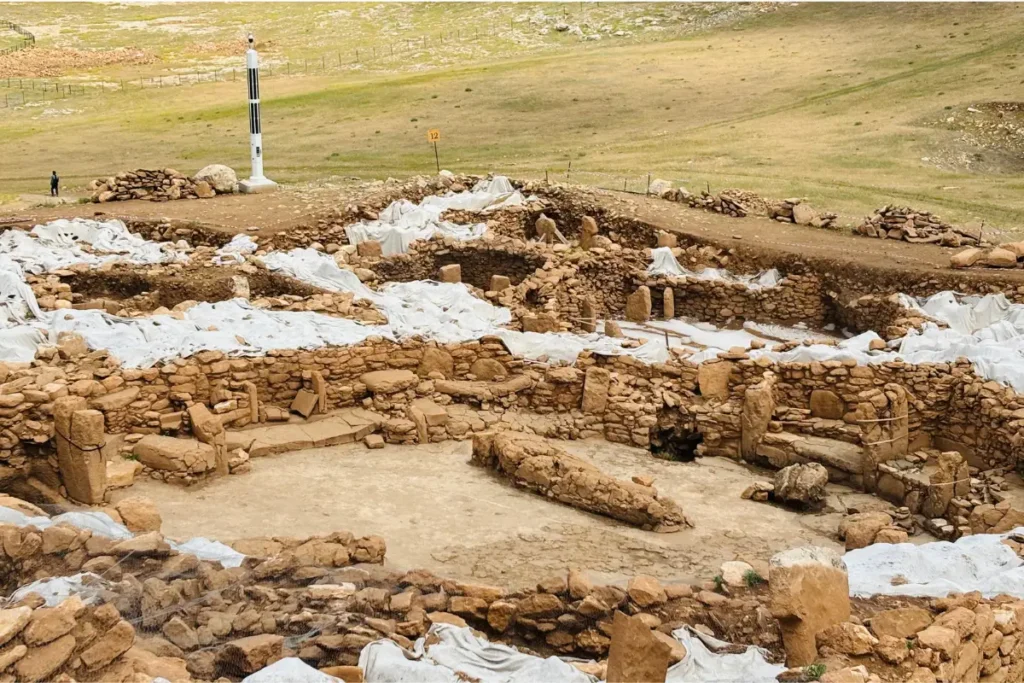
Karahan Tepe was not abandoned. It was buried.
This is the detail that makes it qualitatively different from an archaeological site that was simply lost to time. At some point, after centuries of use, the people who built and used Karahan Tepe made a deliberate decision to fill in the chambers. They brought in dirt, gravel, and debris. They covered the pillars, the face, the channels, the crawlway. They sealed the space.
This pattern of intentional burial is shared with Göbekli Tepe and with several other sites in the Taş Tepeler cluster. The people who built these spaces also preserved them, not by maintaining them but by burying them. The burial prevented erosion, looting, and destruction. Whether it was also a ritual act… the closing of a sacred space with the same intentionality as its opening… is a question the excavations have not definitively answered.
What the intentional burial produced is 11,000 years of preservation. The chamber and the face and the crawlway survived beneath the earth until 21st-century excavators removed the covering. They were waiting.
We stood above them on April 26th, 2025. That morning, the only people at the site. The Anatolian sun was already overhead. In the southeastern hills around us, nothing had changed in the landscape that would allow you to date the morning to any particular century.
Karahan Tepe vs Göbekli Tepe: Why Both Matter
| Karahan Tepe | Göbekli Tepe | |
| Age | ~11,000 years (Pre-Pottery Neolithic) | ~11,500 years (Pre-Pottery Neolithic) |
| Builders | Same culture of nomadic hunter-gatherers | Same culture of nomadic hunter-gatherers |
| Entry fee | Free (April 2025) | 1,840 Lira for two (April 2025) |
| Famous for | Subterranean phallic chamber, stone face, crawlway | T-shaped animal-carved pillars, circular enclosures |
| Atmosphere | Intimate, eerie, human-centred | Vast, spectacular, cosmic-scaled |
| Visitor count | Very low. We were alone. | High. International tourist site. |
| What it shows about the builders | Their ritual understanding of the human body and spiritual transformation | Their astronomical knowledge and relationship to the animal world |
| Intentionally buried? | Yes | Yes |
Visit Karahan Tepe first. The experience of the intimate, human-centred chamber prepares you for the cosmic scale of Göbekli Tepe. Reversed, Göbekli Tepe’s grandeur can make Karahan Tepe feel anticlimactic. It is not. It is stranger and more unsettling. But you need to arrive at it with the right expectations, and the right expectations require understanding what it is before you see it.
What We Noticed as Indians
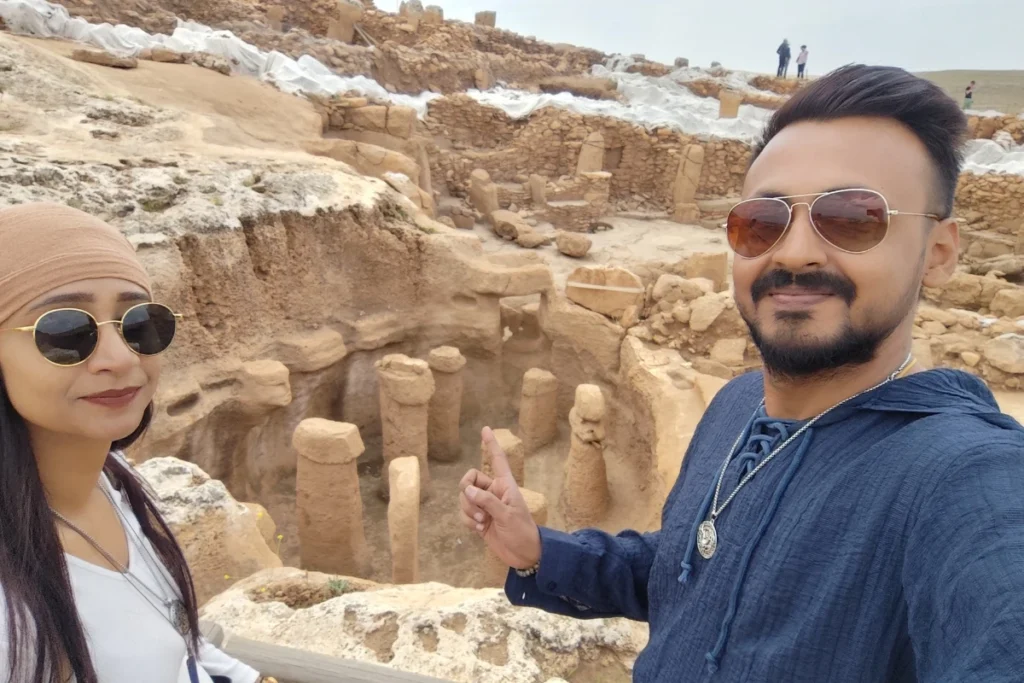
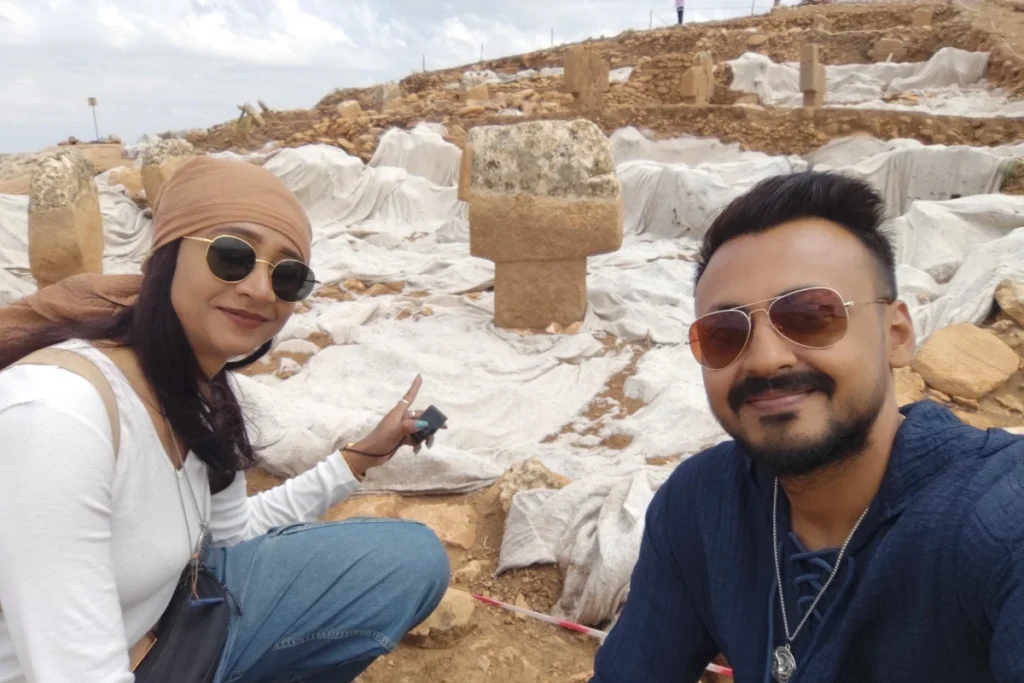
We want to be precise about how this section is framed. The observations below range from well-documented historical parallels to personal observations that mainstream archaeology treats as coincidence. We are sharing them as they were: things that stopped us mid-thought while standing above an 11,000-year-old chamber in southeastern Turkey.
The Chamber and the Garbhagriha
Every Hindu temple, regardless of size or regional tradition, contains a garbhagriha: the innermost sanctum, literally ‘womb chamber’ in Sanskrit. It is the dark, small, enclosed space at the heart of the temple, where the deity’s image is housed and where the divine is considered most present. Access is restricted. The darkness is intentional. The etymology is precise: garbha (womb) + griha (house).
The Karahan Tepe chamber is carved downward into bedrock, oval-shaped, intentionally dark, with restricted access, and interpreted by archaeologists as a space for ritual transformation or initiation. The leading theory calls it a shamanic womb of rebirth. The architectural logic is identical to the garbhagriha: small, dark, downward, the site of transformation.
Whether this represents direct cultural connection, parallel spiritual logic, or convergent architectural intuition is genuinely debated. The mainstream position is convergence: humans in different times and places arrive at similar ideas independently because similar ideas solve similar problems. We do not dispute this. We only note that standing above the Karahan Tepe chamber with garbhagriha in mind, the similarity was too specific to pass without acknowledgement.
The Crawlway and the Symbolic Birth
The narrow crawlway at Karahan Tepe, through which initiates exited the chamber after the ritual, is interpreted as a physical enactment of birth: the tight passage, the darkness, the emergence. This concept… a physical space that the human body must navigate in a way that enacts the act of being born… appears in multiple Indian traditions. Cave temples, narrow temple passages, the act of circumambulating a tight corridor: the principle of the body’s physical experience encoding a spiritual meaning appears consistently in Indian sacred architecture.
We are not claiming these are the same tradition. We are noting that when we understood the crawlway, we understood it immediately. The concept was not foreign.
The Vedic Parallels at Göbekli Tepe
While Karahan Tepe gave us a striking encounter with a ritual womb space, the broader region holds even more intriguing parallels. In our guides to Göbekli Tepe and the Şanlıurfa Museum, we explore these connections further… from the Vulture Stone’s striking resemblance to the Garuda motif, to circular pillar layouts that evoke the Shiva Lingam, and the Nevalı Çori stone head featuring a braided tuft identical to a traditional Brahmin sikha.
At Karahan Tepe, what we noticed was simpler and more physical: a womb chamber. A ritual of descent, transformation, and emergence. A face rising from the earth. These are not unique to Indian spiritual tradition. But they are deeply present in it. And standing above the chamber on that April morning, we felt at home in a way that the word ‘foreign country’ does not accommodate.
How to Visit
- Karahan Tepe is approximately 46 km east of Göbekli Tepe, and approximately 150 km from Mardin. From Şanlıurfa, the drive is approximately 40 to 50 minutes. A car is essential. The site has no public transport connection and the surrounding landscape is largely rural.
- Entry was free during our April 2025 visit. This may change as the site becomes better known and infrastructure is developed. Verify before traveling.
- Visit Karahan Tepe before Göbekli Tepe, not after. The intimate scale and the specific character of the chamber prepare you for Göbekli Tepe’s grandeur. Reversed, the experience is less rich.
- The chamber cannot be entered by visitors… it is protected by fencing. You view it from the rock edge above. The view from above is sufficient: the chamber’s layout, the pillars, and the face are all visible from the rim. Bring a camera with a zoom capability.
- The site has no shade. Bring water and sun protection. The Anatolian hills in April are already hot by mid-morning. We were there before 10 AM and were grateful for arriving early.
- There is no visitor centre or guide at the site, unlike the elaborate setup at Göbekli Tepe. Read about the site thoroughly before arriving. The experience of standing above the chamber changes completely when you know what you are looking at.
- The drive between Mardin and Karahan Tepe passes through southeastern Anatolian landscape that is worth allowing time for. We drove from Mardin at 9 AM and reached Karahan Tepe first, then Göbekli Tepe, then Şanlıurfa by 4-5 PM. That sequence, across approximately 200 km, is a full and complete day.
What It Costs
| Item | Cost (April 2025) |
| Karahan Tepe entry | Free |
| Göbekli Tepe entry, two people | 1,840 Lira / INR 4,230 / 50–52 USD |
| Ramin Hotel, Şanlıurfa (per night) | 1789 Lira / INR 3,647 / 48–50 USD |
| Şanlıurfa Museum, two people (next morning) | 871 Lira / INR 2,003 / 24–25 USD |
Karahan Tepe is free. This is one of the most significant archaeological sites on Earth, and it charges no admission.
“Long before our ancestors planted their first crops or built their first cities, they stood in a dark stone chamber in Anatolia, creating art to make sense of life, death, and rebirth. Karahan Tepe reminds us that the human spirit didn’t evolve after civilisation… it built it.”