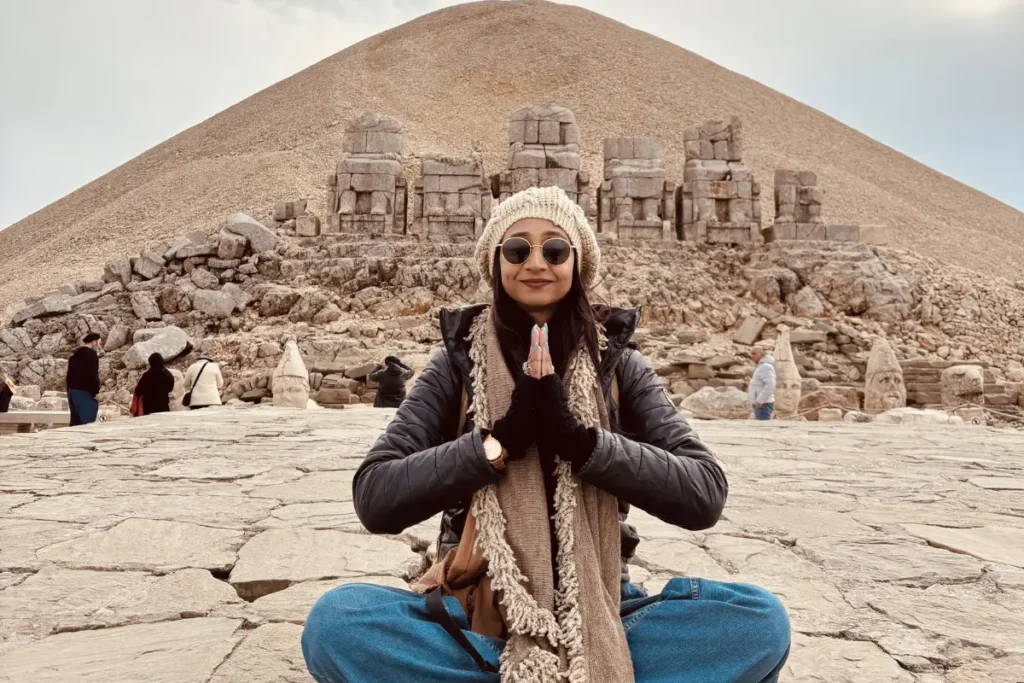
Planning the ultimate Mount Nemrut sunset experience often conjures images of clear skies and glowing golden hour light hitting ancient stone heads. However, mountain weather at 2,134 metres follows its own rules. Our trek to the summit taught us that even when low clouds and shifting fog alter your plans, standing among the colossal statues of Antiochus I at dusk remains one of the most remarkable archaeological encounters in Turkey.
The parking area near the summit of Mount Nemrut sits at approximately 2,000 metres above sea level, with the mountain peak rising to 2,134 metres. The East Terrace, where the colossal stone heads rest on the mountain floor, is a short walk from the upper path drop-off point, a short, uphill, wind-exposed, altitude-affected walk that feels short the way a “quick question” from your manager feels quick.
We arrived in the late afternoon, our legs already unreliable. The long drive from Cappadocia had ended with our tyres losing traction on loose mountain gravel and our arms tired from hours of steering corrections. We stepped out of the vehicle into cold mountain air. Not cool, cold. The kind of bitter chill that enters through your collar and takes up residence between your shoulder blades.
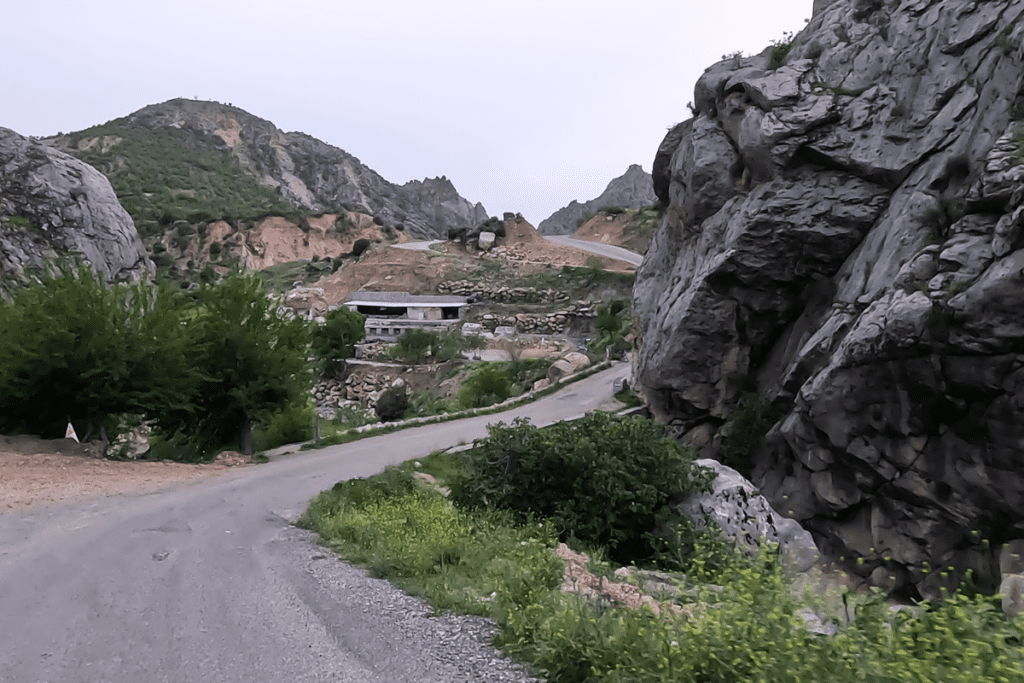
The walking path to the summit terraces climbs steadily over roughly 500 metres. At over 2,000 metres elevation, where the air is noticeably thinner than at sea level, the short incline registers quickly. Our pace slowed, and our breathing became audible. A small group ahead of us moved at the exact same pace, providing the dual comfort of solidarity and proof that the altitude was the main variable.
The clouds were low… grey, shifting, and entirely in charge. They opened and closed around the summit like a curtain operated by an unorganised stagehand. Through one gap: blue sky, distant ridges, and the faint suggestion of the Euphrates River valley far below. Through the next gap: total grey darkness. The world was reduced to the stone path, the cold rocks, and the person walking beside you.
Then the heads appeared.
“The summit doesn’t yield its secrets all at once. At two thousand metres, shrouded in cold cloud, you don’t just view the ancient gods, you wait for them to decide when they want to be seen.”
The Thirty Minutes
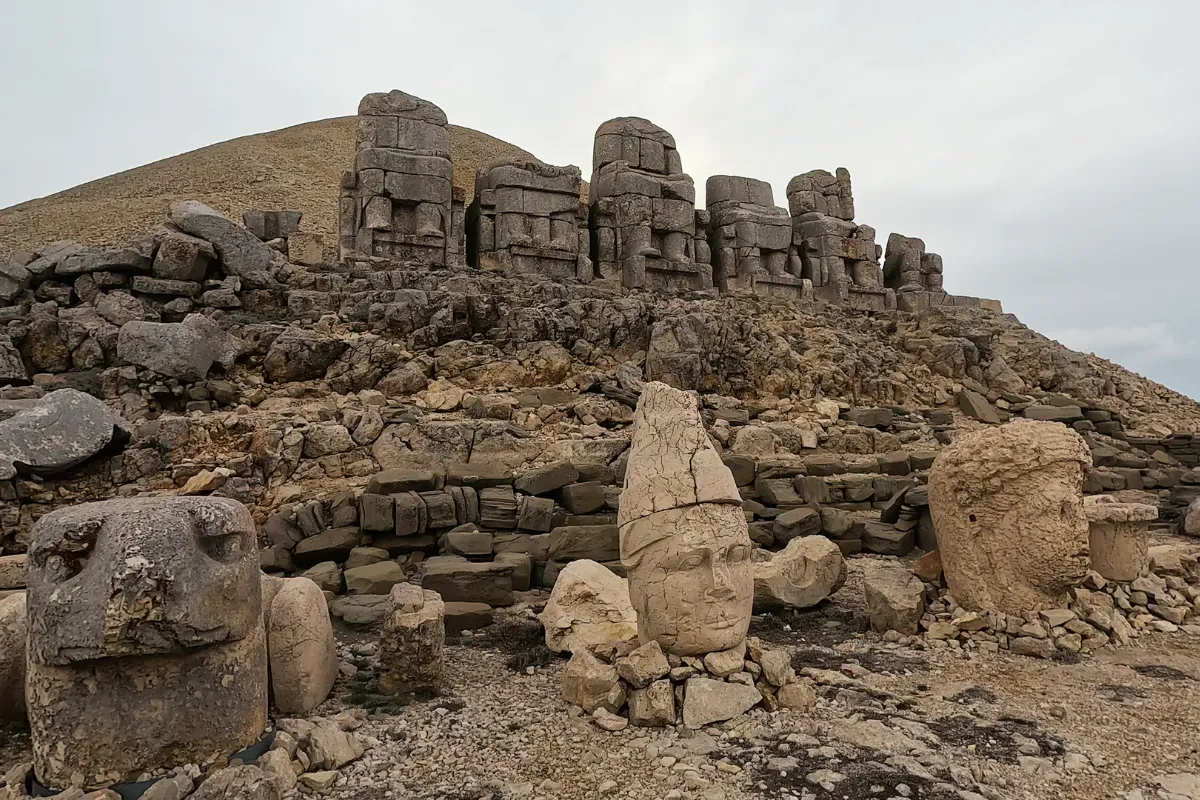
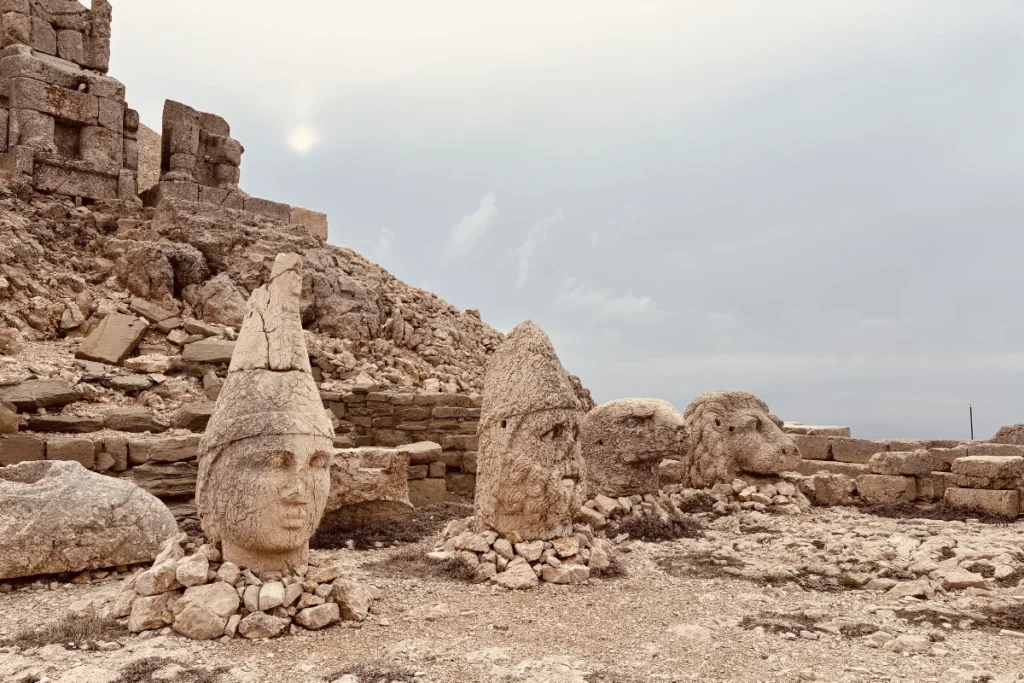
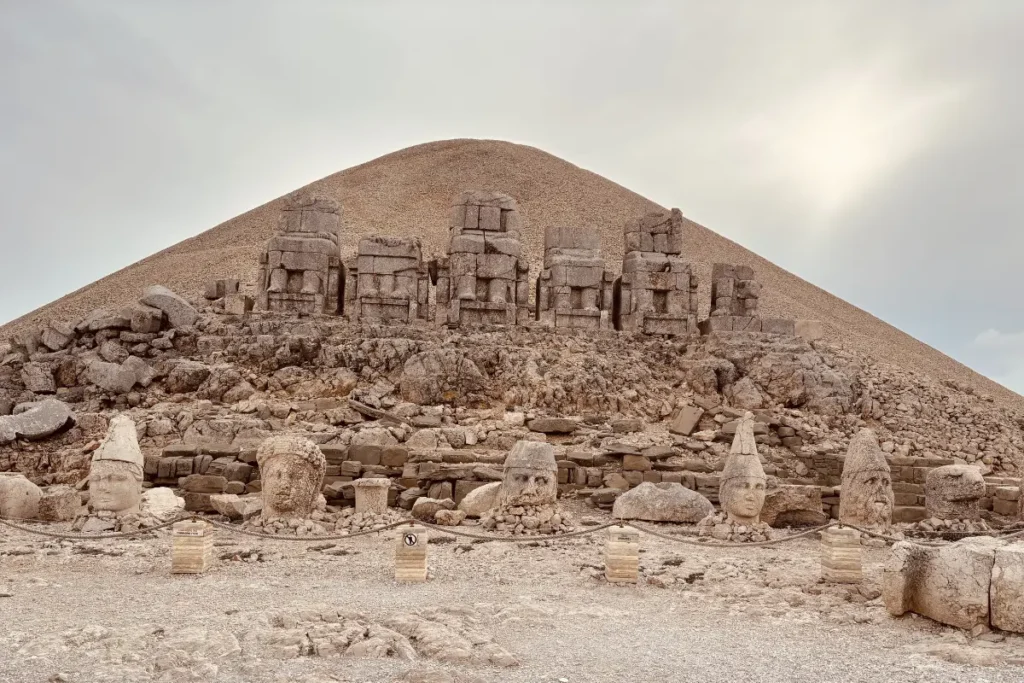
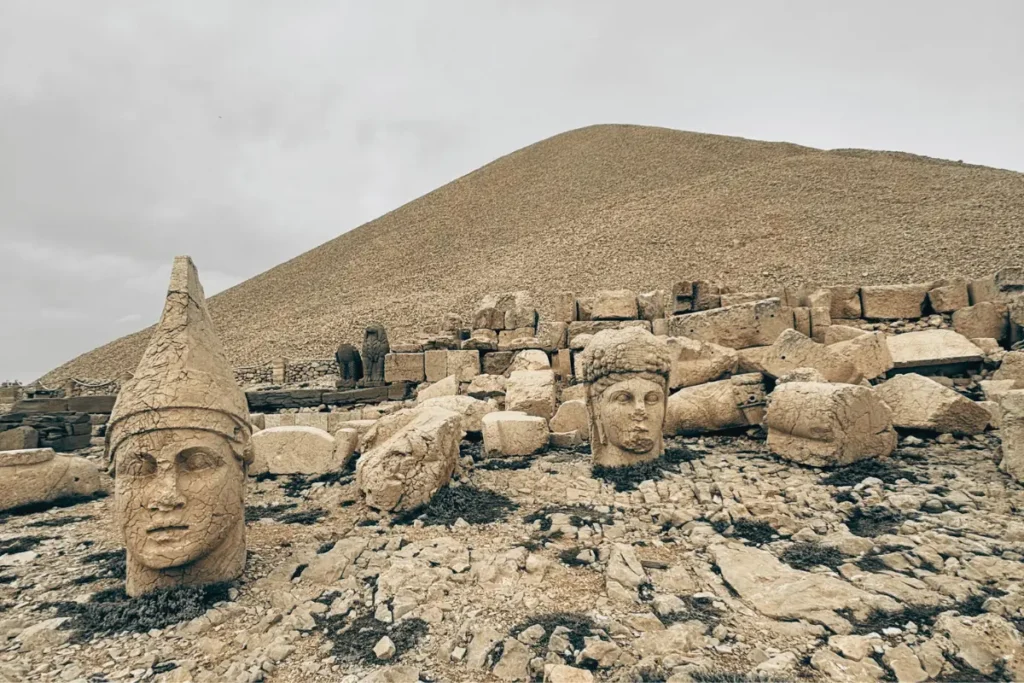
The stone heads of Antiochus I and his Greco-Persian gods sit on the East Terrace in a rough line, detached from their seated bodies. The headless torsos still sit on stone thrones at the rear of the terrace, while the heads… toppled by earthquakes over two millennia… rest on the ground. Each head stands roughly 1.5 to 2 metres tall. Looking at them doesn’t require craning your neck upward; you meet their gaze directly at eye level.
The cloud cover revealed the East Terrace in fragments. A gap would open in the fog and the heads would materialize: first one face, then three, then the full line, each wearing the unbothered expression of a 1st-century BCE limestone carving accustomed to harsh mountain weather. Then the cloud would close again, dissolving the gods back into grey mist while we stood waiting for the next glimpse.
The late afternoon light filtered through the fog, softening the harsh stone surfaces. The carved noses, beards, Persian tiaras, and Greek crowns caught an oblique glow that deepened the shadows in the stone grooves, warming the weathered limestone from dull grey to pale gold.
This on-off quality, the cloud playing editor with our experience, did something that a clear sky would not have. A clear summit delivers the full view immediately and continuously. You see everything. You photograph everything. You process everything in real time. The cloud made us wait for each reveal. The waiting made each reveal sharper. The heads were more vivid after three minutes of grey than they would have been after thirty minutes of uninterrupted visibility.
The light at this altitude and hour was doing specific things. The late afternoon sun, filtered through cloud, softened the stone surfaces. The carved features, the noses, the beards, the headdresses, the eyes, caught oblique light that deepened the shadows in the carved grooves and warmed the limestone from grey to pale gold. The heads are photogenic in any light. In the filtered gold of a cloud-broken late afternoon at 2,100 metres, they are something else. They are faces that appear to be thinking, which is an optical illusion created by shadow geometry, but at this altitude and this hour, the rational explanation feels less relevant than the visual one.
What Sunset at Nemrut Is Not
We need to clarify something: we did not witness the postcard-perfect, clear-sky Nemrut sunset.
The classic version of a Mount Nemrut sunset features unhindered golden-hour light bathing the West Terrace as the sun dips below distant mountain ridges, turning the 2,000-year-old stone heads deep amber and orange.
We visited both the East and West Terraces during our time at the summit, but the mountain weather had other plans. Low-hanging clouds, shifting fog, and severe cold compressed our visibility across both sides. Instead of direct golden light hitting the statues, we experienced indirect illumination, a soft, cloud-filtered glow reaching the stone faces through atmospheric scattering rather than clear sunlight.
We share this because we want to describe the actual experience we had, not the idealized version found on postcards. Viewing both terraces cloaked in mountain fog was dramatic and extraordinary in its own right- the difference between listening to music in a silent hall and hearing it resonate through a gathering storm.
“There is a quiet grace in getting the imperfect version of an iconic place. A clear sky hands you a postcard, but a foggy summit makes you earn every single glance.”
Sunrise vs Sunset
Most guided tours bring visitors for sunrise. The logistics: stay at a guesthouse in Karadut village at the mountain’s base, wake before dawn, drive or walk to the summit in darkness, reach the east terrace before first light, watch the sun rise over the stone heads.
Sunrise has the advantage of timing. The east terrace faces east. Sunrise light hits the heads directly. The colour sequence (grey to pink to gold) plays out on the carved faces with the precision of a show designed for exactly this audience. The dawn cold is severe, but the sunrise compensates.
Sunset has the advantage of solitude. The tour groups come for sunrise and depart by mid-morning. The afternoon summit is quieter. We shared the east terrace with perhaps eight to ten other visitors. A sunrise morning can hold fifty or more, with guides narrating, cameras clicking, and the specific crowd dynamics of a shared spectacle.
Once you reach the summit parking area, visiting both sides is straightforward. A single stone path circles the central burial mound, letting you walk directly from the East Terrace to the West Terrace in minutes. We covered both terraces together during our afternoon visit, watching the shifting clouds wrap around the statues on both sides.
The ideal setup for any traveller is to stay overnight in Karadut. You can visit in the afternoon to easily walk the loop between both terraces for sunset, then return pre-dawn the next morning for sunrise on the East Terrace… giving you two different lightings on the exact same walk.
What to Know Before the Climb
The Cold and Wind: Even in late spring or summer, summit winds are freezing. A windproof jacket, thermal layers, beanie, and gloves are essential.
Altitude Adjustments: The 500-metre walk is steep and taxing at 2,100 metres. Take slow, steady steps.
Cloud Dynamics: Cloud cover on Mount Nemrut shifts constantly. If the summit is foggy when you arrive, wait 10 to 15 minutes; gaps open frequently.
Flashlights: Carry a headlamp or phone light if visiting for sunset. The stone paths down to the parking area are dark and uneven after dusk.
Entrance Fees & Costs:
- Mount Nemrut National Park Ticket: TRY 240–350 / INR 580–850 / USD 7–10 per person.
- Shuttle Bus (Parking to Summit Path): TRY 40–60 / INR 95–145 / USD 1.15–1.75 round-trip.
- Karadut Guesthouse (Per Night): TRY 1,200–2,200 / INR 2,900–5,300 / USD 35–65 including breakfast.
“Two thousand years of weather have softened their edges, but the stone heads of Antiochus still hold their ground. You leave Mount Nemrut cold, breathless, and entirely certain you’ll come back.”