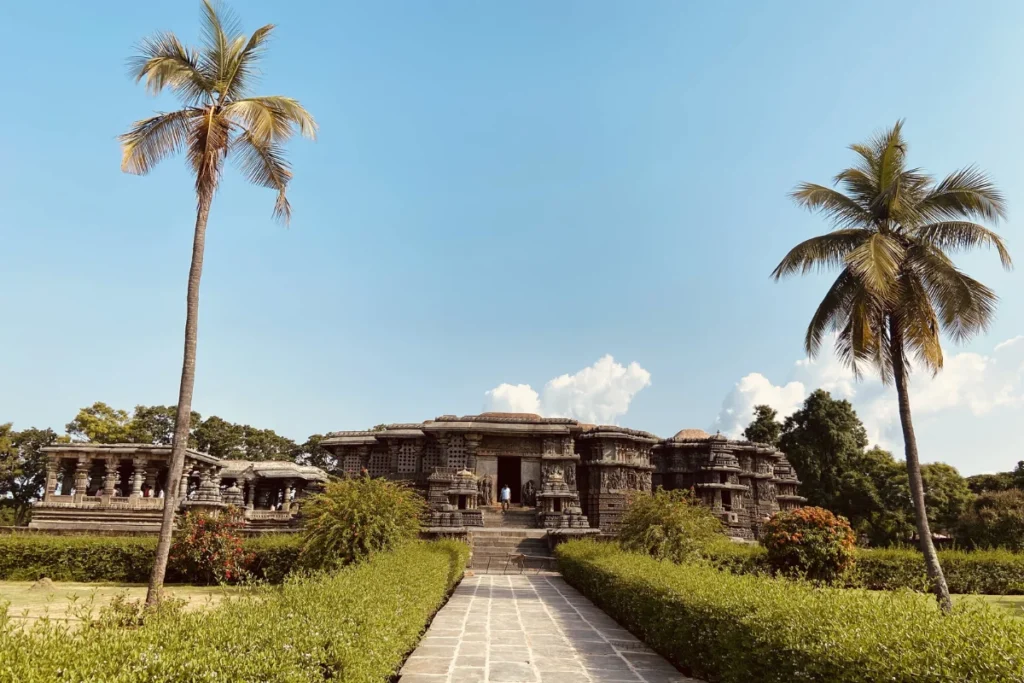
This Chikmagalur and Sakleshpura guide is built from a Hassan-based weekend: one evening at one of the finest Hoysala temples in Karnataka, and one morning covering the haunting gothic ruins of Shettihalli Rosary Church before heading onto the most underrated drive in the Western Ghats.
The standard weekend itinerary from Bengaluru to Hassan takes the highway both ways: fast, direct, functional. Arrive Saturday afternoon. Visit Hoysaleshwara Temple in the evening. Drive home Sunday afternoon. The itinerary works. It misses the second half of why this area is worth the drive.
The second half is the Sakleshpura road.
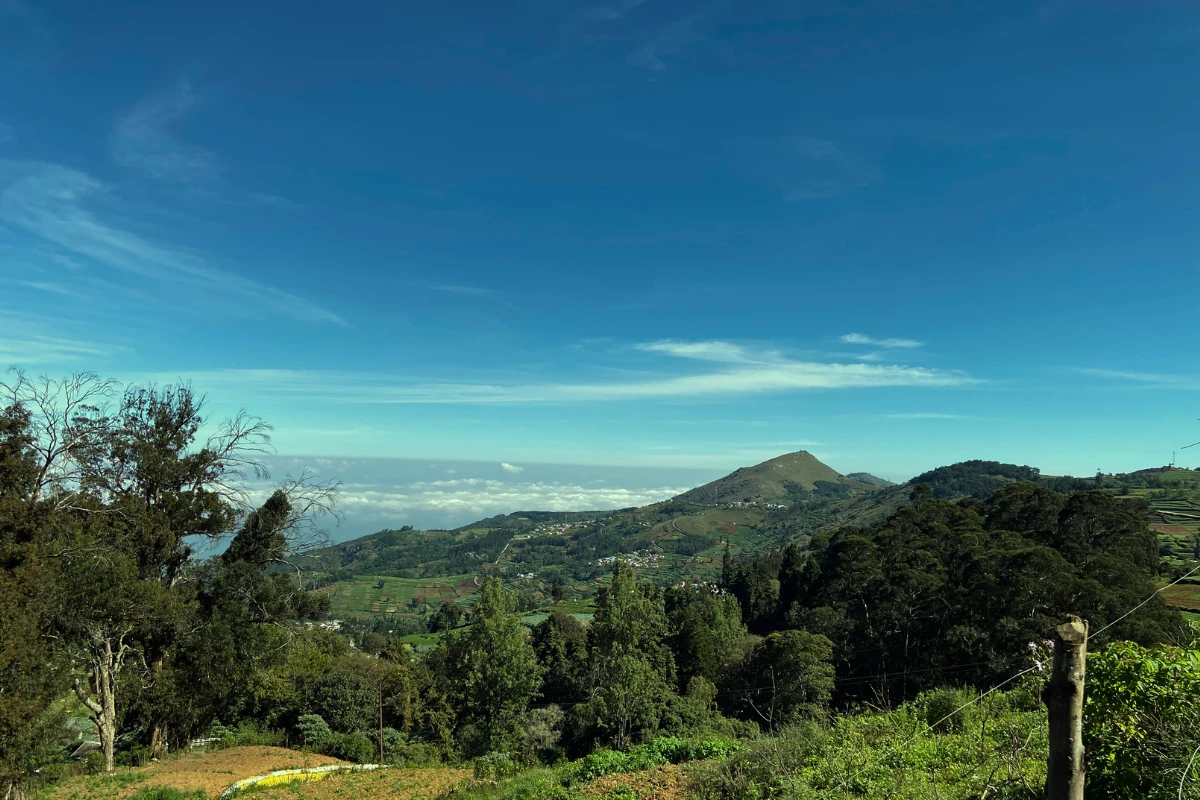
Hassan to Sakleshpura via the scenic route through coffee plantations is approximately 45 to 60 km of road that belongs to a different category from the national highway it eventually rejoins. The road passes through the foothills of the Western Ghats, through coffee and areca nut estates, through villages where stray dogs snooze on the warm asphalt and a herd of cattle constitutes a significant traffic event, and through stretches of road where the canopy closes overhead and the light arrives in fragments through the leaves. We drove it on the morning after the Hoysaleshwara Temple visit and arrived in Sakleshpura with the feeling that we had been somewhere, rather than driven through somewhere.
This article is about that morning.
“Under the high canopy of silver oaks, the coffee estates create a landscape that feels less like farmland and more like an engineered forest… a cool, quiet sanctuary where shade, soil, and altitude dictate the rhythm of the Ghats.”
What Coffee Country Looks Like
The Western Ghats between Hassan and Sakleshpura are coffee country. Not metaphorically. Literally: the hillsides are planted with Coffea arabica and Coffea canephora (robusta) in orderly, closely spaced rows that create a distinct landscape character. The coffee bushes are low, dense, and deep green, growing in the partial shade of taller trees planted specifically to provide the filtered light conditions that coffee requires. The shade trees are typically silver oaks or rainforest species: tall, spreading, with enough canopy to create the filtered-light environment but not enough to block all sun.
The visual result is a specific Western Ghats landscape aesthetic: multiple layers of green at different heights, the low coffee bushes, the mid-height understory, the tall shade trees above, and the hill slopes visible through the gaps between the estates. In the early morning, before the day’s heat flattens the colours, the green of a coffee estate is the most saturated and layered thing in the landscape.
Chikmagalur is the name most associated with this coffee country. The Chikmagalur district, approximately 70 to 80 km northwest of Hassan, is where the majority of Karnataka’s coffee production is concentrated, and where the estate-tourism industry has developed most visibly. Sakleshpura, in the Hassan district, sits at the southern edge of the same coffee belt: the landscape character is identical but the tourism infrastructure is lighter and the roads are quieter.
We drove the Sakleshpura approach rather than the Chikmagalur approach because it was the natural morning route from our Hassan hotel back toward Bengaluru. The road south from Hassan turns west into the Ghats before eventually rejoining the Bengaluru highway. The detour to Sakleshpura and Manjarabad Fort adds time but adds the landscape that justifies the trip.
“Under the high canopy of silver oaks, the coffee estates create a landscape that feels less like farmland and more like an engineered forest—a cool, quiet sanctuary where shade, soil, and altitude dictate the rhythm of the Ghats.”
The Drive: What You Actually Experience
The Village Roads
The route from Hassan toward Sakleshpura, before it reaches the coffee estate landscape, passes through agricultural villages. The road narrows. Houses press close to the asphalt’s edge, and laundry lines stretch between wooden posts. The pace of life immediately adjacent to the road is domestic and unhurried in a way that the highway’s peripheral towns are not.
We stopped the car when a herd of cattle made the road temporarily impassable. This is not a complaint. It is a description of the correct way to experience a village road. The cattle moved on their own schedule. We waited. The waiting produced a minute or two of complete stillness in a place that had no obligation to entertain or perform for us.
The Coffee Estate Roads
After the villages, the road enters the estate landscape. The elevation gains gradually. The road surface may narrow further. On both sides, the coffee bushes close in. The shade trees above create a canopy that turns the road into a tunnel of green.
We stopped when the view opened. We continued when it closed. The drive rewards this approach: the Western Ghats landscape does not reveal itself through windshields at speed. It reveals itself through windows that are open, through stops at clearings, through the willingness to park on a verge when a viewpoint appears without warning.
The coffee flowers, when present (typically January to March), produce one of the most distinctive smells in the Western Ghats: a sweet, jasmine-adjacent scent that permeates the air around a flowering estate at very close range. In May, when we made this drive, the flowers were gone and the berries were not yet ripe. What remained was the visual quality of the landscape without the added olfactory layer. That was enough.
The Wildlife Probability
The Sakleshpura area lies within or adjacent to forested corridors that connect the Western Ghats protected areas. Leopards, elephants, and gaur (Indian bison) are present in the surrounding forests. We did not see any on this drive. The probability of encounters on the plantation roads is lower than on dedicated forest drives, but not zero. Keep speed low and pay attention to the road edges, particularly in the early morning.
Shettihalli Rosary Church: The Gothic Ruin in the Backwaters
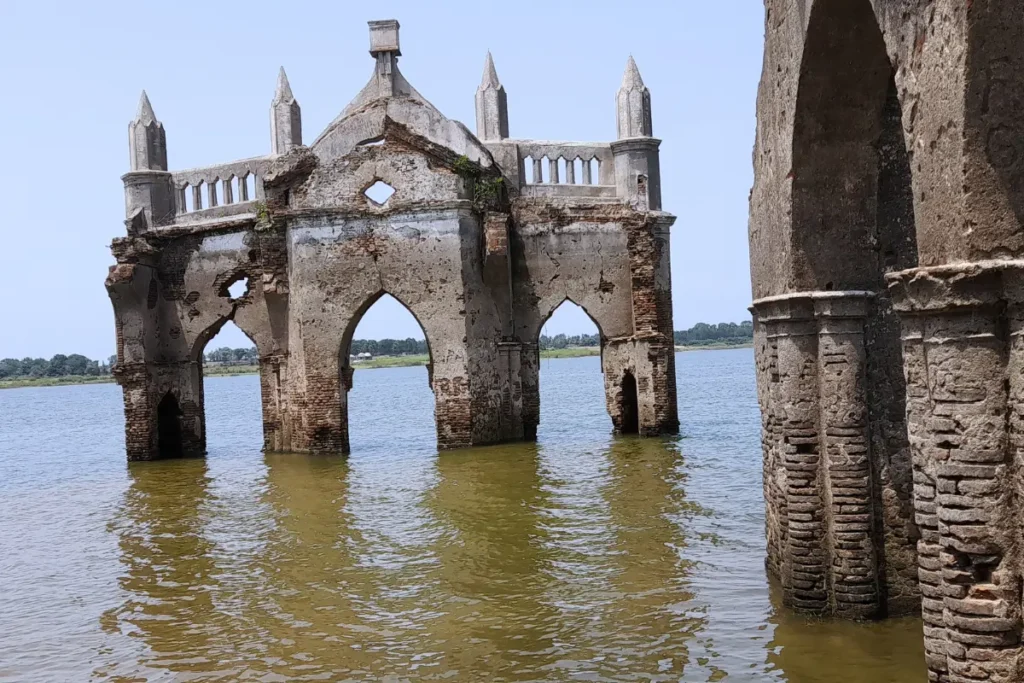
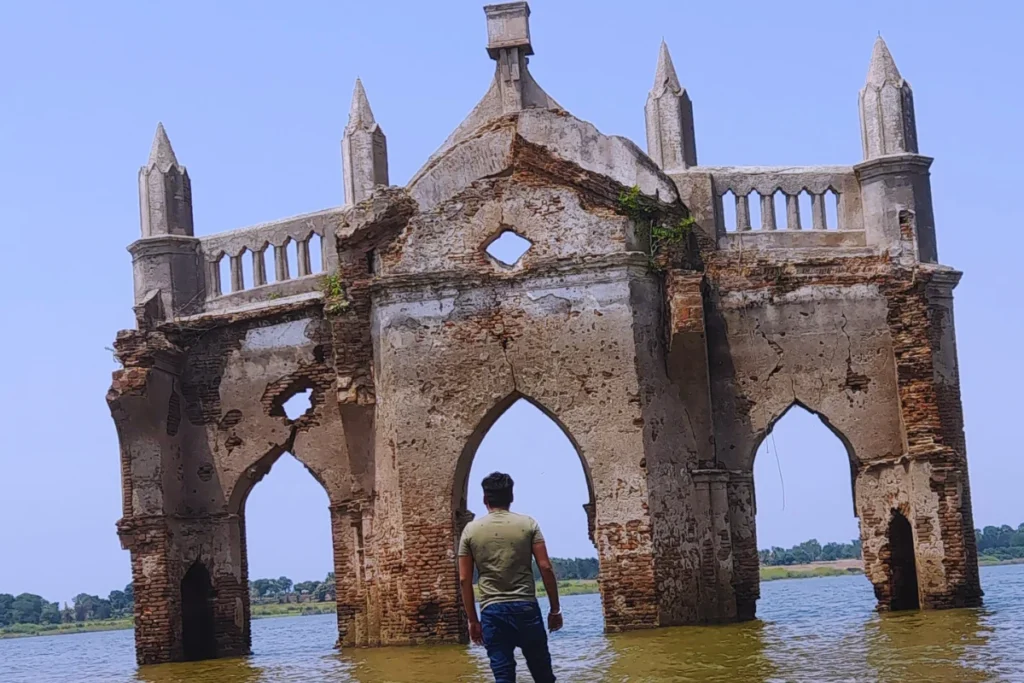
Before entering the deep coffee estate canopy toward Sakleshpura, there is a necessary detour 22 km south of Hassan: the gothic ruins of the Shettihalli Rosary Church.
Built in 1860 by French missionaries for local wealthy estate owners, the church was abandoned a century later in 1960 when the construction of the Gorur Dam across the Hemavathi River threatened the surrounding villages. What remains today is a skeletal, roofless basilica made of brick, mortar, and a mixture of lime and eggshells… a structure that has quietly refused to dissolve into the reservoir that floods it every year.
The Church’s Dual Life
Shettihalli changes entirely depending on when you visit:
- The Floating Church (July to October): During the monsoon and post-monsoon months, the rising waters of the Hemavathi Reservoir submerge the lower half of the church. The structure appears to float on the water, accessible only by boat or viewed from the riverbanks… a surreal sight that looks entirely alien to the Karnataka plains.
- The Dry Walkway (December to May): When we visited in May, the waters had fully receded, leaving behind a dry, cracked riverbed. You can walk straight through the central aisle, look up through the ribless vaults directly at the morning sky, and examine the weathered brickwork that has survived decades of annual drowning.
It is quiet in the early morning. A few local fishermen cast nets from the shore, and the breeze coming off the reservoir carries none of the highway noise. Spending 30 minutes here before starting the winding drive into the Sakleshpura coffee hills provides a striking historical transition… from 19th-century French sacral architecture to 18th-century military fortifications.
Manjarabad Fort: The Star Above the Ghats
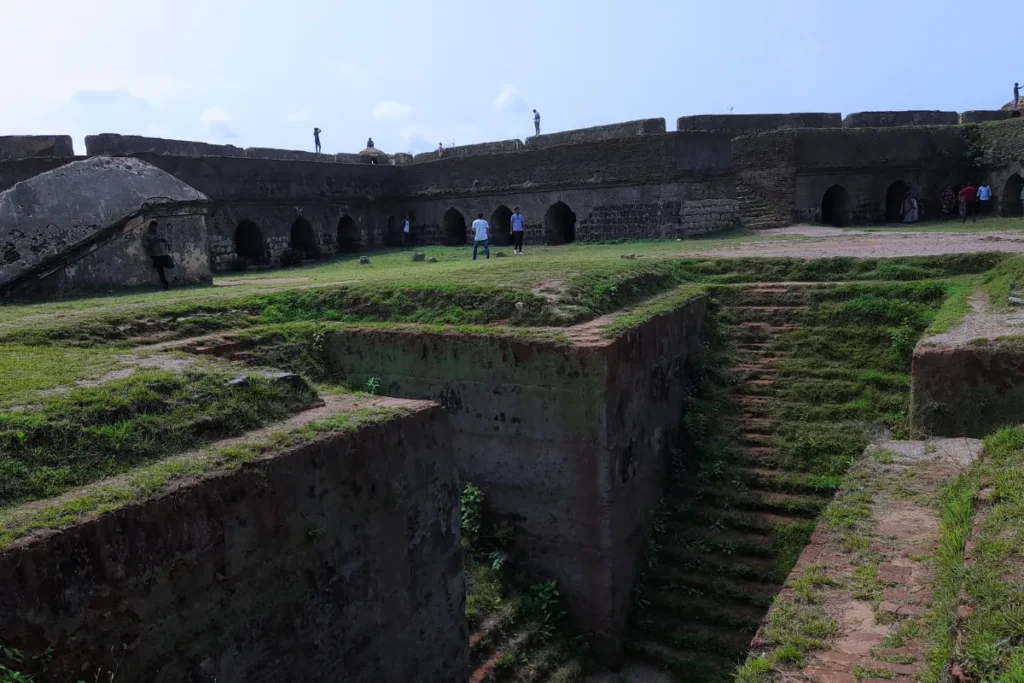
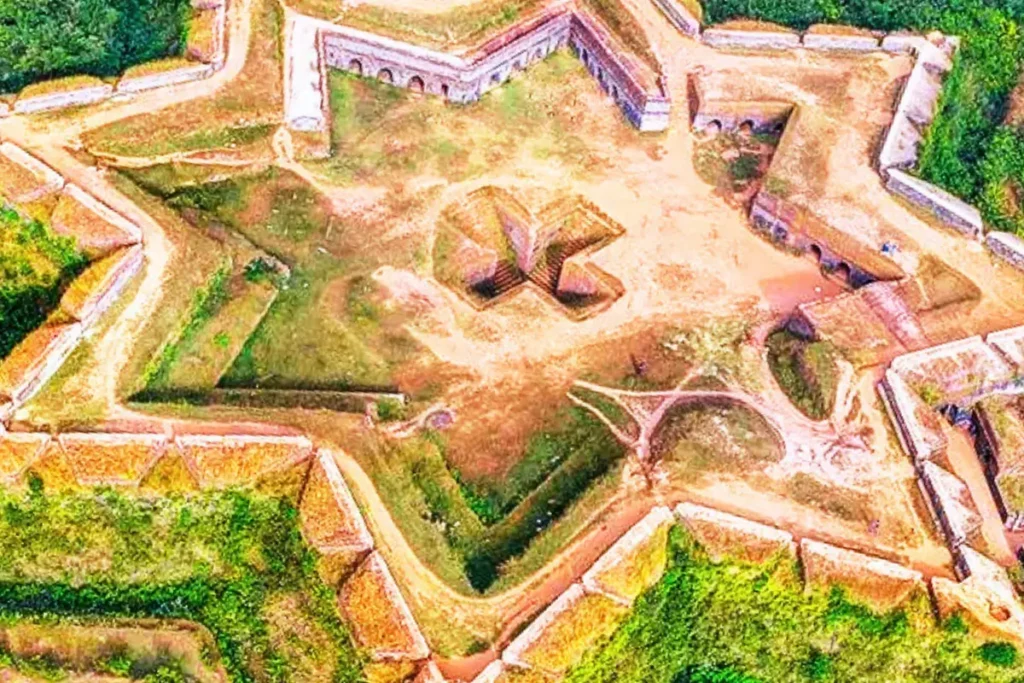
The reason to drive through Sakleshpura specifically, rather than taking a more direct route back to Bengaluru, is Manjarabad Fort: an 18th-century fort built on a hilltop above the town with a design so unusual that it must be seen from above to be understood.
The History
Manjarabad Fort was built by Tipu Sultan in 1792 CE during the Mysore Sultanate’s strategic efforts to secure the trade routes connecting his capital, Srirangapatna, to the coastal ports of Mangalore. When the British defeated Tipu Sultan at the Siege of Seringapatam in 1799, they captured Manjarabad as part of the territorial settlement and used it as an administrative outpost before eventually abandoning it.
The fort is built in an eight-pointed star plan: from above, the perimeter walls project outward in eight alternating angled bastions, creating a geometry that provides overlapping fields of fire with no blind angles. This design came from French star-fort military architecture (popularized by Sébastien Le Prestre de Vauban), constructed with the assistance of French engineers who were allied with Tipu Sultan against British expansion. The star fort at Manjarabad is a direct expression of that engagement: an Islamic construction tradition building a French-derived defensive geometry on a Ghats hilltop overlooking the trade routes between the coast and the interior.
The Climb and the View
The fort is accessible via a road that climbs the hill and deposits you near the entrance. We hiked to the ramparts: the path requires some effort but is not technically demanding. The rampart walk around the perimeter of the fort takes 20 to 30 minutes at a slow pace.
The view from the ramparts is the first full experience of the Sakleshpura landscape from above: the coffee plantation country spreading in every direction, the Ghats ridgelines visible beyond, Sakleshpura town visible in the valley below, and on a clear morning, the Western Ghats descending toward the coastal lowlands at the far edge of the view.
The star geometry of the fort becomes visible from the ramparts. Looking down at the walls from the elevated internal structures, the eight-pointed plan is legible: the bastions projecting outward, each angled to provide flanking coverage of the adjacent wall sections. The geometry is not decorative. It is functional, derived from the specific mathematics of artillery defence, applied here in stone on a hillside in Karnataka.
We stood at the highest accessible point and looked at the fort’s layout and at the landscape around it simultaneously. This is the correct Manjarabad experience: the star below you and the Ghats around you, the specific historical clarity of a military structure whose purpose is entirely readable from above in a way that the ground level does not provide.
“Standing on the ramparts of Manjarabad, 18th-century French military engineering merges seamlessly with the rugged crests of the Western Ghats… a geometric masterpiece in granite and lime overlooking the ancient trade routes to the coast.”
How Chikmagalur Fits In
This article is titled Chikmagalur & Sakleshpura, but our specific drive was the Hassan-to-Sakleshpura route rather than a Chikmagalur-specific visit. The inclusion of Chikmagalur in the title reflects the broader coffee country context to which Sakleshpura belongs and which most travelers associate with this region.
Chikmagalur, approximately 70 to 80 km northwest of Hassan, is the dominant coffee destination in Karnataka and the one most represented in travel writing, estate-tourism marketing, and Instagram content. The Baba Budangiri hills, where according to tradition a Sufi saint named Baba Budan first brought coffee seeds to India in the 17th century (hidden in his beard, concealing them from the Arab merchants who had a near-monopoly on coffee cultivation), are in the Chikmagalur district.
Mullayangiri, the highest peak in Karnataka at 1,930 metres, is also in Chikmagalur. The drive from Bengaluru to Chikmagalur itself takes approximately 4 to 5 hours. For a weekend that wants to combine coffee country, the Western Ghats, and the Hoysala temple circuit, the Hassan-based approach (combining Chikmagalur proximity with the Hoysaleshwara Temple at Halebidu) is the most efficient structure.
The Hassan-Chikmagalur-Sakleshpura Circuit
For travelers who want the complete coffee country experience rather than our specific Hassan-Sakleshpura route, a two-night circuit is possible: Day 1 drive from Bengaluru to Chikmagalur (4 to 5 hours), overnight. Day 2 explore Chikmagalur: Mullayanagiri peak, coffee estate visit, Hebbe Falls. Day 3 drive from Chikmagalur to Hassan via the scenic Ghats road (approximately 70 km), visit Hoysaleshwara Temple at Halebidu in the afternoon, overnight in Hassan. Day 4 morning visit to the gothic ruins of Shettihalli Rosary Church, followed by the drive to Sakleshpura and Manjarabad Fort, returning to Bengaluru by evening.
This circuit covers the coffee belt comprehensively. Our version was the compressed weekend alternative: arrive at Hassan Saturday afternoon, temple in the evening, Sakleshpura drive Sunday morning, return to Bengaluru Sunday evening. Both structures work. The longer circuit is richer. The weekend version is what Bengaluru-based travelers with two days can actually do without annual leave.
The Weekend That Built This Article
We drove from Bengaluru on a Saturday morning, arriving in Hassan by afternoon in time to check in and rest. Hotel United Kites in Hassan: INR 1,500 (17 USD) per night, clean, centrally located, no pretension and no need for it. Standard Karnataka food near the hotel: the specific comfort of a rice and sambar meal.
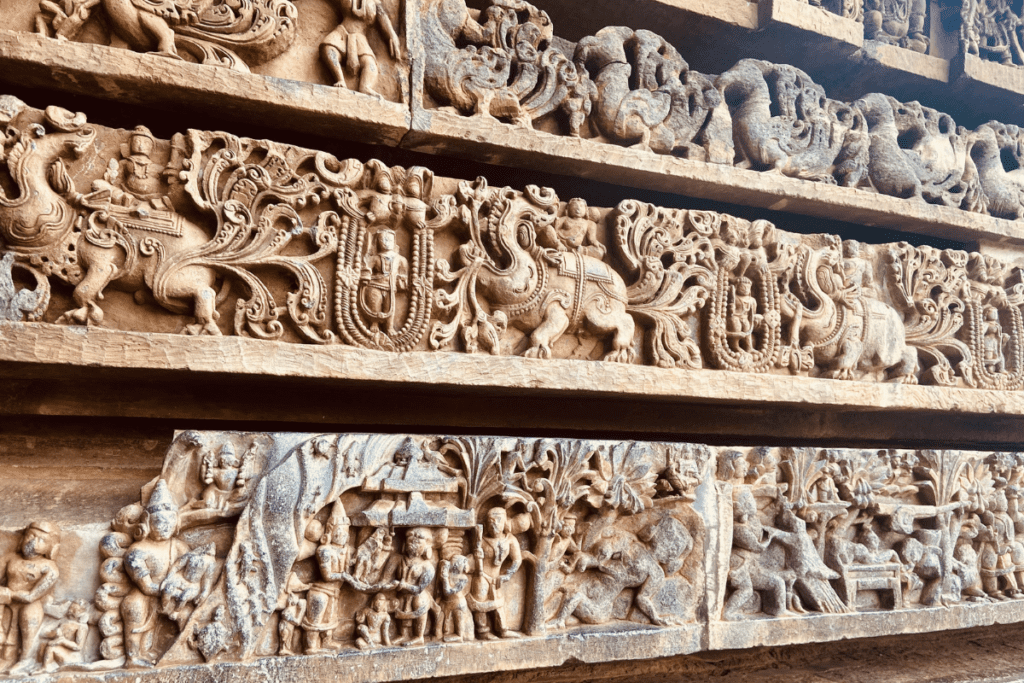
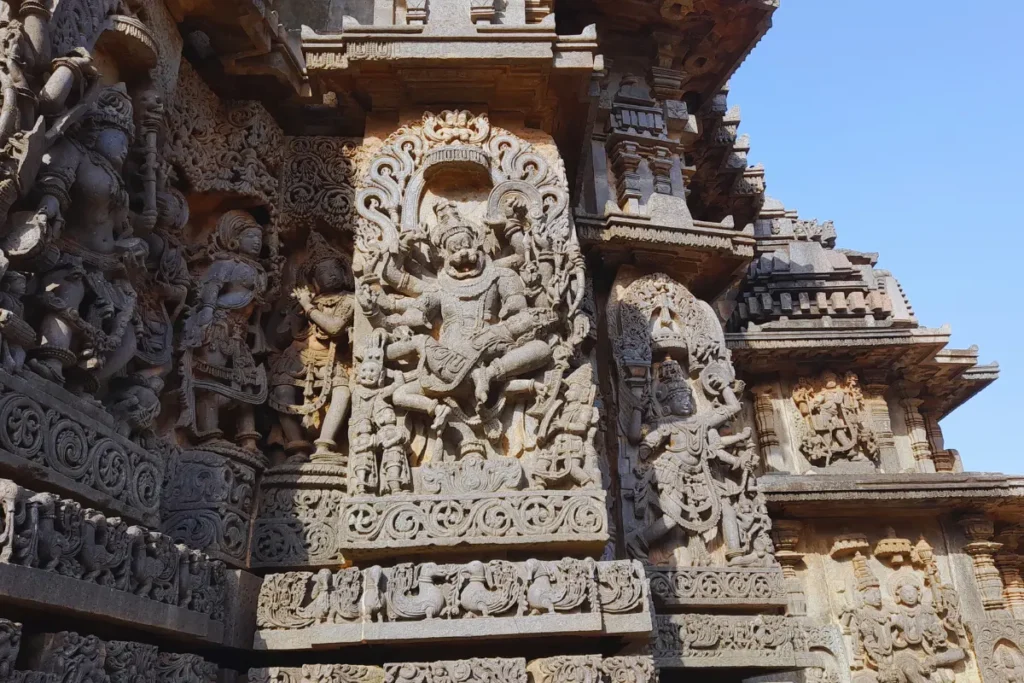
Saturday evening: Hoysaleshwara Temple at Halebidu, 30 km from Hassan, with a guide who showed us the seven horizontal friezes on the outer wall (elephants at the base for stability, horses above for speed, foliage, warriors, geese for the soul, makaras, narrative panels), and found the sculptor’s hidden self-portrait in a border frieze. The temple guide is covered in the companion article. The short version: hire the guide, it changes the entire experience.
Sunday morning: the drive to Shettihalli Rosary Church ruins, followed by the Sakleshpura scenic road through coffee country and Manjarabad Fort from the ramparts. The view from the top and the view of the geometry below. Return to Bengaluru by evening.
The total cost of the weekend for two people, excluding fuel: Hotel United Kites (one night, INR 1,500 / 17 USD), the temple guide (approximately INR 300 to 500 / 4–5 USD), food across two days, and nominal entry fees for Manjarabad Fort and Shettihalli Church. Under INR 3,100 (34 USD) excluding fuel, or under INR 5,000 (55 USD) including fuel. For a weekend that covered a 12th-century Hoysala temple, a gothic church ruin, a coffee country drive, and an 18th-century star fort, this is the correct relationship between money spent and experience received.
What It Costs
| Item | Cost |
| Hotel United Kites, Hassan (1 Night) | INR 1,500 / 17 USD |
| Hoysaleshwara Temple guide | ~INR 300 to 500 / 4 to 5 USD |
| Hoysaleshwara Temple entry | Free (ASI maintained) |
| Shettihalli Rosary Church | Free |
| Manjarabad Fort entry | Nominal (INR 25 to 50) / 0.30 to 0.50 USD |
| Fuel, Bengaluru to Hassan return (estimate) | INR 1,500 to 2,000 / 17 to 22 USD |
| Food, two days (local Karnataka restaurants) | INR 600 to 1,000 / 7 to 11 USD |
| Total (two people, excluding fuel) | Under INR 5,000 / 55 USD |
The coffee country weekend from Bengaluru is one of the most cost-efficient two-day trips available in Karnataka. The most significant expenditure is fuel.
Before You Go
- Leave Bengaluru early on Saturday morning (around 6:00 to 7:00 AM) to reach Hassan by early afternoon (4 to 4.5 hours via NH75). This gives you ample time to check into your hotel, rest, and head to Hoysaleshwara Temple at Halebidu for a relaxed evening visit.
- The Sakleshpura road from Hassan is the scenic route and is the entire point of the drive. Do not take the highway. Set your navigation to avoid the main highway through Sakleshpura and take the inner route via the village roads and coffee estate areas. The route adds time, but the experience is worth every minute.
- Visit Shettihalli Church early on Sunday morning before heading toward Sakleshpur. The gothic ruins sitting near the Hemavathi Reservoir are quietest in the early hours and make a seamless stop before you connect to the coffee country estate roads.
- Manjarabad Fort is best seen from the ramparts looking down at the star geometry. Take the time to climb to the highest accessible internal point and look at the fort’s layout before looking out at the landscape. The geometry rewards the elevation.
- If visiting both the Hoysaleshwara temple and the fort in the same weekend, the temple guide is worth reading before the visit: the outer wall friezes, the lathe-turned pillars, and the sculptor’s hidden self-portrait are all features that require prior context.
- Coffee estate visits: if you want a formal estate visit, Chikmagalur is better organised for this than Sakleshpura. Several estates near Chikmagalur offer walk-through experiences and farm-to-cup demonstrations. In Sakleshpura, the experience is the landscape rather than the estate interior.
- December to March is the best season. The coffee flowers from January to March, producing the characteristic sweet scent. October to February has the clearest Ghats views from Manjarabad. June to September is monsoon… the landscape is vivid, but Manjarabad is slippery, and the village roads can flood.
- The return drive from Sakleshpura to Bengaluru via Hassan takes 4 to 4.5 hours. Leave Manjarabad by 1 to 2 PM to reach Bengaluru comfortably before dark.
“The true beauty of a Western Ghats weekend isn’t measured in luxury stays or checked-off sights, but in the quiet geometry of an 18th-century fort, the patience of a village road, and the estate canopy that makes you feel you have truly been somewhere, rather than merely driven through.”