This Pamukkale travel guide covers Days 12 to 14 of our 14-day Turkey road trip (part of a broader 17-day Turkey itinerary): visiting Çatalhöyük as we arrived in Konya from Gaziantep, exploring Laodicea after driving from Konya to Denizli the next day, and ascending Pamukkale-Hierapolis the following morning in freezing rain.
We visited Çatalhöyük on the morning of April 29th on our approach into Konya, driving west from Gaziantep. Çatalhöyük is the proto-city that the Museum of Anatolian Civilisations in Ankara had prepared us for: a Neolithic settlement from approximately 7500 to 5700 BCE, where thousands of people lived in mud-brick honeycomb houses connected by shared walls and rooftop walkways, with no streets at ground level. You entered your home through a hole in the roof.
The site’s physical presence is less dramatic than its historical significance suggests. The excavation mounds are low, and the protective display structures are functional rather than spectacular. What makes Çatalhöyük significant is not the grand architecture, but the object it produced: the Mother Goddess figurine, a voluptuous clay figure giving birth while seated on a throne flanked by two leopards. The original sits in the Ankara museum. The site provides the living context… this is where she was crafted, inside a grain bin, by people who had been farming for a thousand years and were still processing their relationship with the wild through a form that combines domestication and the primal.
The following day, we drove 368 km from Konya to Denizli and checked into the Akapella Hotel. The service was genuinely good, complimentary breakfast was included, and the two-night stay cost us 3,240 Lira / INR 7,265 / 85 USD… high by the standards of the eastern Turkey circuit, but consistent with what proximity to Pamukkale commands. That evening: khichdi and boiled eggs cooked in our hotel room… the right meal after a six-hour driving day.
“Driving west across central Anatolia feels like traveling through human time… from the quiet mud-brick origins of Çatalhöyük to the neon-lit hotel strips of Denizli, where ancient thermal waters meet modern highway stops.”
Laodicea: The City That Was Neither Hot Nor Cold
Day 13 ended with Laodicea, approximately 10 km north of Denizli, reached in the afternoon after the drive from Konya. Entry: 1,050 Lira / INR 2,415 / 28.25 USD for two people. for two people.
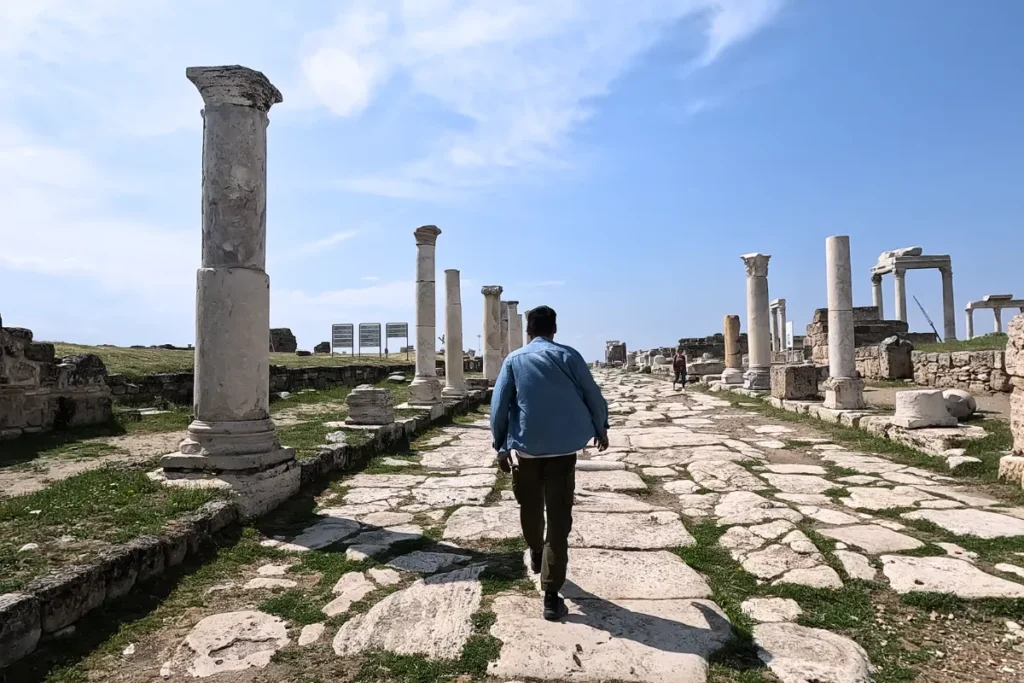
Laodicea is the ancient megacity that most Turkey itineraries skip because Ephesus is larger and more famous. This is Ephesus’s gain and Laodicea’s advantage. We walked the marble avenues almost entirely alone.
What Laodicea Was
Laodicea was one of the wealthiest cities in the Roman world. It generated enormous fortunes from two sources: a rare, glossy black wool unique to the region’s sheep, and a medical school that produced world-famous eye salves exported across the empire. When a major earthquake destroyed the city in 60 CE, the citizens were wealthy enough to refuse Roman financial aid and rebuild the city entirely from their own resources. This is the city the Book of Revelation addresses as ‘lukewarm’: the specific metaphor came from the city’s water, which was piped from mineral-hot springs miles away and arrived tepid, neither the therapeutic heat of nearby Hierapolis’ springs nor cold and refreshing. The lukewarm water was a known quality of life problem in the city.
What You Walk Through
The sacred Church of Laodicea: one of the Seven Churches of Asia mentioned in the Book of Revelation. The preserved 4th-century church has a glass floor installed over the original mosaic foundation, and you walk across the glass looking down at geometric patterns, early Christian symbols, and the original baptismal pool, one of the largest intact monumental fonts ever excavated.
Syria Avenue and Ephesus Avenue: the main colonnaded thoroughfares of the city, flanked by re-erected marble columns. The stone floor slabs still carry the wheel grooves cut by Roman chariot traffic over two thousand years of use. The grooves are deep. The traffic was constant for centuries. The stone absorbed it. You walk in the same direction the chariots traveled.
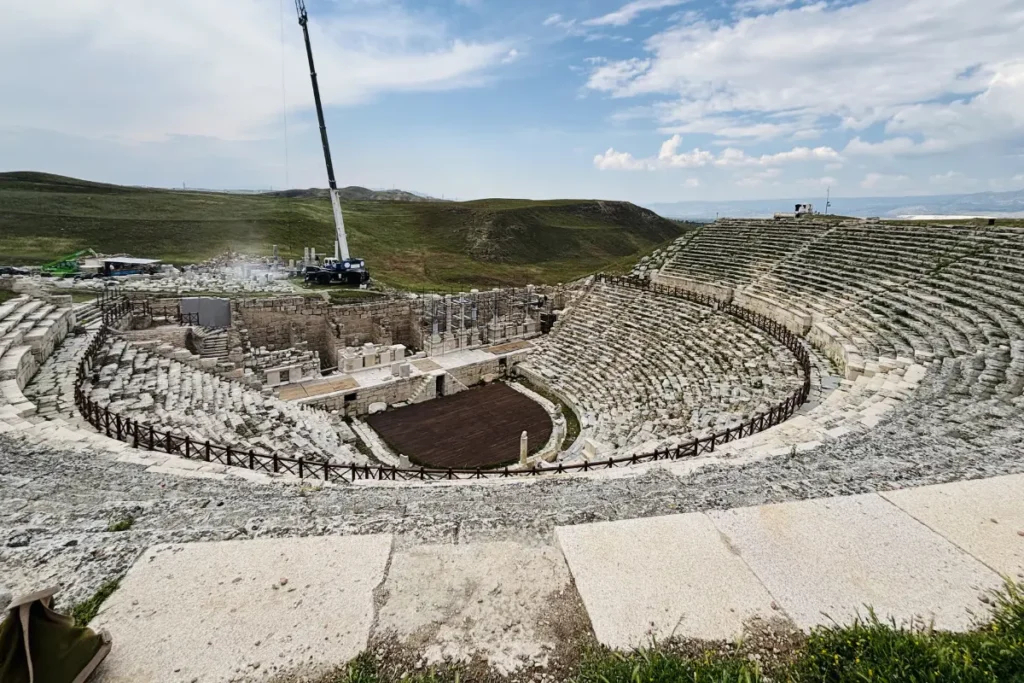
The two theatres: Laodicea’s wealth supported not one but two theatres. The West Theatre, Hellenistic in style, has been so thoroughly restored that it looks usable tonight. From the upper tier, the white travertine terraces of Pamukkale are visible in the distance across the plains… the two cities, the ancient spa and the ancient trade capital, visible to each other across the valley.
The Trajan Water Tower: at the water tower, the ancient clay pipes are visible inside the stone housing. The interior surfaces of the pipes are encrusted with thick white calcium carbonate deposits: the exact same mineral that built the white terraces of Pamukkale six kilometres away. The pipes that delivered Laodicea’s water also deposited the mineral that defined the city’s spiritual reputation in the Book of Revelation. The lukewarm water left its evidence inside the pipes.
Laodicea’s gift to the traveler is silence. We had the marble avenues to ourselves. After the compressed crowds of Cappadocia and the intensity of the eastern circuit, walking alone through a Roman city’s main street, with the columns re-erected and the chariot grooves underfoot, was an experience that the more famous sites cannot replicate precisely because they are more famous.
“Standing on the marble streets of Laodicea, you realise that true antiquity isn’t found in polished displays… it is etched into the deep wheel ruts cut by Roman chariots thousands of years ago.”
Pamukkale: Barefoot on Warm Calcium in Freezing Rain
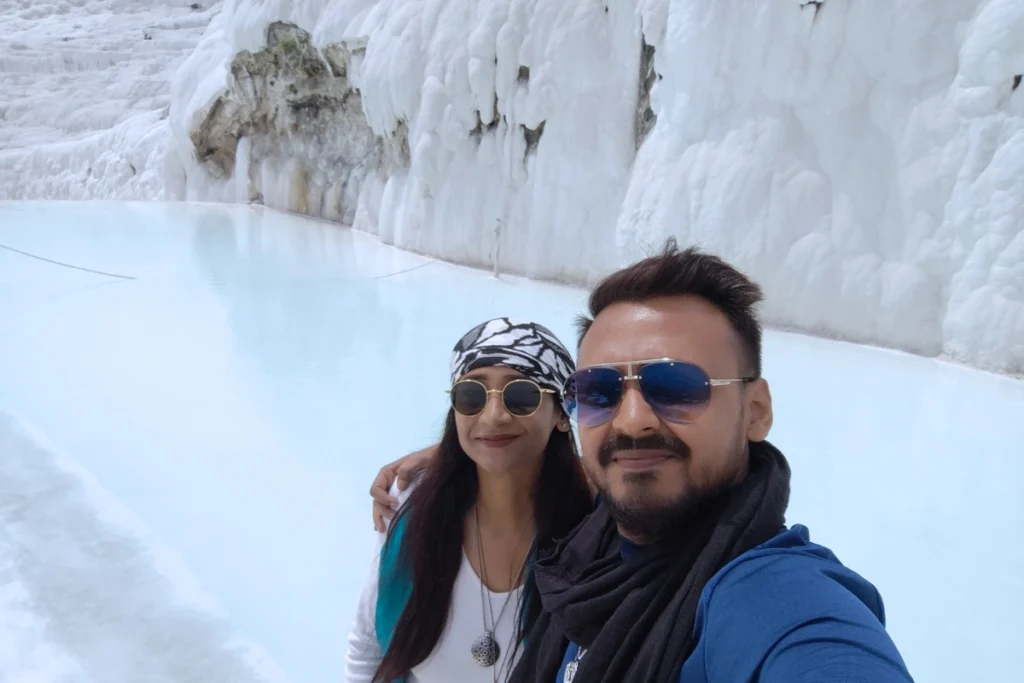
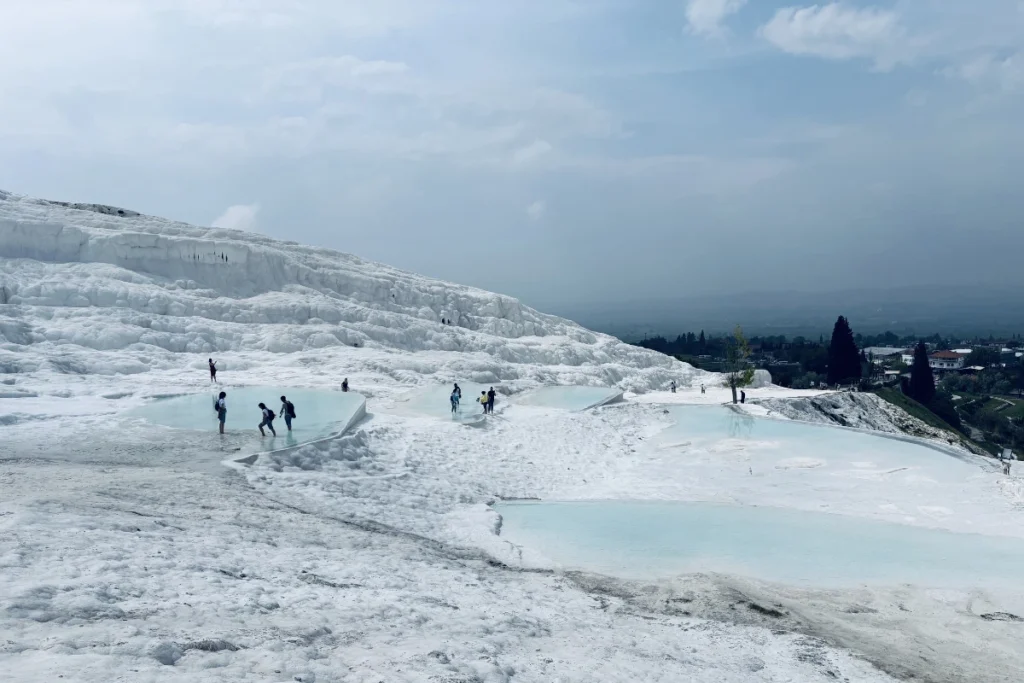
We woke early on Day 14 at the Akapella Hotel, which is a short walk from the Pamukkale lower gate. The hotel’s proximity meant we did not need the car for the morning.
The morning greeted us with freezing rain.
Not light rain. Heavy, cold, persistent rain that required thick jackets and layers and made the prospect of walking barefoot on warm terraces feel, in the first few minutes, like a poor planning decision. We went anyway.
Why the Lower Gate
Pamukkale has two entry points: the upper entrance, which is where tour buses deposit hundreds of visitors at once, creating immediate congestion at the most crowded sections of the terrace; and the lower gate, which allows a progressive ascent from the bottom of the travertine cliffs through the pools to the upper plateau where Hierapolis sits.
The lower gate approach is significantly better. You ascend through the terraces rather than descending. The crowds from the upper gate have not yet reached the lower sections by the time you arrive. And the experience of the travertines rewards walking upward through them, with the valley view opening progressively as you climb, rather than arriving at the top and walking down into a crowd.
Shoes must come off at the entrance to the travertine path. This is enforced, not advisory. Bare feet on the calcium surface protect the fragile white structures from the oils and abrasion of footwear. Staff check compliance.
The Travertines
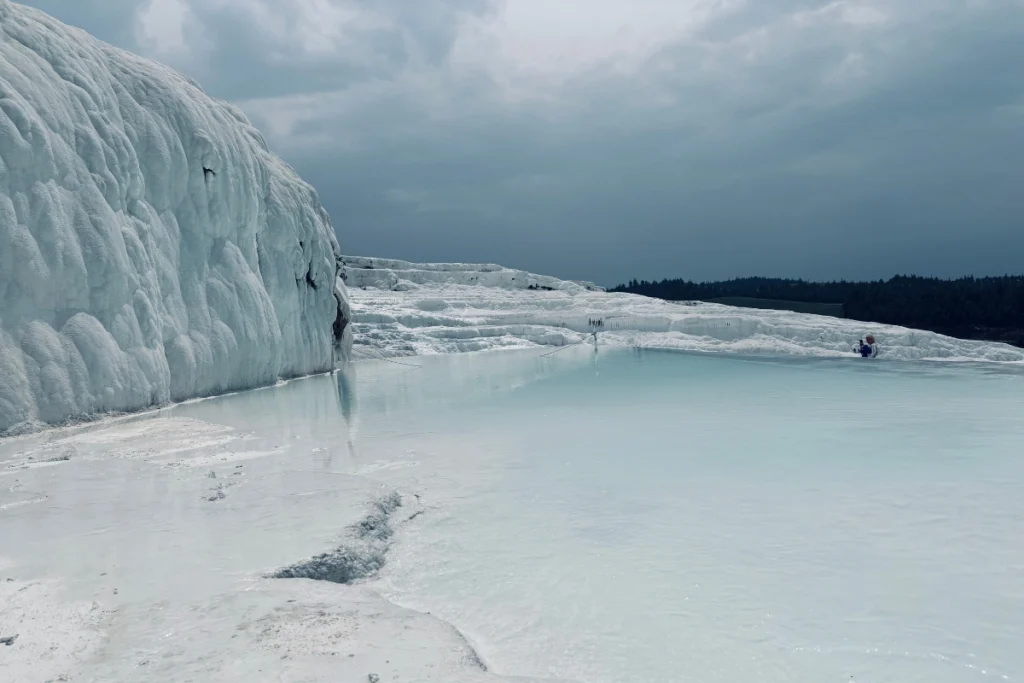
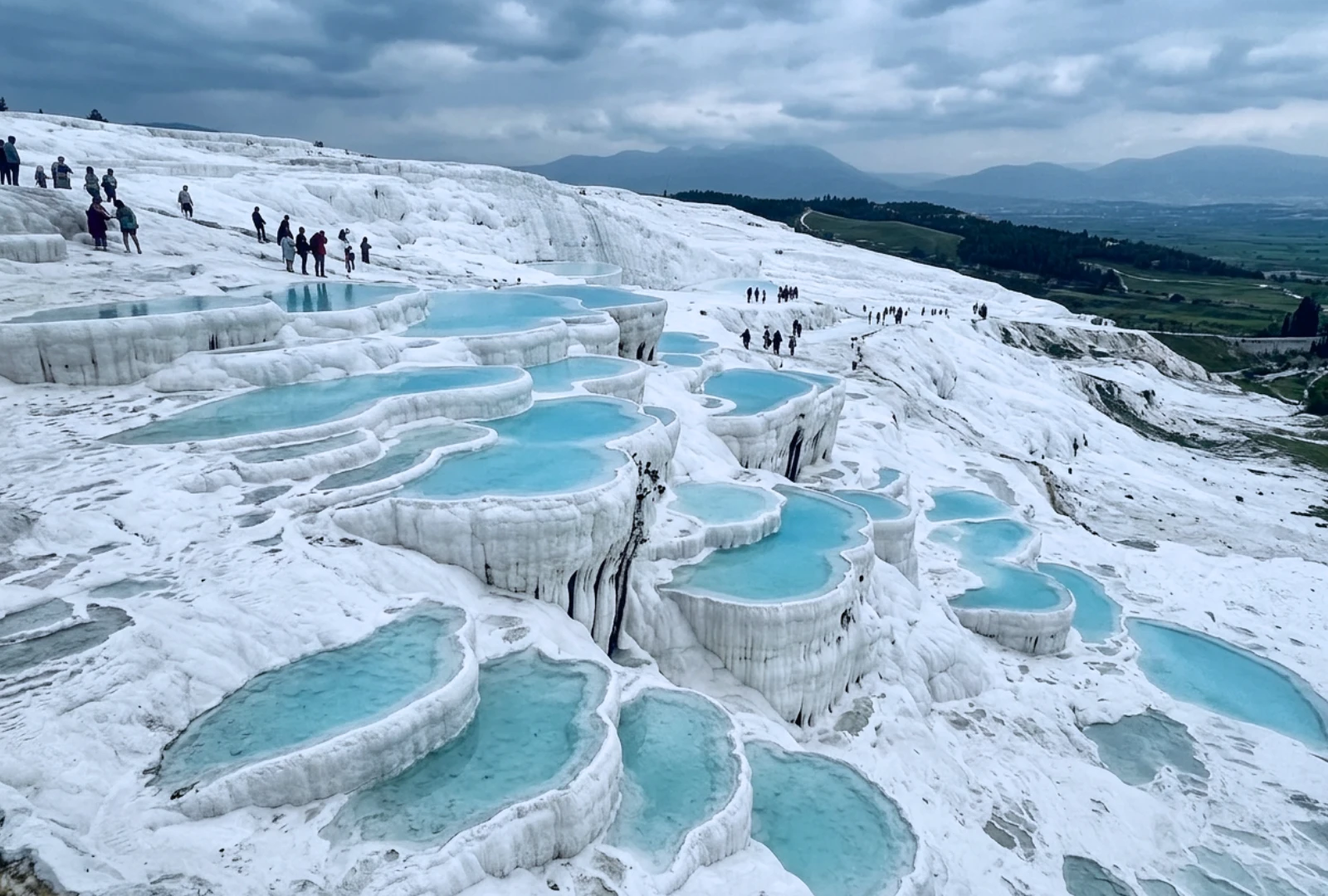
Pamukkale means Cotton Castle in Turkish. The name is visual shorthand for what the cliff face looks like: white, soft-appearing, shaped into curves and lips and pools by thousands of years of calcium carbonate deposits from the thermal springs above. The thermal water emerges from the earth at approximately 35°C, supersaturated with calcium bicarbonate. As it flows down the cliff face and the water temperature drops and the carbon dioxide escapes, the calcium precipitates out of solution and deposits on the surface. Each year, a thin layer of new calcium builds the terrace higher.
The thermal pools in the travertines collect the water behind the lips of calcium that grow at the pool’s edge. The colour of the water in these pools… a brilliant turquoise that in photographs looks artificial… is real. It is produced by the suspended calcium carbonate in the water, which scatters light in a specific way that gives the shallow pools their distinctive blue-green colour.
Walking barefoot on warm calcium surfaces while cold rain fell on our heads and jackets and the mist turned the valley below into a white interior space was the specific, unplanned experience that the morning produced. The thermal water was warm under our feet throughout the walk. The rain was very cold on our faces. The two temperatures existing simultaneously, on different parts of the body, produced a sensory dissonance that was not unpleasant. It was simply strange, in the way that a geological wonder encountered during adverse weather is strange.
The heavy mist that the rain produced did something to the landscape that clear weather might not have. The valley below the terraces disappeared. The terraces floated above the mist. The pools reflected the grey sky. The white calcium formations, which in strong sun photograph brilliantly against blue sky, in the mist became luminous in a different and quieter way.
The Combined Ticket Tip
Pro Tip on Combined Tickets: When you arrive at Laodicea, ask the guards or ticket desk for a combined ticket covering Laodicea, Pamukkale, and Hierapolis. Local site staff often offer bundled entrance options that save significant money compared to paying individual full rates at each gate. If you plan to visit all three, buy this bundled entry at your first stop.
Hierapolis: The Healing City at the Edge of the World
At the top of the travertine ascent sits Hierapolis: a Greco-Roman spa city founded in the 2nd century BCE specifically to exploit the thermal springs that also built the white terraces below it. The city was one of the ancient world’s most significant healing centres. Wealthy, terminally ill patients traveled from across the Mediterranean to receive treatment at its thermal baths and temples. Many died here. The necropolis reflects the volume.
The Ancient Theatre
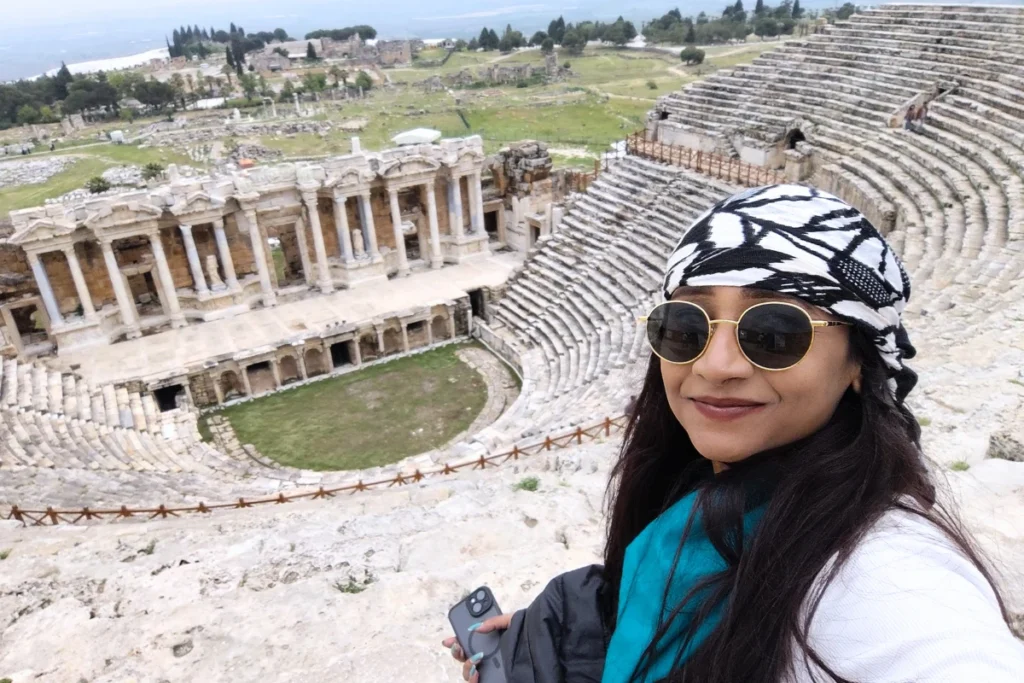
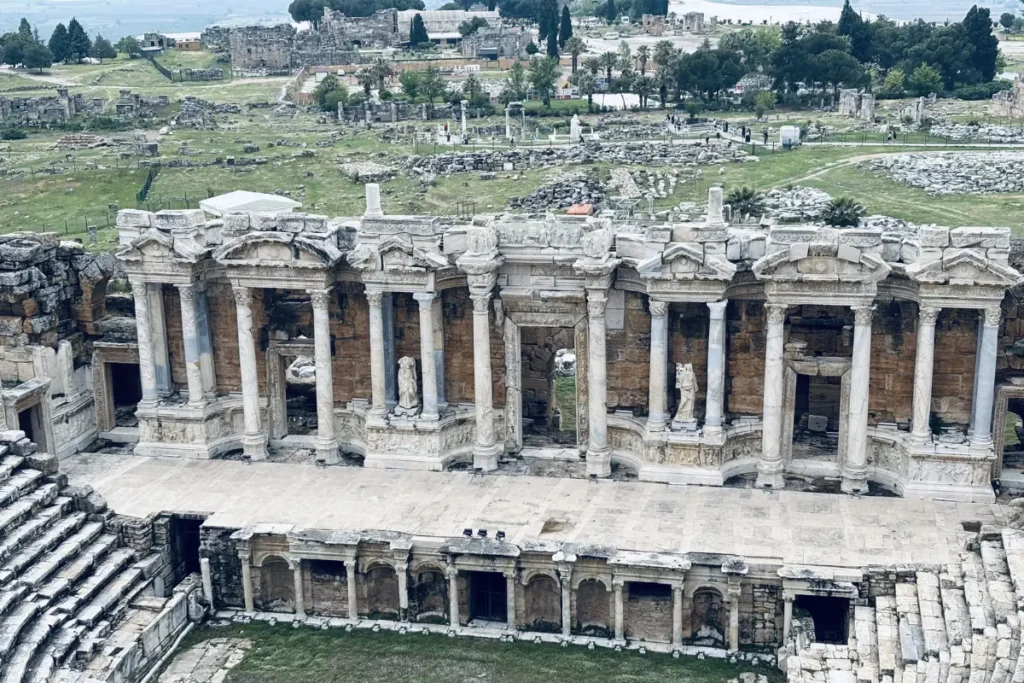
The Hierapolis Ancient Theatre is one of the most intact Roman theatres in the Mediterranean. Built under the emperors Hadrian and Septimius Severus, its stage wall (scaenae frons) still stands at multiple stories, with detailed stone reliefs depicting mythological battles, Roman gods, and gladiatorial scenes visible from the seating tiers. The acoustics are remarkable: sound carries from the stage to the highest row with the specific clarity that Roman theatre architects designed for and achieved through the geometry of the seating arrangement.
The theatre’s upper tiers offer a sweeping view over the entire Hierapolis plateau and the travertine terrace below, with the valley stretching to the horizon. Hierapolis at the theatre’s height is the complete picture: the healing city, the white cliff it was built on, the plain it presided over.
Cleopatra’s Antique Pool: Closed
We had planned to swim in Cleopatra’s Antique Pool.
The pool is legendary: a thermal bath at 36°C, fed by the same springs that have bubbled up here for millennia, with the floor littered with authentic Roman marble columns, fluted pedestals, and carved capitals that collapsed into the water during a major earthquake centuries ago. Swimming over submerged Roman architecture is the pool’s specific attraction and the reason visitors pay the separate entry fee.
It was closed for maintenance.
We noted this as bad luck and moved on. There is no useful advice to extract from this experience except the practical reminder to verify before visiting. The pool operates under its own separate ticketing and schedule. It closes for maintenance. This happens. If you plan around it as a primary experience, check current status before arriving.
The Necropolis: 1,200 Tombs and a Two-Kilometre Walk
Outside the ancient city gates of Hierapolis, stretching over two kilometres along the road that exited the city toward the east, is the Necropolis of Hierapolis. It contains over 1,200 stone sarcophagi, circular tumuli, and family house-tombs belonging to the people who died at the healing city: gladiators, merchants, soldiers, and the wealthy pilgrims who traveled here seeking a cure and remained permanently.
Walking the Necropolis in the rain, with nobody else on the path, was the most atmospheric experience of the entire Pamukkale-Hierapolis day. The stone sarcophagi line both sides of the ancient road. Some are ornate, with carved reliefs of the deceased’s life. Some are plain. Some have toppled. Some stand perfectly upright. The scale of the cemetery… 1,200 tombs for a single ancient city… communicates the traffic that Hierapolis received as a healing destination over its centuries of operation. This many people came here dying. This many people died.
The Ploutonion: Where the Underworld Began
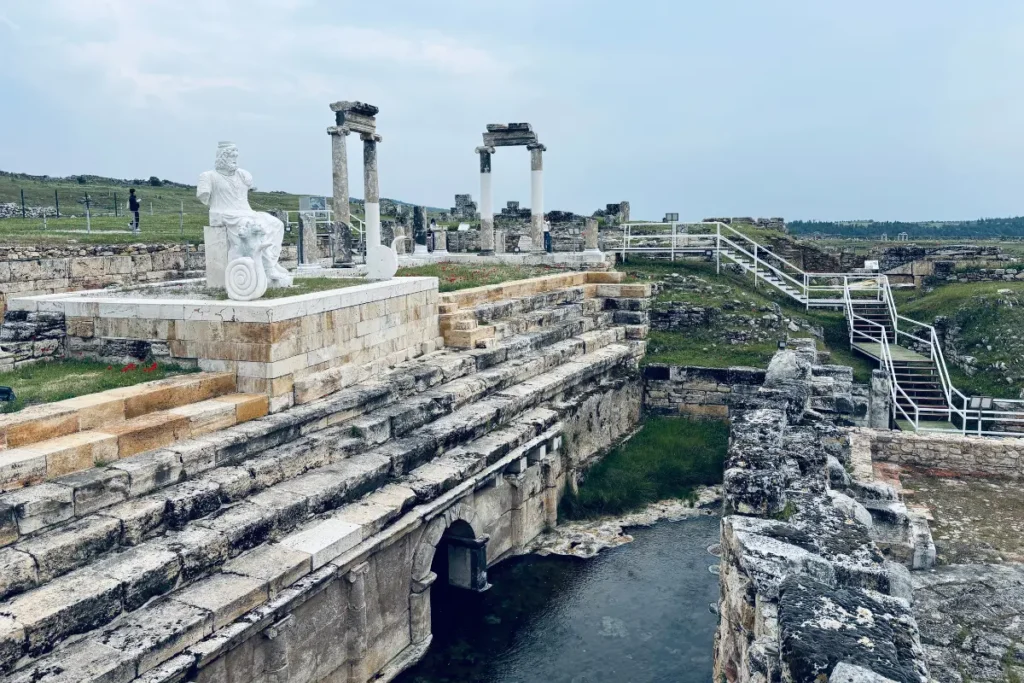
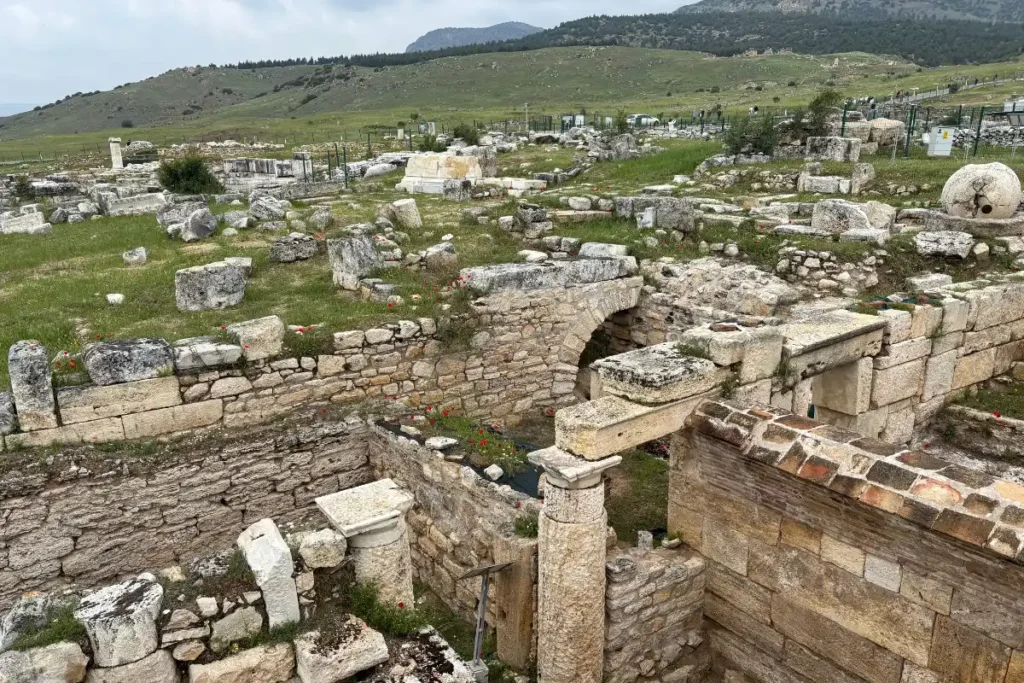
At the edge of the Hierapolis temple precinct sits the Ploutonion, the Gate of Pluto: a cave entrance that ancient priests believed was a physical gateway to the underworld. The cave naturally vents lethal concentrations of carbon dioxide directly from the earth. In antiquity, the priests of the Ploutonion would lead sacred animals (birds, cattle) to the cave entrance, and the animals would immediately die from the gas while the priests appeared unaffected… because they had learned to breathe from pockets of oxygen above the carbon dioxide layer.
The display was taken as proof of divine connection: the priests had power over death because their god gave it to them. The actual mechanism is chemistry. The CO₂ is heavier than air, sinks to ground level, and kills the animals that breathe at ground height while the standing humans breathe the oxygen above. The priests’ ‘miracle’ was knowledge of this layering, kept as a cult secret.
The ruins are safely fenced today. The gas still vents. Dead insects have been found near the cave entrance in modern times. The Ploutonion is the point where the geology of Pamukkale… the same thermal underground activity that produces the springs and the travertines… expresses itself in a form that the ancient world could only explain through mythology.
“Ancient priests saw a portal to the underworld where modern science sees heavy carbon dioxide… proof of how the thermal forces shaping Pamukkale’s white beauty also held the power to command fear.”
The Hierapolis Archaeological Museum
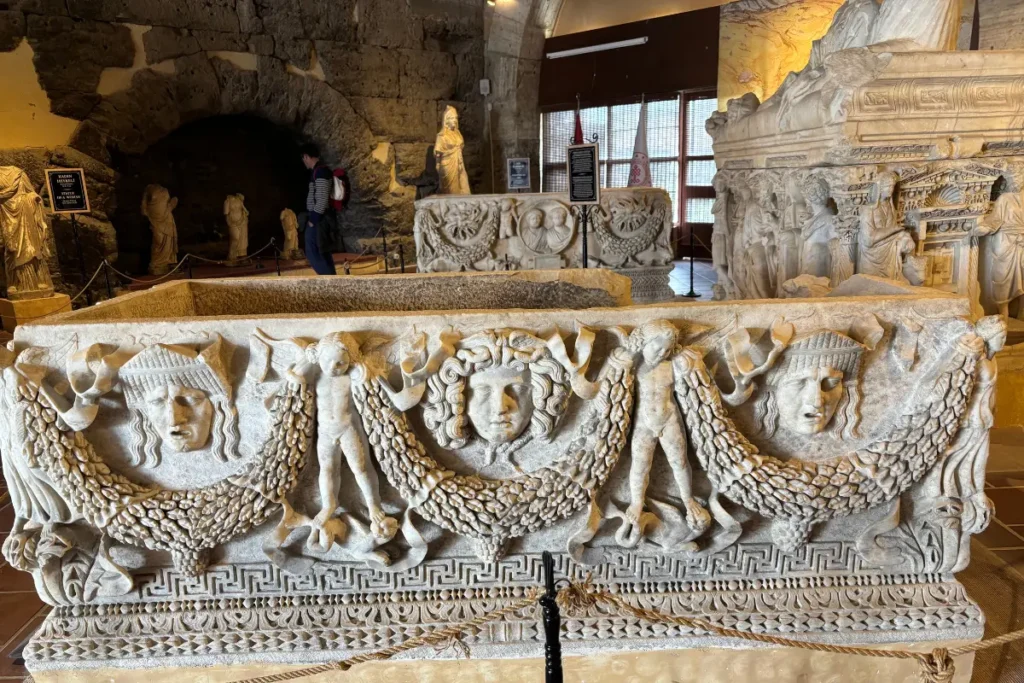
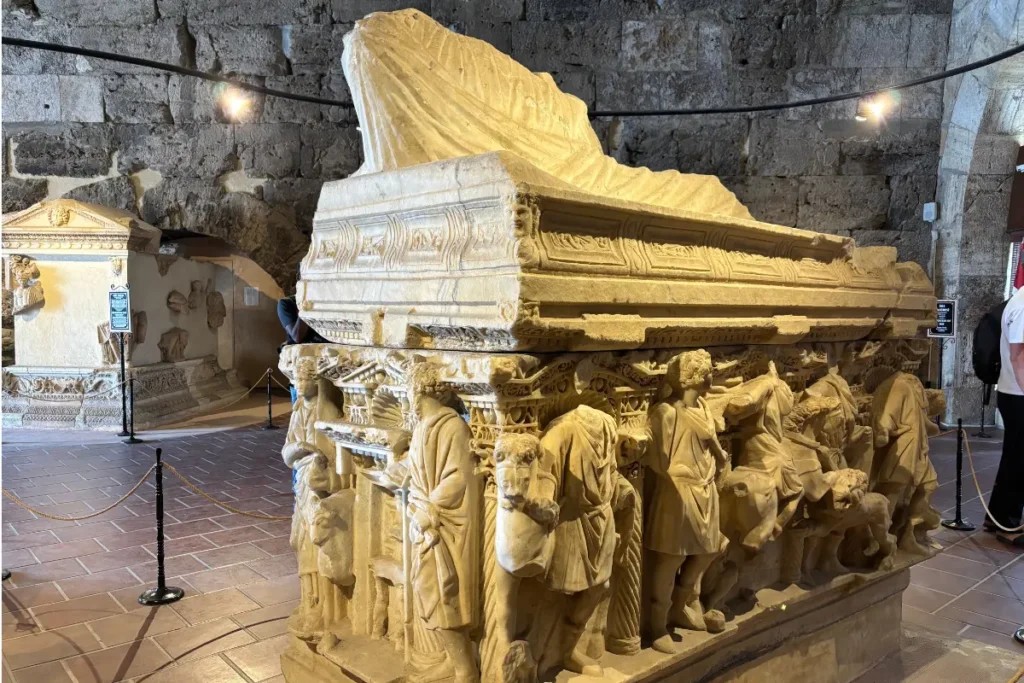
We sheltered from the rain inside the Hierapolis Archaeological Museum, housed in the ancient Roman baths at the site: a set of vaulted stone rooms that have been converted into exhibition spaces with the atmosphere of the original building intact. The collection includes colossal marble statues of Roman emperors, massive sarcophagi with deeply carved narrative reliefs, and a cabinet of ancient medical instruments… forceps, probes, scalpels, specula… used by the physicians who treated patients at the healing city 2,000 years ago.
The medical instruments are the most intimate objects in the museum. Holding a piece of metal cut to a specific surgical shape by someone 2,000 years ago, for a specific medical purpose that the shape still makes legible, produces a feeling that the large-format archaeology of temples and theatres does not. The scale is human. The purpose is recognisable.
What It Costs
| Item | Cost (April 2025) |
| Akapella Hotel, Denizli (2 nights, two people) | 3240 Lira / INR 7,265 / 85 USD |
| Laodicea entry (two people) | 1,050 Lira / INR 2,415 / 28.25 USD |
| Pamukkale + Hierapolis combined (two people) | 2,630 Lira / INR 6,049 / 70.77 USD |
| Combined ticket: Laodicea + Pamukkale + Hierapolis | Significantly cheaper than buying individually |
| Cleopatra’s Antique Pool (separate entry) | Was closed during our visit… verify before buying |
| Dinner (khichri + eggs, room cooked) | Cost of groceries from local market |
The accommodation near Pamukkale runs higher than the eastern Turkey circuit. The 3240 Lira / INR 7,265 / 85 USD for two nights at Akapella (with complimentary breakfast included) was offset by two consecutive evenings of room cooking. The combined ticket is the most important money decision of the day: buying Laodicea, Pamukkale, and Hierapolis separately costs significantly more than the combined entry.
Before You Go
- Enter Pamukkale from the lower gate. The upper entrance delivers tour buses directly to the top, creating immediate crowds. The lower gate allows a progressive, less crowded ascent through the terraces.
- Shoes must come off. This is strictly enforced, not suggested. Bring a plastic bag to carry your shoes. The calcium surface is warm and walkable barefoot, including in cold weather, because the thermal water keeps the surface temperature higher than the air.
- Buy the combined ticket if visiting Laodicea, Pamukkale, and Hierapolis. Buying individually at each site costs significantly more.
- Cleopatra’s Pool has a separate ticket and is sometimes closed for maintenance. Verify current status before making it a primary purpose of the visit. We arrived expecting to swim and found it closed. This happens.
- If you want to wade comfortably in the thermal pools, wear swimwear under light clothing. We wore thick jackets because of rain and could not make full use of the thermal pools. The thermal water is warm but the experience of wading freely requires being dressed for it.
- The Necropolis is two kilometres long. Allow 45 minutes to an hour for the walk in both directions. It is outside the main site area and most visitors skip it. Do not skip it.
- Visit Çatalhöyük on your drive approaching Konya from Gaziantep. It requires a minor detour before reaching Konya and provides crucial context for the Mother Goddess figurine displayed in Ankara’s Museum of Anatolian Civilisations.
- Laodicea is less crowded than Ephesus and covers comparable ground. Visit it if you are on the Denizli approach… the marble avenues and the calcium water tower pipes are both significant, and the site can largely be had to yourself.
“From the humble mud-brick roofs of Çatalhöyük to the silent marble avenues of Laodicea and the steaming white cliffs of Pamukkale, this stretch of Anatolia proves that history isn’t just something you observe in a museum… it is a landscape you walk through, barefoot in the rain.”