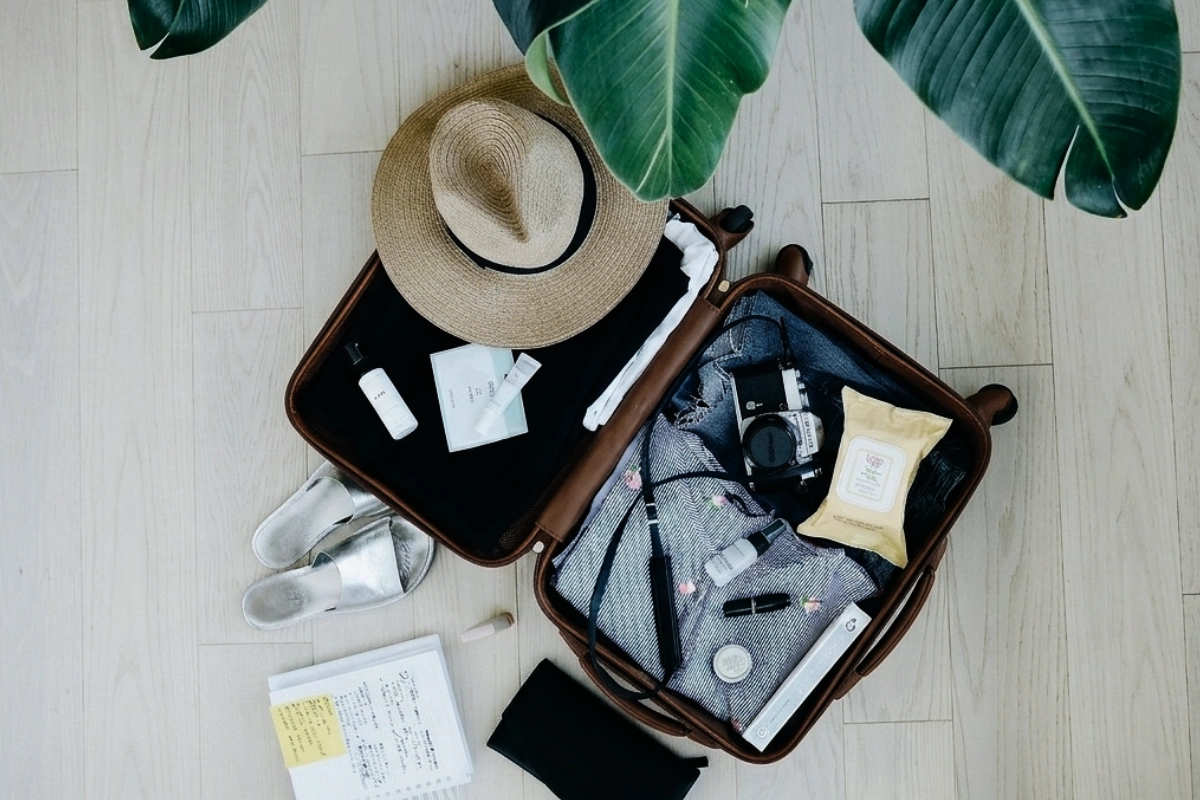
This couple packing list for 2 weeks has been tested across three international trips…Egypt, Dubai, and a 17-day, 4,150 km Turkey road trip…and refined after every single one of them.
We do not pack for two weeks like we are packing for two weeks. We pack like we are packing for five days, and then we plan to wash.
That single shift, made after our first international trip, is the foundation of everything below. A 17-day Turkey road trip and a 9-day Egypt trip both fit into one shared check-in suitcase and two cabin bags. Neither trip required checked-bag fees beyond the standard fare. Neither trip left us short of a clean shirt. The system is not about owning less. It is about making every gram carried do more than one job.
“Every item earns its place by doing at least three jobs. The ones that only do one rarely make the cut.”

The Principle
Every item in the bag earns its place by surviving one question: does this work in at least three different situations on this trip?
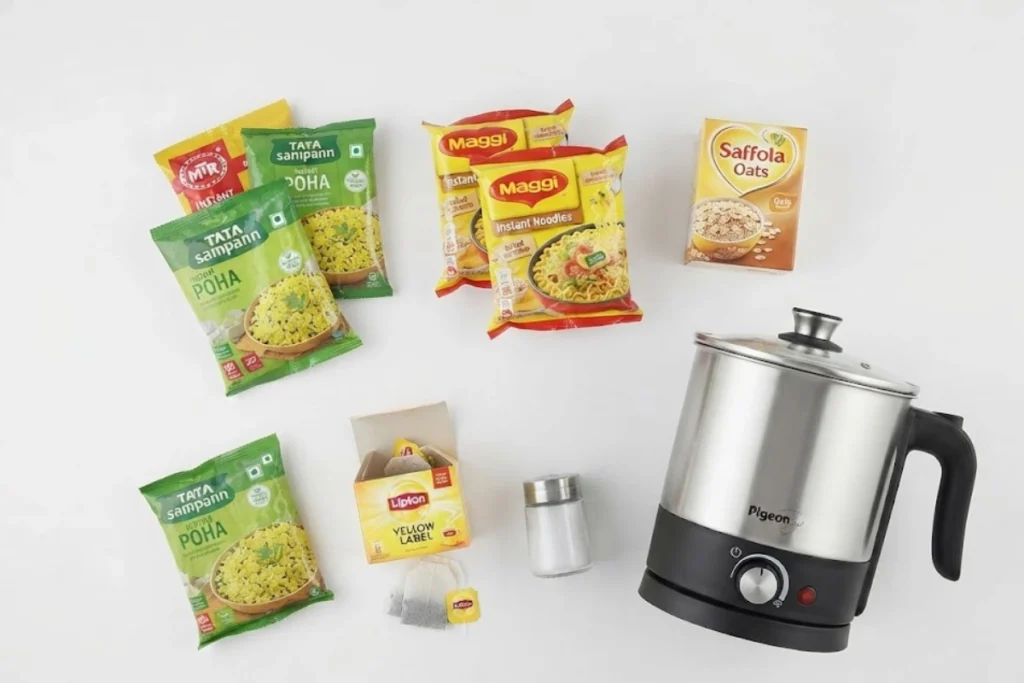
A merino t-shirt works as a base layer, a daywear top, and a sleep shirt in a cold cave hotel. A travel kettle boils water for tea, cooks Maggi, and sterilises a bottle of water. A scarf is sun protection, a head covering for a mosque, and an extra layer on a cold night bus. If an item only does one job, it has to be genuinely essential to make the cut. Most things that only do one job do not make the cut.
The Wardrobe Math
Why Five Tops and Four Bottoms Is Enough
The instinct when packing for two weeks is to pack fourteen outfits. One per day. This is the instinct that produces the overstuffed suitcase and the gate-check fee.
The math works differently. If every top pairs with every bottom, five tops and four bottoms produce twenty unique combinations. Twenty outfits from nine garments. Add a fleece and a jacket as layering options, and the number of distinct looks doubles without adding a single extra item.
The constraint that makes this work is colour. Every garment needs to pair with every other garment. We stick to a simple range: navy, black, grey, olive, white. No patterns that clash. No statement pieces that only work with one specific bottom. The result is a set of clothes that combines in any order and looks intentional rather than repetitive.
Per person, what we carry:
| Type | Count | Selection Logic |
| Tops (t-shirts, shirts) | 5 to 6 | Neutral colours, all interchangeable with all bottoms |
| Bottoms (trousers, jeans, track pants) | 3 to 4 | One jeans, one lightweight trouser, one track pant/pyjama |
| Warm layer | 1 + 1 | One jacket, one fleece…the layer system we built after freezing more than once on a cold night |
| Shoes | 2 | Walking shoes (worn during transit) plus sandals (packed) |
| Undergarments | 7 sets | Washed once, midway through the trip |
Six tops and four bottoms produce twenty-four combinations. Six tops, four bottoms, and two layers produce forty-eight. For a two-week trip, that is more variety than any photographer will notice and less weight than most travellers carry for five days.
The transit-day trick: wear your heaviest items on the plane. The jacket, the jeans, the walking shoes. These three items alone weigh approximately 3 to 4 kg. Wearing them instead of packing them keeps the checked bag 3 to 4 kg lighter, which on a budget airline with a strict cabin limit is the difference between making the cut and paying a surcharge.
Why Fabric Matters More Than Quantity

The Rewear Equation
A cotton t-shirt, after one full day of walking through Hampi at 38 degrees or exploring an archaeological site in the rain, needs washing. It absorbs sweat, holds moisture, and starts developing odour within hours of heavy use.
A merino wool t-shirt, in the same conditions, can be worn for three to five days before it needs washing. This is not marketing. It is the physical structure of the fibre. Merino wool naturally resists bacterial growth because the protein structure of the wool does not provide a surface that bacteria colonise easily. It absorbs up to 30 percent of its dry weight in moisture while keeping the surface dry against the skin. And it does not wrinkle after compression in a bag, which cotton does aggressively.
The practical implication: two merino t-shirts replace five cotton ones. The weight saving is approximately 400 to 600 grams. The space saving is one less packing cube.
We do not carry an entire merino wardrobe. Merino is expensive. What we do is carry two merino base layers for the cold and active days…a desert overnight, a mountain summit, a night drive through a forest corridor…and cotton or cotton-blend t-shirts for the regular days. The merino pieces carry the load on the hard days. The cotton pieces carry the load on the easy ones.
| Fabric | Rewear Days | Dry Time | Wrinkle Recovery | Best For |
| Merino wool | 3 to 5 | Moderate | Excellent | Cold days, active days, long stretches between laundry |
| Cotton blend | 1 to 2 | Slow | Poor | Warm, low-activity days in cities |
| Synthetic (polyester) | 1 | Fast | Excellent | High-sweat activities, humid climates |
The calculation: if merino lets you rewear three times instead of once, you need one-third the number of tops for the demanding portion of the trip. On a 17-day trip with six demanding days (desert, mountains, ruins) and eleven regular days, two merino tops and four cotton tops covers every day with margin.
How to Pack the Bag
Rolling, Folding, and Where Things Go
Two methods. Each for a different type of garment.
Roll: t-shirts, track pants, undergarments, synthetic layers, pyjamas. Rolling into tight cylinders eliminates the air gaps that flat stacking creates. The density improvement is approximately 15 to 20 percent compared to folding. Everything rolled goes into compression packing cubes, which use a second zipper to mechanically force remaining air out.
Flat fold: jeans, trousers, button-down shirts, the fleece. These fabrics wrinkle or bunch when rolled. Lay them flat inside a standard, non-compression packing cube, placed at the top of the suitcase where they will not be crushed.
Where it goes in the bag: heavy items (shoes, toiletries, the travel kettle, jeans) go at the bottom of a rolling suitcase, near the wheels. Light items (rolled t-shirts, undergarments) go at the top. The physics is simple: weight near the wheels lowers the centre of gravity, which prevents the suitcase from tipping when stationary or rolling over uneven ground. We have rolled our bag across cobblestones in Istanbul, gravel in Boğazkale, and broken pavement in Cairo. The heavy-at-bottom rule kept it upright every time.
For the cabin bag, reverse the logic. The document pouch and food kit go on top, accessible without unpacking. The power bank and charger go in a side pocket. The change of clothes…one full set, in case the checked bag is delayed…goes at the bottom.
The Midway Wash
Washing Clothes on Day Eight
A two-week trip with seven sets of undergarments requires a midway wash. On our Turkey trip, this happened more than once, using the simplest possible method: the hotel bathroom sink.
1. Fill the sink with warm water.
2. Add a single laundry detergent sheet. We carry a packet of 30 biodegradable sheets, weighing approximately 50 grams.
3. Soak garments for five to ten minutes. Agitate by hand.
4. Rinse with fresh water.
5. Lay each garment flat on a hotel towel. Roll the towel into a cylinder and press firmly. The towel absorbs most of the water from the garment.
6. Hang on the shower rod, door handle, or a compact elastic travel clothesline.
Drying time: lightweight synthetics and merino dry overnight. Cotton takes 12 to 18 hours in a ventilated room. In humid conditions, or if the hotel room has no ventilation, hang garments near an air conditioning vent.
What this enables: seven sets of undergarments, washed once at the midpoint, cover a 14-day trip. Without the midway wash, you would need fourteen sets, doubling the space and weight allocation for undergarments alone.
What we add to the packing list for this: biodegradable laundry detergent sheets (30-pack, approximately 50 grams) and one compact elastic clothesline, no pegs needed, the twisted design grips fabric between the cords. Combined weight: under 100 grams. Combined value: it eliminates the need for hotel laundry services, which in tourist areas can cost INR 100 to 300 per garment…meaning a single load of ten items could otherwise cost INR 1,000 to 3,000.
Toiletries: The Liquid Problem
Replacing Liquids with Solids
International airport security enforces the 3-1-1 rule on liquids in cabin bags: all liquids, gels, and creams must be in containers of 100 ml or smaller, all fitting inside a single clear plastic bag. This is the rule that makes you pour expensive shampoo into tiny bottles and pray that the cap holds.
The solution: stop carrying liquids.
Solid alternatives to every standard toiletry exist, weigh less, last longer, and bypass the 3-1-1 rule entirely because they are not classified as liquids.
| Liquid Product | Solid Alternative | Approximate Lifespan |
| Shampoo bottle (200 ml) | Solid shampoo bar | 60 to 80 washes |
| Conditioner bottle (200 ml) | Solid conditioner bar | 50 to 60 washes |
| Body wash (250 ml) | Bar soap | 3 to 4 weeks of daily use |
| Toothpaste tube (100 ml) | Toothpaste tablets | 60 to 120 tablets per tin |
| Deodorant spray (150 ml) | Crystal mineral deodorant stick | 6 to 12 months |
The volume reduction: a standard liquid toiletries bag occupies approximately 350 to 400 cubic centimetres. The solid equivalent occupies approximately 100 to 120 cubic centimetres…a 70 percent reduction in toiletry volume, which in a carry-on bag is the difference between fitting everything and not fitting everything.
The practical note: solid soap bars left in sealed plastic bags turn to mush. Carry them in a breathable pouch or a container with ventilation holes. The bar dries between uses and lasts the full trip.
We have not fully transitioned to an all-solid kit. We carry a mix: solid shampoo bar, regular bar soap, toothpaste tablets, and a few small liquid items (sunscreen, prescribed medication) in a compliant clear bag. The hybrid approach captures most of the volume savings without requiring a complete product overhaul.
The Tech Setup
eSIM: we used a Nomad eSIM for Turkey, approximately INR 4,000 for data only. It activated automatically on landing. For Egypt, we skipped the airport SIM queue and regretted it for the rest of the trip. The rule: if the destination supports eSIM, activate before departure. If it does not, buy the physical SIM at the airport. Accept the queue.
One charger to replace three: a GaN universal adapter replaces the separate phone charger, laptop charger, and camera charger that most travellers carry. GaN technology produces higher power output from a physically smaller unit than traditional silicon chargers. A single 65-watt GaN adapter with multiple USB-C and USB-A ports charges a laptop, a phone, and a power bank simultaneously from one wall socket. We carry one universal adapter with slide-out prongs for Type C (Europe, Turkey), Type G (Dubai), and Type D (India). One device. Every country. Every gadget.
The weight saving compared to carrying separate chargers: approximately 300 to 500 grams, plus the elimination of a tangle of cables that always ends up knotted around something else.
Power bank: a 20,000 mAh unit covers two full phone charges. On a desert overnight, it was the only power source for an entire night and the drive back. On long Turkish driving days, it kept navigation running when the car USB port was unreliable. On cold nights, phone batteries drain faster…lithium-ion batteries measurably lose efficiency below 10°C. The power bank compensates.
Offline maps: downloaded before entering any zone with unreliable connectivity. A forest corridor in Karnataka: no signal. Eastern Turkey between two remote archaeological sites: intermittent. The Egyptian desert: nonexistent. Download the relevant Google Maps region over hotel WiFi the night before. Storage cost: approximately 200 to 500 MB per region. Value: every correct turn in a country where you do not speak the language.
If You Must Check a Bag
Protecting the Checked Suitcase
Our standard is one shared check-in suitcase plus one cabin bag each. The cabin bags carry everything irreplaceable: documents, tech, food kit, one change of clothes. The checked bag carries everything recoverable: the majority of clothing, shoes, and toiletries.
If the checked bag is lost, we can function for 48 hours from what is in the cabin bags while the airline locates it. This is the design principle: the cabin bags are the survival kit, the checked bag is the resupply.
1. Remove all old routing labels. Automated airport sorting systems read barcodes. An old label from a previous flight can confuse the scanner and misroute the bag. We strip every previous sticker before each trip.
2. Place a Bluetooth tracker inside. An AirTag or equivalent, tucked into an internal pocket, provides real-time location tracking. If the bag does not appear on the carousel, we can tell the airline desk exactly where it is, which converts a multi-day recovery into a same-day delivery in most cases.
3. Photograph the bag and its contents before check-in. Exterior and interior. If the bag is lost or damaged, these photographs are the evidence that insurance and airline claims require. The thirty seconds this takes has a potential return of thousands of rupees.
Identification: our contact details (email and phone, not home address) are on the external luggage tag. A copy of the trip itinerary is inside the bag. If the external tag is torn off during handling, the internal itinerary tells any airline agent where to forward it.
The Actual List
For reference: the consolidated system for a two-week international trip.
- Clothing per person: 5 to 6 tops (2 merino for demanding days, 3 to 4 cotton blend for regular days), 1 jeans, 1 lightweight trouser, 1 track pant, 7 sets of undergarments, 1 warm jacket, 1 fleece or sweater, 1 scarf, 1 hat, 1 pair walking shoes (worn during transit, not packed), 1 pair sandals.
- Food kit (shared): instant poha, Maggi, oats, vermicelli, tea bags, salt, pepper, travel kettle. Approximately 2.5 kg.
- Tech (shared): 2 phones, 1 power bank (20,000 mAh), 1 GaN universal adapter (65W, multi-port), earphones. eSIM or local SIM confirmed before departure.
- Laundry kit (shared): biodegradable detergent sheets (30-pack), compact elastic clothesline. Under 100 grams combined.
- Documents (shared): printed flights, hotel confirmations, visa, IDP plus photocopy, passport photocopies, insurance, emergency contacts. Waterproof pouch.
- Walking kit (shared): sunscreen, 2 reusable water bottles, 1 daypack, hat.
- Toiletries (per person): solid shampoo bar, bar soap, toothpaste tablets or tube, crystal deodorant, prescribed medication, basic first-aid (pain relief, antacid, anti-diarrheal, band-aids). Compact bag. Liquids in compliant clear bag if any remain.
- Luggage protection (shared): 1 Bluetooth tracker in checked bag, contact details on tag, itinerary copy inside bag.
- Total bag count: 1 check-in suitcase (shared) plus 1 cabin bag each. Cabin bags carry documents, tech, food kit, and one change of clothes.
The Weight Calculation
Budget airlines enforce weight limits strictly. Knowing the exact limits for the airlines you fly prevents surcharges that can exceed the cost of a meal.
| Airline | Cabin Bag Dimensions | Cabin Limit | Check-in Allowance | Enforcement |
| Air Arabia | 55 × 40 × 20 cm | 10 kg | 20–30 kg (by fare) | Moderate–high |
| IndiGo | 55 × 35 × 25 cm | 7 kg | 15–25 kg (by fare) | High; weighed at counter |
| Emirates | 55 × 38 × 20 cm | 7 kg | 30 kg | Low; rarely weighed |
| Etihad | 56 × 36 × 23 cm | 7 kg | 23–30 kg | Low–moderate |
Our approximate packed weights: check-in suitcase (shared), 15 to 18 kg. Cabin bag 1, 6 to 7 kg. Cabin bag 2, 6 to 7 kg. Total carried for two people: 27 to 32 kg.
How the system stays within limits: the food kit (2.5 kg) and the travel kettle (0.5 kg) together weigh 3 kg. On a strict 7 kg cabin limit, that is 43 percent of the allowance for one cabin bag. The offset comes from what we do not carry: no sleeping bag (1.5 kg saved), no guidebook (0.3 to 0.5 kg saved), no formal shoes (0.8 kg saved), no excess liquid toiletries (0.5 to 1 kg saved by switching to solids). Total eliminated weight: 3.1 to 3.8 kg. The net effect is that the food kit and kettle fit comfortably within the weight freed by removing items we proved unnecessary.
The transit-day offset: wearing the jacket (0.8 kg), jeans (0.7 kg), and walking shoes (0.8 kg) during the flight removes approximately 2.3 kg from the bag. On a 7 kg cabin limit, that 2.3 kg is the margin between compliance and a surcharge.
The system is not theoretical. It has passed the weight check on Air Arabia, IndiGo, Emirates, and Etihad across three international trips without a single surcharge.
“The bag is not the point. It is the thing that gets out of the way so the trip can happen. Pack light enough that you stop thinking about the suitcase by Day 3, and you will remember the temple, not the zipper that would not close.”