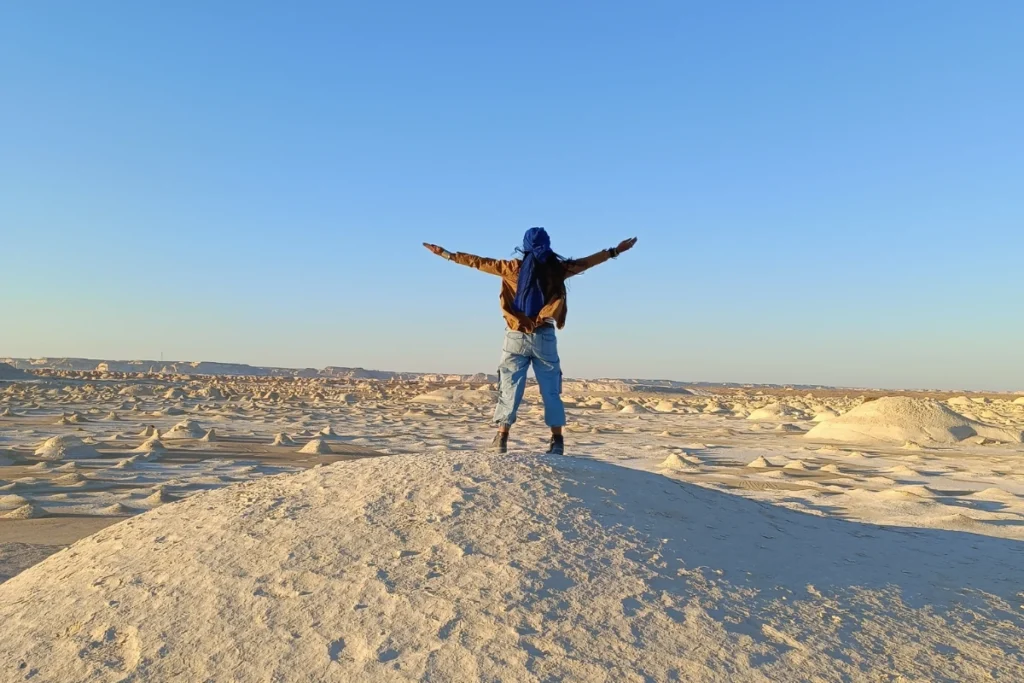
This Egypt black & white desert safari experience guide is built from Day 3 and Day 4 of our nine-day Egypt trip…the two days we almost did not book, that became the two days we have not stopped thinking about.
We woke up early on our third morning in Egypt and did something that should not have felt as difficult as it did: we left the pyramids.
Two days of breakfast on the Sahara Pyramids Inn rooftop with three pyramids in front of us. Two days of walking inside structures that should not exist. Two days of a view that had lived in our heads since childhood, finally real, finally right there. And now we were getting into a car and driving away from it.
The feeling lasted about an hour. Then the desert took over.
The drive from Cairo to the Bahariya Oasis takes four to five hours through the western desert. The city disappears. The noise disappears. The green disappears. What replaces it is a landscape that does not negotiate with your expectations. It is flat, dry, and enormous, and it makes no effort to be anything other than what it is.
Somewhere during that drive, the scale of what we were doing arrived. We were two people from Bengaluru, IT professionals, ordinary in every measurable way, driving into the Sahara Desert to camp overnight under stars in a landscape that was already ancient when the first pyramid was conceived. The pyramids are 4,500 years old. The desert formations we were driving toward are 180 million years old. The gap between those numbers is the gap between human ambition and geological indifference.
We were about to sleep in the space between them.
“The pyramids are 4,500 years old. The desert formations we were driving toward are 180 million years old. The gap between those numbers is the gap between human ambition and geological indifference.”
- What Is the Black and White Desert Safari?
- How the Desert Begins: The Bedouin Lunch
- The Black Desert: Where the Jurassic Period Is Visible
- Crystal Mountain: A Meteorite Left This Here
- The Agabat Valley: Standing on a Dried Sea
- Sandboarding: Doing Something Badly in a Beautiful Place
- Camping in the Sahara: What Nobody Tells You
- The Sky at Zero Light Pollution
- The Morning After: The Breakfast That Changed the Standard
- Mahmood: The Guide Who Changed the Tone
- How to Book the Desert Safari
- What It Costs
- Before You Go: What Actually Matters
- Frequently Asked Questions About the Egypt Desert Safari
What Is the Black and White Desert Safari?
The Black and White Desert safari is a 2-day, 1-night overland expedition through Egypt’s western Sahara, departing from the Bahariya Oasis. The route covers four distinct landscapes in sequence: the Black Desert (Jurassic-era volcanic formations), Crystal Mountain (a meteorite impact site studded with natural crystals), the Agabat Valley (an ancient seabed with visible fossilised oyster shells), and the White Desert (a surreal field of chalk-white limestone formations sculpted by millions of years of wind erosion). The experience includes a Bedouin lunch on arrival, sandboarding near the Agabat Valley, overnight desert camping with a fire, and sunrise breakfast in the White Desert.
Most Egypt itineraries skip the western desert entirely and route travellers directly from Cairo to the Nile. That omission removes the most extraordinary landscape in a country famous for extraordinary landscapes.
We booked the 2D1N package before leaving India, through an operator contacted online. The total cost was approximately INR 25,000 for two people, all-inclusive: transport, all meals, water, camping equipment, and our Bedouin guide and driver, Mahmood.
How the Desert Begins: The Bedouin Lunch
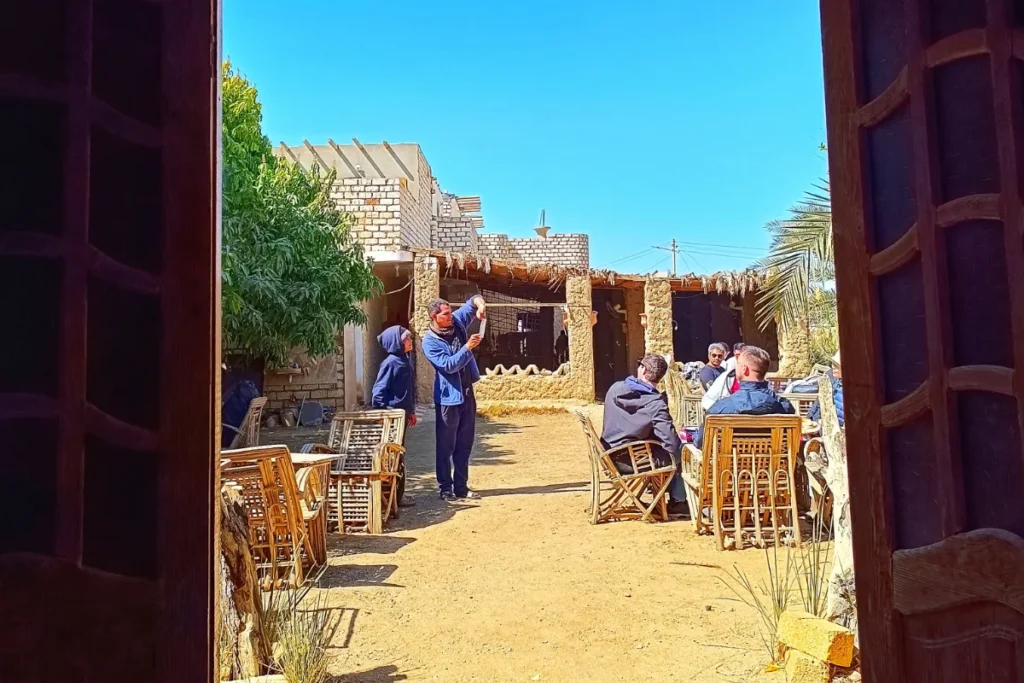
The first stop after the drive was a Bedouin settlement near the Bahariya Oasis.
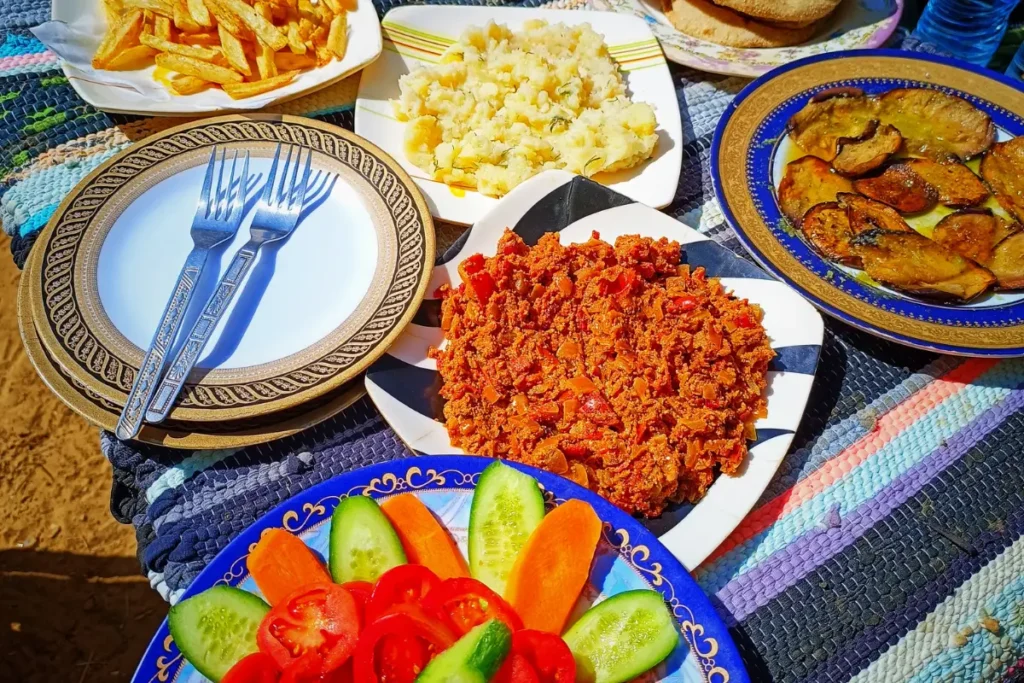
The Bedouin home where we had lunch was not a restaurant. It was a living space adapted for travellers: low seating arrangements on the ground, a cooking area, handmade decorations on the walls. The food arrived in quantities that assumed we were four people, not two: mashed potatoes, French fries, fried eggplant, salad, beans, Bedouin-style scrambled eggs, and Egyptian flatbread.
Everything was unfamiliar and everything was good. The recipes were new to us — as Indians, our palates are calibrated differently…but the flavours had a warmth and simplicity that crossed the gap. We ate until we could not, thanked the family, and stepped into Mahmood’s vehicle.
“Now,” Mahmood said, “the desert.”
The Black Desert: Where the Jurassic Period Is Visible
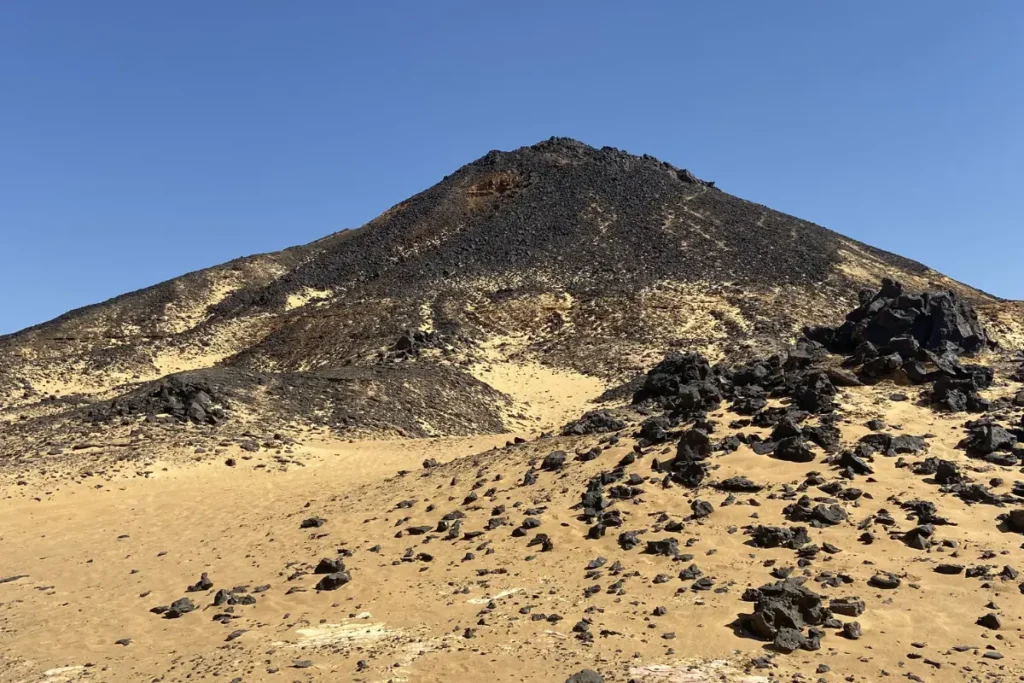
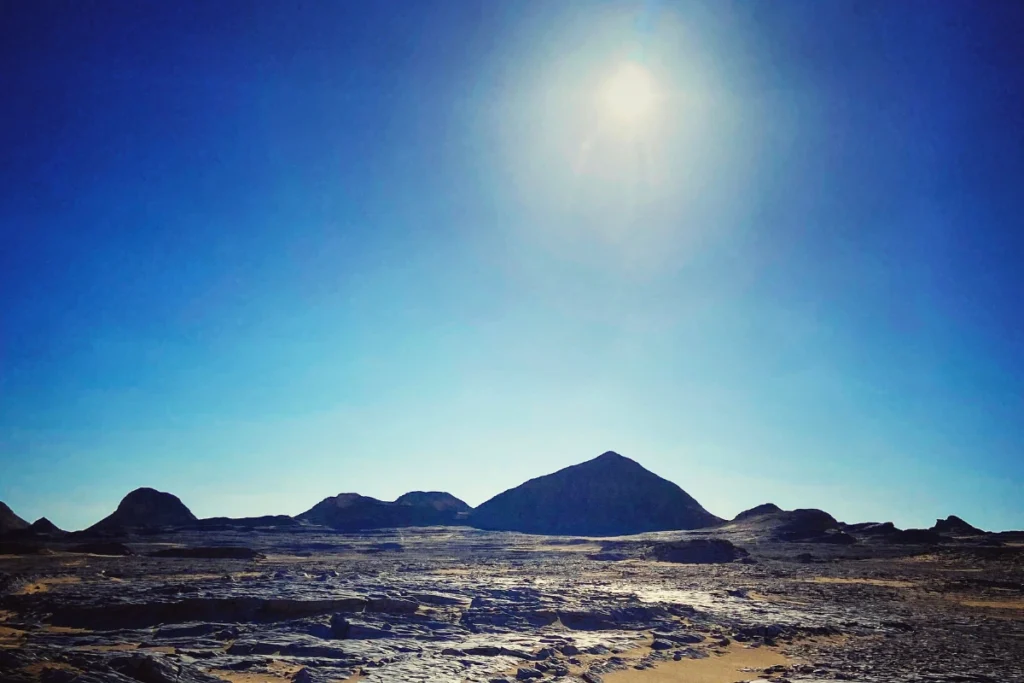
The first thing that changes is the colour.
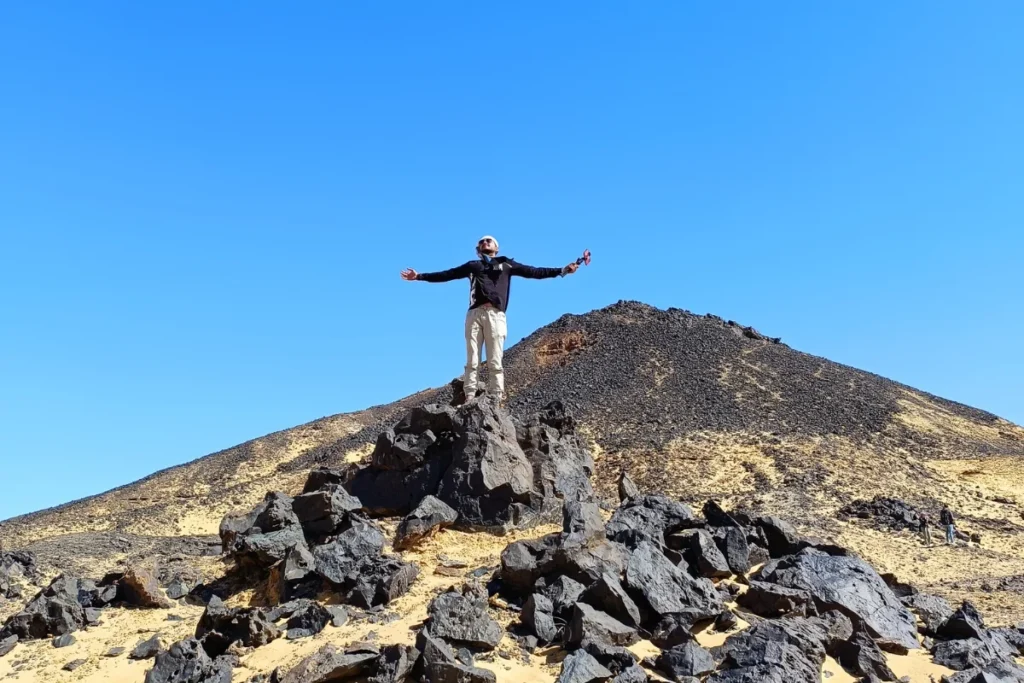
The sandy beige of the drive gives way, over a few kilometres, to black. The landscape darkens as though someone is slowly adjusting the saturation of the earth itself. Then the formations appear: hills and mounds covered in black basalt and dolerite, remnants of volcanic eruptions from approximately 180 million years ago, during the Jurassic period.
Let that number settle. 180 million years. Dinosaurs walked the earth when these eruptions happened. The black rock you are looking at solidified before most of what we call “the ancient world” had any reason to exist.
We climbed one of the smaller volcanic mounds. Cold February wind pulling at our jackets. From the top, the view extended in every direction without interruption: black formations against pale sand against a sky that was too blue and too large.
What we felt is: “This does not feel like being on Earth.”
It did not. It felt like a place that predates the concept of places. A landscape formed before anything was alive to see it, unchanged since. The feeling is not beauty, exactly. It is something closer to confrontation. The Black Desert makes you aware that you are standing on a planet, not in a country.
Crystal Mountain: A Meteorite Left This Here
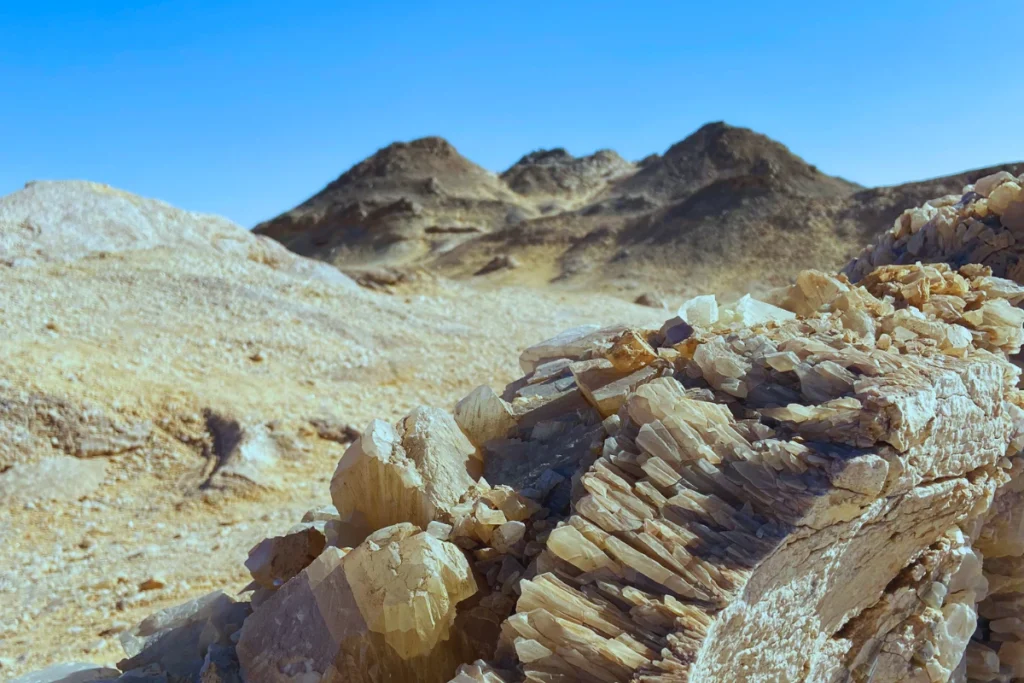
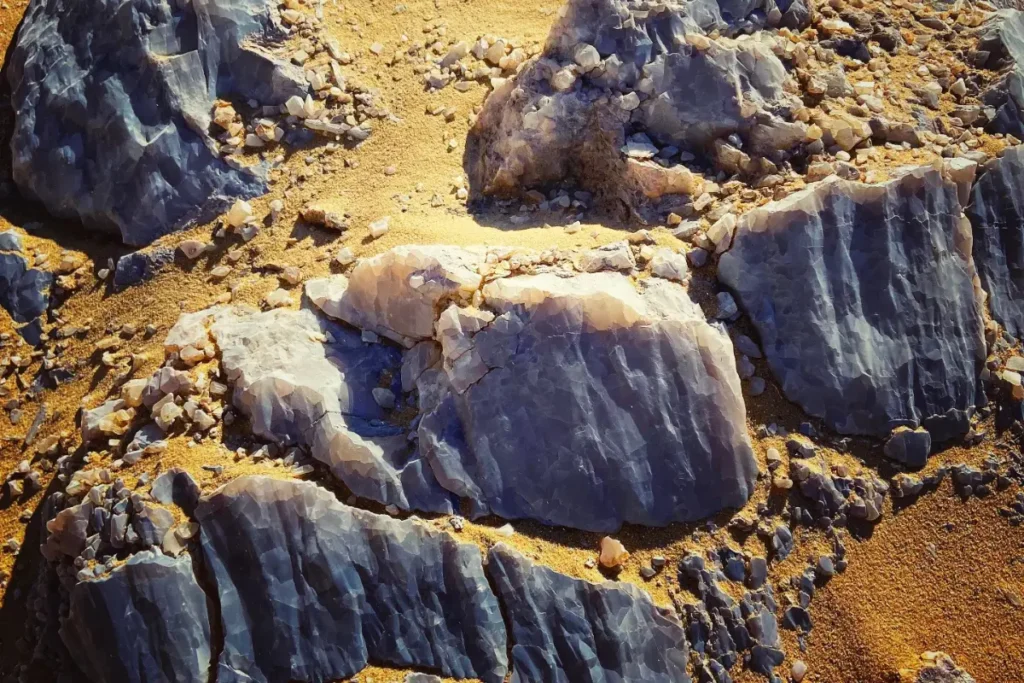
Further into the desert, the volcanic black gives way to something that catches the light differently.
Crystal Mountain is a low ridge formed by a meteorite impact millions of years ago. The heat of the collision melted the surrounding stone into natural crystals, and the surface glitters. Not metaphorically. Actually glitters. In direct sunlight, the ground around Crystal Mountain looks like someone scattered broken glass across the sand, except the glass is naturally formed quartz crystal embedded in rock.
We picked up pieces and held them to the light. The facets caught the sun and threw small rainbows into the air. We found a particularly clear piece and held it up…the video from that moment is still one of our favourite clips from the entire Egypt trip. Once, the crystals here were large and plentiful. Visitors have taken most of the major pieces over the years. What remains is smaller but still extraordinary: a field of natural crystal in the middle of the Sahara, left by something that fell from space.
There is a specific feeling that comes from holding a crystal formed by a meteorite impact, knowing that the object you are touching exists because something collided with the Earth millions of years before any human existed to notice. It is a small, quiet feeling. It does not compete with the pyramids for drama. But it stays.
The Agabat Valley: Standing on a Dried Sea
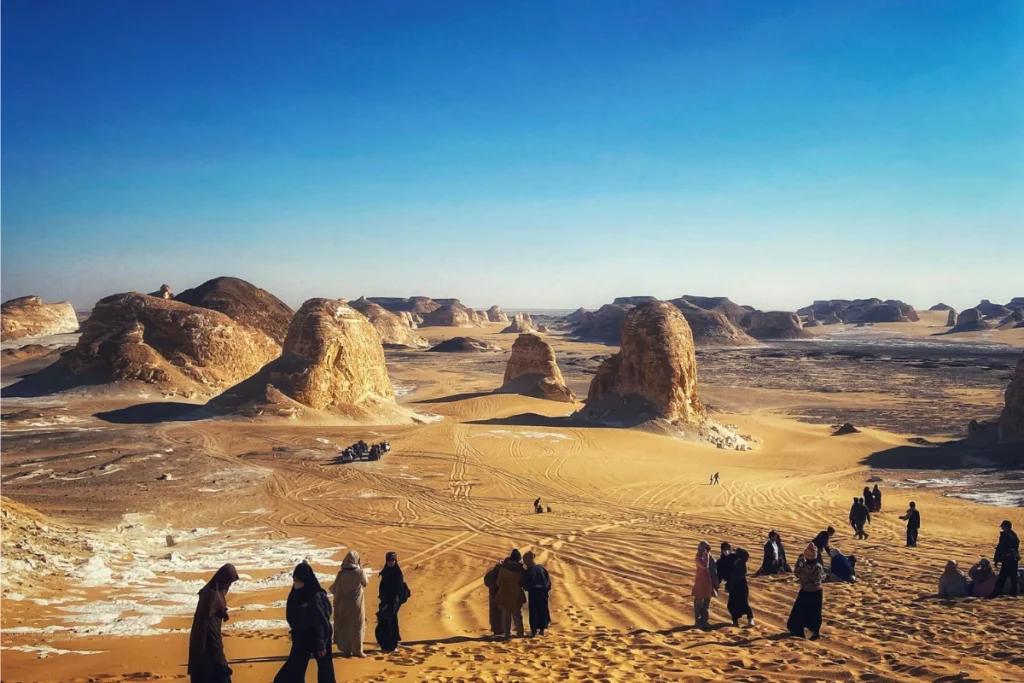
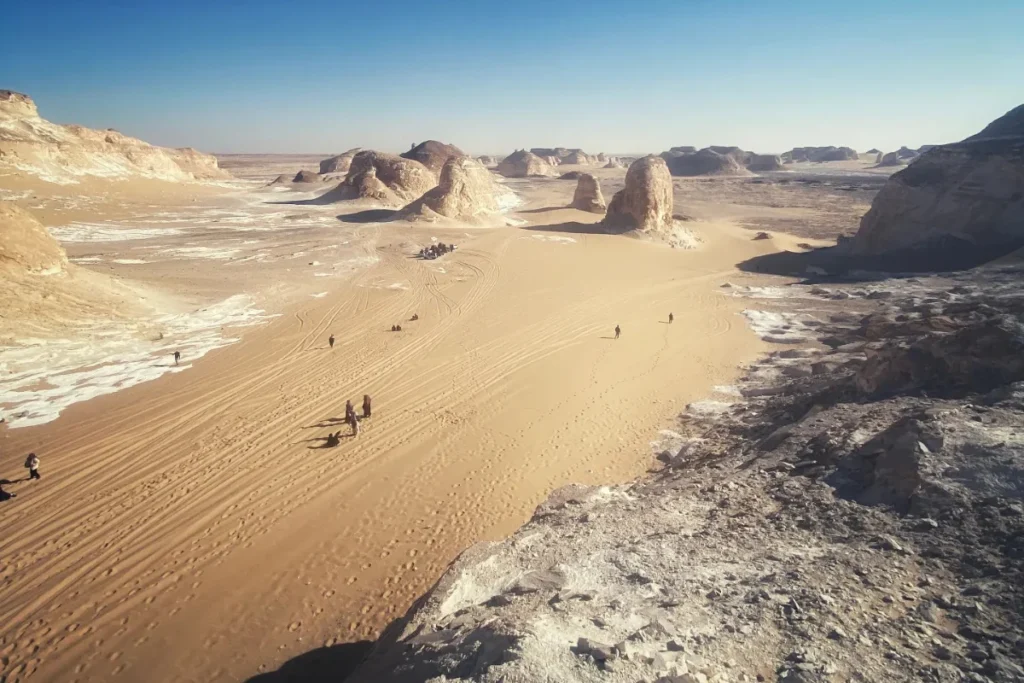
The valley appeared around a curve, and the landscape changed again.
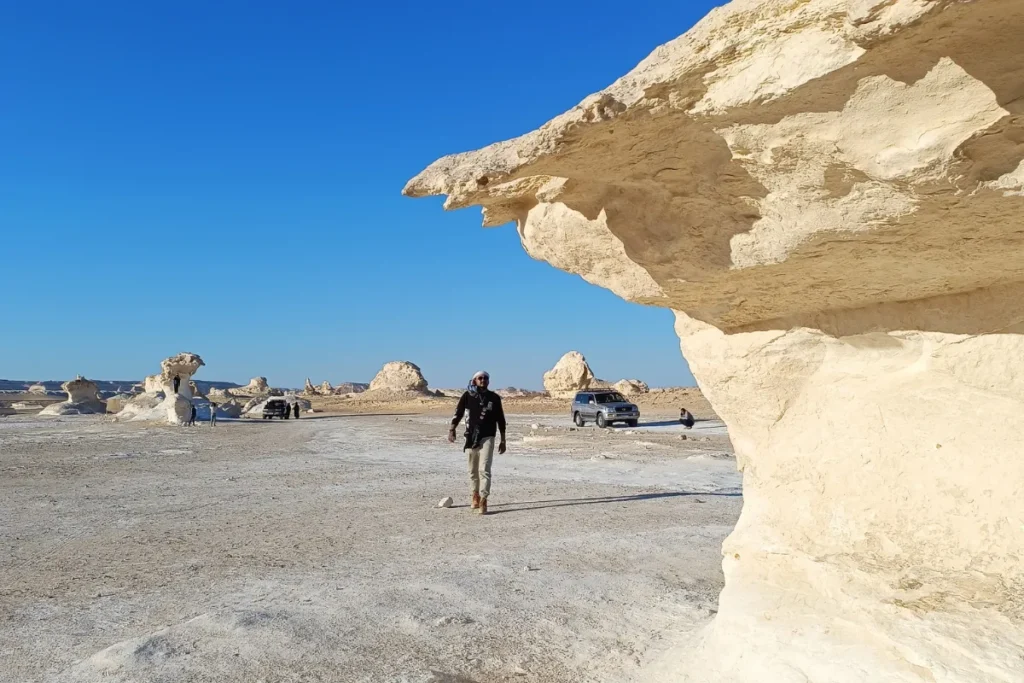
The Agabat Valley is a field of massive white limestone formations rising from golden sand. The formations have been sculpted by wind erosion over millions of years into shapes that look deliberate but are entirely natural: towers, arches, mushrooms, abstract figures. The white is vivid against the gold. The scale is disorienting.
But the detail that stopped us was not the formations. It was what was inside them.
Among the rocks, visible if you look carefully, are fossilised oyster shells. Embedded in the limestone, preserved by the mineral content of the stone. This valley was the floor of an ancient sea. Millions of years ago, the spot where we were standing was underwater. The limestone that now rises from the sand was once a seabed where marine life lived and died and was compressed into rock.
Standing on a dried sea in the middle of the Sahara Desert, looking at the shells of creatures that swam here before the desert existed, produces a specific kind of vertigo. Not physical. Temporal. The feeling of standing on a timeline so long that your own existence is not even a rounding error.
So how do we define this experience? Simply, for us, “it feels like a dream.”
Sandboarding: Doing Something Badly in a Beautiful Place
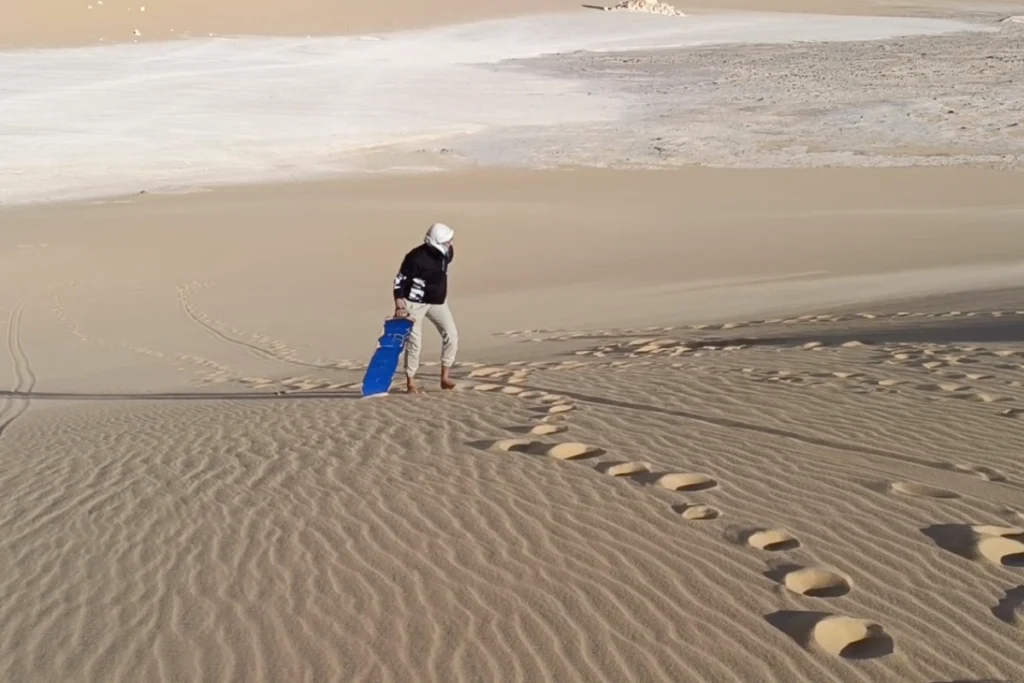
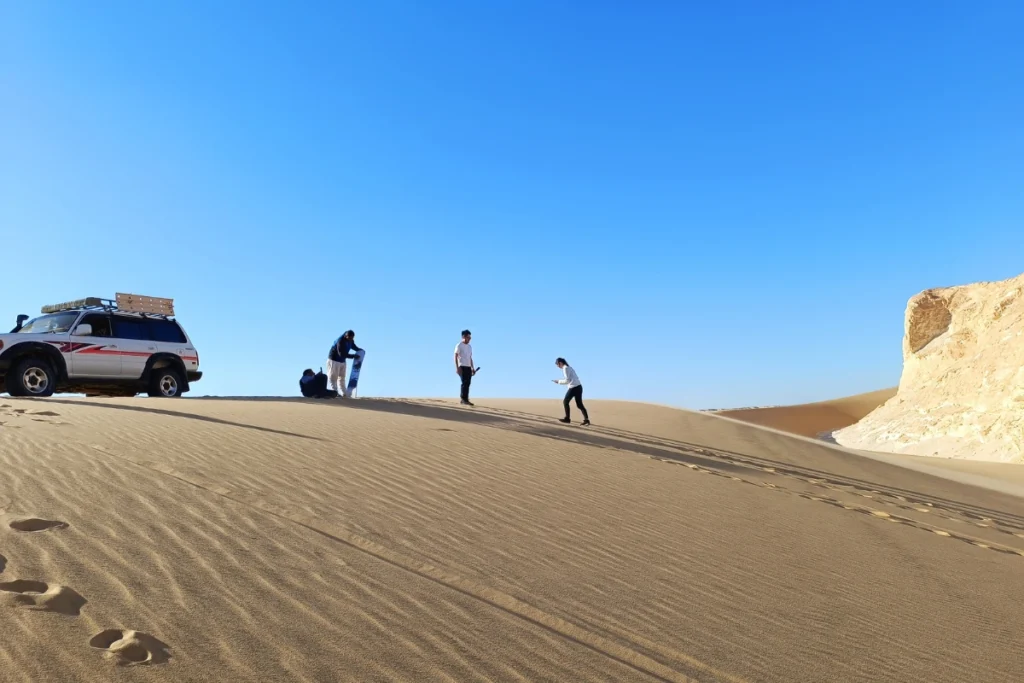
Between the Agabat Valley and the White Desert, the dunes offered an opportunity we had not expected.
Sandboarding is, on the face of it, straightforward: you stand on a board at the top of a sand dune and slide down. In practice, sand offers less predictable resistance than snow. The board catches, jerks, accelerates, and occasionally stops without warning.
Neither of us demonstrated anything resembling athleticism. It did not matter. The dune was large, the sunset was approaching, and the specific joy of doing something badly in a beautiful place is underrated.
As the afternoon light shifted toward golden hour, we entered the White Desert.
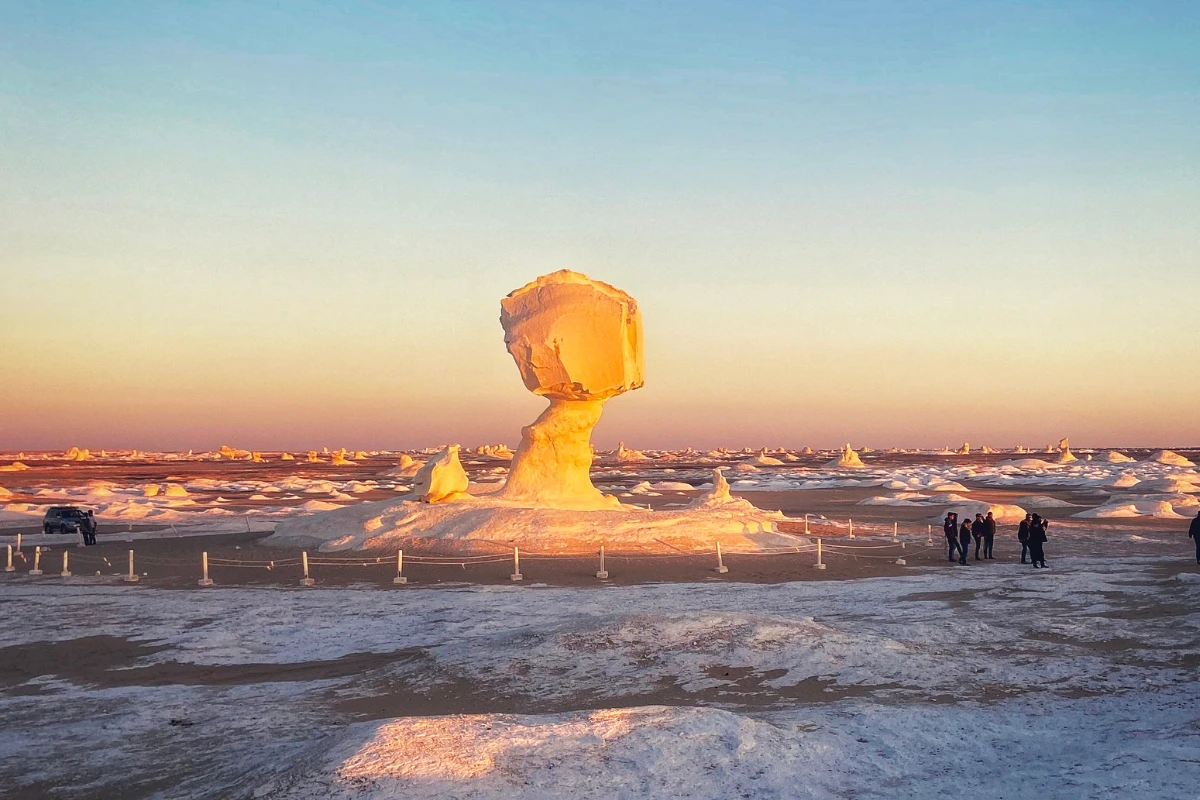
Sahara el Beyda…the White Desert…is a protected national park where chalk-white limestone formations rise from the sand in shapes that do not look real. Millions of years of wind erosion have carved the soft chalk into forms that resemble mushrooms, pillars, animals, and abstract sculptures. Some are the height of a person. Others are the height of a building.
The formations change colour as the sun moves. In the afternoon, they are cream-white. At sunset, they turn gold and amber. At twilight, they go grey-blue against a darkening sky. And then the stars come out.
We drove through formations that looked like ice, that looked like snow, that looked like the architecture of a civilisation that had never existed. Mahmood pointed out the mushroom formation and the chicken formation with the calm familiarity of someone who has seen them every day for years and still finds them worth pointing out. Our camp was set up near the mushroom. He stopped the vehicle, unloaded the supplies, and began building a fire.
Camping in the Sahara: What Nobody Tells You
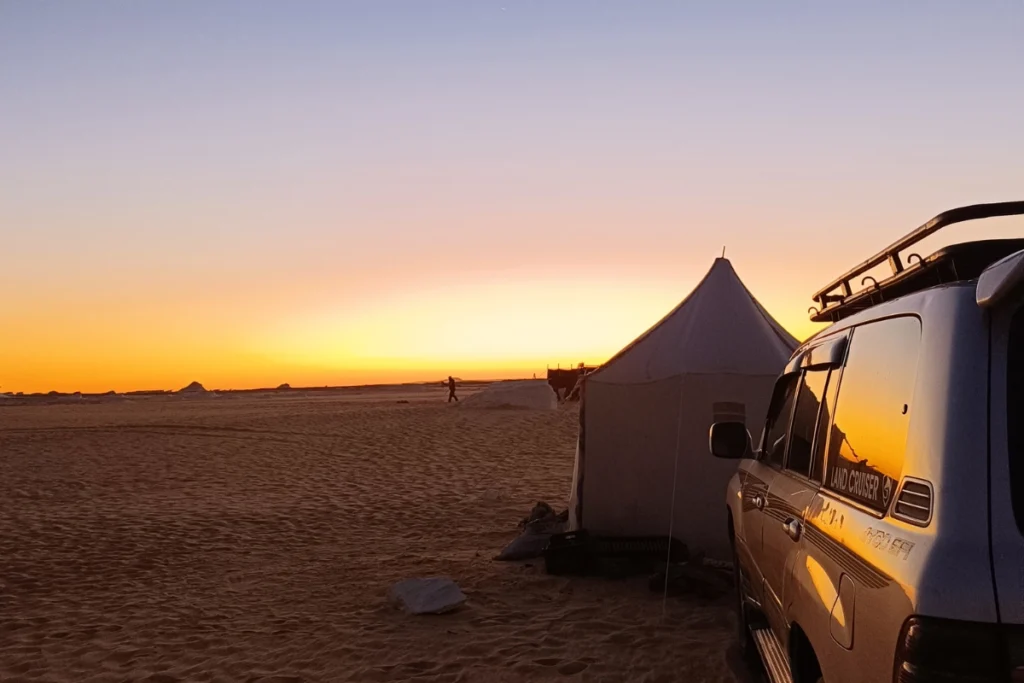
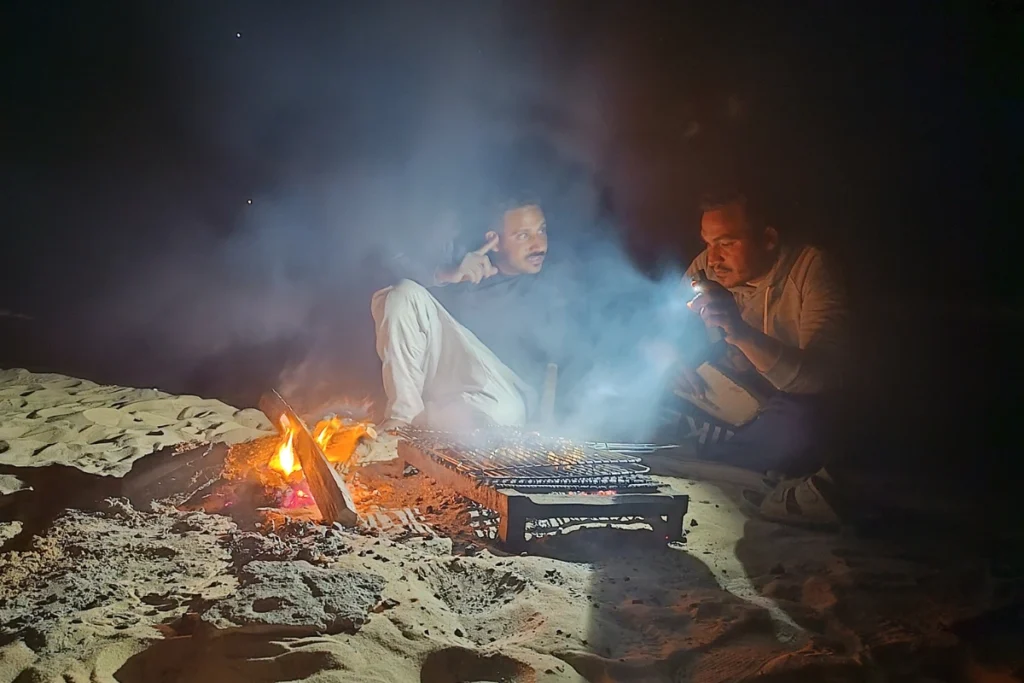
The fire took time against the wind.
This is the first thing to know about desert camping: the wind does not stop. In February, the Sahara’s night wind is not gentle. It is cold and persistent and it treats fire as a personal challenge. Mahmood built the fire with the patience of someone who has done this calculation a thousand times. We tried to help. Our help was mostly symbolic.
The camp was simple. Sleeping bags on the sand, a few blankets, a flat area near the vehicle for cooking. No tent. No structure between us and the sky except the curve of the Earth.
The second thing to know: the cold is not what you expect. During the day, the desert was warm enough for light jackets. By sunset, the temperature had dropped noticeably. By midnight, the cold was beyond what the word communicates. A desert stores no heat overnight. The temperature drops with the efficiency of a system designed to expel warmth. We were wearing every layer we had brought and it was not enough.
The third thing to know: none of this mattered.
“None of the cold mattered. None of the wind mattered. Because of what happened when the fire died down and the sky opened.”
The Sky at Zero Light Pollution
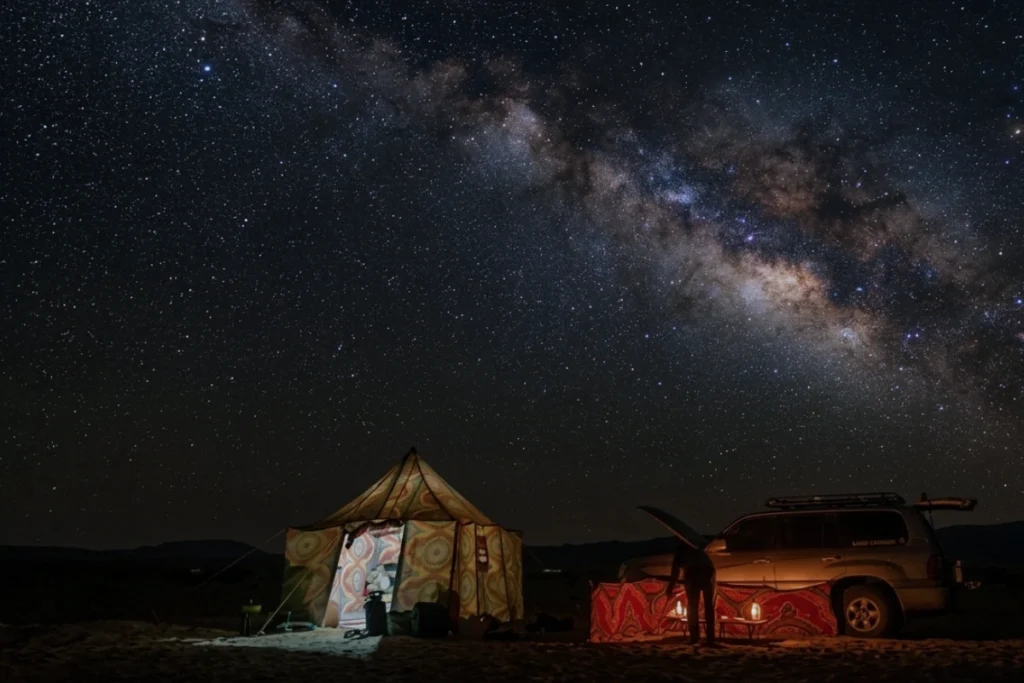
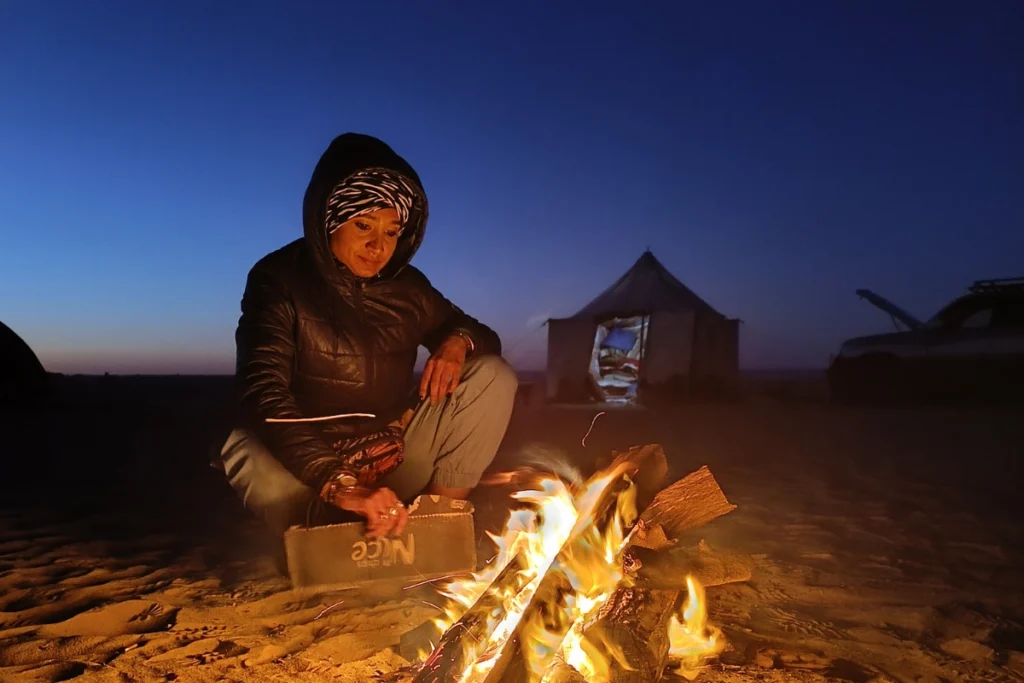
This section is the reason we are writing this article.
We lay on our backs on the sand and looked up.
The nearest artificial light was hundreds of kilometres away. The nearest city, even further. There was no glow on the horizon. No ambient brightness. No diffusion of the dark. There was the sand beneath us, the cold around us, and the sky above us, and the sky was not what we had ever seen before.
The Milky Way was not a faint smear. It was a physical presence across the sky…a dense, luminous band of light that looked like someone had torn a strip out of the darkness and revealed what was behind it. Stars filled every available space. Not dozens. Not hundreds. Thousands. The density was so extreme that the familiar constellations were nearly impossible to identify because there were too many stars in between.
The sky did not look like a sky. It looked like the actual universe, which is what it was, except that in cities we only ever see a dim, filtered suggestion of it. In the White Desert, the filter is gone.
For a stretch of time that felt both short and very long, neither of us spoke. There was nothing to say that would have been more accurate than silence.
We have traveled to several countries since that night. We have seen remarkable things. Nothing has replicated what the sky looked like from the floor of the White Desert in February at 2 AM.
The Morning After: The Breakfast That Changed the Standard
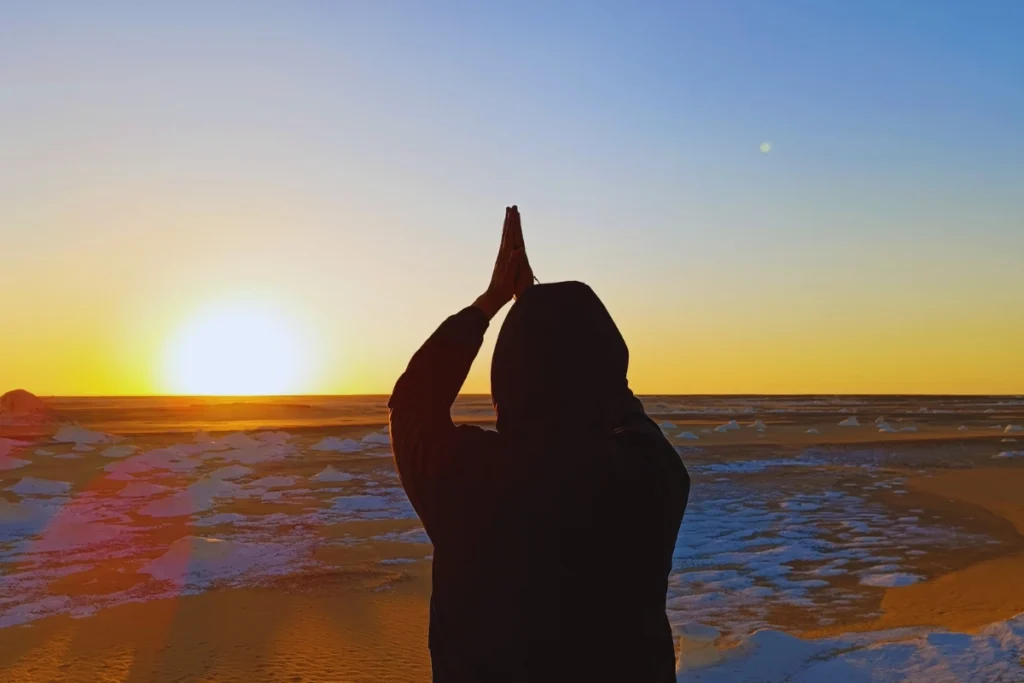
We woke before sunrise.
The White Desert at dawn is a different landscape from the one we had camped in. The formations, which at night were grey silhouettes against the star field, were now turning blue in the pre-dawn light, then pink, then gold as the sun appeared on the horizon.
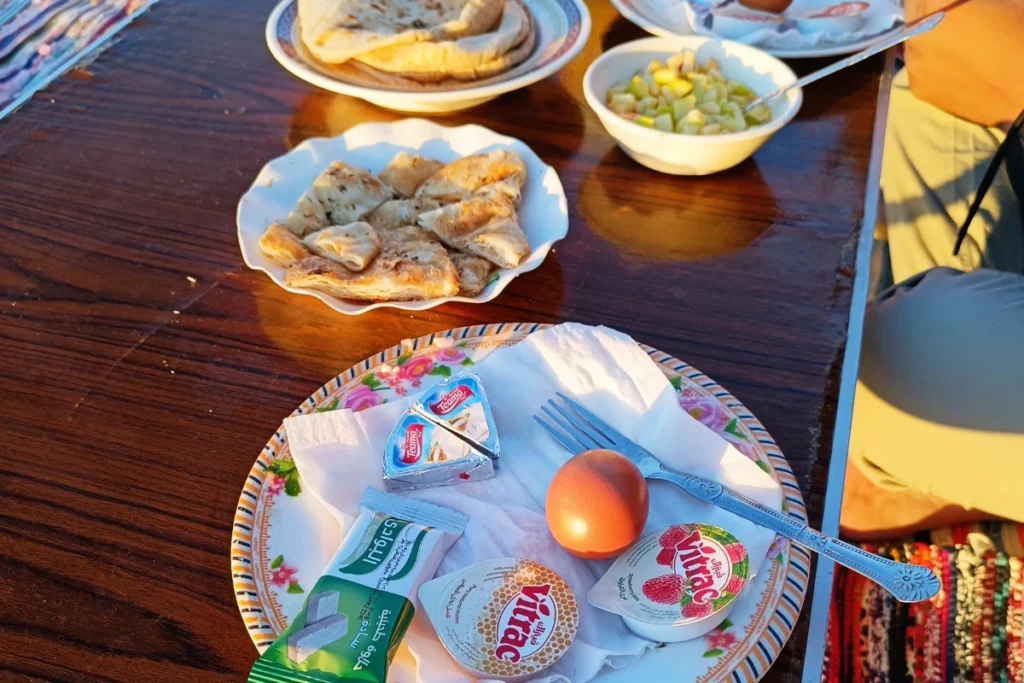
Mahmood was already awake. He had started preparing breakfast on the camp fire: Egyptian flatbread baked on the flames, tahini, olives, scrambled eggs, and fruit. We sat on a blanket on the sand, surrounded by limestone formations casting long morning shadows, and ate.
We have not eaten a more memorable breakfast anywhere.
Not at hotel rooftops in front of pyramids. Not at Turkish pensions with spreads of cheese and olives. Not at any restaurant in any city. The breakfast in the White Desert, eaten on the sand with our hands, cold morning air on our faces, the formations golden in the early light, Mahmood sitting across from us eating the same food and calling us “brother” and meaning it…that was the breakfast against which every breakfast since has been quietly measured.
The quality of that morning was not about the food. It was about the accumulation: the volcanoes, the crystals, the seabed, the sandboarding, the formations, the wind, the cold, the stars, the silence. All of it had happened in the previous twenty-four hours. The breakfast was the moment where the accumulation arrived and we sat inside it.
Mahmood: The Guide Who Changed the Tone
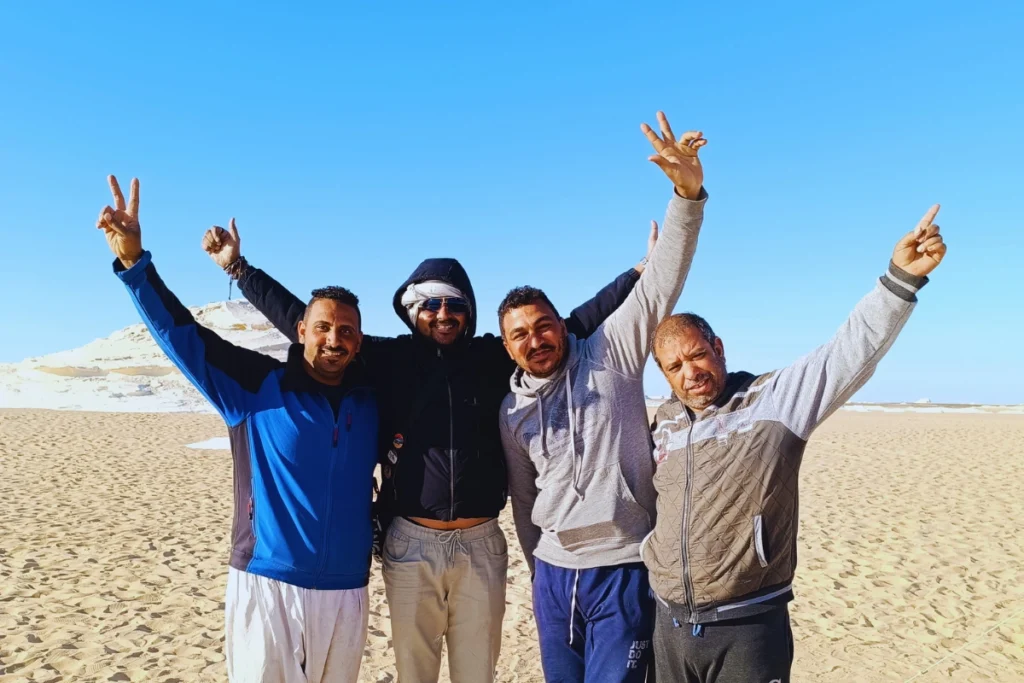
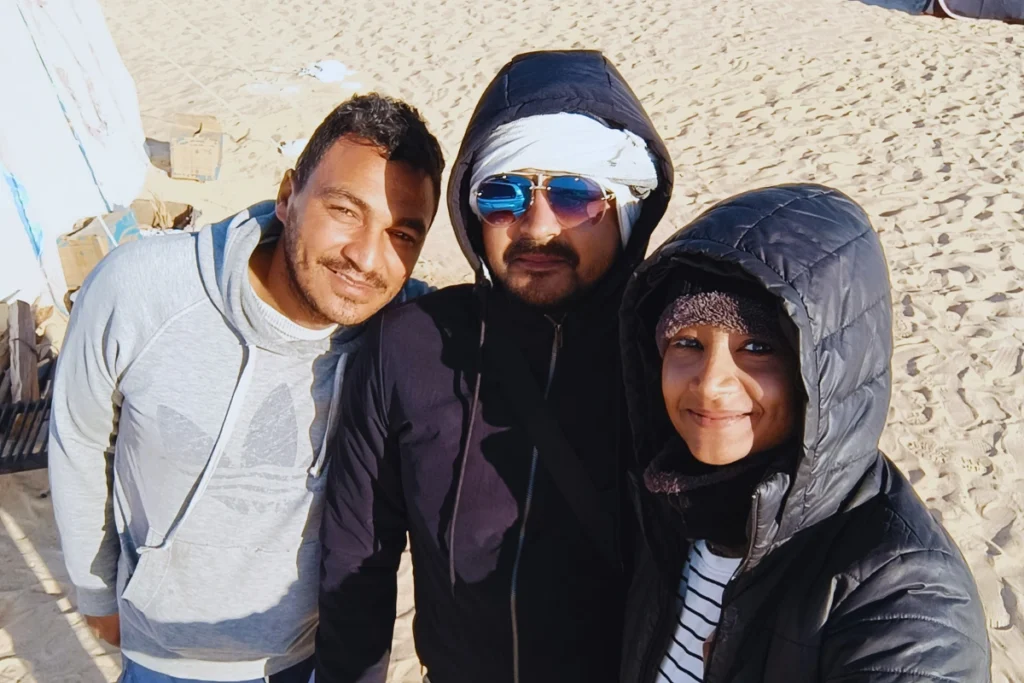
In every trip we have taken, there is one person who changes the tone of the experience.
In Egypt, that person was Mahmood. Our Bedouin guide and driver for the two-day safari. He picked us up from the Bahariya settlement, drove us through every landscape, set up the camp, built the fire, cooked the food, pointed out the formations, and at the end of it, collected the agreed price and asked for nothing more.
He did not ask for a tip. He did not suggest a tip was expected. He did not create a moment where a tip would be socially required. He provided two days of genuine, warm companionship in one of the most remote landscapes in Egypt, called us “brother” from the first hour, and treated the experience as something he was sharing rather than something he was selling.
Mahmood is the reason we tell people to book this trip. The desert is extraordinary. The guide makes it personal. We cannot guarantee you will find a Mahmood. We can tell you that the Bedouin culture of the western desert takes hospitality seriously, and that the quality of the human connection is what separates a memorable desert experience from a logistics exercise.
How to Book the Desert Safari
We booked the 2D1N package before leaving India through an operator contacted online. The package included transport from Cairo to the Bahariya Oasis and back, all meals (Bedouin lunch on Day 1, camp dinner, camp breakfast on Day 2, and return-day lunch), water, camping equipment, and the full guided safari.
From Cairo: Most operators offer pickup from your Cairo/Giza hotel in the early morning, with a four-to-five-hour drive to Bahariya Oasis. The return on Day 2 brings you back to Cairo by late afternoon, in time for an evening train or next activity. We took the Watania sleeper train to Aswan on the evening of our return.
Operators: Multiple operators run this route. Research recent reviews carefully. The quality of the guide and the camping equipment varies significantly. We booked based on recommendations from travel communities.
Duration: The 2D1N version is the standard and the minimum. Some operators offer longer options that include deeper exploration of the Bahariya Oasis. We did the standard and felt it covered the essential sequence completely.
What It Costs
All figures are from our February 2022 visit. Desert safari prices shift based on operator, group size, season, and demand. The current estimated ranges are for planning purposes only…always verify before booking.
| Item | We Paid (Feb 2022) | Estimated Now | Notes |
| 2D1N Black & White Desert safari (two people) | INR 25,000 / ~USD 330 | INR 30,000 – 45,000 | All-inclusive: transport, all meals, water, camping gear, guide |
| Additional costs | None | None expected | Mahmood did not ask for extras; tip is at your discretion |
This was, per hour of experience, the best value of our entire Egypt trip. Two days, one night, four distinct landscapes, overnight Saharan camping, all meals, and a guide who treated us like family. Prices have risen since 2022 and will continue to; verify current rates with multiple operators before booking.
Before You Go: What Actually Matters
- February is the optimal month. Cold enough at night for a genuine desert camping experience. Warm enough during the day for comfortable exploration and sandboarding. Summer temperatures make the journey physically punishing and camping dangerous.
- Bring layers. More than you think. We underestimated the February night cold. The temperature drop between afternoon and midnight is severe. A warm jacket, a hat, and a scarf are not optional. The sleeping bags provided are adequate but not generous.
- The stars require darkness. Do not look at your phone after the fire dies. Let your eyes adjust fully. The sky rewards patience in a way that no screen can.
- Carry a camera with manual settings if you want to photograph the Milky Way. Automatic phone cameras cannot capture the night sky at this latitude with zero light pollution. Or skip the photography entirely and just look up. What your eyes see will exceed any photograph.
- The White Desert formations are fragile. Chalk limestone erodes. Do not climb on them. The shapes took millions of years to form.
- The food is included and good. Every meal of our two-day safari was prepared by Bedouin hosts from simple, fresh ingredients. Do not expect restaurant service. Expect hospitality.
- Combine with the Cairo pyramids before and the Watania sleeper train after. We spent two days at Giza, two days in the desert, then took the sleeper train to Aswan on the evening of our return to Cairo. This sequence works logistically and emotionally: the pyramids are human history at its most ambitious, the desert is geological time at its most honest, and the train is the transition between the two halves of Egypt.
- This is not a luxury experience. You sleep on sand. You share a fire with your guide. The facilities are the desert itself. What the desert gives in exchange is a night sky that no hotel window can provide and a breakfast that no kitchen can replicate.
“Most Egypt itineraries send you straight from the pyramids to the Nile. They skip the part where the Sahara shows you what geological time looks like. If you want to know what the night felt like after the route ended…the fire, the cold, the sky at 2 AM…that is a separate piece. And if you are still in the planning stage…what it costs, whether it is safe, what to carry, and the one mistake almost everyone makes at Cairo Airport…our Egypt travel tips has the practical layer that the experience articles leave out. The Egypt Travel Guide ties the whole nine days together.”