This visitor guide is for Hattusa archaeological site written by two Indian travellers who drove through the rain to find their own gods written on a 3,400-year-old clay tablet in a sleepy Turkish village most itineraries drive past without stopping.
We did not expect to find India in Turkey.
We expected volcanic landscapes and Roman ruins. We expected the fairy chimneys of Cappadocia and the minarets of Istanbul. What we did not expect was to walk into a small museum in a sleepy Turkish village, three hours east of Ankara, and find the names of our own gods written on a clay tablet that is 3,400 years old.
Indra. Varuna. Mitra. The gods of our Rigveda…the oldest sacred text we grew up learning about…named in cuneiform script on a political treaty excavated from the ruins of a Bronze Age empire that fought Egypt to a standstill.
The discovery happened in stages. First, the Netflix series The Gift, which placed Hattusa in our minds. Then months of late-night research, which revealed the Mitanni-Hittite Peace Treaty and its explicit invocation of Vedic deities. Then the Green Wish Stone: a geological anomaly sitting inside these ruins that connects this site to ancient Egypt through the oldest surviving peace treaty in world history. Each layer pulled us deeper into a place that most Turkey itineraries skip entirely.
We drove from Ankara on the morning of April 20th. A 199-kilometre drive through open Anatolian farmland that took exactly three hours. The approach to Boğazkale felt like arriving somewhere the modern world had forgotten to update. A quiet village with old houses and the particular atmosphere of a settlement that has existed for a very long time without needing to announce itself.
When we parked the car and walked toward the Boğazkale Museum, it began to rain. It rained on and off for the rest of the day. It did not slow us down. What was inside those ruins was worth every wet step.
This is the Hattusa visitor guide where three ancient civilisations…Indian, Hittite, and Egyptian…converge in a single walkable archaeological park. If you read one article about Hattusa before visiting, make it this one. Not because it is the most comprehensive academically. Because it is written by two Indian travellers who found something here that changed how we think about our own history.
“Three and a half thousand years ago, someone in this exact spot wrote the names Indra and Varuna on wet clay and pressed it with a stylus. The clay dried. The empire fell. The city was buried. Two people from India drove through the rain to stand on that ground.”
- What Is Hattusa?
- Start at the Boğazkale Museum
- The Mitanni Treaty: When India Was Written into Turkish Stone
- The Green Wish Stone: The Pharaoh’s Gift Nobody Wanted
- What the Archaeological Site Looks Like
- Yazılıkaya: The Crown Jewel
- How Hattusa Connects to Ancient Egypt
- How to Get to Hattusa
- What It Costs to Visit
- Before You Go: What Actually Matters
- Frequently Asked Questions About Hattusa
What Is Hattusa?
Hattusa is the ruined capital of the Hittite Empire, located near the modern village of Boğazkale in central Turkey, approximately 200 kilometres east of Ankara. Dating from roughly 1700 to 1200 BCE, the Hittites were a formidable Bronze Age superpower known for advanced iron-working, massive walled fortifications, and fierce chariot warfare. They were one of only two civilisations in the ancient world powerful enough to fight Egypt as an equal.
The city was sacked and abandoned around 1200 BCE during the Late Bronze Age collapse, but the Hittites left behind thousands of cuneiform clay tablets that preserved their laws, diplomacy, and religious practices. Among them is a document that brought us across a continent to stand here. Hattusa was designated a UNESCO World Heritage Site in 1986.
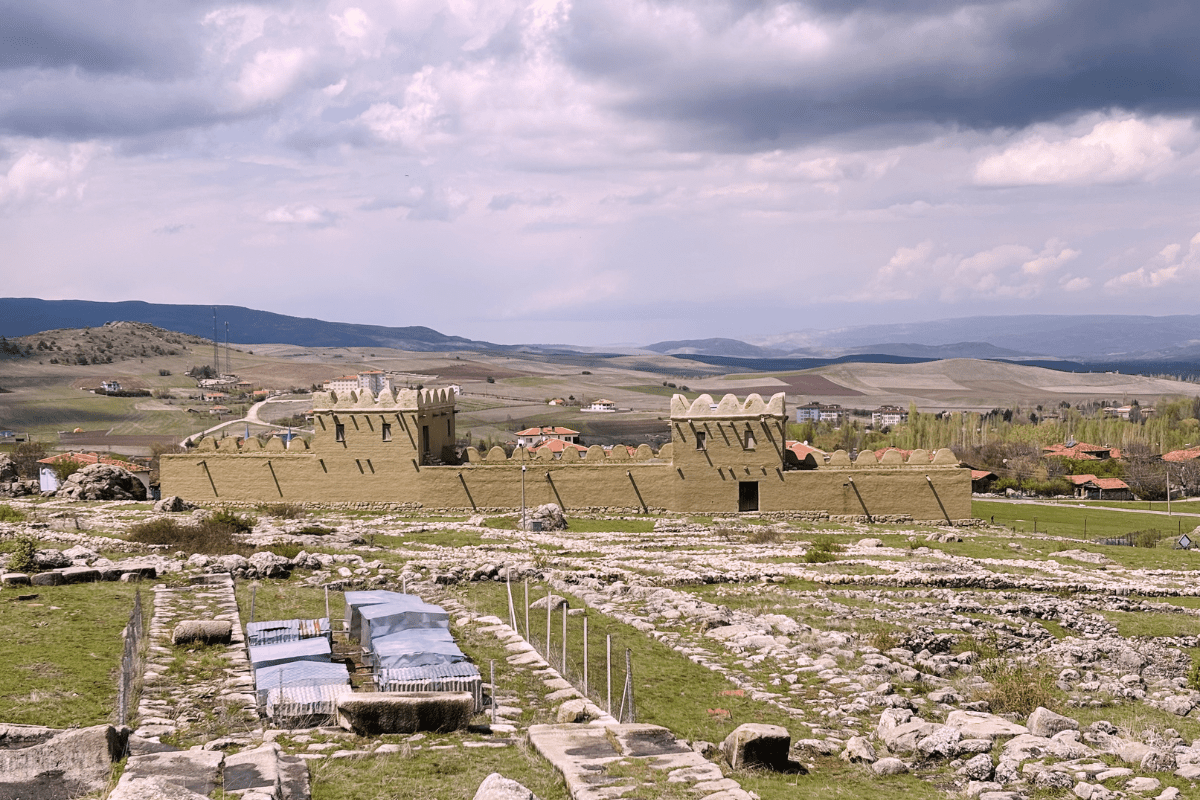
The site spans over 1.8 square kilometres of open-air ruins, divided into a Lower City and an Upper City. The Lower City holds the Great Temple and the Green Wish Stone. The Upper City contains monumental gates, the secret Postern Tunnel, and the royal fortress. Two kilometres northeast, the rock sanctuary of Yazılıkaya holds some of the most extraordinary religious carvings in the ancient Near East.
Almost nobody comes here. The tour buses go to Cappadocia, to Ephesus, to Pamukkale. Hattusa sits off every standard itinerary, visited mainly by archaeology specialists and the occasional independent traveller who has done enough reading to understand what this place represents. We explored everything…every gate, every tunnel, every temple, every rock chamber…in the rain. Without a single break.
Start at the Boğazkale Museum
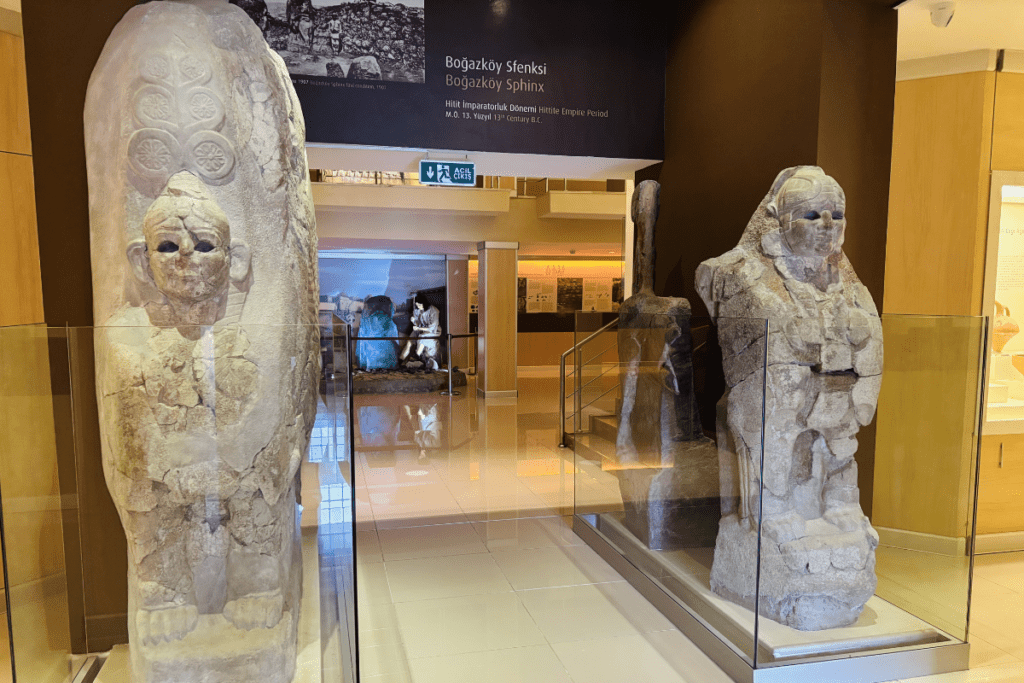
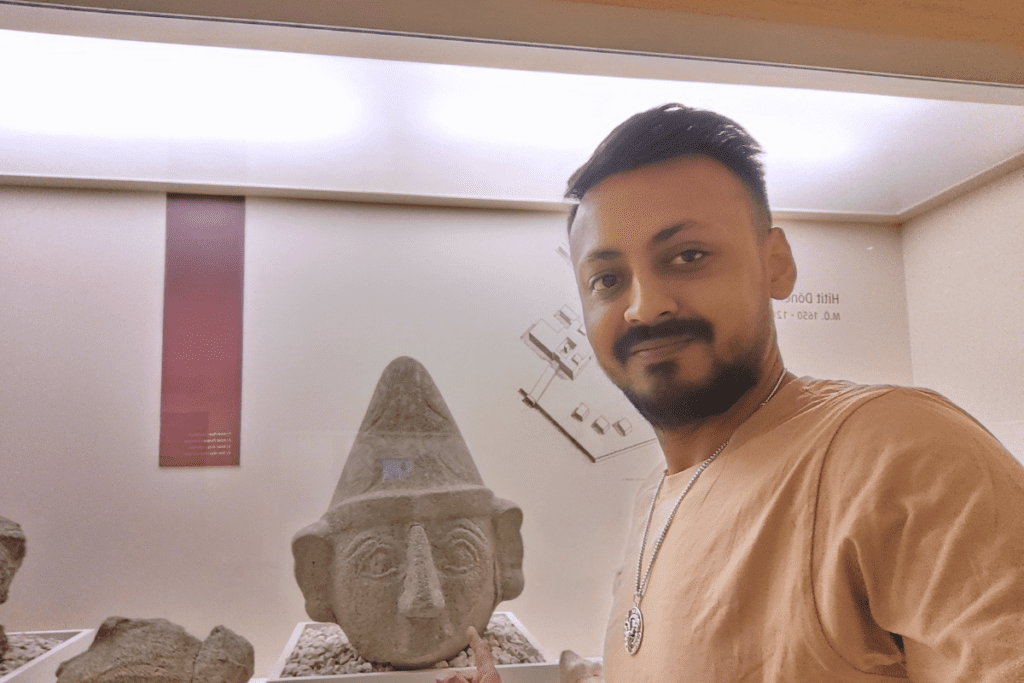
Start here. As with Göbekli Tepe, the museum provides the context that transforms the ruins from interesting to extraordinary.
The Boğazkale Museum is small but precisely curated. It holds Hittite artefacts not transferred to the Museum of Anatolian Civilizations in Ankara: pottery, tools, religious figurines, and cuneiform tablets. The larger Ankara museum…which we had visited the evening before…holds the major sculptures, including the original King’s Gate warrior relief. Both are worth visiting in sequence. The Boğazkale Museum handles what is specifically local; Ankara handles the monumental pieces.
As Indians, walking through this museum was a particular kind of disorienting. The linguistic echoes began before we reached the first display case. Our Sanskrit-derived word for elephant is “Hathi.” The capital city of this empire is “Hattusa.” The similarity is not a proven direct etymological link, but standing in a museum named after a word that sounds like your own language’s word for one of its most sacred animals produces a particular alertness. You start looking at everything more carefully.
The tablets are the centrepiece. Thousands of cuneiform tablets were found in the archives of Hattusa, recording everything from royal correspondence with Egyptian pharaohs to legal codes to a horse-training manual that counts chariot laps in Sanskrit. Among them is the document that brought us here.
The Mitanni Treaty: When India Was Written into Turkish Stone
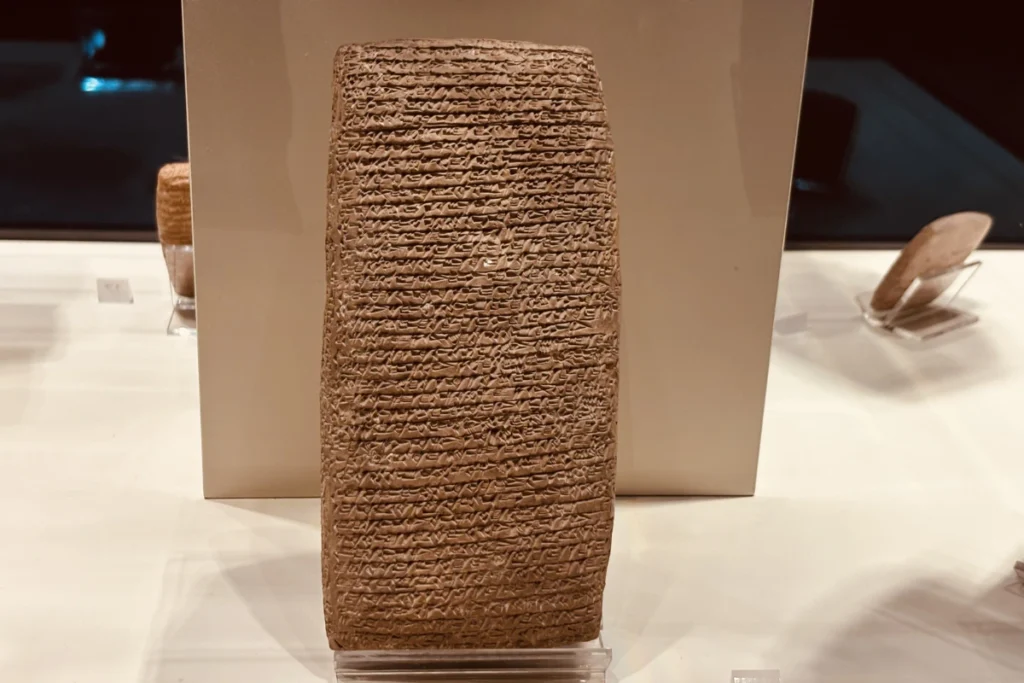
This is the section that no other Hattusa visitor guide contains. It is the reason we came.
In the early 20th century, archaeologists excavating the Hattusa archives discovered a clay tablet containing a peace treaty known as the Treaty of Shattiwaza, dated to approximately 1380 BCE. The treaty was drawn between Hittite King Suppiluliuma I and King Shattiwaza of the Mitanni Empire, an ancient kingdom spanning modern Syria and Iraq. To make the alliance spiritually binding, both sides invoked their respective gods to curse anyone who broke the agreement.
Among the Mitanni deities named, written in cuneiform script, are three names that stopped us completely:
Indra — the Vedic King of Gods and Storms.
Varuna — the Vedic God of Water and Cosmic Order.
Mitra — the Vedic Sun and Contract Deity.
These are not obscure figures. These are the central gods of the oldest layers of the Rigveda. Their names were written in Turkish ruins 3,400 years ago.
The Evidence Does Not Stop at the Treaty
The Kikkuli Horse Manual, also found at Hattusa, is a training guide for chariot horses written by a Mitannian named Kikkuli. It uses literal Sanskrit numerals to count training laps: aika (eka, one), tera (tri, three), panza (pañca, five), satta (sapta, seven), nava (nava, nine). These are not approximate similarities. They are the same words, written in a different script, in a different country, in 1400 BCE.
Mitanni kings bore Sanskrit-derived names: Tushratta (Dasharatha), Sutarna (Sutaran), Artatama (Rtadhama). These are recognisable to anyone who grew up with the Ramayana.
At Yazılıkaya, two kilometres from Hattusa, bas-reliefs depict Hittite and Hurrian storm gods riding on the backs of animals. This is the concept of Vahanas…Shiva rides Nandi, Vishnu rides Garuda, Durga rides a lion. The visual grammar is identical.
The chief Hittite storm deity, Tarhunt, slayed the giant chaos serpent Illuyanka. This myth directly mirrors Lord Indra’s slaying of the serpent demon Vritra in the Rigveda. The parallel is structural, not superficial: a supreme storm god defeats a cosmic serpent to restore order to the world.
What Does It Mean?
Historians generally agree this does not mean ancient Indian kings marched to Turkey. Instead, it proves that before migrating into the Indian subcontinent, the ancestral Indo-Aryan peoples shared a common linguistic, cultural, and spiritual world with the peoples of the Near East. The Mitanni treaty is a literal time capsule proving that the central figures of the Hindu pantheon were already worshipped as major deities 3,400 years ago, thousands of kilometres from India.
We stood in the ruins of the Great Temple where these tablets were stored and tried to process what that means. The feeling does not have a word. It requires being in the place where it happened.
The Green Wish Stone: The Pharaoh’s Gift Nobody Wanted
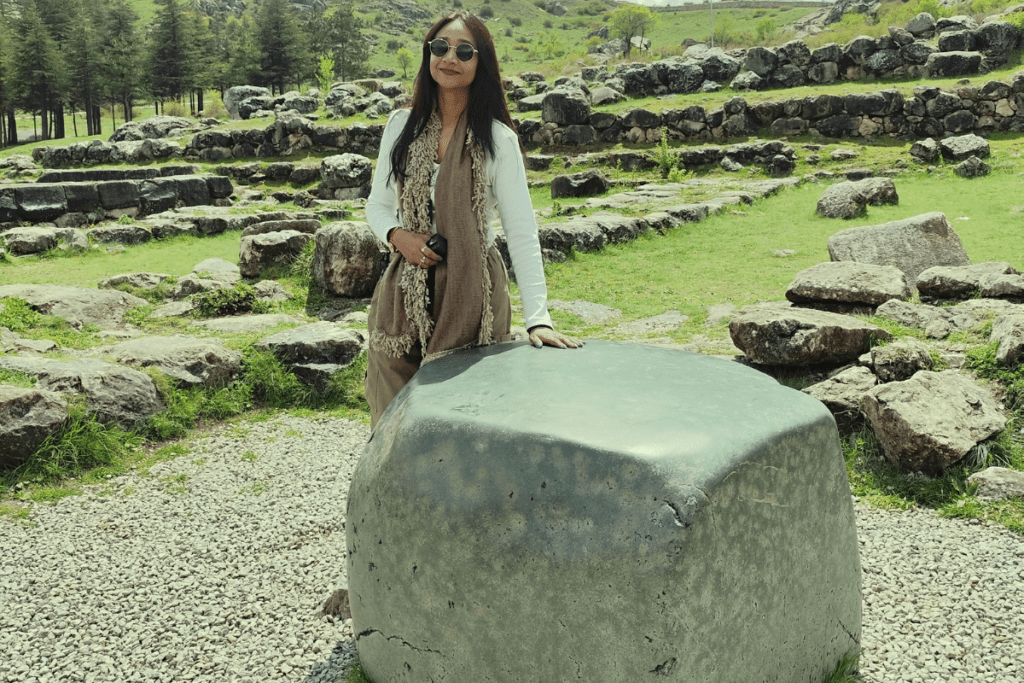
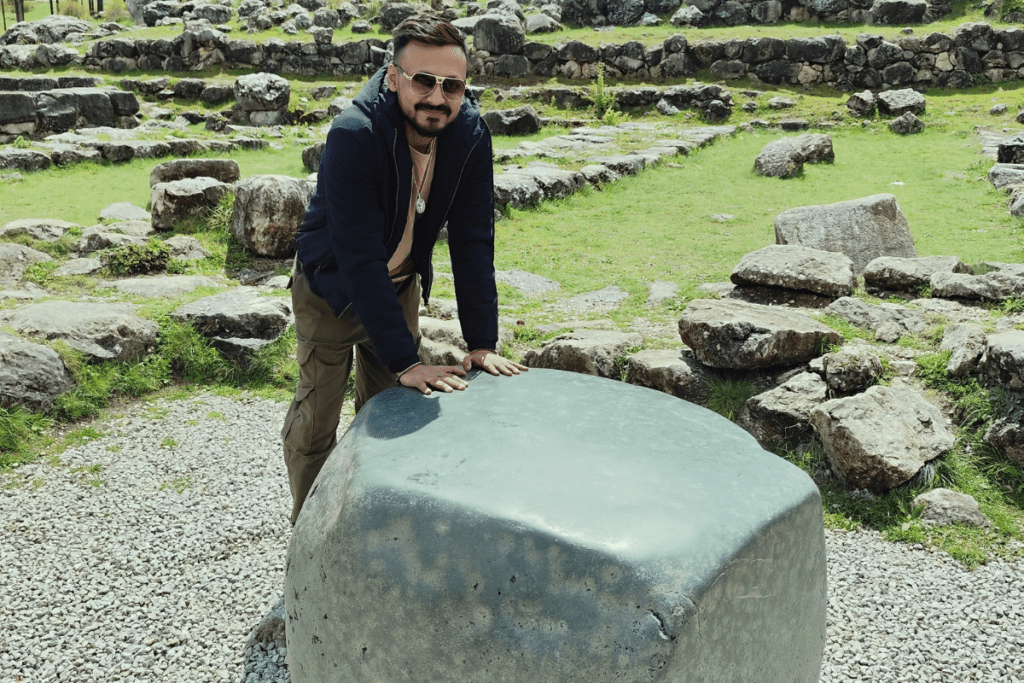
This is the other story that makes Hattusa unlike any other archaeological site.
Inside the ruins of the Great Temple, tucked into a side room rather than a central sanctuary, sits a massive cubic boulder of highly polished green nephrite or serpentinite. It weighs approximately 1,000 kilograms. It is luminous, smooth, and entirely, impossibly green.
Every other structure in Hattusa…every wall, every gate, every temple foundation…is built from local grey limestone and dark basalt. This green block is a complete geological anomaly. Nothing like it exists anywhere in the region. It had to be transported across vast distances, possibly from the Taurus Mountains or further. Someone wanted it here badly enough to move a tonne of stone across a continent.
The Egypt Connection
In 1274 BCE, the Hittite Empire and the Egyptian Empire fought the Battle of Kadesh in modern Syria: the largest chariot battle ever fought in human history. Neither side won decisively. Fifteen years of stalemate followed. In 1259 BCE, Hittite King Hattusili III and Pharaoh Ramesses II signed the Treaty of Kadesh, widely celebrated as the oldest surviving peace treaty in world history. A reproduction of this treaty hangs in the United Nations headquarters in New York.
To seal this eternal brotherhood, the two courts exchanged gifts. Archaeologists speculate that Ramesses II personally gifted this massive green monolith to the Hittites to commemorate the peace. The theory has three supporting pillars. The stone is exotic and foreign, consistent with a diplomatic gift from a distant empire. The ancient Egyptians were legendary for their ability to quarry and polish hard stone to a mirror finish, and this stone’s surface matches that craftsmanship. And in ancient Egypt, the colour green (wadj) symbolised fertility, rebirth, resurrection, and the god Osiris. Gifting a luminous green monolith was the ultimate Egyptian gesture of wishing eternal life to an ally.
The same Ramesses II who may have gifted this stone to the Hittites built Abu Simbel…the temple whose inner sanctum is illuminated by sunlight twice a year with an astronomical precision that has no business existing in the 13th century BCE. We stood inside that sanctum too, four hours before dawn, on a bus from Aswan. You can find the complete story in our Egypt Travel Guide.
The Twist: Was It Unwanted?
The stone was not found on a central pedestal in the main sanctuary. It was tucked away in a side storeroom near the temple entrance. This detail has produced an amusing secondary theory: the Green Stone may have been an unwanted diplomatic gift.
The Hittites had their own strict religious traditions dedicated to the Storm God Teshub. A massive, sacred Egyptian green block may have presented a theological problem they could not resolve. Not wanting to offend their powerful ally by destroying it, the Hittite priests may have quietly stowed it away, where it sat forgotten for over 3,000 years until modern excavations brought it back to light.
The Wish Stone
The Turkish villagers of Boğazkale call it the Wish Stone. The tradition holds that if you place your hands on its cool, glass-like surface and make a sincere wish, the ancient energies of the stone will manifest your deepest desire.
We placed our hands on it. The stone was cold and impossibly smooth. The sensation of touching something that may have been a gift between two of the most powerful rulers in ancient history, inside a temple where the names of our own gods were stored on clay, is not something we can describe in the language of a visitor guide. It requires being there.
“The Green Stone was cold and impossibly smooth. A pharaoh may have sent it. Hittite priests may have hidden it. We placed our hands on it anyway, inside a temple where our own gods were named in writing 3,400 years ago.”
What the Archaeological Site Looks Like
After the museum, we bought our tickets, covering both Hattusa and Yazılıkaya, and entered the archaeological park. The rain had started. We did not care.
The Lower City: The Great Temple
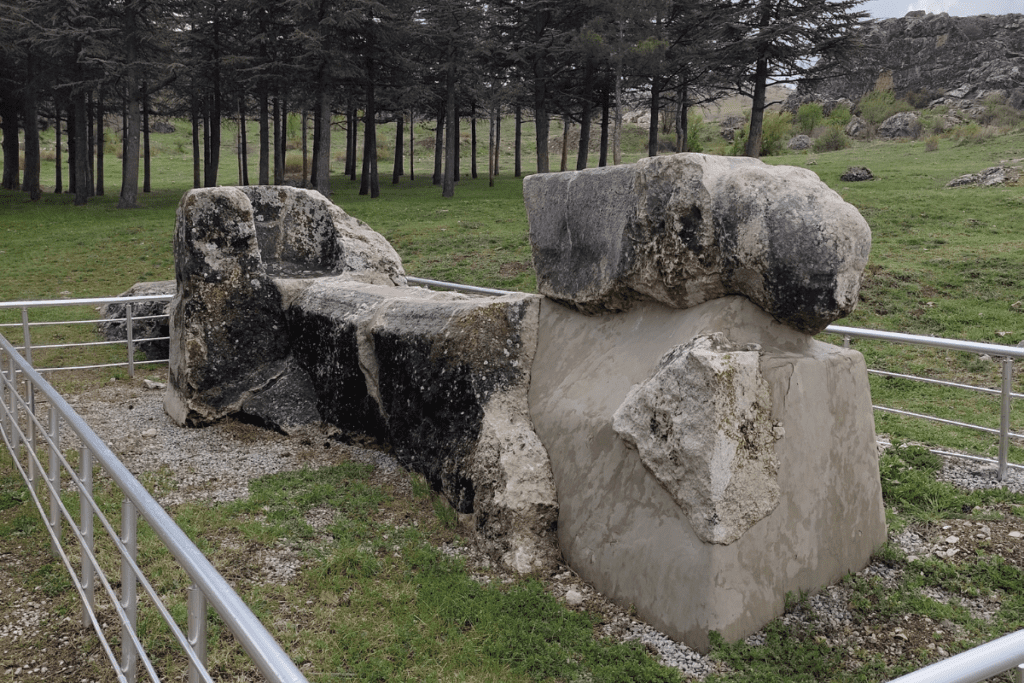
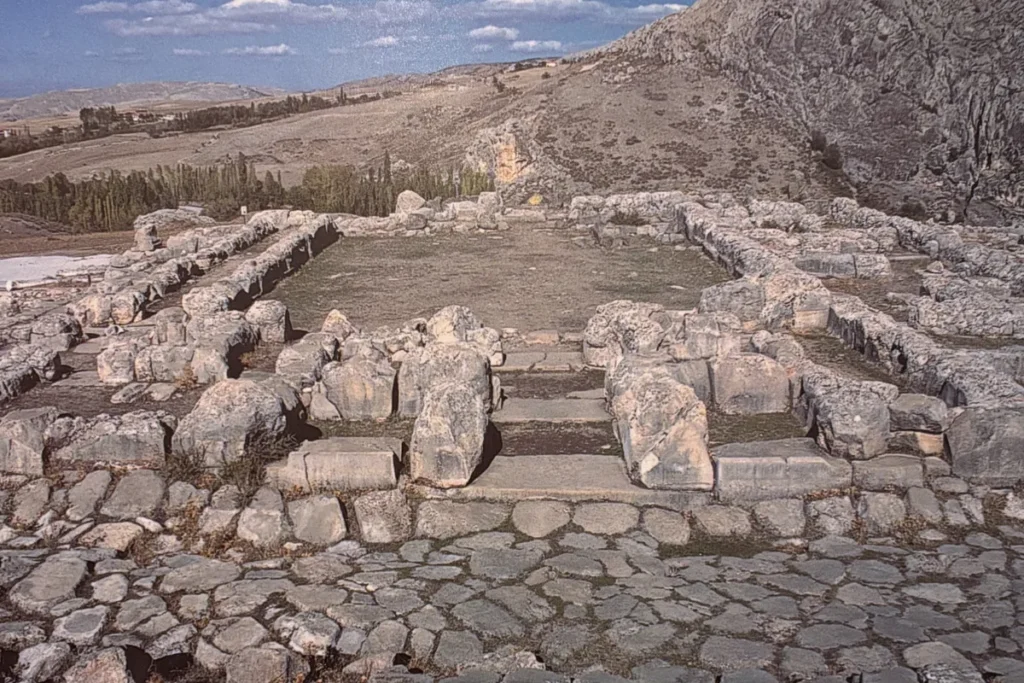
The Great Temple, also called Temple 1, is the largest structure in Hattusa. Dedicated to the Storm God Teshub and the Sun Goddess Arinna, its massive limestone foundations mark out a complex that once included the main sanctuary, the royal archives where the cuneiform tablets were stored, and the storerooms where the Green Stone sits.
Walking through the foundation layout, you begin to understand the scale of Hittite ambition. This was not a village temple. It was the spiritual and administrative heart of an empire that stretched across Anatolia and into Syria. The archive rooms that held the Mitanni treaty, the Kikkuli manual, and thousands of other tablets were within this complex. The Green Stone sits in a room to the side of the main entrance, accessible and touchable. Most visitors walk past it without knowing what they are looking at.
The Upper City: Gates, Ramparts, and the Secret Tunnel
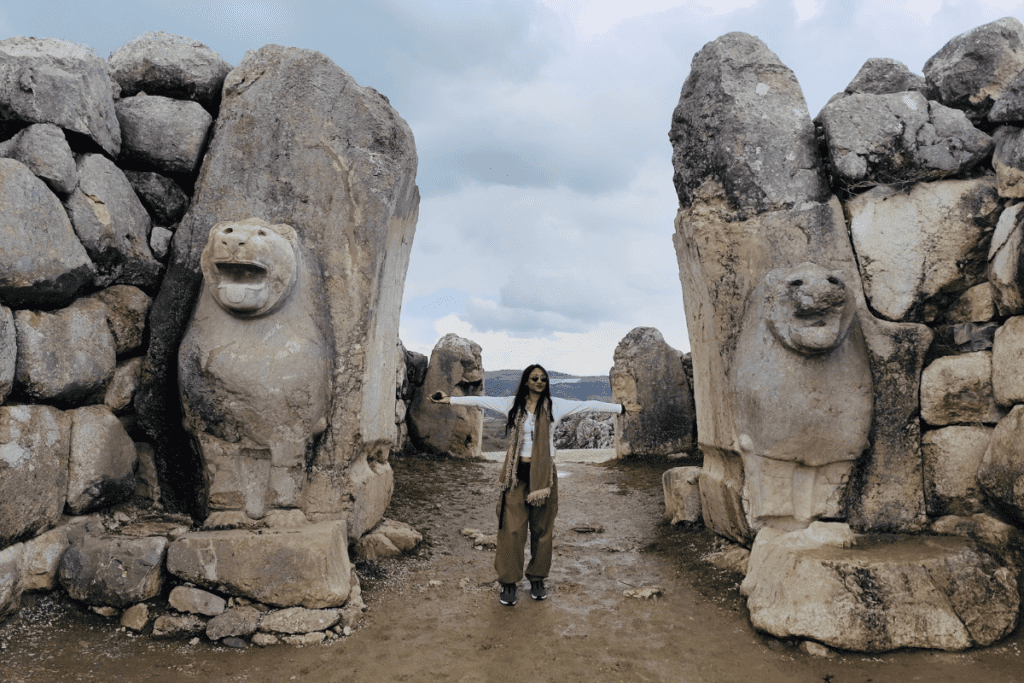
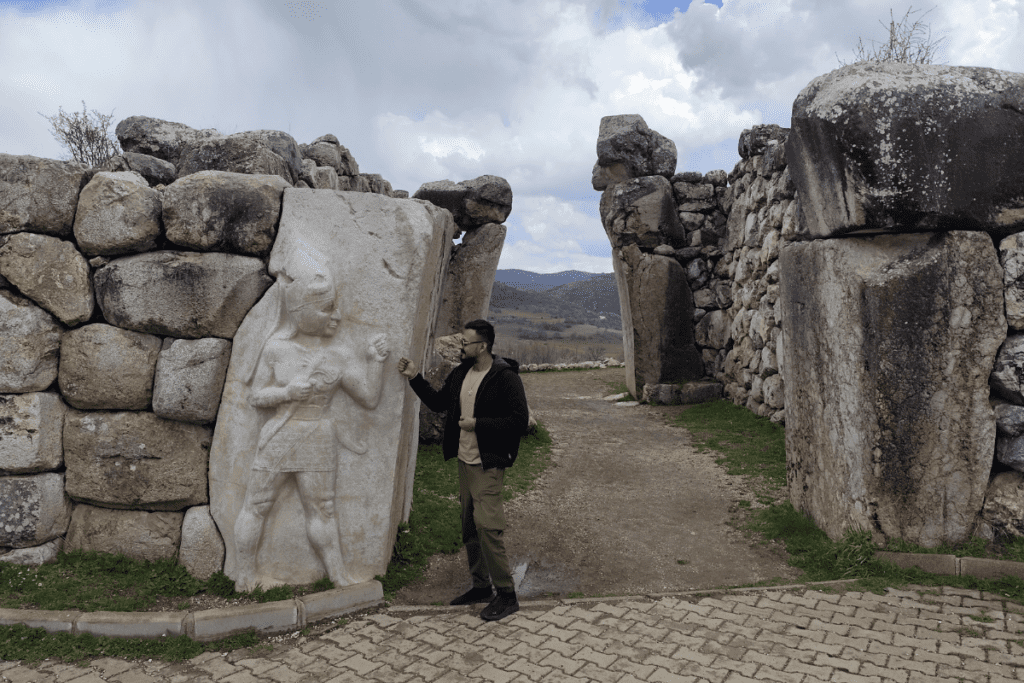
The Upper City is where Hattusa reveals its military intelligence.
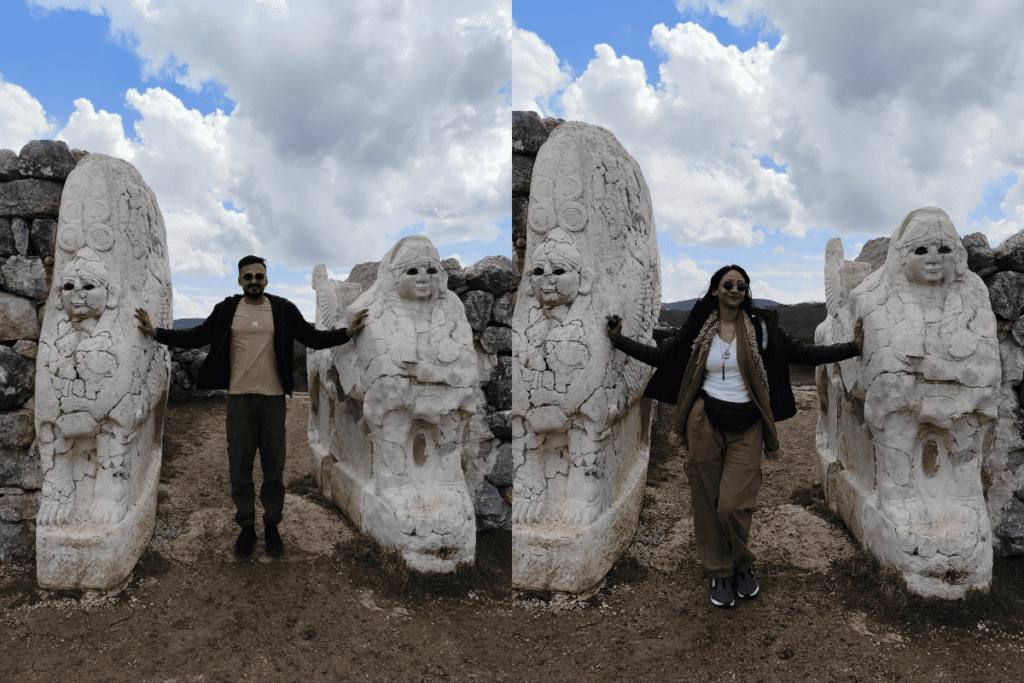
The Lion Gate is the most photographed feature: two stone-carved lions flanking the entrance, carved in the Bronze Age with hand tools to a quality that makes the mind recalibrate what Bronze Age means. The lions’ mouths are open. They are not welcoming you. They are warding something off.
The Sphinx Gate sits at the highest point of the 250-metre Yerkapu rampart, an artificial earthen wall that represents one of the most impressive feats of Bronze Age military engineering in the ancient world. The original sphinxes are in museums in Istanbul and Berlin; replicas stand at the site.
The King’s Gate features a high-relief carving of a Hittite warrior god (the original is in the Ankara Museum). The scale and detail of the carving communicate something specific about how the Hittites saw themselves: a civilisation that placed gods and warriors at the same threshold.
The Postern Tunnel: The Experience Most People Skip
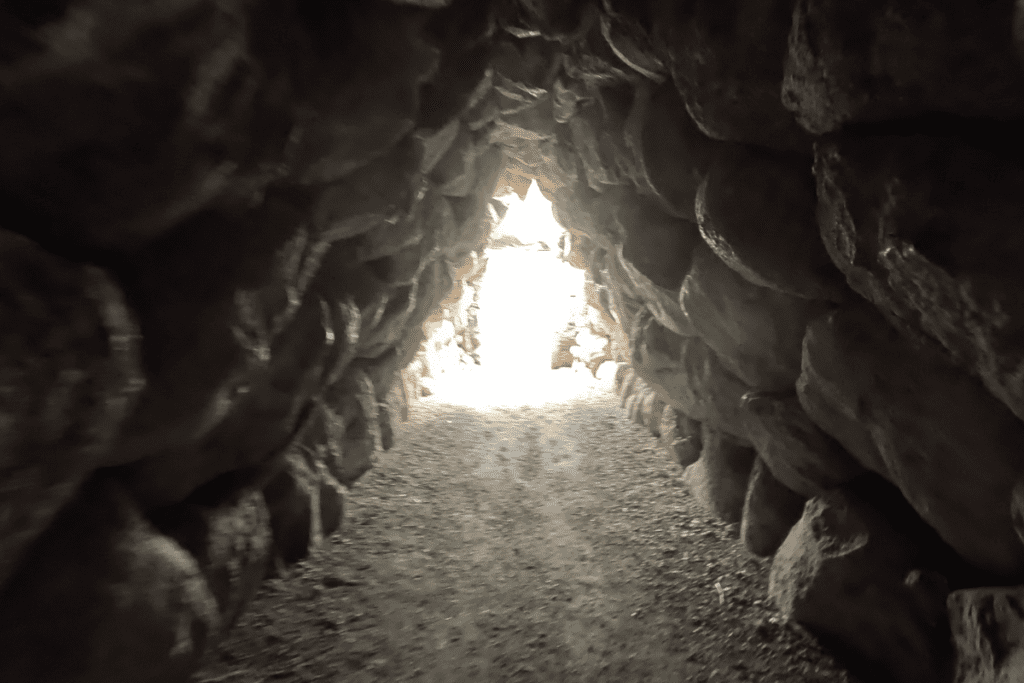
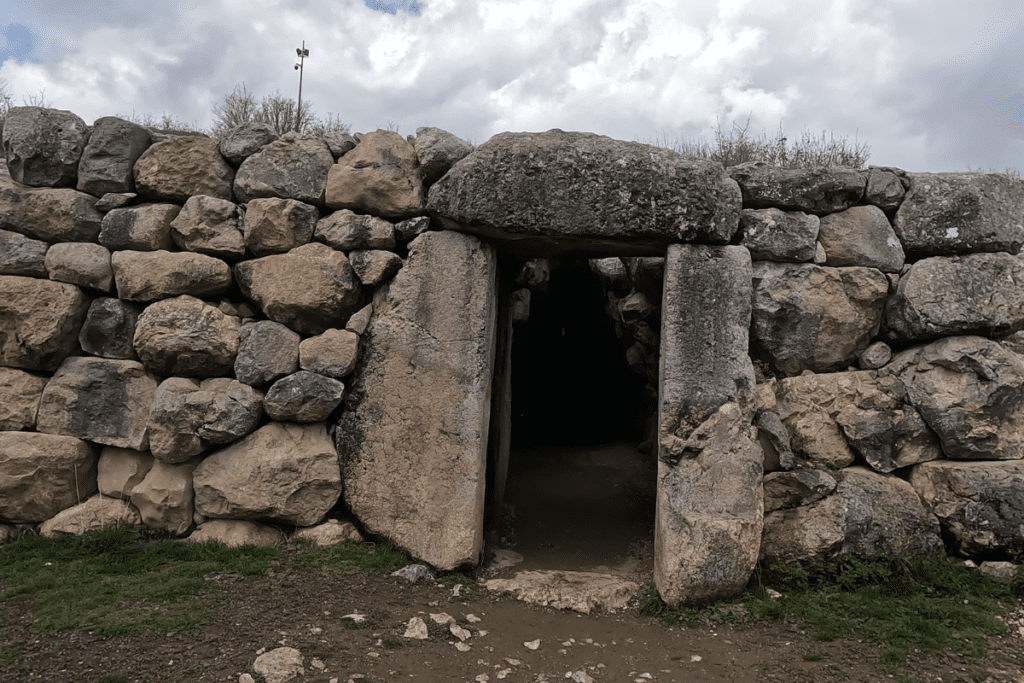
Directly beneath the Yerkapu rampart, a 71-metre stone tunnel descends into darkness and emerges on the other side of the fortification wall. It was used for surprise military sorties: soldiers would descend into the tunnel, emerge outside the walls unseen, and attack besieging forces from behind.
We walked through it entirely. The darkness is real. The stone is close. The air changes quality. For 71 metres, you are inside a Bronze Age military secret, walking the same path that Hittite soldiers walked 3,500 years ago when the city was under threat. This is not a museum reconstruction. It is the tunnel itself. Bring a phone torch.
The Royal Fortress and Final Inscriptions
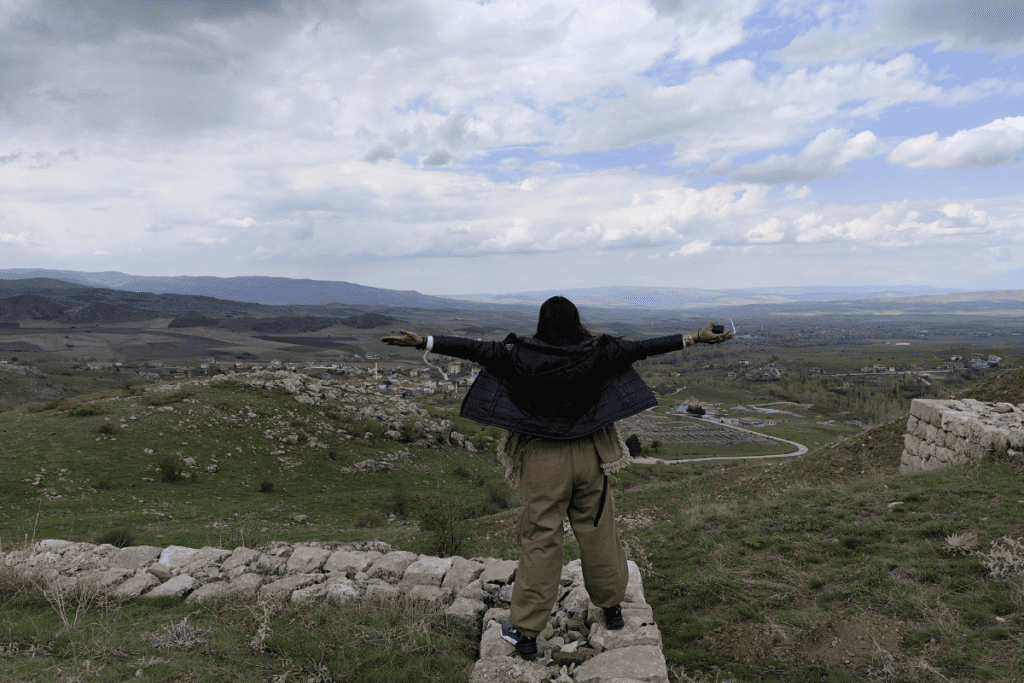
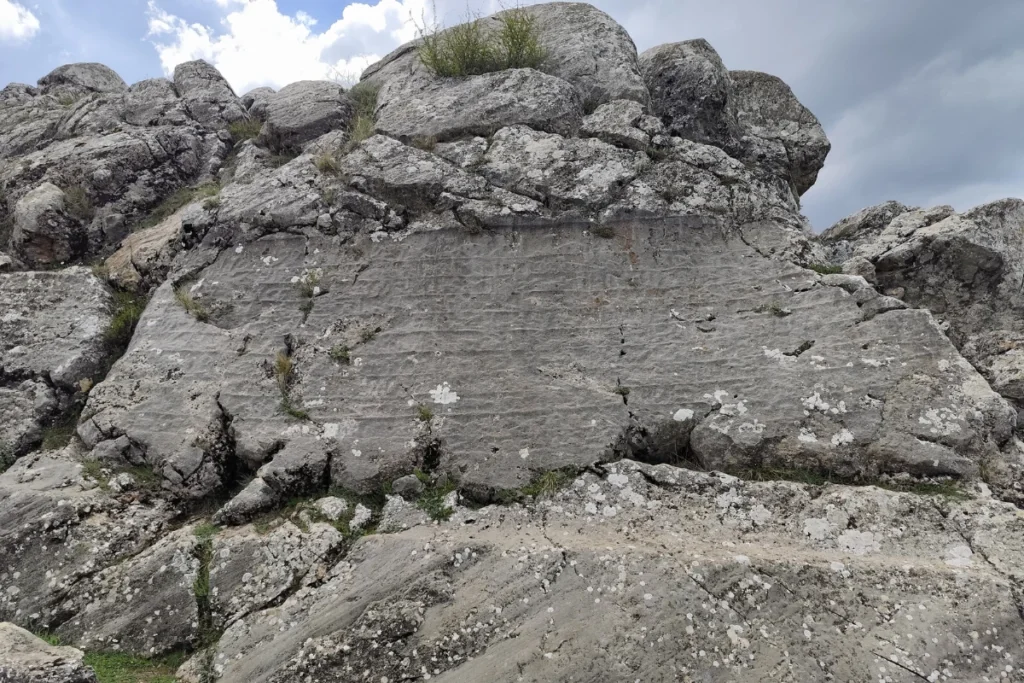
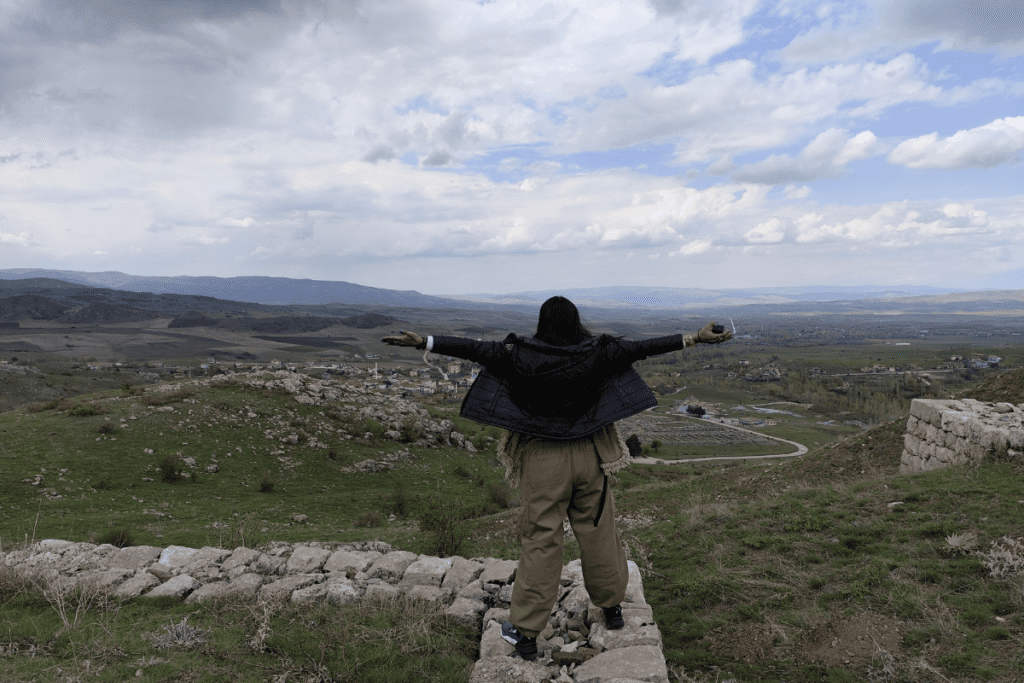
Büyükkale, the Great Fortress, is the natural rocky acropolis that served as the royal palace complex. The panoramic views from the top extend across the entire valley. This is where the Hittite kings lived, governed, and stored the most sensitive archives.
Nişantepē holds a weathered 11-line cuneiform inscription carved by Suppiluliuma II, the last known king of the Hittite Empire. The inscription is faded by 3,200 years of weather. Knowing that the man who ordered it was the last ruler of a civilisation that collapsed shortly after he carved his name into rock gives the faded lines a weight that does not require translation.
The Südburg chamber contains well-preserved hieroglyphic reliefs depicting a Hittite king and religious symbols inside a small vaulted stone chamber built into a hillside. It is easy to miss and worth finding.
Yazılıkaya: The Crown Jewel
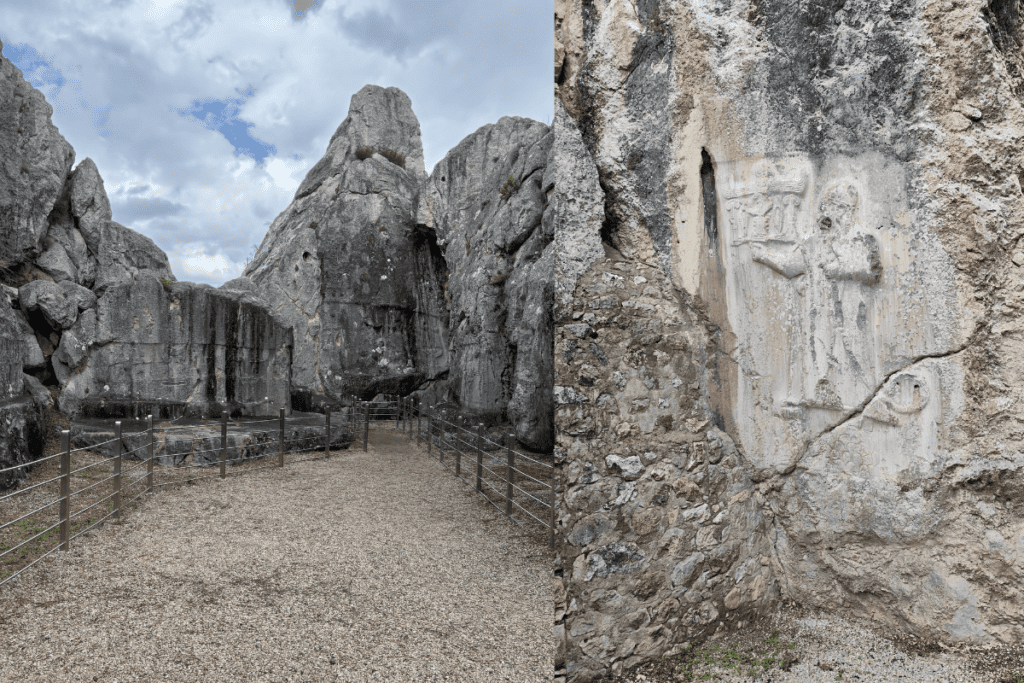
Two kilometres northeast of the main ruins, accessible by a short drive, lies the site that turned a historical visit into a spiritual one.
Yazılıkaya means “Inscribed Rock” in Turkish. It is an open-air rock sanctuary built into a massive natural cluster of limestone outcrops reaching 12 metres high. Roofless by design, this is where the Hittite kings performed their grandest seasonal ceremonies, including the spring New Year festival. The sanctuary contains two chambers. Both stopped us.
Chamber A: The Procession of Gods and the Hidden Calendar
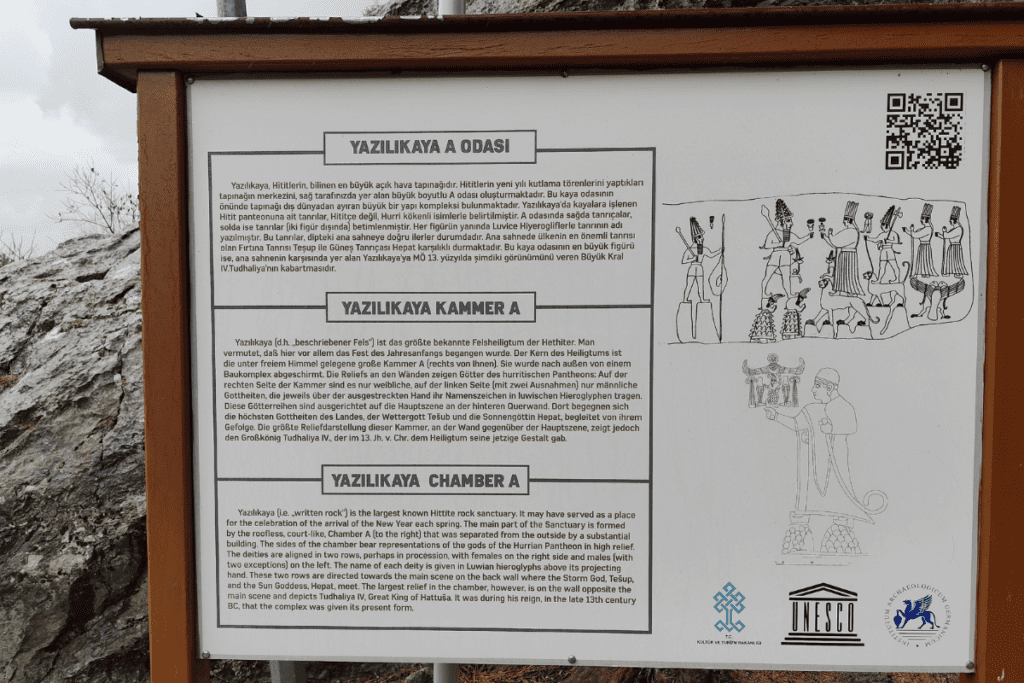
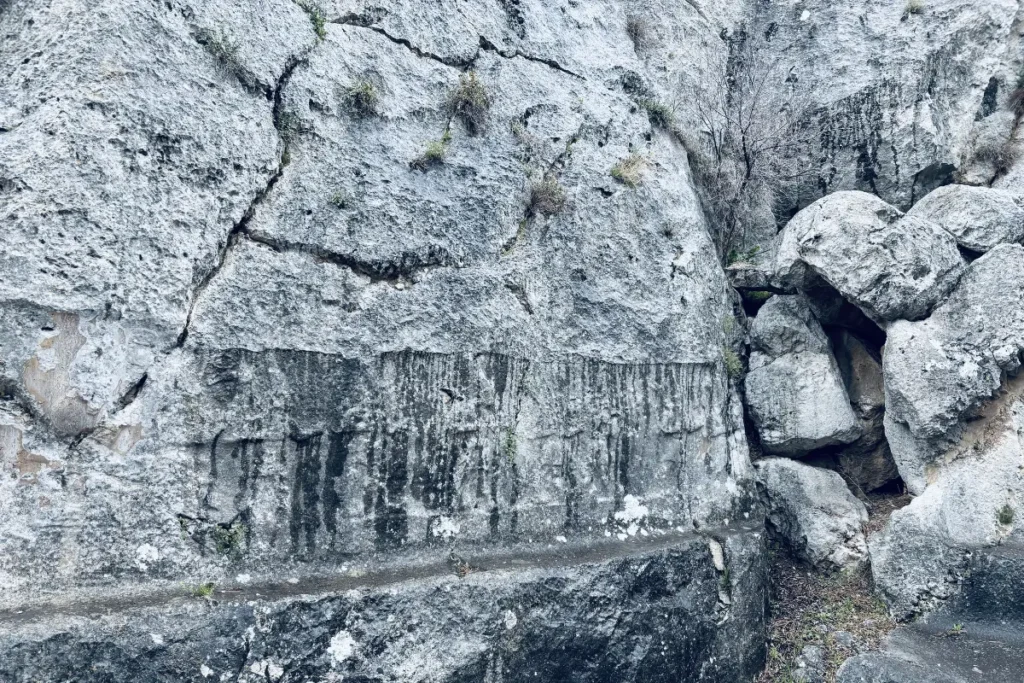
The larger gallery features 64 distinct deities carved directly into the limestone walls in two processions. On the left, male gods in short kilts, pointed boots, and horned hats march forward. On the right, female goddesses in long gowns and tiaras walk to meet them. At the northern focal point, the two lines converge at the supreme rulers of the Hittite pantheon: Teshub, the Storm God, standing atop two mountain deities, and his consort Hebat, the Sun Goddess, standing on the back of a leopard.
Recent archaeological studies have proposed something extraordinary about the arrangement. The 30 male gods may represent the days of a lunar month. Twelve deities may correspond to the lunar months of the year. Nineteen female deities may track the years in a 19-year cycle used for predicting eclipses and calibrating the lunisolar calendar. If this interpretation holds, Chamber A is not only a temple. It is a working astronomical instrument carved into rock 3,300 years ago, functioning through the precise arrangement of divine figures.
We stood in that chamber in the rain, looking at a procession of gods that may also be a calendar, and the question we kept asking was: what else in the ancient world have we been looking at without understanding what it does?
Chamber B: The Underworld
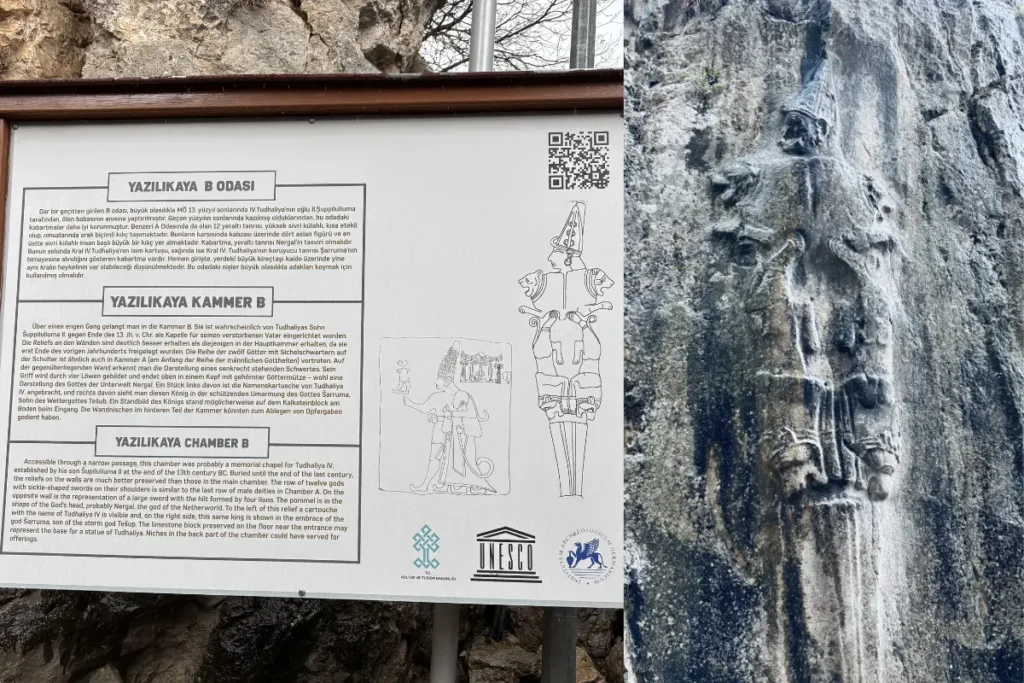
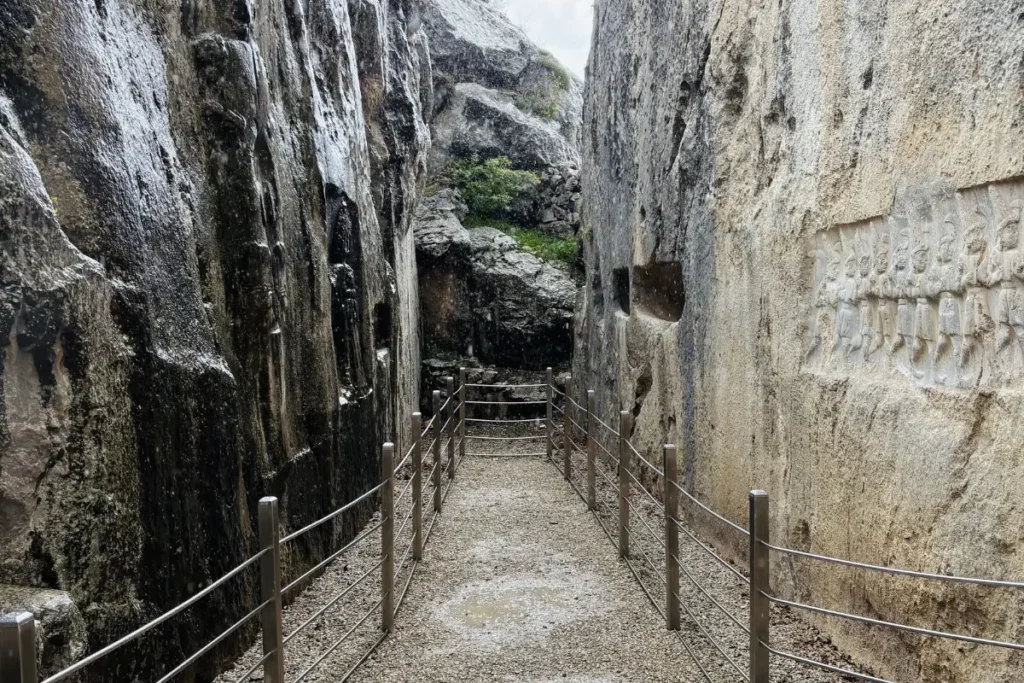
Accessed through a narrow gap in the rock, guarded by reliefs of winged, lion-headed demons, Chamber B feels entirely different. Smaller. Darker. More intimate. Because it was buried under soil until the 19th century, its carvings are among the best-preserved reliefs in the ancient Near East.
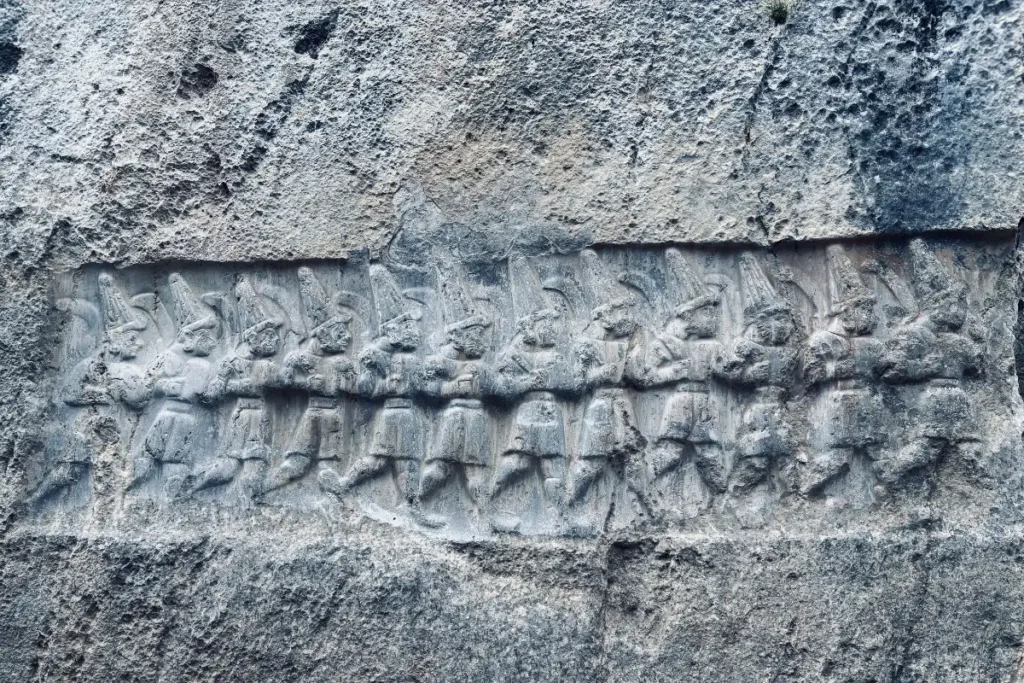
The famous line of Twelve Underworld Gods marches in tight formation, each carrying a curved, crescent-shaped sword slung over the shoulder. The carving is disciplined, military, and quietly unsettling.
The Sword God Nergal is a 3-metre relief depicting a giant sword blade driven vertically into the earth, its pommel shaped into four lions and the head of a god. It represents the King of the Underworld. The blade enters the earth like a key being inserted into a lock.
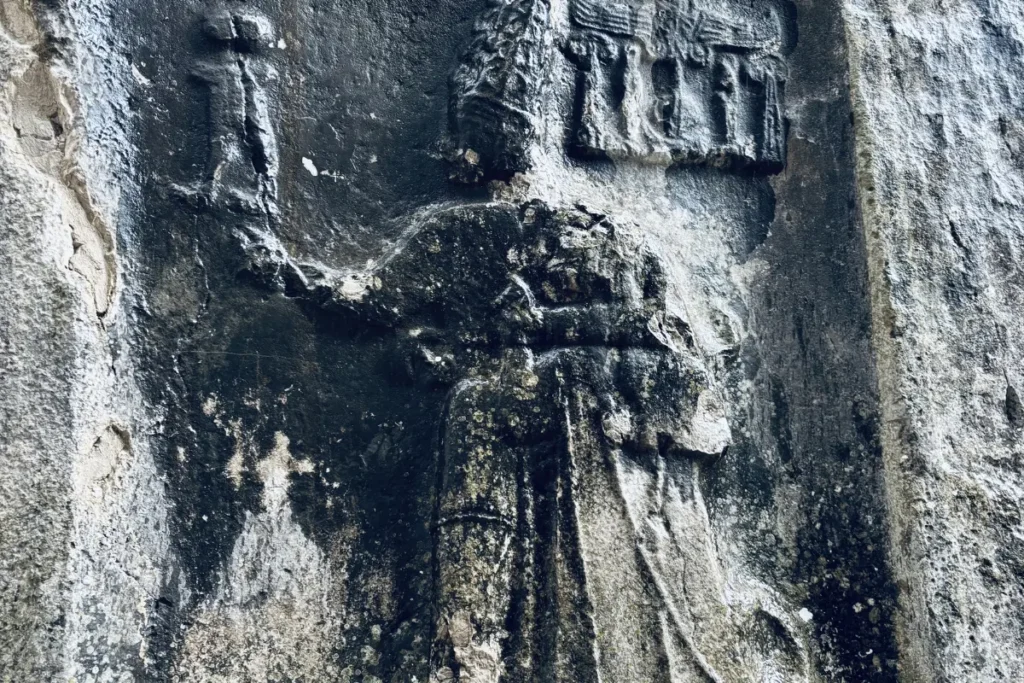
The most human moment in the entire site is here: a relief showing the god Sharruma wrapping a protective arm around the neck of King Tudhaliya IV, guiding him through the afterlife. It is not a scene of worship. It is a scene of companionship. A god walking a mortal through the dark. After everything else at Hattusa… the treaty, the Green Stone, the 64 marching gods…this small, quiet image of a deity with an arm around a human shoulder is the one that stayed with us longest.
How Hattusa Connects to Ancient Egypt
The connections are physical, not theoretical.
The Treaty of Kadesh, sealed in 1259 BCE between the Hittites and Egypt, was found in the archives of the Great Temple at Hattusa. A copy was found in Egypt. The treaty is significant enough that a reproduction hangs in the United Nations headquarters in New York as a symbol of the earliest diplomatic resolution of conflict between powers.
The Green Wish Stone, possibly a gift from Ramesses II, sits in the same temple complex.
When we visited Egypt in February 2022, we stood in front of the Abu Simbel reliefs depicting the Battle of Kadesh from the Egyptian perspective. Two years later, we stood in the ruins of the Hittite capital where the same battle was documented from the other side. The two visits, separated by 3,300 years of history and two trips across different continents, completed each other in a way that no single journey could have achieved.
If you have visited Egypt, Hattusa will rewrite parts of what you thought you understood. If you have not, Hattusa will make you want to.
How to Get to Hattusa
Hattusa is near Boğazkale village, approximately 200 km east of Ankara.
By Rental Car (Recommended)
We drove from Ankara in three hours on well-maintained roads. From Hattusa, it is a further 197 km (approximately three hours) to Cappadocia, making it a natural stop on an Ankara-to-Cappadocia driving route. We visited Hattusa and Yazılıkaya in the morning and drove to Göreme for sunset, arriving in time. The pairing…Hattusa in the morning, Cappadocia sunset in the evening…was one of the strongest days of our entire 14-day road trip.
From Istanbul
The drive is approximately 450 km to Ankara plus 200 km to Boğazkale. We made this as part of our road trip: picking up the car at Sabiha Gökçen Airport, driving to Ankara to visit the Museum of Anatolian Civilizations in the late afternoon, staying overnight, then driving to Hattusa the next morning. This two-day sequence…Ankara museum evening, Hattusa morning, Cappadocia evening…is highly recommended.
By Organised Tour from Ankara or Cappadocia
Day tours from Ankara and Cappadocia to Hattusa and Yazılıkaya are available. The drive is long enough that a full day is required. If you do not have a rental car, this is the most practical option.
What It Costs to Visit
All costs from our April 2025 visit. Turkey’s monument entry fees are reviewed periodically…verify current rates before travelling.
| Item | Cost (April 2025) | Notes |
| Boğazkale Museum (two people) | TRY 100 | Hittite artefacts specific to the local site; visit before entering the ruins |
| Hattusa + Yazılıkaya combined entry (two people) | TRY 260 | One ticket covers both sites; Yazılıkaya included |
| Parking | Included | At both the museum and the archaeological park entrance |
Turkey’s monument entry fees are reviewed periodically. Verify current rates before visiting. That said: the combined entry for two people at one of the most historically significant archaeological sites in the world remains among the best value in Turkey.
Before You Go: What Actually Matters
- Visit the Boğazkale Museum first. The context transforms the site. Without it, you are looking at stone foundations. With it, you are looking at the capital of an empire that fought Egypt, worshipped Indian gods, and sealed peace treaties with pharaohs.
- Allow four to five hours for the full experience. One hour for the Boğazkale Museum. Two to three hours for Hattusa’s Lower and Upper City. One hour for Yazılıkaya. The site is spread over 1.8 square kilometres. A car is useful for moving between the Upper City gates.
- Walk the Postern Tunnel entirely. It is 71 metres long, dark, narrow, and atmospheric. Most visitors look at the entrance and leave. Do not be one of them. Bring a phone torch.
- Yazılıkaya may close earlier than the main site. Confirm closing times at the ticket counter. Drive directly from the King’s Gate to Yazılıkaya without stopping to ensure you have enough time in the sanctuary.
- Combine with the Museum of Anatolian Civilizations in Ankara the evening before. Many of the original Hattusa artefacts…including the King’s Gate warrior relief…are housed there. We visited the Ankara museum the afternoon before driving to Hattusa. The two experiences are deeply complementary.
- Combine with Cappadocia the same day. Hattusa to Göreme is approximately 197 km, a three-hour drive. We arrived at the Göreme panorama viewpoint in time for sunset. This pairing was one of the strongest days of our entire trip.
- Boğazkale village has very limited food options. We relied on instant poha prepared that morning at our Ankara hotel. Bring snacks and water for the full day.
- April is the optimal month. It rained intermittently during our visit, which kept the site empty and gave the ruins a cinematic atmosphere we would not exchange for clear skies. Summer brings heat. Winter brings possible snow and shorter opening hours.
If you are Indian, or if you have ever wondered how the same gods could be worshipped simultaneously in Turkey and India 3,400 years ago, this is the place to stand and ask that question. The stone is cold. The answer is not there yet. But the question, once you have asked it in person, does not leave.
Hattusa sits exactly halfway between Istanbul and Mardin (Syrian border), which tells you something about what kind of trip you need to see it properly. The Turkey Travel Guide links to every stop on that route. If you drove Hattusa to Cappadocia in a single day as we did…watching the fairy chimneys appear at sunset after a morning with the Hittites…you would understand why we did not want that day to end.