This Turkish breakfast culture guide is built from a 17-day journey through Turkey, which included a 14-day road trip… most mornings we self-cooked, and four mornings at hotel spreads that each taught us something different about the kahvaltı format.
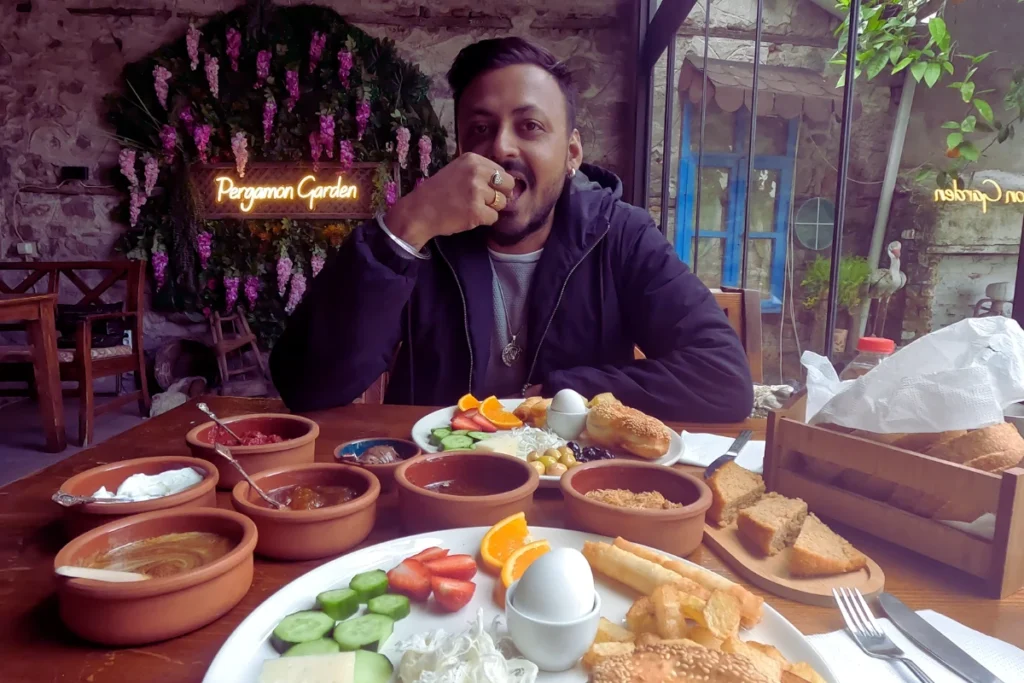
On the morning of our sixteenth day in Turkey, we sat down at the Pergamon Pension in Bergama and had the best breakfast of the trip.
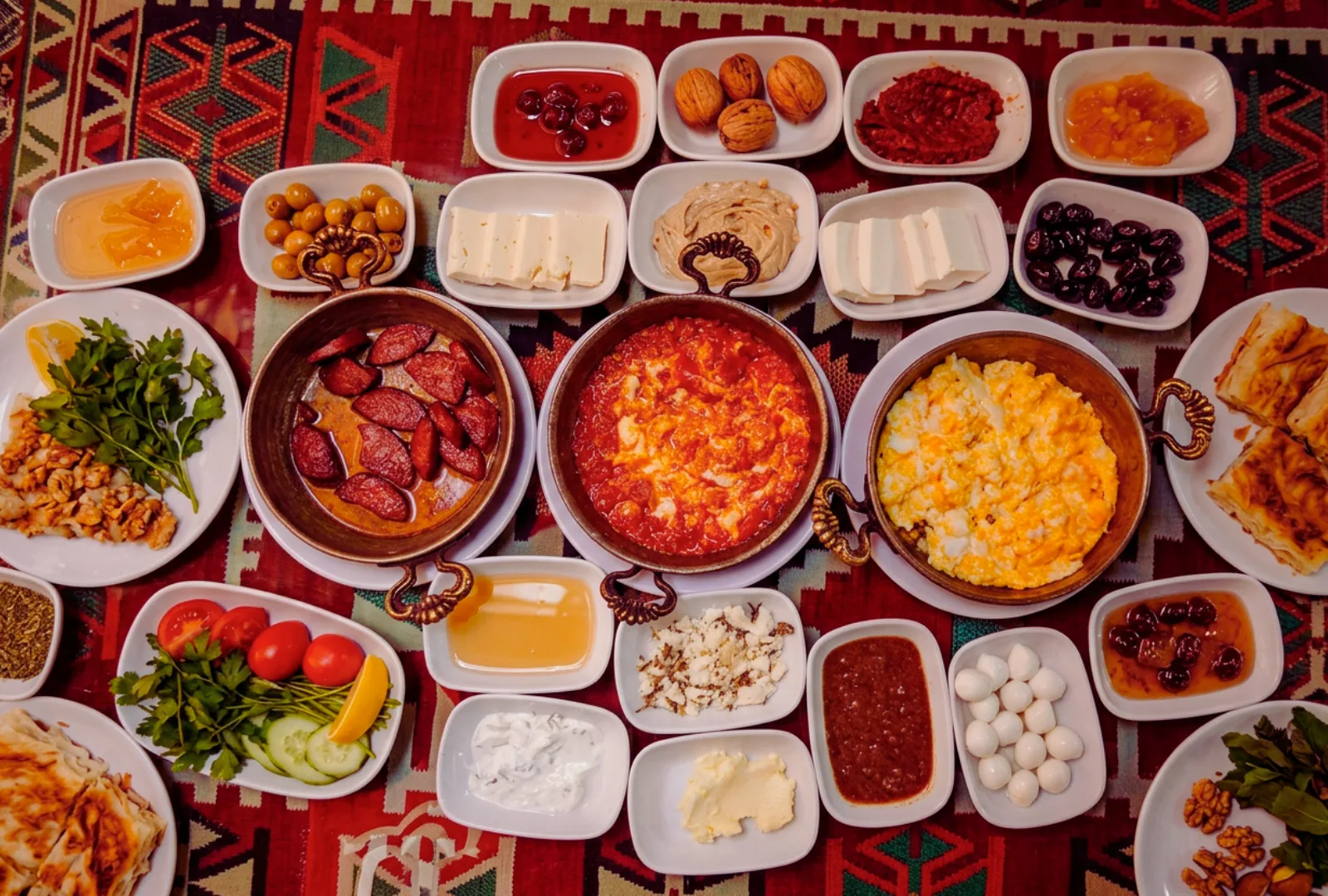
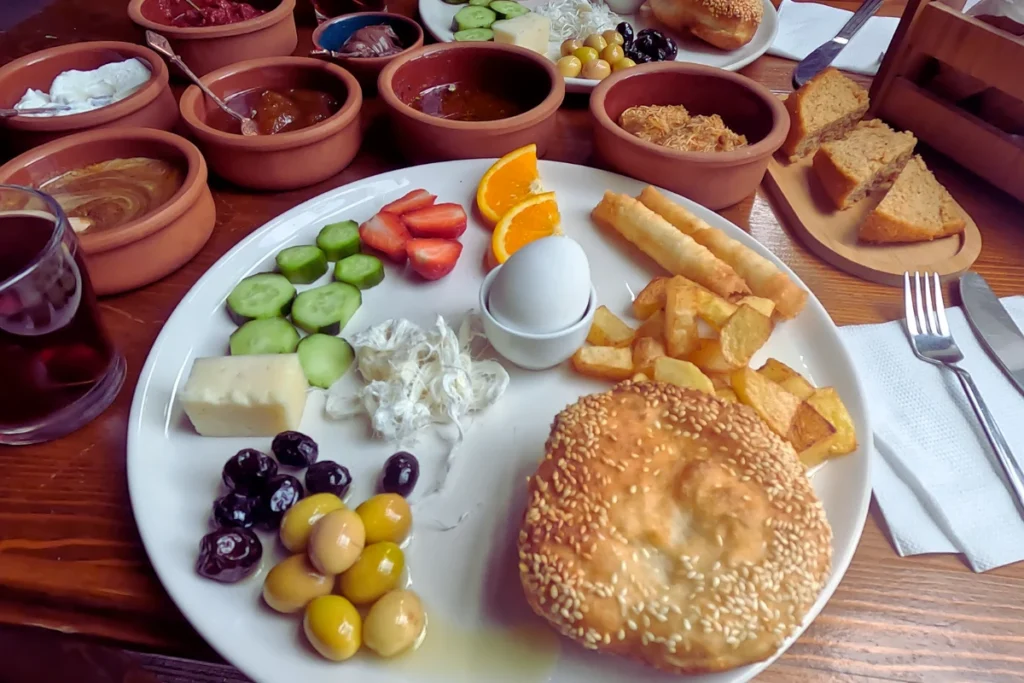
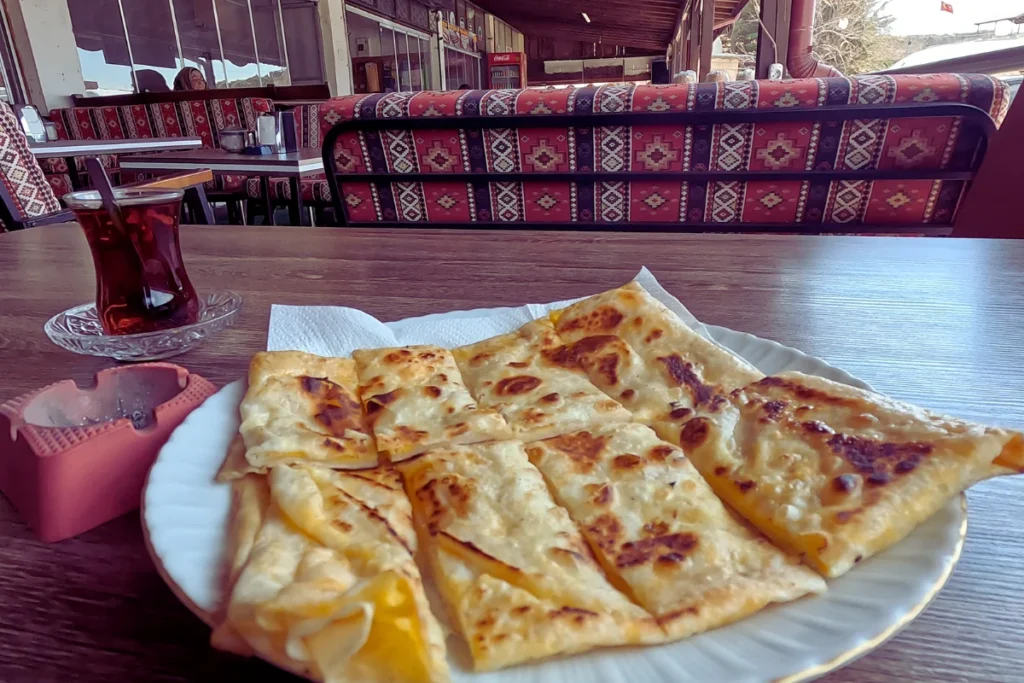
Not the first hotel breakfast. By that point, we had already experienced the Ramin Hotel’s generous spread in Şanlıurfa and two complimentary mornings at the Akapella Hotel in Pamukkale. But Bergama was the one that crystallised everything. The table covered with seventeen plates. Local cheeses in three or four varieties. Olives, black and green. Jams in small glass bowls, each a different colour. Fresh bread, warm, torn rather than sliced. Butter. Honey. Sliced tomatoes and cucumbers. Eggs prepared in a small copper pan. And tea. Turkish tea in tulip-shaped glasses, refilled before the glass was empty, refilled again when it was half-full, refilled until the concept of ‘enough tea’ ceased to have meaning.
We had spent the majority of the previous days cooking Maggi in cave hotels, eating bread and eggs from supermarkets, and drinking instant coffee from a travel kettle. We had saved approximately INR 17,000 through this strategy, and we do not regret a single self-cooked meal. But the mornings we sat at proper serpme spreads across the trip, we understood that Turkish breakfast is not a meal you eat. It is a cultural institution you enter.
This article is about that institution. What it contains, what it means, why it takes two hours, and why two Indians who grew up with the most elaborate breakfast culture in Asia recognised something familiar in a tradition from 4,000 kilometres away.
“We often calculate the cost of travel in currency saved, ticking off compromised meals like badges of financial honor. But sitting before a table overflowing with small plates teaches you a different math. You realize that some traditions cannot be hollowed out to fit a budget… because when a culture offers you two hours of unhurried peace in a tulip-shaped glass, the most expensive thing you can do is try to save time.”
What Is Kahvaltı?
The Turkish word for breakfast is kahvaltı. It translates, roughly, to ‘before coffee.’ The etymology is from kahve (coffee) and altı (under/before). The meal that precedes coffee. The foundation that the rest of the day is built upon.
But the word understates what it describes. Kahvaltı is not a meal. It is a format. A philosophy of morning eating that prioritises abundance, variety, communality, and time. Where most cultures treat breakfast as fuel (eaten fast, often alone, designed to be completed), Turkish breakfast culture treats the morning meal as the social and emotional anchor of the day. You do not eat breakfast in Turkey. You inhabit it.
The standard Turkish breakfast served at pensions, family homes, and neighbourhood restaurants across the country is called a serpme kahvaltı: a ‘spread’ breakfast. The table is covered with small plates and bowls, each containing a different item. Nothing is served in large portions. Everything is served in variety. The cumulative effect is a table that looks like a mosaic of colours, textures, and tastes, and the act of eating becomes an act of selection, combination, and conversation.
The meal has no fixed duration. It lasts until the table is empty or the conversation is finished, whichever comes later. In practice, this means Turkish breakfast routinely extends to ninety minutes or two hours, particularly on weekends, when families gather and the table becomes the centre of the household’s social life.
What Is on the Table
The serpme breakfast follows a pattern. The specific items vary by region, season, and kitchen, but the categories are consistent.
The Cheeses
Turkish breakfast cheese is not one cheese. It is a conversation between several. The white cheese (beyaz peynir), similar in texture to feta but milder, is the base. It appears at every Turkish breakfast without exception, the way rice appears at every Bengali meal. Alongside it: aged kaşar cheese (hard, slightly nutty, often sliced thin), tulum cheese (crumbly, stored in animal skin, sharp), and in eastern Turkey, local varieties that exist only within their region. At the Pergamon Pension, the cheeses occupied three separate dishes. We tasted each one on bread, alone, and with honey. Each combination produced a different flavour profile from the same morning.
The Olives
Black and green, served in separate bowls. The black olives are typically wrinkled and oil-cured, softer and more intense than the brine-cured variety. The green olives are firm, slightly bitter, and often dressed in olive oil. The quantity is generous. The olives are not a garnish. They are a course.
The Spreads
Honey, served alongside kaymak (clotted cream) in the traditional pairing. The combination of honey’s sweetness with kaymak’s richness is the most distinctive flavour of Turkish breakfast and the one that has no direct equivalent in Indian cuisine. Butter. Three or four varieties of jam: strawberry, apricot, cherry, fig, depending on the region and the season.
The Fresh Vegetables
Sliced tomatoes and cucumbers. This sounds simple because it is. The simplicity is the point. The tomato is ripe, red, and unseasoned. The cucumber is fresh and cold. They provide the crisp, clean counterpoint to the richness of the cheese, honey, and butter. Their presence on every Turkish breakfast table, regardless of the meal’s overall quality, is a quiet statement about how seriously Turkey takes the freshness of its produce.
The Eggs
Prepared in multiple ways, but the most iconic is menemen: eggs scrambled with tomatoes, green peppers, and onions in a small copper or cast-iron pan, served bubbling. The pan arrives at the table still hot. The eggs continue cooking while you eat. The bread, torn into pieces, is used to scoop the menemen directly from the pan. At simpler breakfasts, the eggs may be boiled or fried. At a proper serpme, menemen or sucuklu yumurta (eggs with sucuk sausage) occupies the centre of the table.
The Bread
Fresh, warm, and fundamental. Turkish breakfast bread is not an accompaniment. It is the delivery system. Every other item on the table is designed to be eaten on, with, or inside bread. Tearing the bread (never cutting) and using it to carry cheese, honey, olives, or menemen to your mouth is the mechanical rhythm of the meal.
The Tea That Never Stops
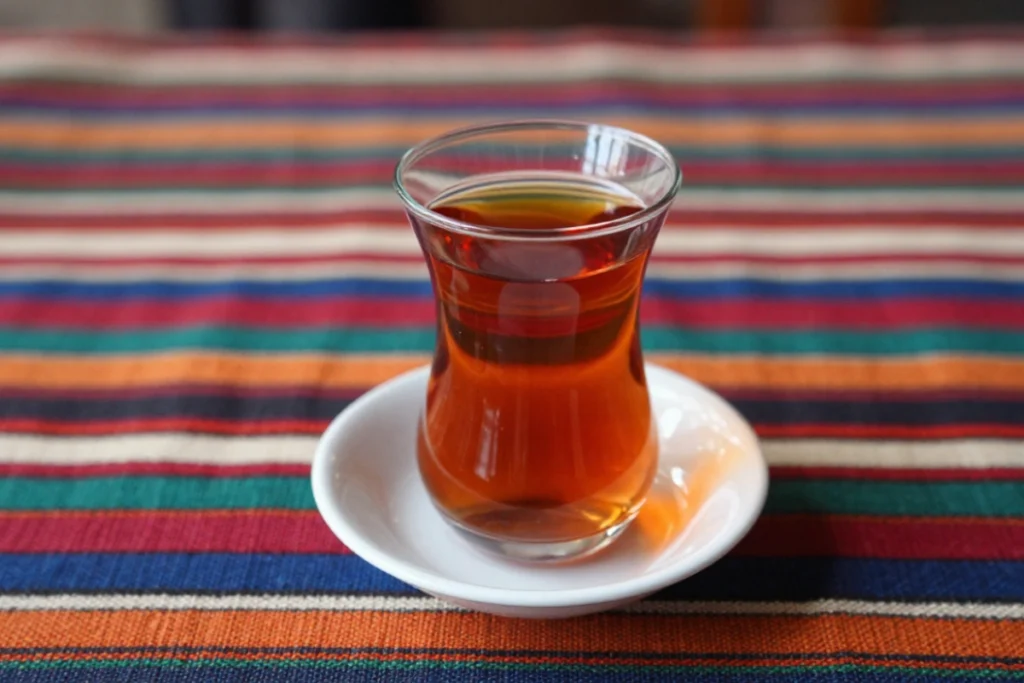
Turkish tea (çay) is not a beverage. It is a medium of communication.
Served in tulip-shaped clear glasses without handles, brewed dark from a double-kettle (çaydanlık) system where the lower kettle boils water and the upper kettle steeps a concentrated tea that is diluted to taste, Turkish tea is the constant of every meal, every conversation, every negotiation, every idle hour in Turkey.
At breakfast, the tea arrives before the food and continues after the food is finished. The glass is small (approximately 100 ml), which means you drink many glasses rather than one large cup. The refill is automatic. In a pension or a family home, the host refills your glass without asking. The act of refilling is an act of hospitality. Accepting the refill is an act of respect. The cycle continues until you place your spoon across the top of the glass, the universal Turkish signal for ‘I have had enough.’
We drank more tea in seventeen days in Turkey than we had in the previous year in Bengaluru. The tea is strong, slightly tannic, always served with two sugar cubes on the saucer (which you may use or ignore), and always hot. The connection to Indian chai culture is immediate and obvious. Both cultures use tea as a social lubricant. Both cultures consider offering tea to a guest non-negotiable. Both cultures would consider a morning without tea to be a morning that has not properly started.
The difference: Indian chai is milk-based, spiced, and typically consumed in larger volumes per sitting. Turkish çay is black, unsweetened by default, and consumed in small, frequent doses throughout the day. The function is the same. The form is different. Recognising this similarity was one of the moments during the trip where Turkey felt less foreign than its geography suggests.
“The small tulip glass functions as a clock without hands. It ensures your tea never gets cold, but it also means the bottom of the glass is always visible… an unwritten cue to your host that the conversation is still active, the table is still alive, and the next pour is already on its way.”
The Mornings We Sat Down
Across our 17-day journey, which included 14 days out on the open road, we balanced thirteen self-cooked mornings with four hotel breakfast mornings. The self-cooked mornings protected our budget, while the hotel mornings explained the culture. Both choices were necessary. Each of our four structured spreads taught us something different about the landscape.
Ramin Hotel, Şanlıurfa (Day 10)
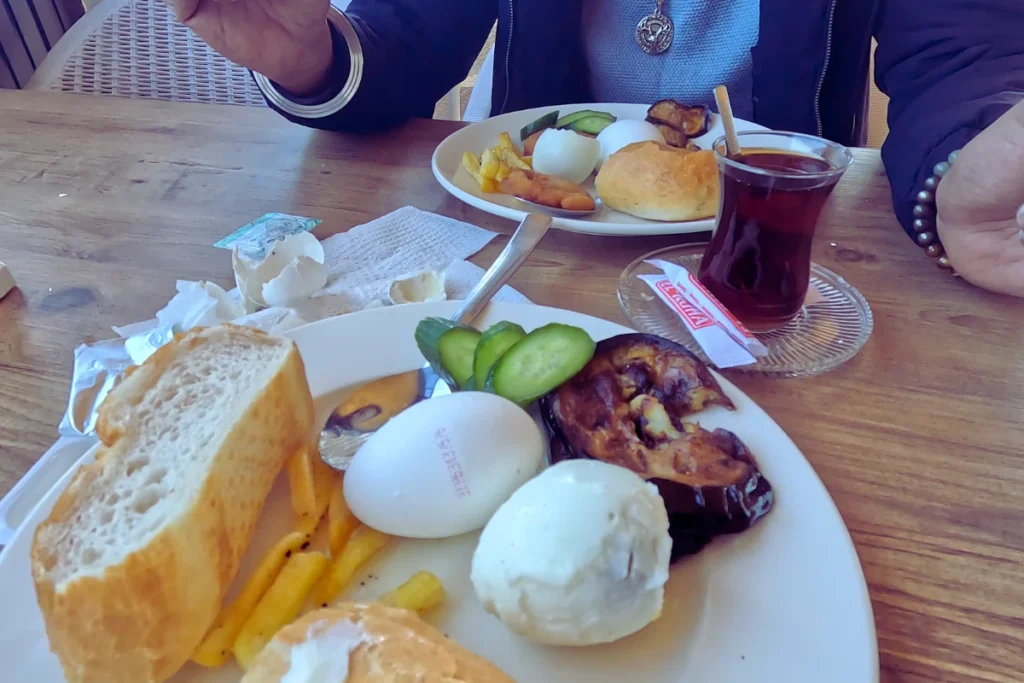
We arrived the evening before having eaten nothing but poha and biscuits brought from India. The city’s shops close early and we reached too late for a sit-down meal. The next morning at the Ramin Hotel, a full serpme breakfast was already set up in the dining room. It was the first morning of the trip where we had no choice but to sit down and eat properly, and it was the morning we understood that eastern Turkey does not do a small breakfast. The spread was generous in a way that felt personal rather than institutional, the kind of generosity that a city with no major tourist economy extends to the visitors it rarely sees.
Akapella Hotel, Pamukkale (Days 14 – 15)
Two consecutive mornings with a complimentary breakfast included. Denizli, the nearest major city to Pamukkale, runs on a tourist economy, and the Akapella’s breakfast reflected that: a properly assembled spread served in a proper dining room, orderly and consistent across both mornings. By Day 14, we had the serpme format understood well enough to move through the plates in order: vegetables first to wake up the palate, then cheese and bread, then the sweeter elements (honey, jam), then a final glass of tea. The second morning at Akapella, we ate the same meal but more slowly, because we had stopped treating it as a meal and started treating it as a ritual.
Pergamon Pension, Bergama (Day 16)
The best of the four. The spread described in the article’s opening. The table was packed with small dishes. The Pergamon Acropolis illuminated through the window. The bread warm. The cheeses in three separate dishes, each worth tasting in three different combinations. The tea that did not stop. We ate slowly, for once, because the table demanded it. We understood, that morning, why Turkish culture builds its day around this meal rather than rushing through it.
If the Ramin breakfast showed us eastern Turkey’s generosity, and the Akapella mornings gave us the tourist-circuit professionalism, Bergama showed us the version that has nothing to prove to anyone: a small pension, a covered table, a window with a view, and no reason to be anywhere else.
“The Ramin Hotel in Şanlıurfa showed us eastern Turkey’s generosity. The Akapella in Pamukkale gave us the ritual twice in a row. The Pergamon Pension in Bergama had nothing to prove and seventeen plates to show for it.”
Why It Takes Two Hours
Turkish breakfast takes two hours because it is designed to take two hours. The small portions across many plates create a natural pacing: you do not eat a single large item and finish. You eat small amounts of many items, pausing between each to reach for the next, tearing bread, pouring tea, continuing the conversation. The format is anti-hurry by design.
On weekends, Turkish families gather for breakfast the way Indian families gather for Sunday lunch. The meal is the event, not a precursor to the event. The conversation is the content, not the interruption. Children eat slowly because the adults are talking. Adults talk slowly because the food allows it. The entire morning is structured around a table that is not cleared until everyone has finished, and ‘finished’ means the conversation has reached a natural pause, not that the plates are empty.
This connects directly to the slow travel philosophy that shapes how we move through destinations. At Hampi, we stopped setting alarms by the third morning. At Kodaikanal, we stopped trying to see things and started noticing them. Turkish breakfast culture embeds that same principle into the first meal of the day. The morning is not a launchpad for the itinerary. The morning is the first experience.
By our second consecutive Akapella breakfast on Day 15, we had stopped eating with purpose and started eating with attention. The distinction matters. Eating with purpose is fuel. Eating with attention is an experience. The serpme table makes the second one inevitable, if you give it enough time.
What Indian Travelers Will Recognise
We grew up in Kolkata. South Indian breakfast culture, which we adopted in Bengaluru, is the closest parallel in our experience to what Turkey does with the morning meal.
A full South Indian breakfast, a crisp dosa with three chutneys and a sambar, followed by idli, vada, and filter coffee, served on a steel plate with the specific generosity that South Indian kitchens bring to the morning, is, like the Turkish serpme, a meal that takes the morning seriously. Both cultures understand that the first meal is not fuel. It is foundation.
The differences are structural. South Indian breakfast is built around a few items prepared with technical skill (the dosa batter fermented overnight, the sambar balanced across a dozen spices). Turkish breakfast is built around many items prepared with simple skill (the cheese sliced, the olives dressed, the bread baked). India goes deep. Turkey goes wide. Both arrive at the same destination: a morning that feels like it matters.
The specific moment of recognition, for us, was the tea. Sitting in Bergama with a tulip glass of dark çay, watching the pension owner refill it without being asked, we felt a hospitality we recognised from Indian homes. The gesture is identical. The cup is different. The warmth is the same.
Where to Experience Turkish Breakfast
- At a pension: family-run guesthouses across Turkey typically include a complimentary serpme breakfast. The smaller the pension, the more personal the spread. The Pergamon Pension (INR 4,933 / €55, breakfast included) served the best breakfast of our trip. The quality of the breakfast is often a better indicator of the pension’s character than the room.
- At a dedicated kahvaltı restaurant: in Istanbul, a specific genre of restaurant exists solely for breakfast. Van kahvaltı salonu (Van breakfast hall) is the term, referencing the eastern city of Van, where the breakfast tradition is considered the most elaborate in Turkey. These restaurants serve massive spreads priced per person, with the table yours for as long as you want it. Most common in Istanbul’s Beşikt aş, Karaköy, and Kadıköy neighbourhoods.
- In eastern Turkey: the further east you travel, the more generous the hotel breakfast becomes. Eastern Turkey’s spreads are larger, more regional, and significantly cheaper than Istanbul’s. A hotel in Şanlıurfa that costs a fraction of an Istanbul boutique will often include a breakfast that exceeds the Istanbul version in warmth and volume.
- At a Turkish home: if you are invited to a Turkish home for breakfast, accept without hesitation. The home version is the most complete, the most personal, and the most time-consuming. It is also the version where the tea refill cycle reaches its full philosophical expression.
The Breakfast We Still Compare Everything To
In our White Desert camping piece, we described the breakfast eaten on sand in the Sahara at dawn with our Bedouin guide (flatbread, tahini, olives, scrambled eggs, cold desert air, and the specific warmth of being called ‘brother’ by someone who barely knew us) as the most memorable breakfast of our combined travel life. The Bergama pension spread was the runner-up.
The Egyptian one won on context. The Turkish one competed on content. The fact that a breakfast eaten on sand in the desert beat a breakfast eaten at a table covered in seventeen plates tells you something about both meals.
If you travel to Turkey and cook your own meals to save money, as we did, build at least four or five serpme mornings into the trip. Choose hotels and pensions that include breakfast. If your route takes you through eastern Turkey, the breakfast there will be the most generous of the trip and the least expected.
The Turkish morning is not a transaction. It is an invitation. The tea is the greeting. The bread is the handshake. The variety of shared dishes forms the conversation. The Ramin Hotel extended that invitation after we arrived hungry and improvised. The Akapella extended it twice in a row and let us learn the ritual. The Pergamon Pension extended it at the end of the trip with nothing left to prove. Each version was the invitation. Each time, we should have accepted more often.
“Every country sells you its landmarks… the monuments, the ruins, the view from the highest tower. But Turkey does something far gentler. It invites you to sit down at a table that belongs to everyone, hands you a warm piece of bread, and tells you that the world can wait for two hours while you drink tea. The ruins of Bergama were spectacular, but it was the quiet hospitality of the morning table below them that we brought home in our pockets.”