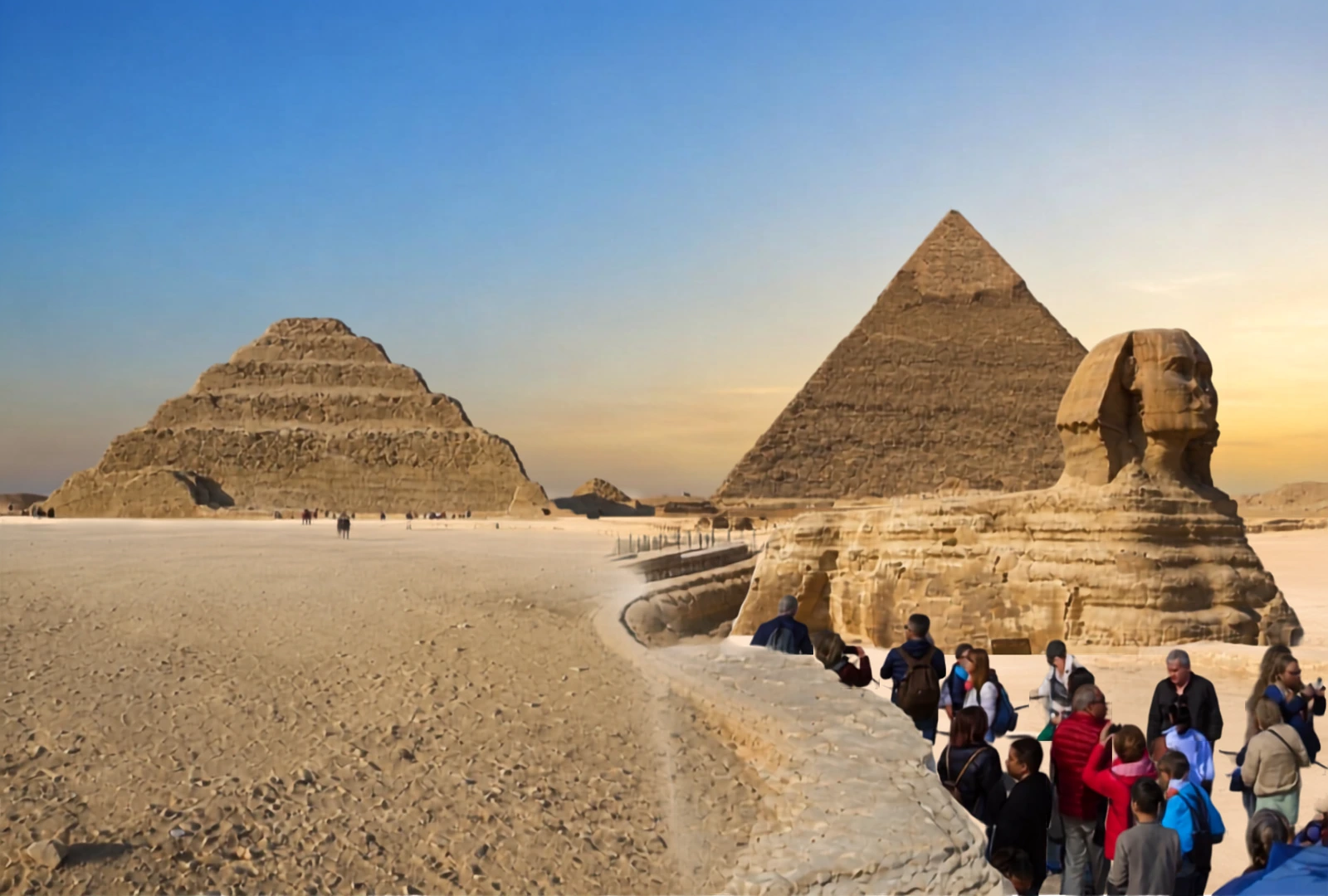
If you are deciding between Saqqara vs Giza and which to visit, the answer depends on whether you want to see the world’s most famous ancient monument or the quiet birthplace where pyramid engineering began. While most travel itineraries default to Giza, each site offers a completely different side of ancient Egypt’s history.
We visited both. We gave Giza a full morning. We gave Saqqara thirty minutes because we arrived late and the complex was closing. One of these was a reasonable allocation of time. The other was a scheduling failure we have been writing about ever since.
Here is what each site offers, side by side, so you can make the decision with more information than we had.
“Giza is where the ancients perfected the pyramid. Saqqara is where they took the risk of inventing it.”
What You Are Choosing Between
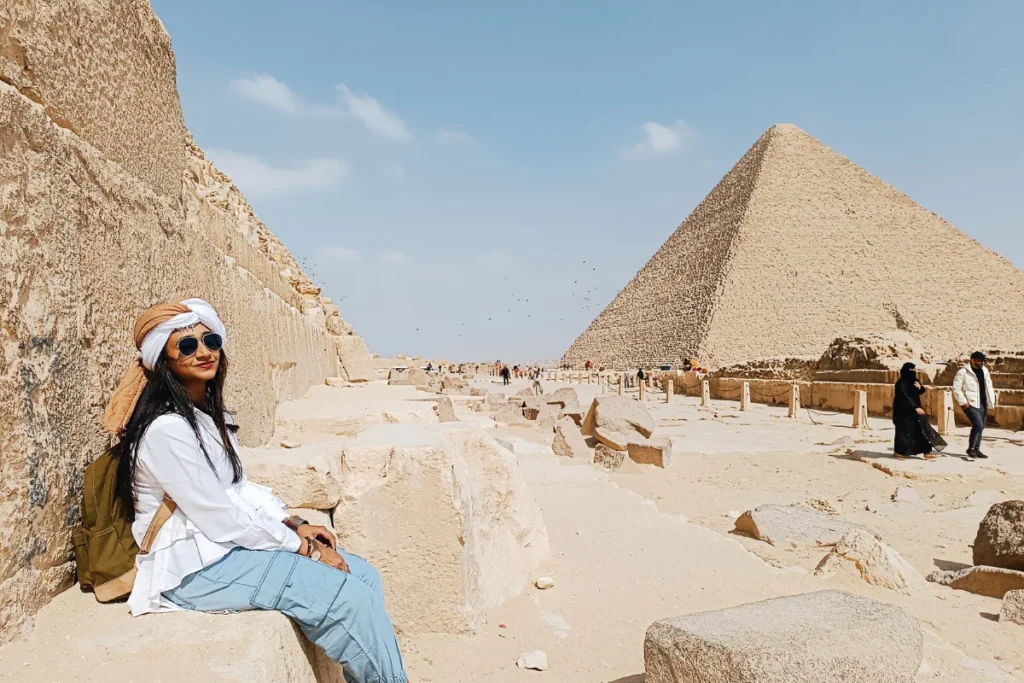
Giza is the pyramid everyone knows. Three pyramids (Khufu, Khafre, Menkaure), the Sphinx, and approximately four thousand years of fame. Built during the 4th Dynasty, around 2560 BCE. The Great Pyramid of Khufu stood as the tallest structure on Earth for 3,800 years. You have seen it on postcards, in films, on the back of textbooks, and in the dreams of everyone who has ever used the phrase “bucket list” non-ironically.
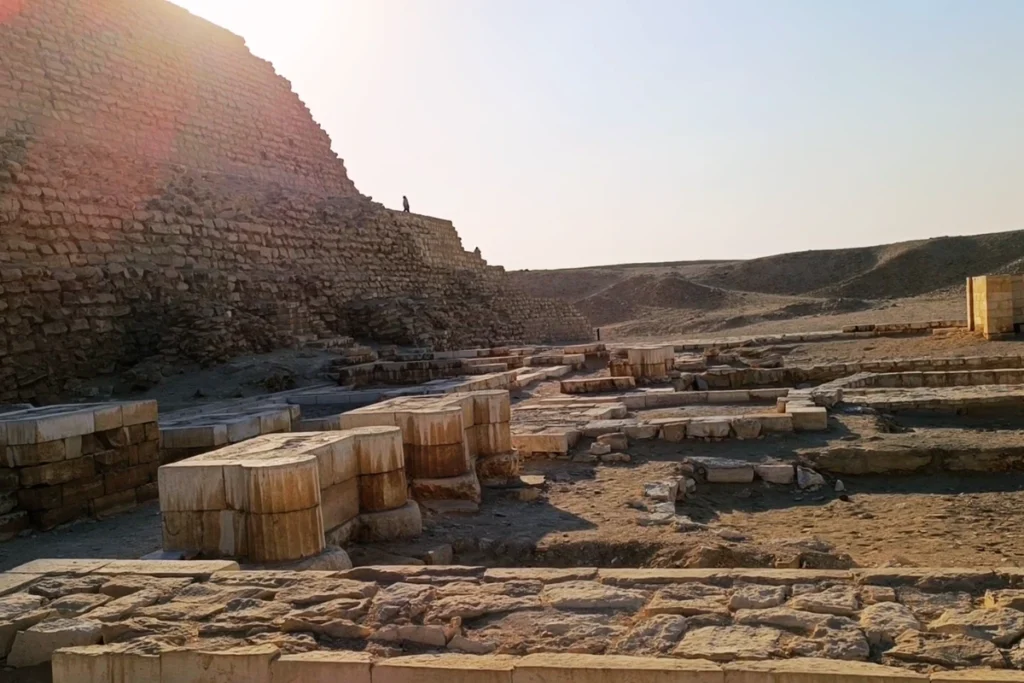
Saqqara is the pyramid nobody knows. The Step Pyramid of Djoser, built around 2670 BCE. A hundred years older than Giza. The first monumental stone structure built by human beings. Not the most impressive pyramid. The first one. Designed by Imhotep, the only architect in history who was later worshipped as a god, which is either the greatest performance review ever recorded or a cautionary tale about scope creep.
Saqqara vs Giza: The Side-by-Side
| Giza | Saqqara | |
| Built | ~2560 BCE (4th Dynasty) | ~2670 BCE (3rd Dynasty) |
| Significance | Perfection of the pyramid form | Invention of the pyramid form |
| Main structure | Great Pyramid: 146 metres, 2.3 million blocks | Step Pyramid: 62 metres, 6-tiered |
| Crowd level | Heavy. Tour buses, vendors, camel operators, selfie sticks | Light. On our visit, nearly empty |
| Entry fee (Feb 2022) | EGP 240 / INR 400 / USD 5 per person (complex). Khafre Interior: EGP 100 / INR 165 / USD 2. Khufu Interior: EGP 440 / INR 730 / USD 9 extra | EGP 180 / INR 300 / USD 4 per person |
| Going inside | Available (Khufu and Khafre, separate tickets) | Periodically open; verify before visit |
| Vendor pressure | Persistent. Constant offers for guides, photos, rides | Minimal |
| Sphinx | Yes, the famous one | No |
| UNESCO status | Yes (1979) | Yes, part of the Memphis and its Necropolis listing (1979) |
| Time needed | 3 to 4 hours minimum | 2 to 3 hours minimum (we had 30 mins; do not repeat our error) |
| Unique experience | Standing at the base of the tallest ancient structure ever built | Looking through two holes in a wall and having a 4,700-year-old statue look back at you |
| What it makes you feel | Small (intentionally; Khufu designed it that way) | Curious (the architecture raises more questions than it answers) |
| Distance from Cairo | 30 km from central Cairo | 15–20 km south of Giza |
| Combine with | The Sphinx, Grand Egyptian Museum | Dahshur (Red Pyramid, Bent Pyramid, 10 km south |
The Case for Giza
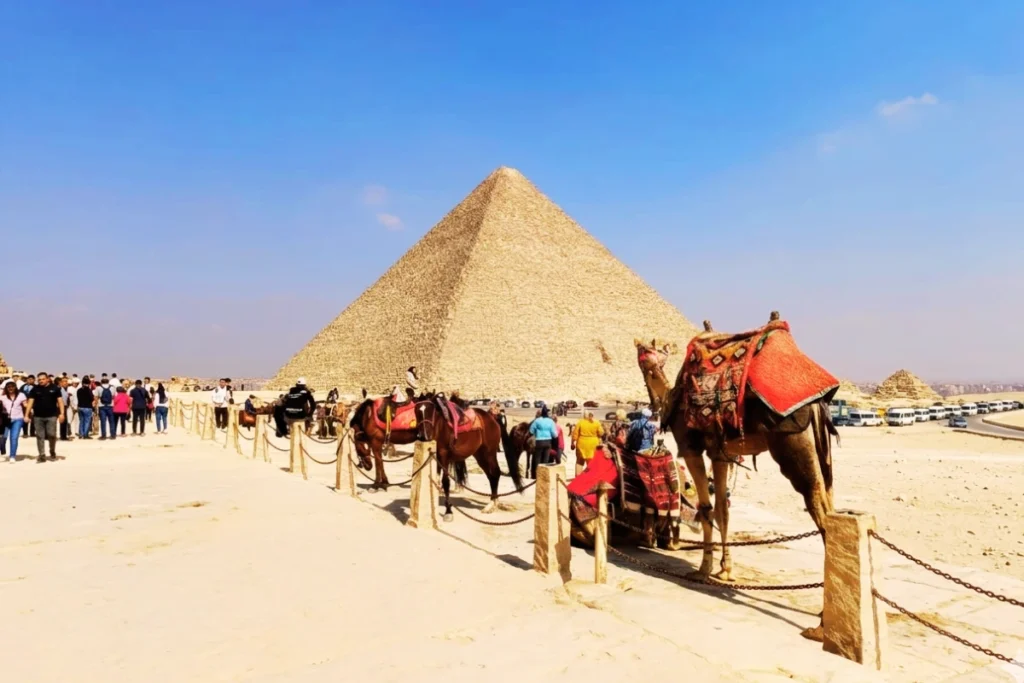
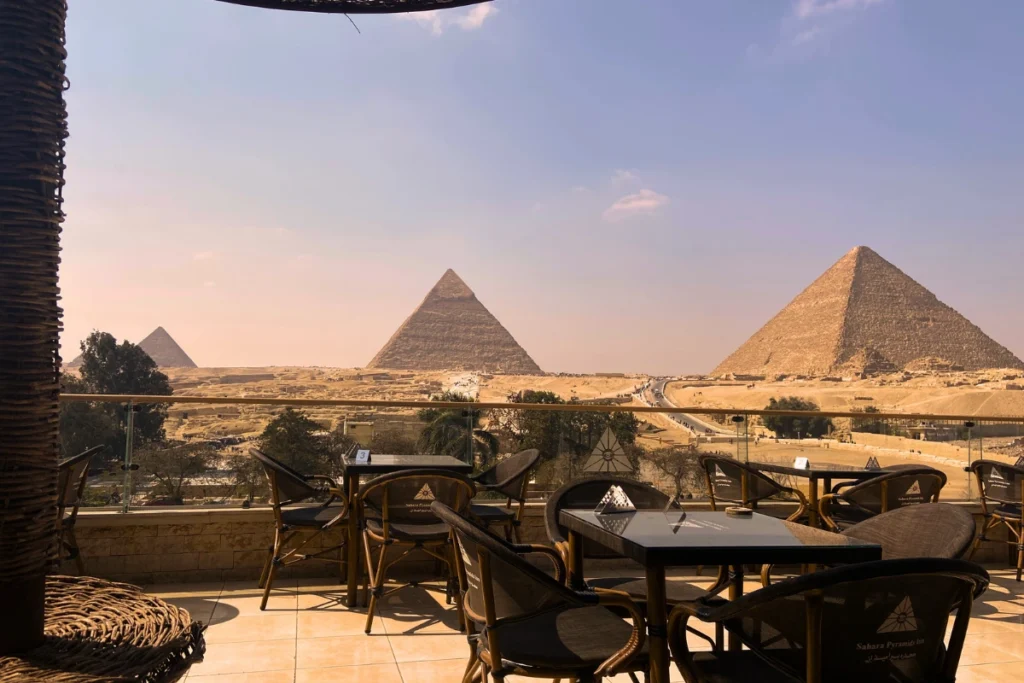
Giza does not need a case. It makes its own. The Great Pyramid is 146 metres of limestone and granite that should not exist given the tools available to its builders. Walking inside the Grand Gallery, ascending the narrow passage into the King’s Chamber, and standing inside the granite sarcophagus is one of the most significant physical experiences available in archaeology. The stone above your head weighs more than you will earn in a lifetime. The precision with which it was placed exceeds what modern contractors routinely achieve.
We stayed at a hotel two minutes from the Giza entrance. Rooftop breakfast with three pyramids in front of us. Two mornings of that view. The coffee got cold both times because we kept forgetting to drink it.
Giza earns its fame. The fame is not the problem.
“The Sphinx has been watching sunrises for forty-six centuries and has not yet seen one that surprised it.”
The Case for Saqqara
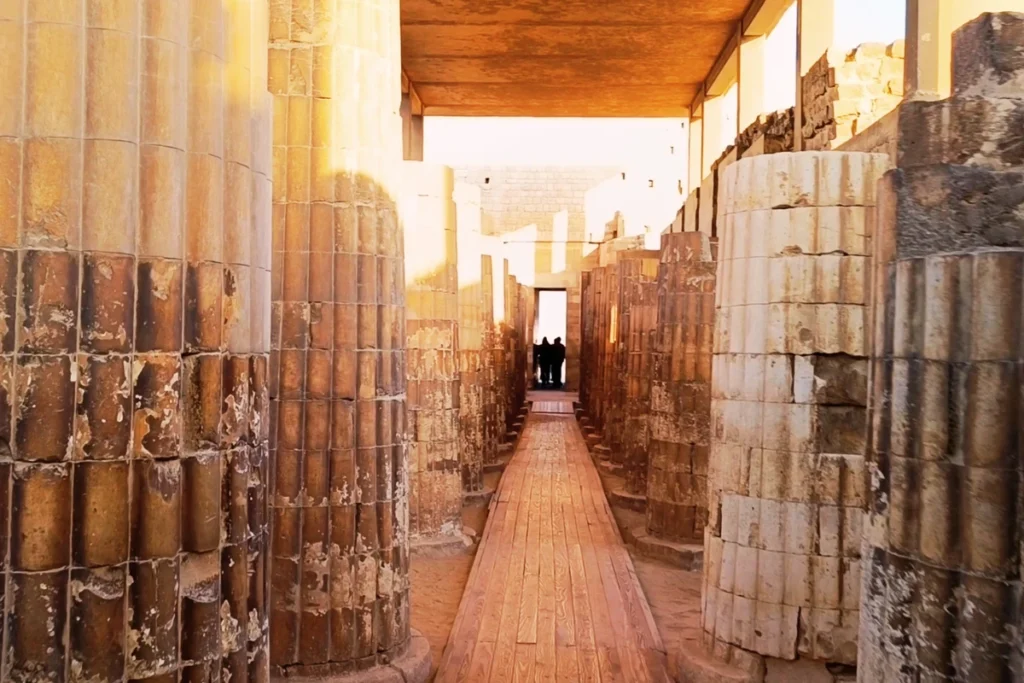
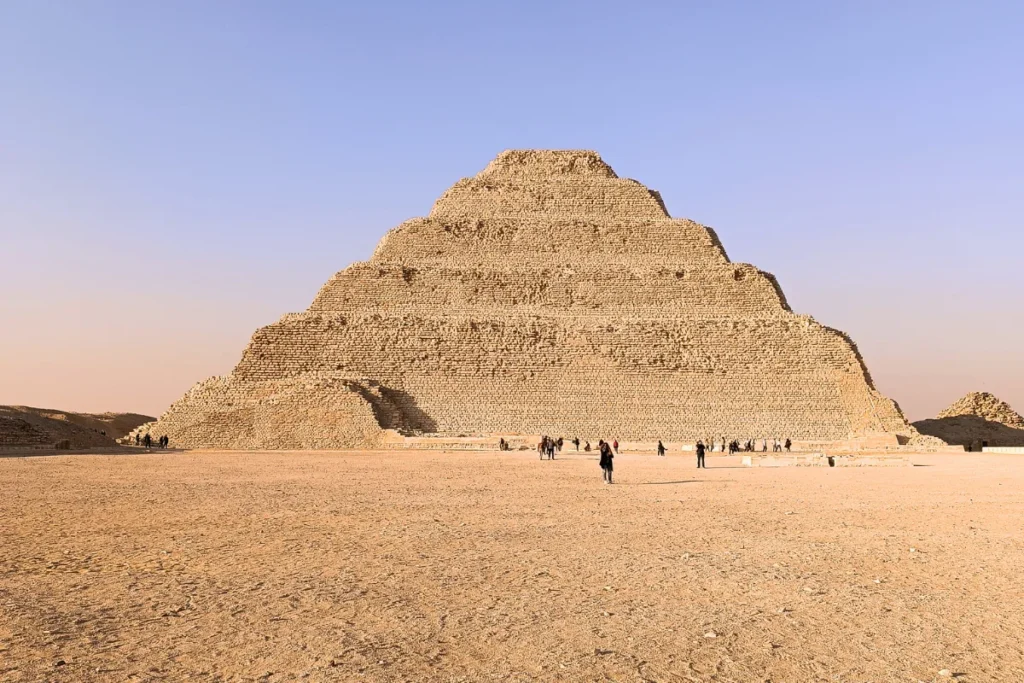
The problem is that Giza’s fame has erased Saqqara from the conversation.
Saqqara is where the entire tradition started. Before Djoser built the Step Pyramid, monumental architecture was mudbrick. After it, everything was stone. The Great Pyramid at Giza exists because Saqqara proved it was possible. Visiting Giza without Saqqara is watching the final episode without watching the pilot. The finale is more dramatic. The pilot is where the story begins.
Saqqara’s complex contains the oldest stone columns in the world, attached to the walls because the builders had not yet developed the confidence to let stone stand on its own. That architectural hesitation, visible in 4,700-year-old construction, is more moving than Giza’s perfected confidence. You are looking at people who were inventing something and did not yet know whether it would work.
The Serdab, a sealed stone chamber with two holes at eye level, contains a painted statue of Djoser that has been staring through those holes for forty-seven centuries. You look in. He looks out. The encounter lasts three seconds and stays for considerably longer.
Saqqara is also where the Pyramid Texts were first carved: the oldest religious writings in the world, inscribed inside the Pyramid of Unas. The Valley of the Kings paintings that most tourists travel to Luxor to see are the grandchildren of what was first written here.
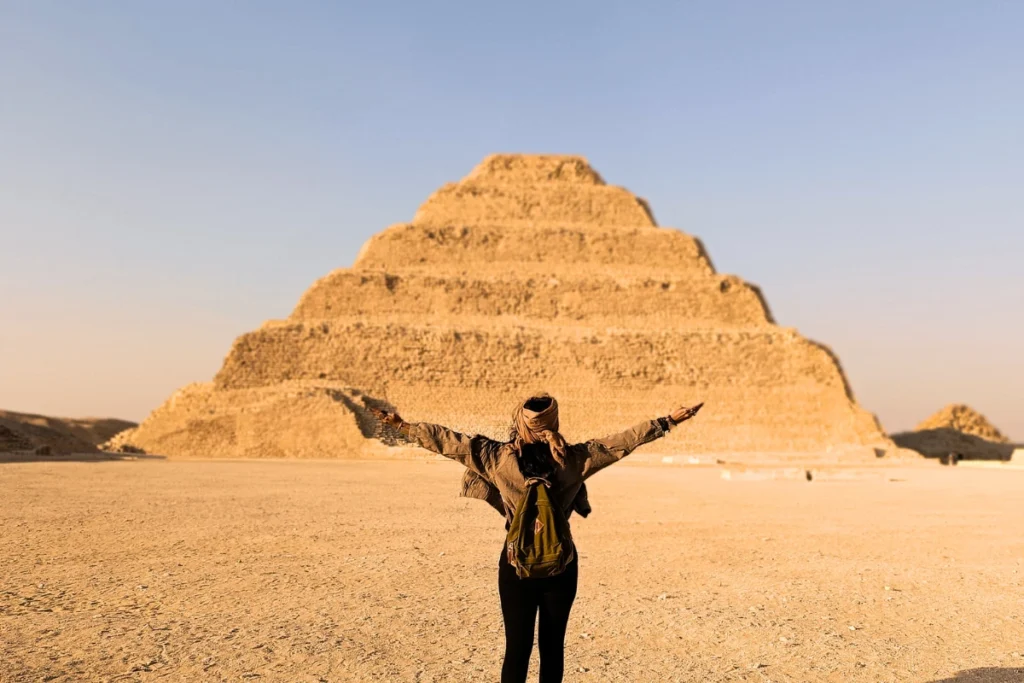
And the crowds at Saqqara, during our visit, were functionally nonexistent. We had the courtyard to ourselves in the fading light of a February afternoon. The Step Pyramid sat in silence. No one was offering us a camel ride. Nobody was asking if we wanted a photograph. The only audience was the pyramid and the sky.
So Which One?
If you have one day and must choose: Giza. The Great Pyramid is the Great Pyramid. You cannot visit Egypt and skip it. Your grandmother will ask. Your colleagues will ask. The bucket list will not forgive you.
If you have two days: Saqqara and Dahshur on Day 1 (the Red Pyramid interior at Dahshur is less crowded and cheaper than Khufu’s, and the 63-metre descent into its chamber smells aggressively of ammonia, which is the kind of sensory detail that no guidebook warns you about). Giza on Day 2. This is the sequence we followed. The chronology flows correctly: Step Pyramid (invention), Red and Bent Pyramids (experimentation), Great Pyramid (perfection). Each site prepares you for the next.
If you are an archaeology nerd: Saqqara first, spend the full morning, enter the Serapeum if open, find the Serdab, read the Pyramid Texts context. Then Giza in the afternoon. You will understand Giza differently after standing in the courtyard where the idea was born.
If you are a photographer: Giza at sunrise (the light on the limestone is extraordinary, the vendors have not yet arrived). Saqqara in the late afternoon (the Step Pyramid in golden light against an empty courtyard is a photograph that Giza’s crowds make impossible).
If you are on a budget: A standard complex ticket is EGP 180 / INR 300 / USD 4, compared to Giza’s EGP 240 / INR 400 / USD 5 entry (plus EGP 440 / INR 730 / USD 9 for Khufu’s interior, or EGP 100 / INR 165 / USD 2 for Khafre’s). By contrast, entry to Dahshur costs EGP 60 / INR 100 / USD 1.25 and includes access to the Red Pyramid’s interior. A full budget day combining Saqqara and Dahshur costs roughly half of the full Giza experience (EGP 240 / INR 400 / USD 5.25 versus EGP 680 / INR 1,130 / USD 14) and gives you access to two pyramid interiors instead of one.
The Actual Answer
Visit both. Budget two separate days. Do not combine them into one rushed afternoon the way we combined Saqqara with Dahshur and arrived at Saqqara with thirty minutes of daylight left.
Giza will make you feel small. This is intentional. Khufu built it to make you feel small.
Saqqara will make you feel curious. This is also intentional. Imhotep built it to make you wonder whether stone could do something that mudbrick could not.
Both feelings are worth the entry fee. The first is the feeling of standing in front of achievement. The second is the feeling of standing in front of ambition. Give each one the time it asks for. Giza asks for awe. Saqqara asks for attention. Neither one is asking too much.
“One site offers world-famous grandeur; the other offers the quiet origins of stone architecture. Both belong on the same itinerary.”