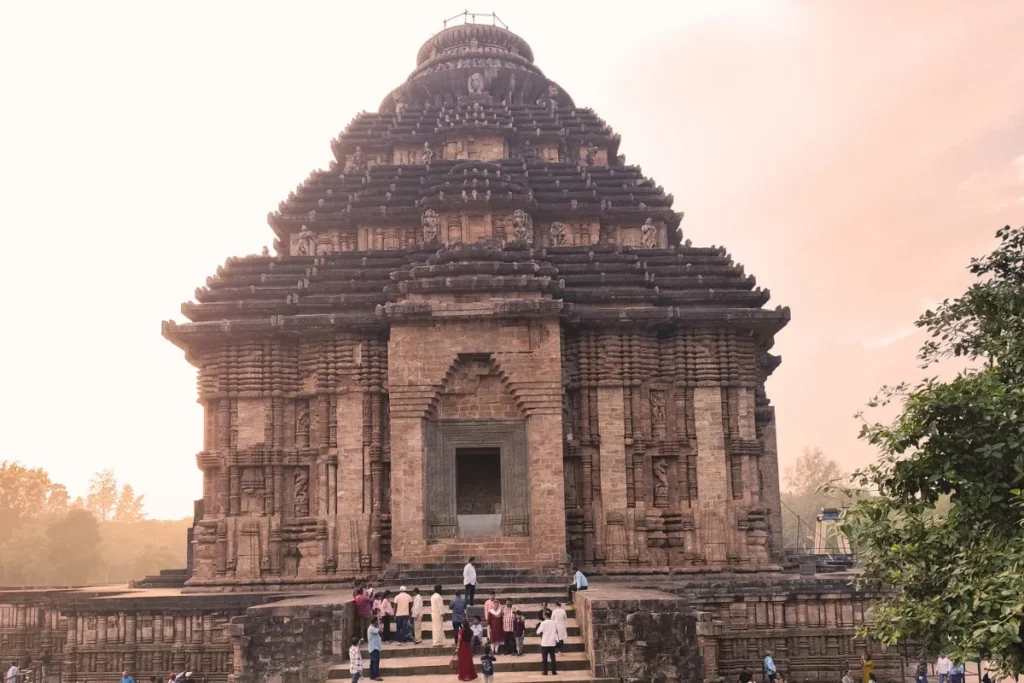
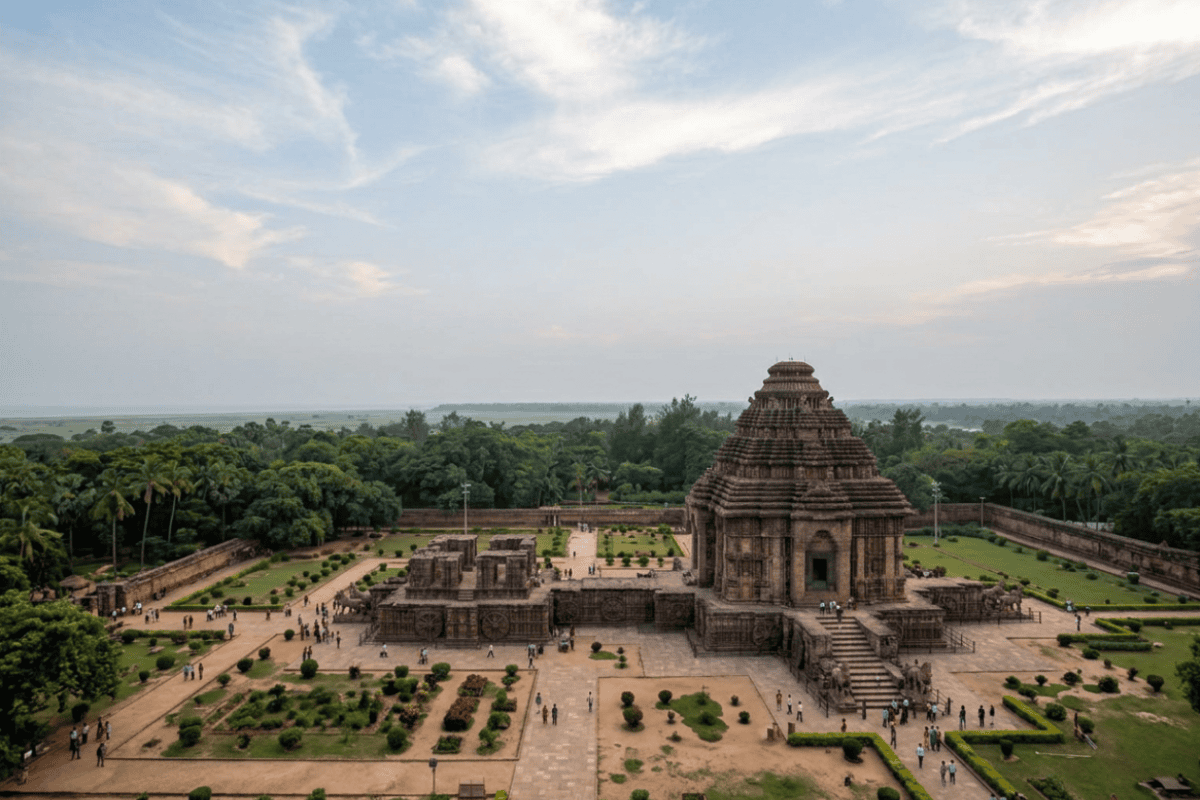
When deciding if a Konark temple day trip from Puri is worth adding to your itinerary, our experience showed us a very specific answer.
Yes. And the reason has nothing to do with ticking off another monument.
Puri and Konark are 35 km apart. The drive takes approximately 45 minutes. A shared auto or taxi from Puri costs a few hundred rupees. The entry fee is nominal for Indian nationals. The logistics are trivial. The question is not whether you can fit it in. The question is whether it adds something to a Puri trip that Puri alone does not provide.
It does. And the addition is not more temple. It is a different kind of temple.
“Puri demands surrender to a living, emotional faith that has burned continuously for centuries. Konark invites admiration for the quiet, enduring brilliance of human hands.”
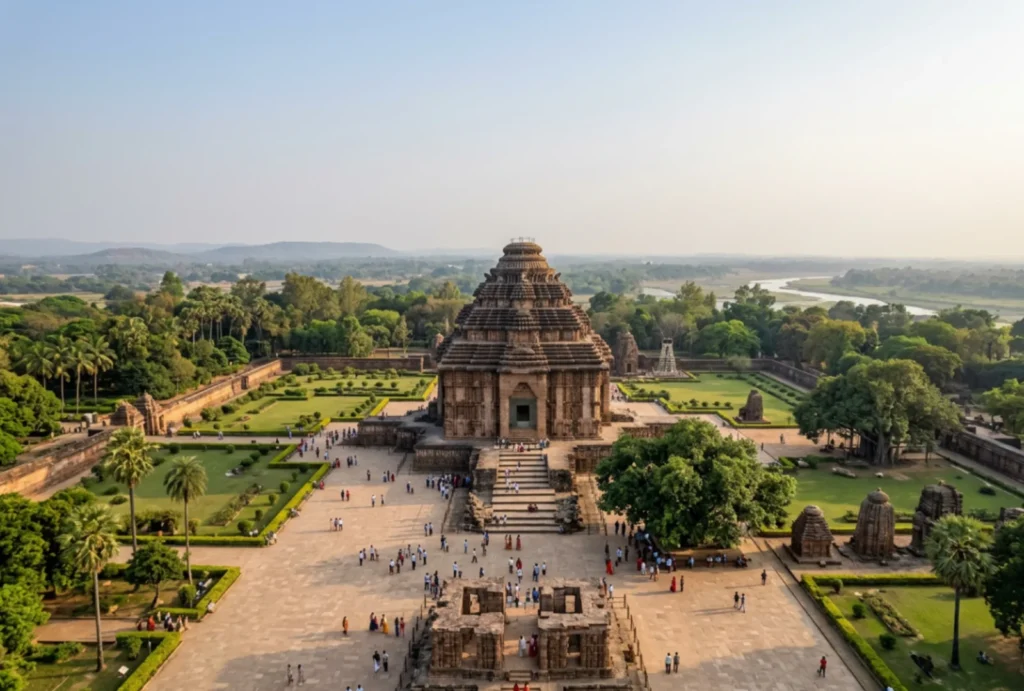
What Puri Gives You and What It Does Not
Puri is devotion. The Jagannath Temple operates on faith. You stand in a queue. You move with the crowd. You receive darshan. The experience is communal, physical, and emotional. The temple does not ask you to understand its architecture or decode its carvings. It asks you to participate in something that eight centuries of continuous worship have charged with a specific energy. You do not study Jagannath Temple. You submit to it.
This is extraordinary. We woke at 4 AM for the pre-dawn darshan and walked back to the hotel in a state that the word “sightseeing” cannot hold. Jagannath is not a site. It is an encounter.
Konark operates on a completely different frequency. The Sun Temple does not ask for surrender. It asks for attention. The carvings demand that you look closely. The engineering invites questions. The mythology, carved across every surface, rewards knowledge. Where Jagannath overwhelms you with the scale of collective belief, Konark engages you with the precision of individual craftsmanship.
A Puri trip without Konark gives you devotion. A Puri trip with Konark gives you devotion and inquiry. Both are Indian temple experiences. They address different parts of the visitor. Together, they cover the full range of what temples in this country are capable of producing.
What You Gain in the Evening
We visited Konark on the evening of our third day in Puri. We had done the 4 AM Jagannath darshan that morning and rested through the afternoon. The evening was free. The light was turning warm. We drove the 35 km and arrived at the temple as the sun began its descent.
The evening timing was not a compromise. It was the correct choice.
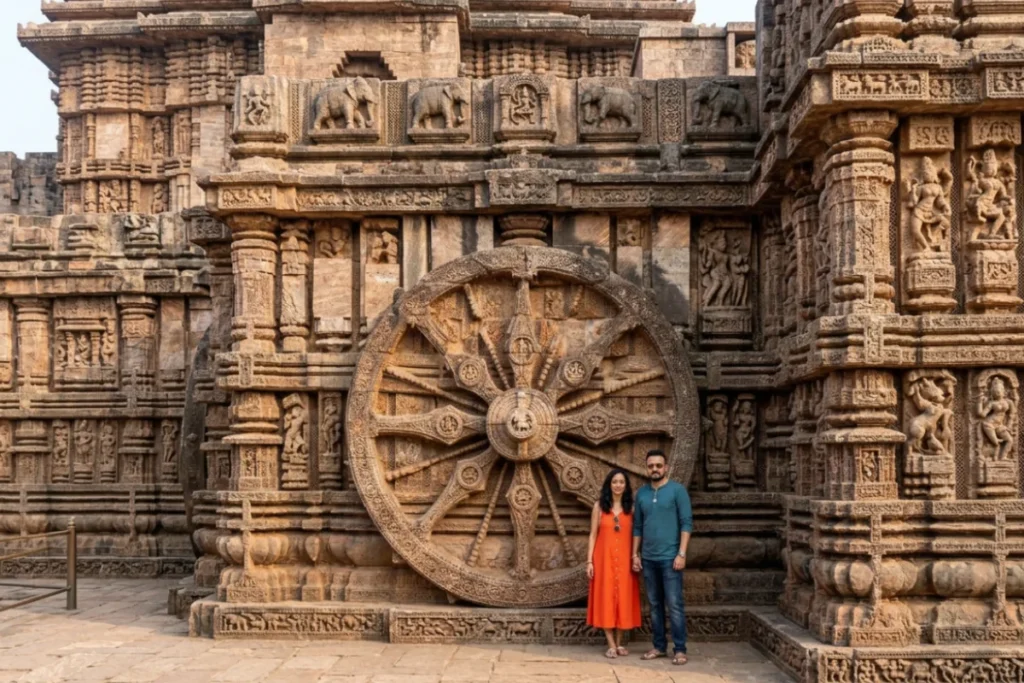
The Sun Temple was built facing east, designed to receive the morning sun through its entrance. The architectural intention favours dawn. But the sculptural programme, the thousands of carved panels covering every exterior surface, responds to evening light in a way that morning light does not. The low western sun hits the carved surfaces at an angle that pushes shadows into the relief channels, making the figures stand out from the stone with a three-dimensionality that overhead or frontal light flattens.
The stone wheels cast their longest shadows at this hour. The carved figures on the horizontal friezes acquire depth. The erotic panels, the mythological scenes, the dancers, the musicians, the animals, all of them gain a visual weight in the evening that they hold for approximately forty-five minutes before the light fades.
We spent that forty-five minutes walking the exterior, looking at panels we would have walked past in flat midday light, noticing details that the angle revealed: a fingernail on a carved hand, the texture of a stone garment, the expression on a face smaller than a palm. The temple is covered in these details. The evening light is the tool that finds them.
“The morning sun reveals the massive scale of Konark’s ambition, but the evening shadows reveal the soul of its sculptors.”
What You Lose from Your Puri Day
Half a day. Approximately four to five hours, including the drive both ways, the temple visit, and a stop at Chandrabhaga Beach afterwards.
If your Puri stay is only one night, the Konark excursion competes with beach time, market exploration, and the Jagannath darshan for limited hours. In that case, prioritise the darshan. It is the reason Puri exists as a pilgrimage destination. Konark is the supplement, not the substitute.
If your stay is two or three nights, as ours was, the Konark excursion does not compete with anything. The rest day we took on Day 2 gave us the energy for the pre-dawn darshan on Day 3 and the Konark drive that same evening. The sequence worked without strain: rest, darshan, rest again, Konark at sunset. Three distinct experiences in one day, each requiring a different kind of presence, none competing for the same energy.
The Practical Calculation
| Item | Detail |
| Distance from Puri | 35 km, approximately 45 minutes |
| Transport options | Own car, taxi, shared auto, or pre-arranged driver |
| Entry fee (Indian nationals) | Approximately INR 40 / USD 0.48 per person |
| Entry fee (international visitors) | Approximately INR 600 / USD 7.20 per person |
| Time at the temple | 60 to 90 minutes for the exterior circuit |
| Chandrabhaga Beach (optional, 3 km further) | Free, 30 minutes |
| Total half-day cost for two (Indian nationals) | Under INR 500–1,000 / USD 6–12 including transport and entry |
The cost of the Konark excursion, for Indian nationals, is negligible. The entry fee is nominal. The transport is a short ride. The time investment is half a day. The return is a temple that the full Konark guide describes in detail and that this evaluation summarises in one sentence: you will stand in front of a 13th-century building whose stone wheels still tell the correct time.
For international visitors, the entry fee is higher but the proposition is the same: the distance is short, the cost is manageable, and the temple provides an intellectual and aesthetic experience that Puri’s spiritual intensity does not duplicate.
Who Should Skip It
If your Puri trip is a single-night pilgrimage focused entirely on the Jagannath darshan, and your time is compressed to the point where adding Konark means reducing your time at the temple or arriving exhausted, skip it. Jagannath is the priority. Konark is the complement.
If you have already visited multiple ornately carved Indian temples on the same trip (Hoysaleshwara, Khajuraho, or similar sites with dense sculptural programmes), Konark may feel incremental rather than revelatory. The carved panels are extraordinary. They are not the only extraordinary carved panels in India.
If mobility is a concern, the temple exterior circuit involves walking on uneven stone surfaces in heat or sun. The main assembly hall interior is permanently sealed with sand for structural stability, meaning the visit is entirely on foot along uneven stone paths around the exterior.
Everyone else: drive the 35 km. Arrive in the late afternoon. Walk the exterior as the light descends. Look at what the low sun reveals on surfaces that the morning sun was designed to enter. Arrive in the late afternoon, walk the exterior as the sun drops, and watch the shadows bring 13th-century stone back to life.
“To experience Puri is to feel the heartbeat of living devotion; to stand before Konark is to marvel at the timeless mind that carved it.”