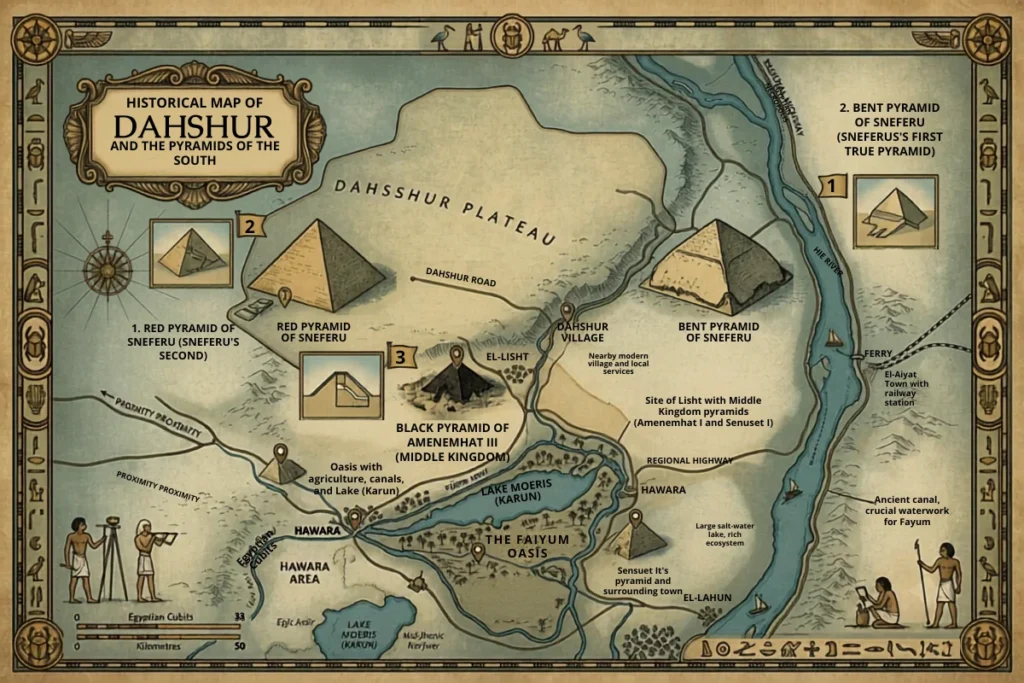
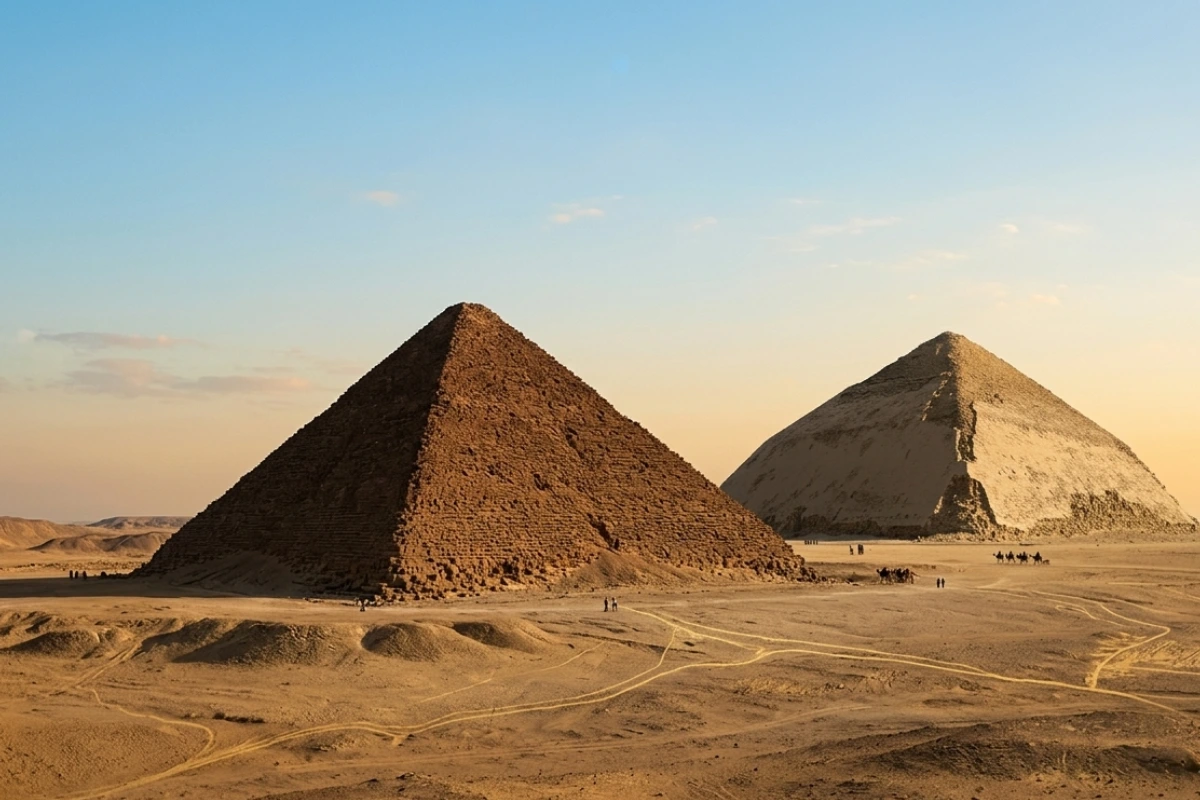
When choosing between the Red Pyramid vs Bent Pyramid, you are weighing the world’s first successful smooth-sided pyramid against its fascinating, kinked predecessor. Understanding how their interiors, exteriors, and historical significance compare will help you decide which to prioritise on your visit.
Pharaoh Sneferu had a problem. He wanted a smooth-sided pyramid. The technology did not yet exist. His solution was to build pyramids until one of them worked.
He built three. Possibly four. The man was committed to the concept the way a startup founder is committed to the pivot: keep building, keep adjusting, keep insisting that this time the geometry will cooperate.
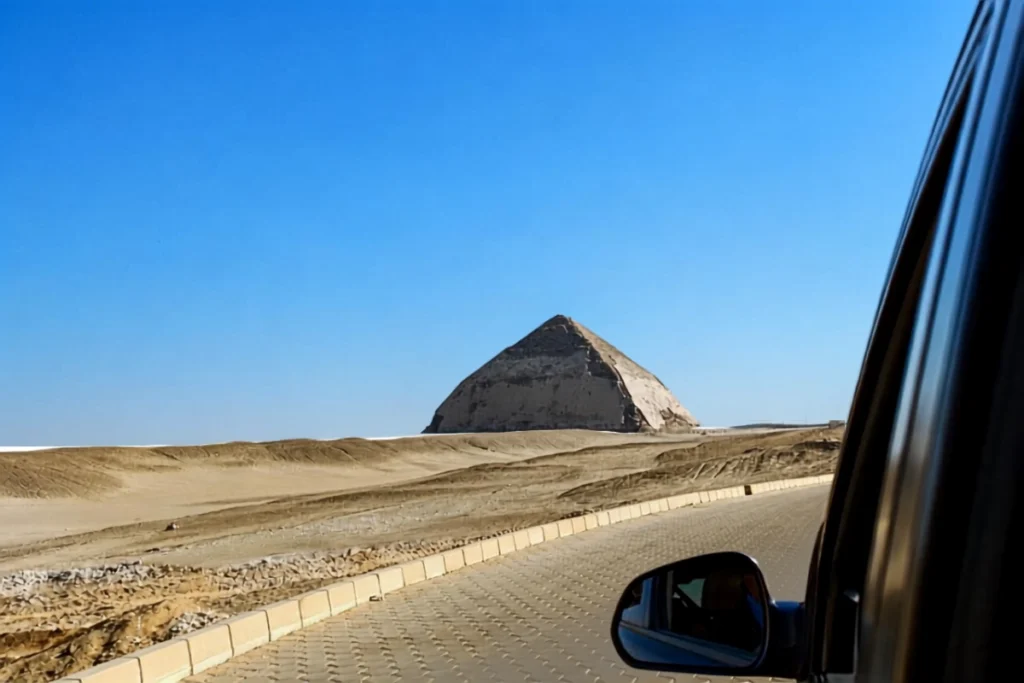
The Bent Pyramid was his second attempt. Halfway up, the angle changes from 54 degrees to 43 degrees, producing a visible kink that either represents a mid-construction engineering correction to prevent collapse or represents a pharaoh looking at his half-finished pyramid, hearing concerning noises from the structural engineers, and saying the ancient Egyptian equivalent of “make it less steep immediately.”
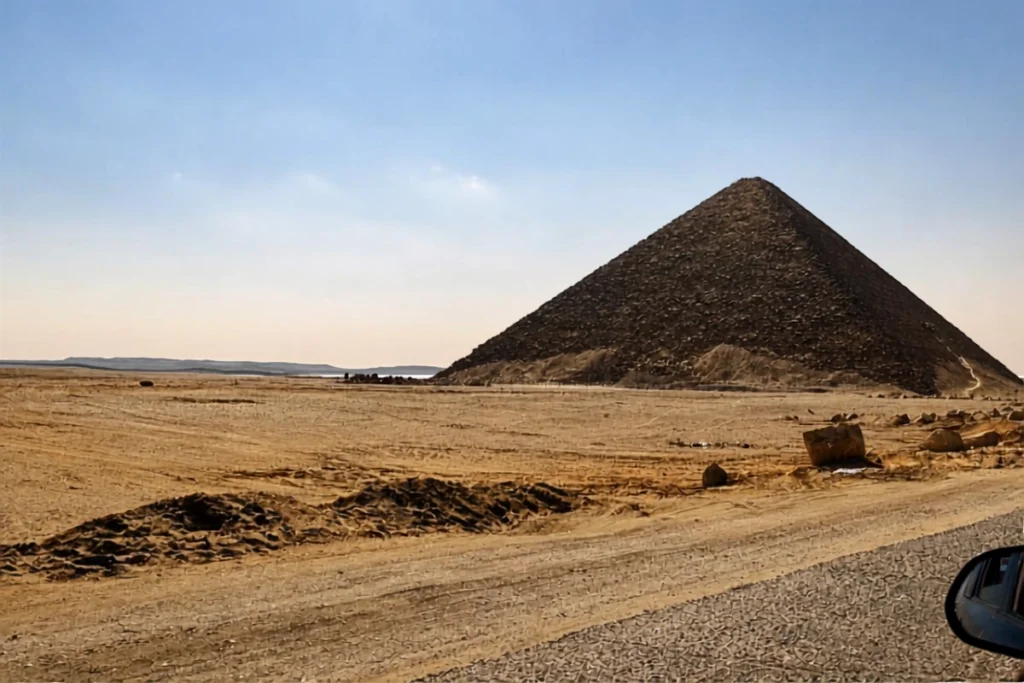
The Red Pyramid was his third attempt. It worked. The angle is a consistent 43 degrees from base to apex. It is the first successful true pyramid in Egyptian history. Every smooth-sided pyramid that followed, including his son Khufu’s Great Pyramid at Giza, descends from this one.
Both pyramids sit at Dahshur, approximately 40 km south of Cairo and 15 km south of Saqqara. Both are included in a single combined entry ticket. Both were built by the same pharaoh within approximately the same generation. And if you are standing in the Dahshur parking lot with limited time, you need to decide which one gets the deeper visit.
We visited both on Day 1 of our Egypt trip. Our driver Ramy brought us here before Saqqara. Here is the honest breakdown.
“Pharaoh Sneferu built pyramids the way modern engineers build prototypes: test the geometry, adjust after the structural cracks, and keep building until one stays standing.”
The Comparison
| Red Pyramid | Bent Pyramid | |
| Builder | Sneferu (~2590 BCE) | Sneferu (~2600 BCE) |
| Height | 105 metres | 105 metres |
| Angle | 43° (consistent) | 54° lower, 43° upper (the “bend”) |
| Historical significance | First successful smooth-sided pyramid | The failed experiment that made the Red Pyramid necessary |
| Can you go inside? | Yes. Included in the entry ticket | Opened to visitors in 2019 after restoration. Verify availability |
| Interior experience | A 63-metre descending passage into three chambers. Smells strongly of ammonia | Two chambers accessible from two separate entrances |
| Exterior condition | Most casing stones removed over centuries | Retains significant portions of original limestone casing |
| Crowds | Quiet during our visit | Even quieter |
| What it teaches you | What a completed true pyramid looks like from the inside | What happens when confidence exceeds knowledge mid-construction |
| What it smells like inside | Ammonia. Industrial-strength. Nobody warned us | Reports suggest a similar situation but less intense |
| Combined entry (Feb 2022) | EGP 60 / INR 100 / USD 1.25 | Included in the same ticket |
The Case for the Red Pyramid
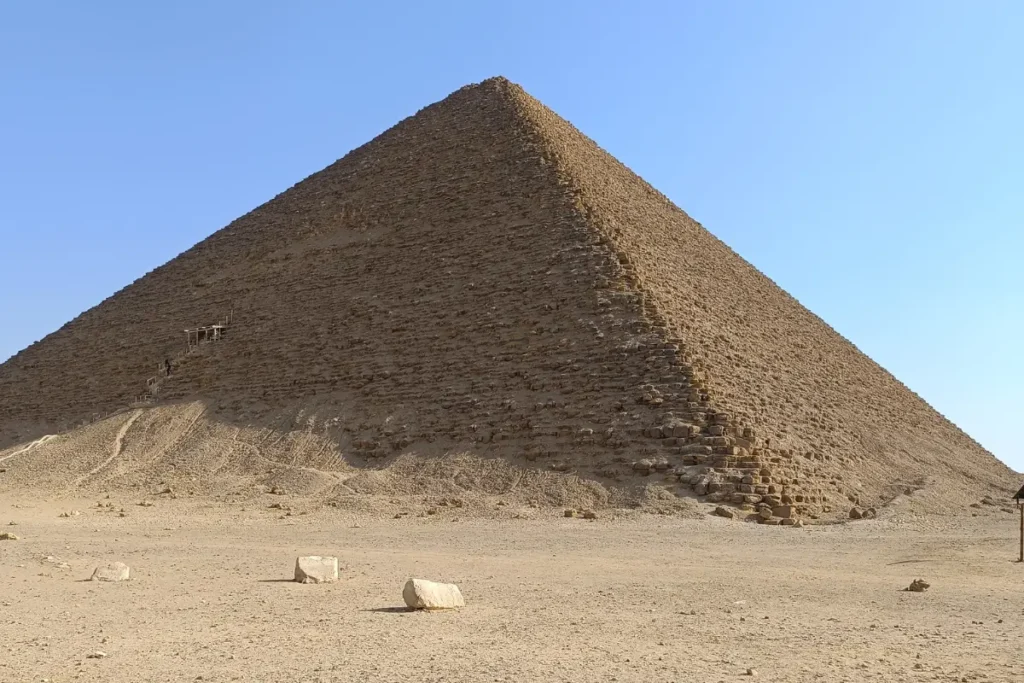
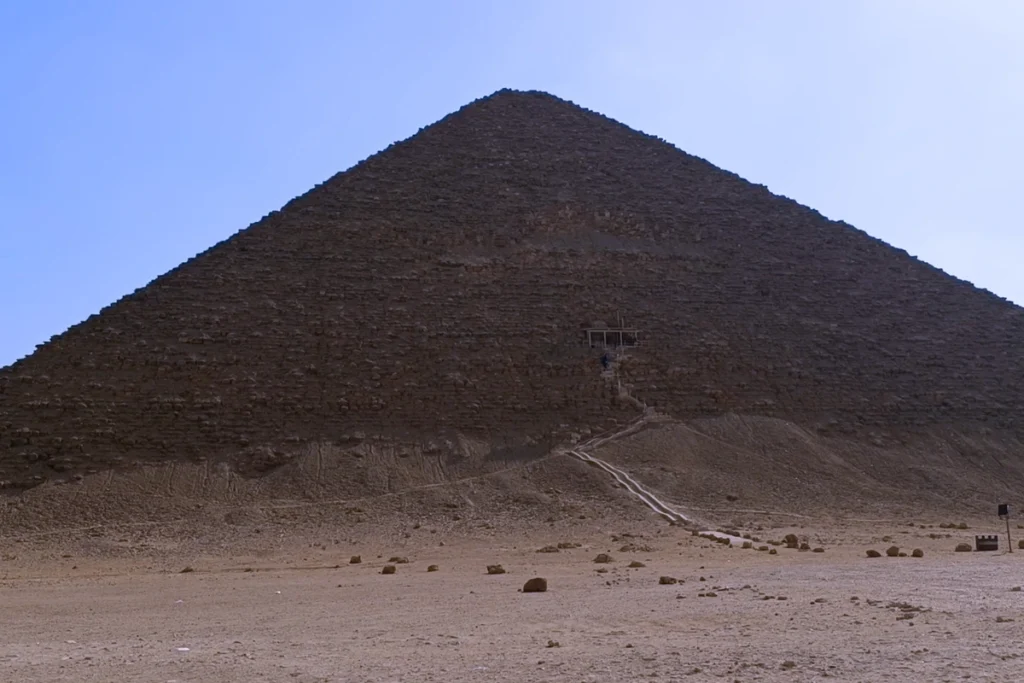
The Red Pyramid is the one you go inside.
The descending passage drops at a steep angle for 63 metres. The ceiling is low. The passage is narrow. Your back bends. Your thighs burn. The air changes. The light changes. The world above, the desert, the parking lot, Ramy waiting by the car, disappears behind you one bent-over step at a time.
At the bottom, three corbelled chambers open up. The corbelling technique, where each successive layer of stone extends slightly beyond the one below to create a gradually narrowing ceiling, was the structural innovation that allowed the pyramid to support its own weight without the internal chamber collapsing. You are standing inside the engineering solution that made the Great Pyramid possible, tested here first, refined here first, proven here first.
The chambers are large enough to stand upright. The stone is massive. The silence is total except for the sound of your own breathing, which at this depth and in this enclosed space becomes the loudest thing in the world.
“We descended 63 metres into a 4,600-year-old pyramid expecting ancient mystery and received ancient mystery plus a chemical experience that cleared our sinuses for the remainder of the day.”
The smell inside the Red Pyramid is extraordinary. Not pleasant-extraordinary. Extraordinary in the way that a sensory experience can be so far outside your expectations that your brain spends several seconds deciding whether to classify it as a smell or as an assault. The ammonia is produced by the chemical decomposition of bat guano accumulated over centuries inside the sealed chambers, combined with the mineral chemistry of the limestone in the enclosed, unventilated space.
Nobody warns you about this. No guidebook we read mentioned it. No website prepared us.
The descent into the Red Pyramid costs nothing beyond the EGP 60 / INR 100 / USD 1.25 combined Dahshur ticket. The descent into Khufu’s Great Pyramid at Giza costs an additional EGP 440 / INR 730 / USD 9. The Red Pyramid interior is less famous, less crowded, and offers a longer, steeper, more physically demanding passage than Khufu’s. If you want to go inside a pyramid and your budget or your patience for Giza’s crowds has limits, the Red Pyramid is the answer.
The Case for the Bent Pyramid
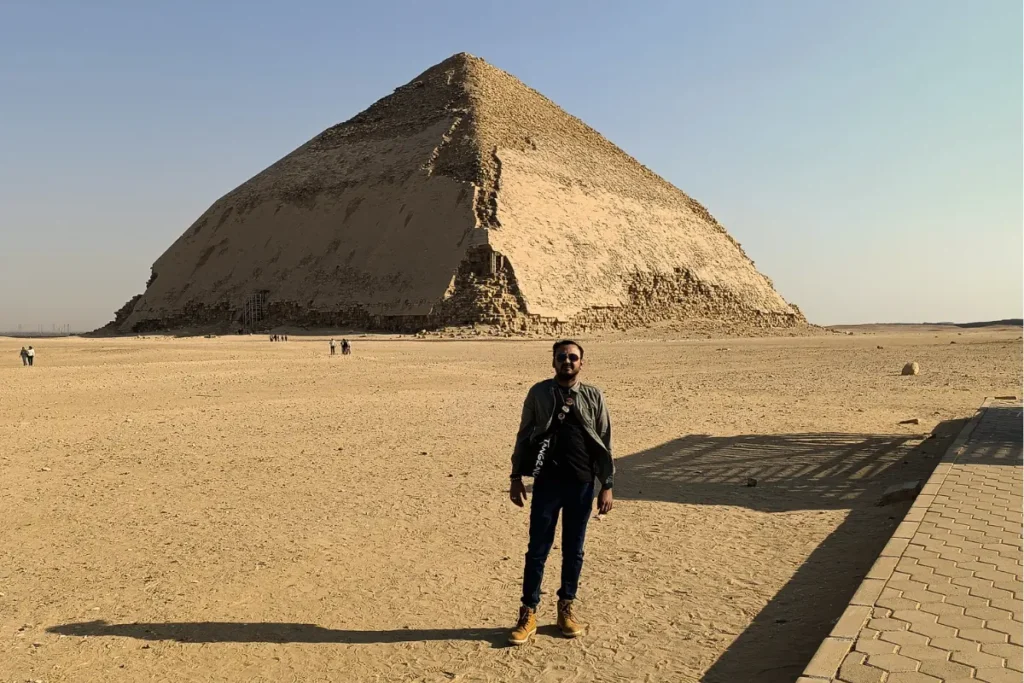
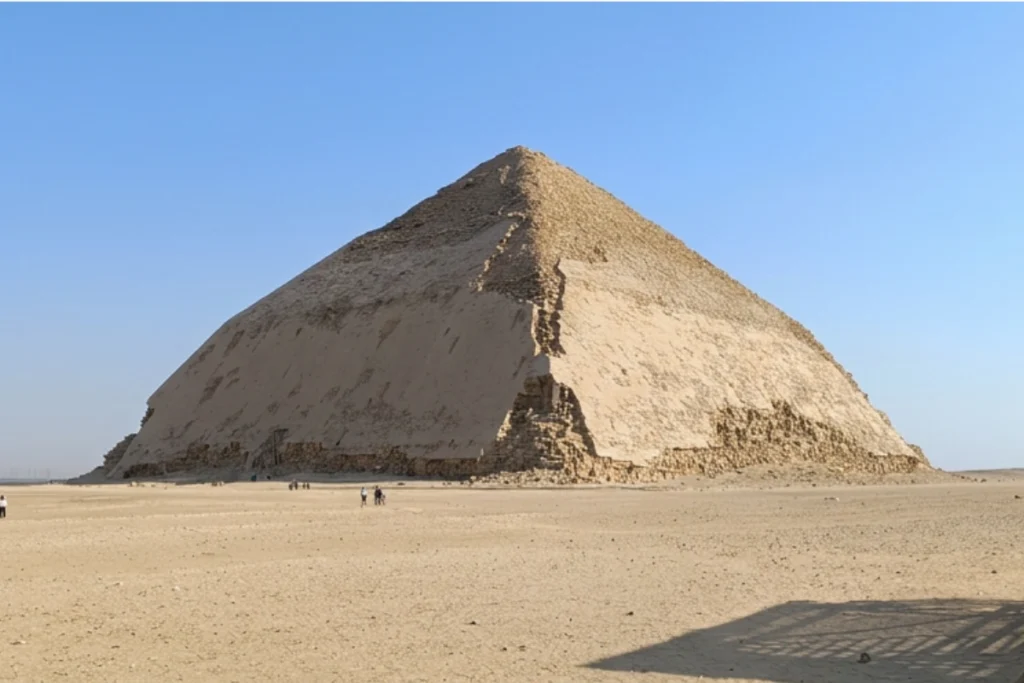
The Bent Pyramid is the one you look at.
From the outside, the Bent Pyramid is more visually interesting than any other pyramid in Egypt, including Giza’s. The angle change is visible from a distance: the lower section rises steeply, then the angle softens abruptly, creating a geometric kink that no pharaoh intended and no subsequent pharaoh repeated.
The leading theory: the builders started at 54 degrees, the same ambitious angle used at Sneferu’s earlier attempt at Meidum (which partially collapsed). Partway through construction, cracks or subsidence appeared. The structural engineers, who presumably valued their lives, recommended reducing the angle to 43 degrees. The pharaoh, who presumably valued his afterlife, agreed. The result is a pyramid that advertises its own engineering crisis in its silhouette.
The Bent Pyramid also retains more of its original polished limestone casing than any other pyramid in Egypt. At Giza, the casing was stripped over centuries for use in other construction projects. Cairo’s medieval buildings contain recycled pyramid casing stones. The Bent Pyramid, being further from the city and less convenient as a quarry, kept its outer surface largely intact. You are looking at something closer to what the pyramids originally looked like: smooth, white, gleaming in the sun, rather than the rough stepped core that most visitors associate with the word “pyramid.”
The Bent Pyramid was opened to visitors in 2019 after a long restoration. Access to the interior chambers requires verification (it may not be consistently available). The interior offers two separate chamber systems accessed from different entrances, one on the north face and one on the western face, each with its own passage and corbelled chamber.
The Black Pyramid (The Bonus)
The Dahshur ticket also includes the Black Pyramid of Amenemhat III, built approximately 700 years after Sneferu’s pyramids during the 12th Dynasty. It is constructed primarily of mudbrick rather than limestone, which is why it has mostly collapsed into a dark, weathered mound. The “black” appearance comes from the exposed mudbrick core.
The Black Pyramid is a different era, a different construction philosophy, and a different state of preservation. It is worth a brief stop on the walk between the two Sneferu pyramids. It takes approximately ten minutes and provides the visual contrast between Sneferu’s limestone ambition and a later dynasty’s mudbrick economy. The engineering lesson: the material you choose determines how long your monument lasts. Sneferu chose limestone. Amenemhat chose mudbrick. Sneferu’s mistakes are still standing. Amenemhat’s finished product is a mound.
The Decision
If you have time for one pyramid interior: Red Pyramid. The 63-metre descent, the corbelled chambers, and the ammonia you did not ask for are a complete experience. Bring something to cover your nose. We did not. We adapted. The adaptation was not pleasant.
If you have time for one exterior photograph: Bent Pyramid. The angle change is the most photographically distinctive feature of any pyramid in Egypt. The retained casing stones add the texture that Giza’s stripped surfaces lack.
If you have two hours (which you should): Both. Walk to the Red Pyramid, descend, experience the chambers, ascend, recover from the ammonia. Walk to the Bent Pyramid, photograph the angle change and the casing, contemplate the engineering pivot that saved the project. Stop at the Black Pyramid on the way between them.
If you are combining with Saqqara (which we did): Arrive at Dahshur first. Give it the morning. Then drive 15 km north to Saqqara and give the afternoon to the Step Pyramid complex. Do not do what we did, which was the reverse order with insufficient time at Saqqara. The chronology also flows better: Bent Pyramid (failed experiment) → Red Pyramid (first success) → Step Pyramid (the original invention, a century earlier). The story moves forward even though the timeline moves backward.
“Giza gives you the scale of ancient Egypt’s peak, but Dahshur gives you something rarer: the unpolished draft where you can still see the trial, the error, and the exact moment they figured it out.”