When planning your itinerary, choosing Old Dubai vs. New Dubai often triggers a familiar debate between rich historic culture and futuristic skyline ambition. Before booking your stays, understanding how the two sides compare in travel time, dining costs, and overall charm will save you from making the wrong choice halfway across the city.
Dubai is two cities wearing one name.
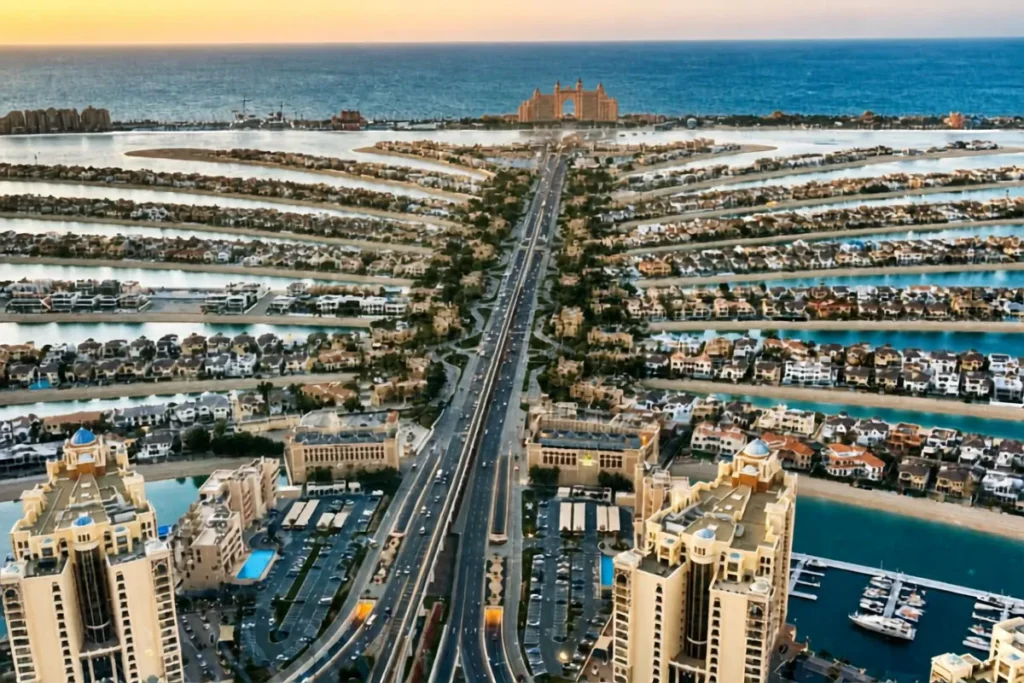
One was built by traders who sailed dhows through a saltwater creek and exchanged spices for gold in covered souks. The other was built by engineers who poured enough concrete into the Persian Gulf to create a palm-shaped island and then put a hotel on it shaped like a sail because apparently the island alone was insufficient.
Both cities are real. Both are accessible by a thirty-minute taxi ride. The meter starts at AED 12 / INR 270 / USD 3.25 and stops at approximately AED 60 / INR 1,350 / USD 16.35 to AED 80 / INR 1,800 / USD 21.80, depending on traffic… That AED 60 / INR 1,350 / USD 16.35 buys you transit across roughly 150 years of urban development, which is a bargain by any historical standard.
We spent five days in Dubai and experienced both sides daily because we based ourselves in Old Dubai (Bur Dubai) and took taxis to New Dubai’s attractions. The commute produced something that staying exclusively on either side would not have: the specific, repeatable experience of crossing the boundary between two versions of the same city and feeling the frequency change.
Here is what each side offers, what it costs, and which one should get your first morning.
“Dubai is not a city that chose between its past and its future; it simply built the future next door and connected them with a one-dirham boat.”
What Each Side Actually Is
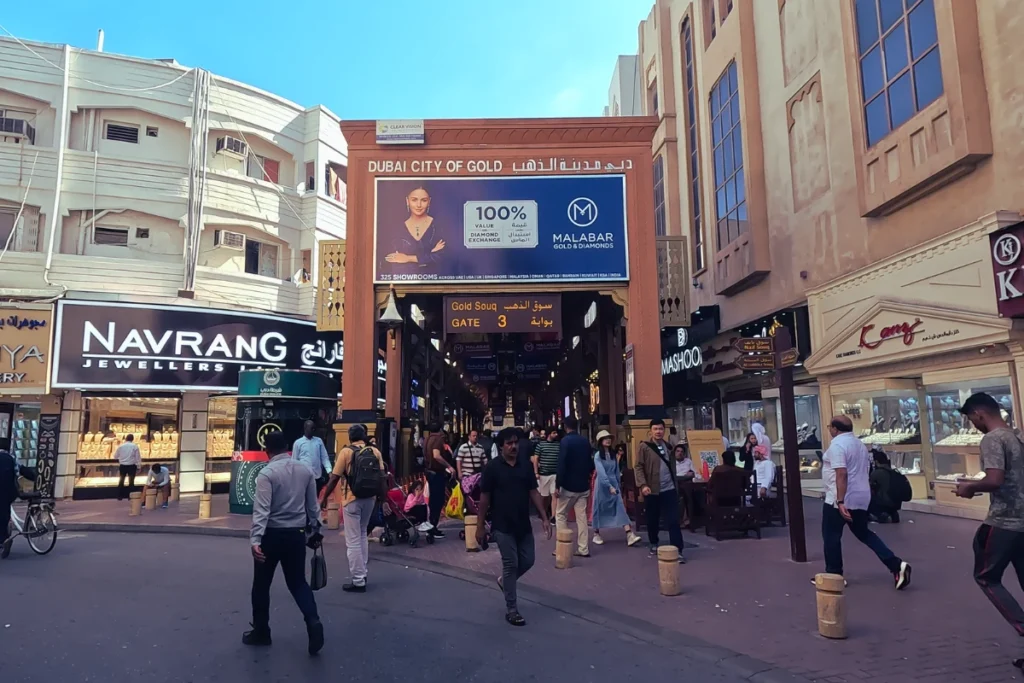
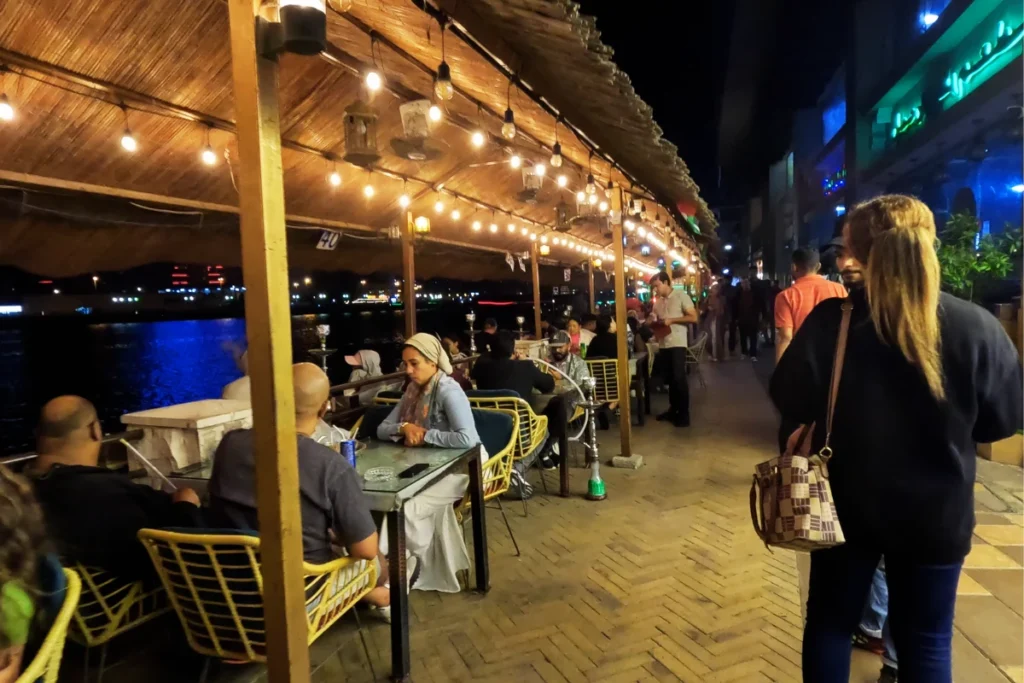
Old Dubai is the historical core along both banks of Dubai Creek: Bur Dubai on the south, Deira on the north. The streets are narrow. The buildings are low. The restaurants serve food to residents, not to visitors, which means the portions are larger and the prices are honest. The architecture spans from 19th-century wind-tower houses to 1970s commercial blocks. The languages on the street are Hindi, Urdu, Malayalam, Arabic, and Tagalog. An AED 1 / INR 22.50 / USD 0.27 abra ride connects the two banks. The Gold Souk glitters. The Spice Souk smells of cardamom and saffron. The vibe is subcontinental Asian with an Arabic undercurrent.
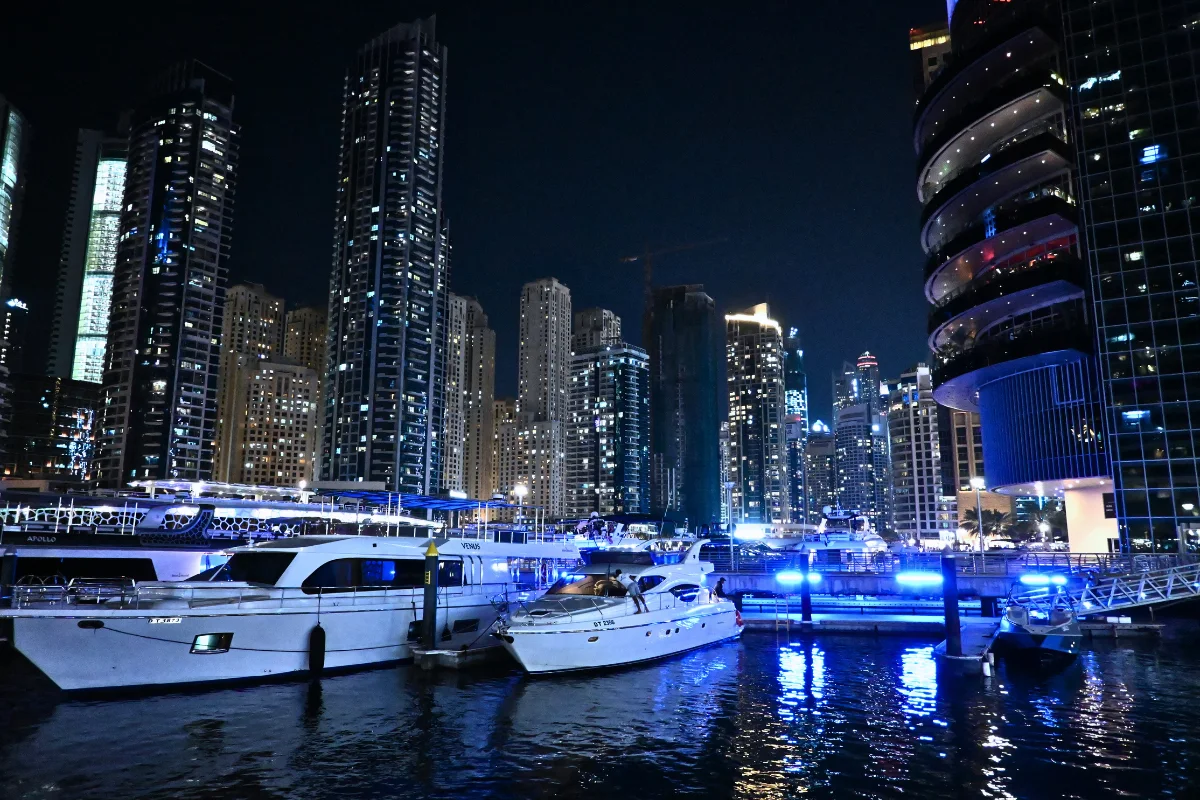
New Dubai is the skyline that sells the city. The Marina, Downtown, JBR, Palm Jumeirah, DIFC, Business Bay. Glass towers competing for altitude. Malls competing for square footage. Hotels competing for star ratings. The architecture is vertical and reflective and communicates, at all times, that someone spent a great deal of money on it and would like you to be aware of that. The restaurants serve food to visitors, which means the presentation is better and the bill is educational. The languages are English, Russian, and the universal dialect of tourism.
The Side-by-Side
| Old Dubai | New Dubai | |
| What it sounds like | Abra engines, market chatter, call to prayer, Hindi film music from a phone speaker | Mall ambience, water features, the hum of air conditioning doing heroic work |
| Dinner for two | AED 25–60 / INR 560–1,350 / USD 6.80–16.35 | AED 80–200 / INR 1,800–4,500 / USD 21.80–54.45 |
| What you photograph | The Creek at dusk. Gold Souk windows. Street food preparation | The skyline at sunset. The Burj from below. The Marina at night |
| What you feel | Like you live here | Like you are visiting here |
| Hotel cost (mid-range, per night) | AED 250–400 / INR 5,625–9,000 / USD 68–109 | AED 500–900 / INR 11,250–20,250 / USD 136–245 |
| Historical depth | 150+ years of trading port history | 25 years of construction that defied physics |
| Best free activity | Walking Al Fahidi’s wind-tower lanes at sunset | Walking the Marina promenade at night |
| Biggest surprise | How affordable it is | How much it costs to eat a salad |
| Getting around | Walking + abra + occasional taxi | Metro + taxi + monorail + the specific cardio of crossing a mall |
| Who lives here | Workers, traders, families, the people who run the city | Tourists, expats, influencers, and the gym memberships that sustain them |
The Personality Test
The choice between Old and New Dubai is a personality test disguised as a travel decision.
Old Dubai is for you if you eat at restaurants where the menu is on the wall, the cutlery is functional rather than decorative, and the waiter does not ask how you would like your water (it arrives without ceremony, in a glass, cold). If you have ever visited a South Asian city and felt comfortable in it. If you find charm in the specific energy of a neighbourhood where four languages overlap in a single queue. If your definition of a good evening involves a walk along a waterfront where the boats are wooden and the transactions happening on them have not changed structurally since the 1800s.
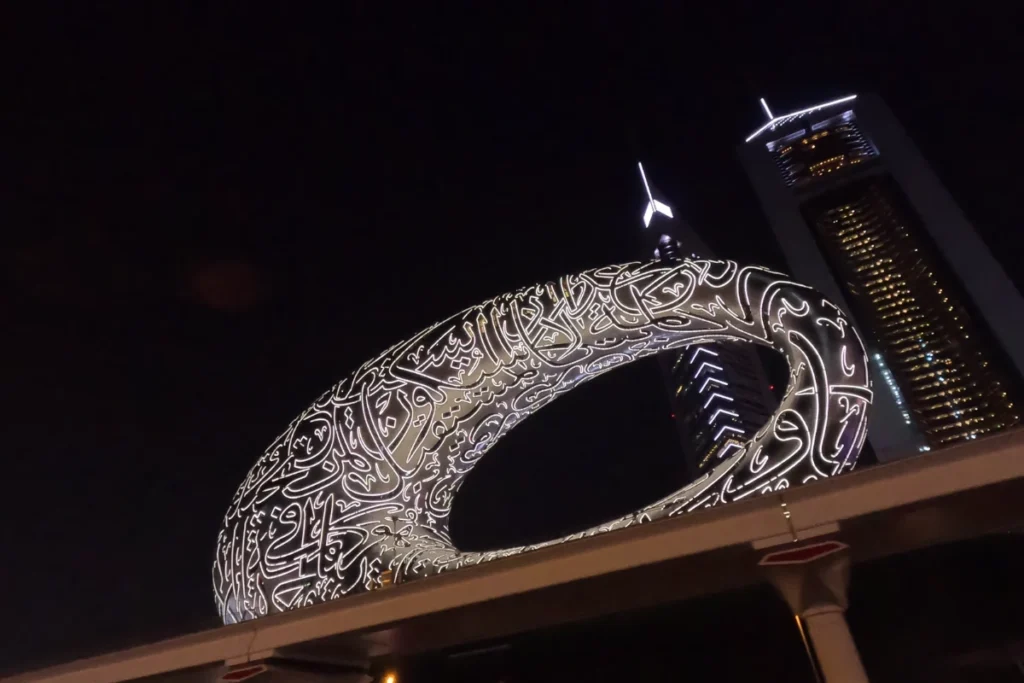
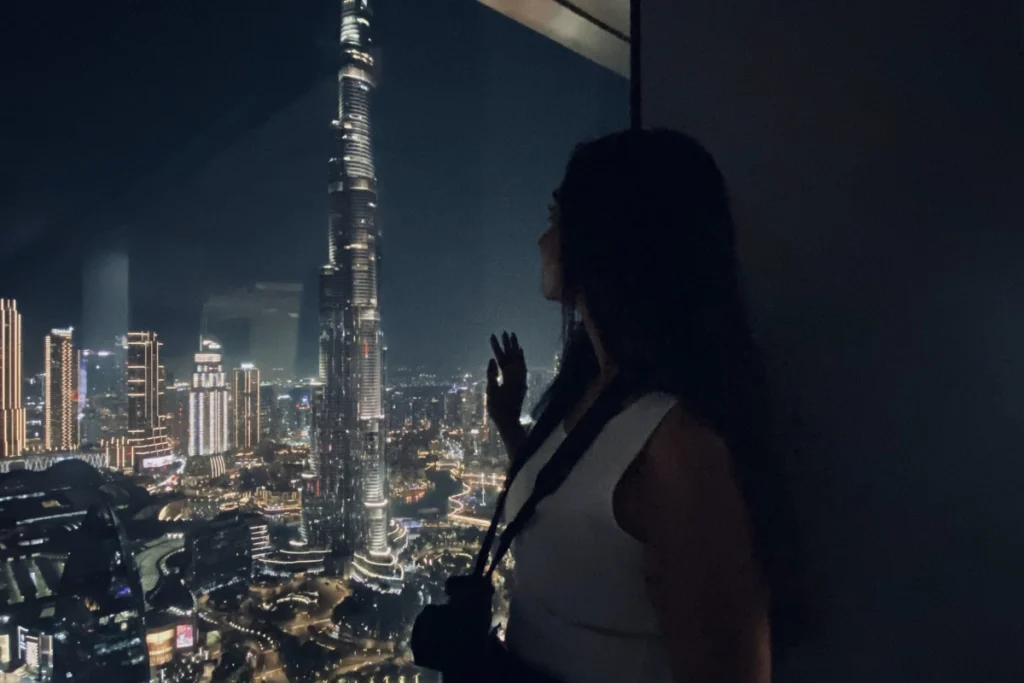
New Dubai is for you if you want to stand on the 124th/125th floor of a building and watch the sun set behind a skyline that did not exist thirty years ago. If “experience” means the Museum of the Future, the Dubai Aquarium, the view from the Palm Tower, and the specific pleasure of walking through a space that was engineered to make you feel a particular way about the future of human capability. If your photographs need vertical lines and glass reflections. If you believe that ambition, regardless of what you think about its results, deserves to be witnessed up close.
“Neither answer is wrong. Both sides deliver what they promise. The question is which promise resonates with your particular version of curiosity.”
The Cost Equation
We based ourselves in Bur Dubai for a practical reason that the budget article documents in detail: the neighbourhood sets the food budget.
The summary version: Our dinners in Bur Dubai averaged AED 25 / INR 560 / USD 6.80 to AED 60 / INR 1,350 / USD 16.35 for two. Our one meal at Dubai Mall cost AED 80 / INR 1,800 / USD 21.80 for two… The hotel in Bur Dubai cost AED 302 / INR 6,795 / USD 82.20 per night. A comparable room in the Marina or Downtown would have started at AED 500 / INR 11,250 / USD 136.00.
The cost of New Dubai’s attractions (Burj Khalifa, Museum of the Future, The View at The Palm, Miracle Garden, Desert Safari) was fixed regardless of where we slept. The cost of eating and sleeping was variable. We chose to spend the variable money in Old Dubai and allocate the savings toward New Dubai’s fixed-price attractions.
The math: base yourself in Old Dubai, save on food and accommodation, spend the savings on the experiences that New Dubai charges admission for. The skyline does not care where you slept. The Burj Khalifa sunset looks the same from the 126th floor whether you showered in Bur Dubai or the Marina.
Which Side First?
Start with Old Dubai. Here is why.
Old Dubai provides context. Before you see the Marina’s glass towers, see the Creek where the money that built those towers originally flowed. Before you pay AED 169 / INR 3,800 / USD 46.00 to stand on the 124th/125th floor, pay AED 1 / INR 22.50 / USD 0.27 to cross the Creek on a wooden boat that has been running the same route since before the Burj Khalifa was a concept.
The sequence from old to new produces understanding. You see where Dubai started. You see what it became. The gap between the two is the story. Arriving at the Marina first, without the Creek, is arriving at the conclusion without the context. The conclusion is still impressive. The context makes it meaningful.
There is also a practical benefit. After two or three days of Old Dubai (walking the souks, eating affordably, absorbing the pace), the transition to New Dubai hits differently. The scale of the Marina, the height of the Burj, the engineered perfection of the malls: these register more intensely when your baseline has been the human-scale streets of Bur Dubai. Contrast creates impact. Start where the buildings are low. End where they are not.
The exception: if you have only one day in Dubai and it is your only visit, go to New Dubai. The Burj Khalifa, the Museum of the Future, and the Marina are the experiences you will not find anywhere else on Earth. Old Dubai’s souks and waterfront are wonderful. Souks and waterfronts exist in many cities. An 828-metre building with a sunset view does not.
“New Dubai shows you what money can build when constraints are removed; Old Dubai shows you what life feels like when a city is built around human beings.”