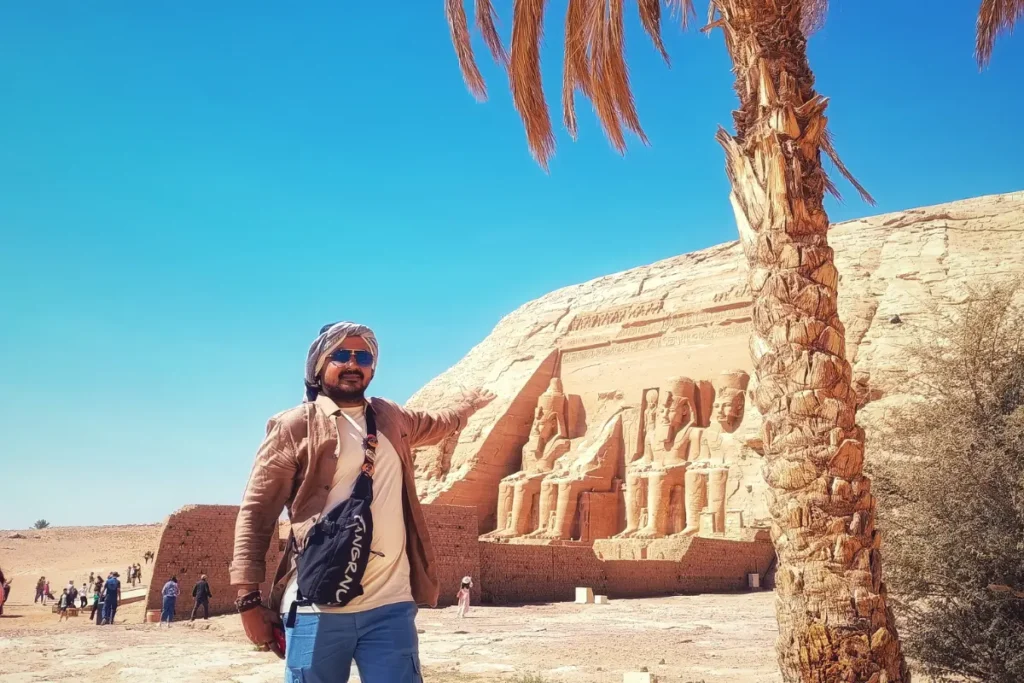
Is Abu Simbel worth visiting? From the 7-hour desert drive and 4:30 AM wake-up call to current entry fees (EGP/INR/USD), here is an honest review of whether Egypt’s most famous temple is worth the journey.
Yes. Without qualification.
We woke at 4:30 AM on our Nile cruise. We boarded a bus in the dark. We drove three and a half hours south through the desert toward the Sudanese border, watching nothing through the window because there was nothing to watch: sand, darkness, and the headlights of other buses carrying other passengers asking themselves the same question.
We arrived. We walked from the bus to the entrance. We turned the corner and saw the façade.
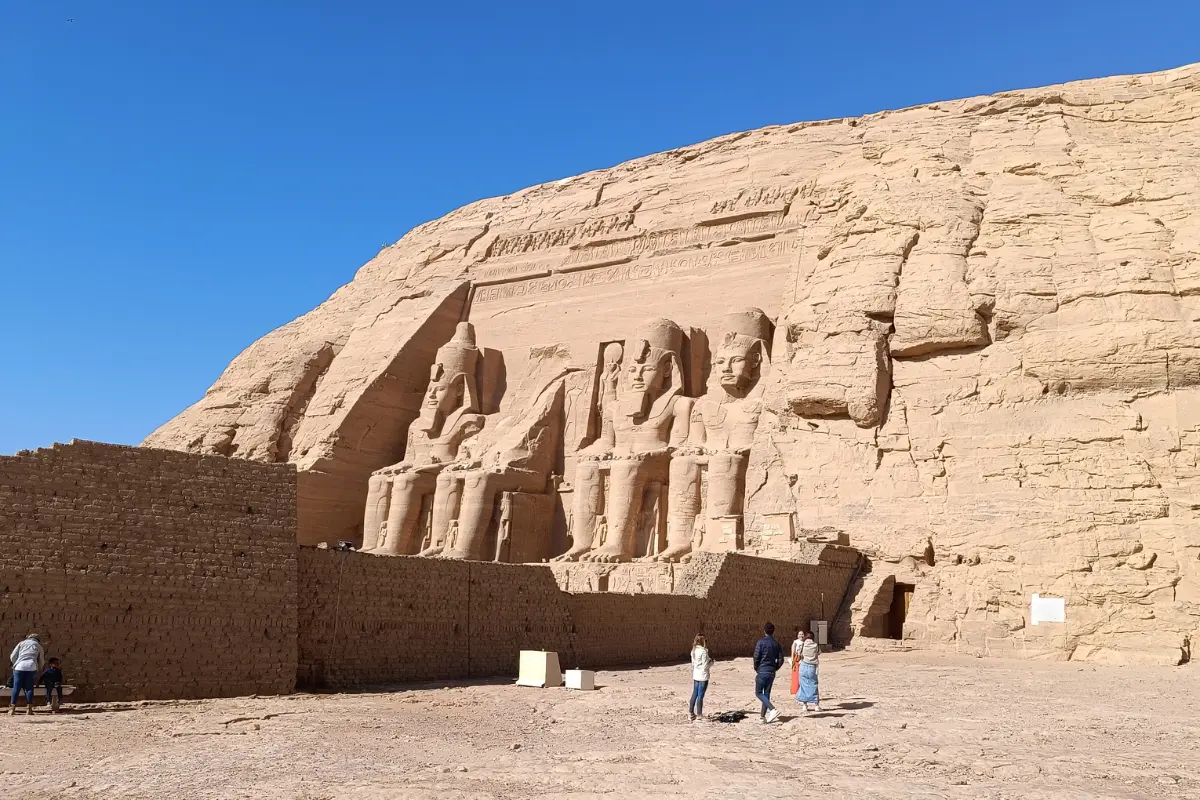
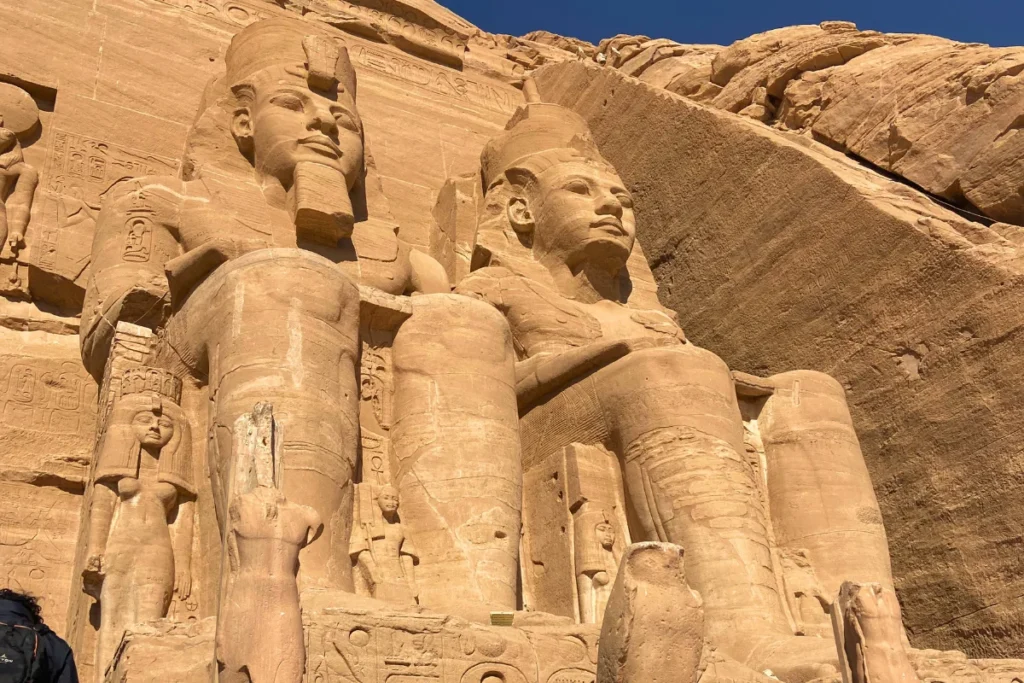
The question answered itself in the time it took our eyes to travel from the ground to the top of Ramesses II’s head. Twenty metres of carved stone. A face three thousand years old. Four of them, seated, gazing east across a reservoir that did not exist when they were carved, toward a sunrise they were positioned to receive.
The drive is long. The alarm is painful. The cost… EGP 600 / INR 1132 / 11.85 USD per person when we visited in February 2022, likely higher now… is the single largest individual entry fee in Egypt. Every fact argues against going. Every fact is wrong.
“We turned the corner and saw the façade. The question answered itself in the time it took our eyes to travel from the ground to the top of Ramesses II’s head.”
What the Drive Is Actually Like
The bus departs from the cruise dock or hotel in Aswan between 3:00 and 4:00 AM. The cruise organises the excursion as a group departure. Multiple buses leave in convoy, which is a security protocol for the desert highway south of Aswan.
The drive is approximately 280 km each way. Three and a half hours in each direction. Seven hours of bus time for a site visit that lasts approximately ninety minutes. The maths looks punishing on paper.
Mostly, the outbound drive passes in sleep. The bus is air-conditioned. The seats recline. Most passengers fall asleep within the first thirty minutes. We did. The drive disappeared. We woke when the bus stopped, the door opened, and the desert air arrived.
The return drive is more conscious. You are awake, processing what you saw, watching the desert landscape pass in daylight that the outbound drive denied. The Saharan terrain between Abu Simbel and Aswan is flat, vast, and hypnotic. The drive back is not pleasant, but it is not wasted: it is the decompression space between the monument and the rest of the day.
What You Stand in Front Of
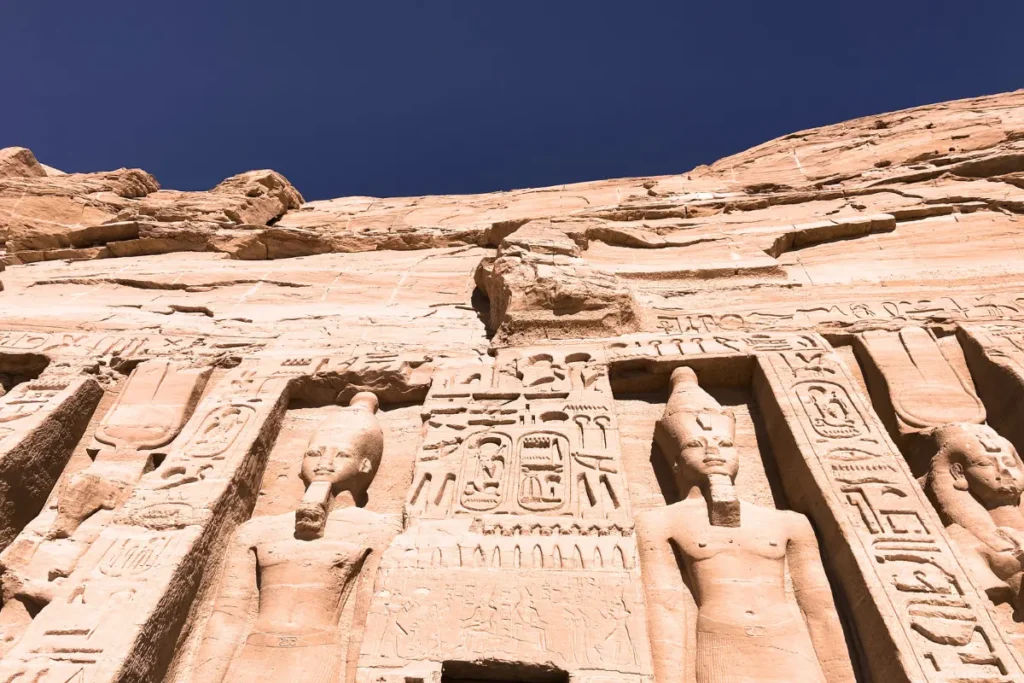
Four seated statues of Ramesses II, carved directly from the sandstone cliff face, each approximately 20 metres tall. The statues flank the entrance to the Great Temple, which extends 56 metres into the rock behind them. The smaller Temple of Hathor… dedicated to Ramesses’ queen, Nefertari… stands adjacent, with six 10-metre standing figures on its façade.
The scale works on you physically. Standing at the base, your neck cranes to reach the crown. The feet of the statues are above your head height. The nostrils are large enough to fit a fist inside. The proportions were engineered to produce exactly this reaction: smallness. Ramesses did not build Abu Simbel to honour the gods. He built it to communicate what it means to stand before a king who considers himself one of them.
“The scale was engineered to produce exactly one emotion: smallness. Ramesses built Abu Simbel not just to honor the gods, but to show what it means to stand before a king who considered himself one of them.”
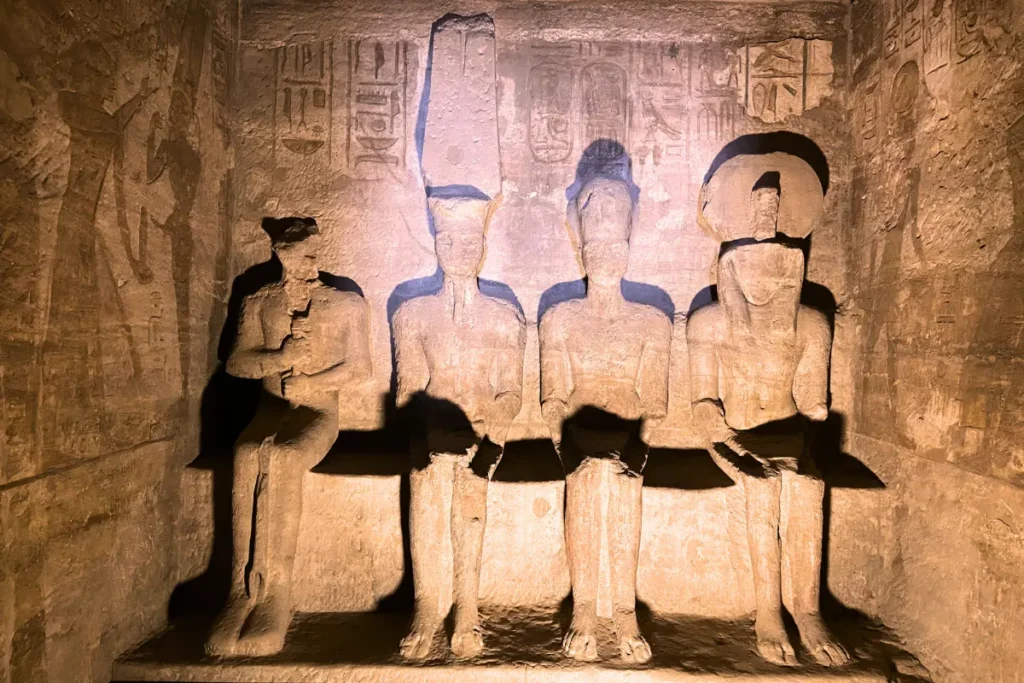
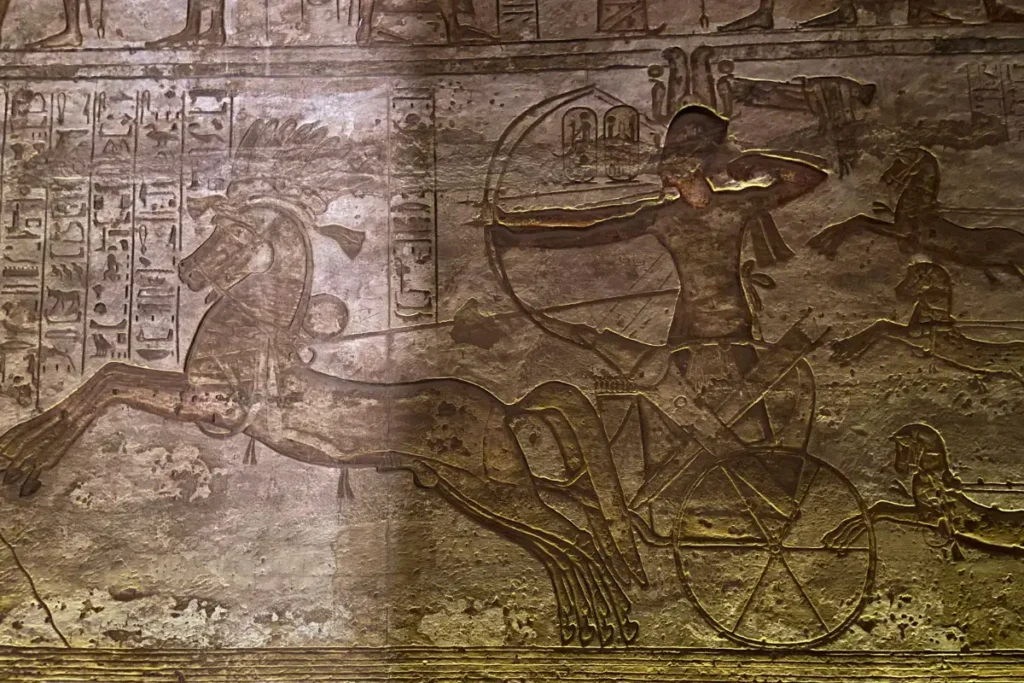
The interior is a sequence of chambers descending 56 metres into the cliff, the walls covered in carved reliefs depicting Ramesses’ military campaigns… the Battle of Kadesh against the Hittites is prominent among them… and his offerings to the gods. The innermost sanctuary holds four seated statues: Ramesses himself among three deities.
Twice a year, on February 22 and October 22, the rising sun sends a beam of light through the temple’s alignment, 56 metres along the central axis, and illuminates three of the four statues in the sanctuary. The fourth, Ptah, god of the underworld, remains in shadow. The alignment is not approximate. It is precise to within a few degrees, and it has held for over three thousand years.
We visited on February 23, one day after the solar alignment. We did not see the beam. We saw the sanctuary. Both are significant. The beam, when it arrives, is the universe confirming that someone understood astronomy well enough three thousand years ago to build a calendar into a cliff.
The Relocation: Engineering on Top of Engineering
Between 1964 and 1968, as the Aswan High Dam’s reservoir rose and threatened to submerge the temples permanently, UNESCO coordinated the most ambitious archaeological rescue in history. The two temples were cut into 1,041 numbered blocks, each weighing between 3 and 20 tonnes. The blocks were lifted, transported, and reassembled on an artificial hill 65 metres higher and 200 metres further from the water. An artificial mountain was constructed behind the reassembled façade to replicate the original cliff.
The operation cost approximately USD 40 million in 1960s currency, backed by twenty contributing nations. Reassembling the temple inside a hollow reinforced concrete dome was so precise that even the bi-annual solar alignment was preserved… shifting by only a single day (from February 21/October 21 to February 22/October 22) due to the new position.
Walking around the site knowing that every stone was cut, labelled, moved, and repositioned adds a second layer of engineering awe on top of the ancient one. Ramesses built it. UNESCO saved it. Both achievements are visible simultaneously. The temple you stand before is three thousand years old and also sixty years old. Both are true at once.
A Note for Indian Travelers
Standing at Abu Simbel, the ancient trade connection between India and Egypt feels especially personal. Tamil merchants from the Sangam period… several of whom left inscriptions in the Valley of the Kings in the 1st to 3rd centuries CE… may have passed through this region during their journeys up the Nile. The India-Egypt trade route was active and significant enough to leave physical evidence in royal tombs. Standing at Abu Simbel as an Indian traveller, knowing this history, adds a layer that most visitors do not have access to. The relationship between India and Egypt was not peripheral. It was documented in stone, in both directions. The statues that faced Indian traders, if they came this far south, are the same statues you face today.
Who Should Skip It
The honest section, because not every experience is for every traveler.
- If you only have three or four days in Upper Egypt and must choose between making the trek to Abu Simbel or spending a full day across Karnak and the Valley of the Kings, choose Luxor. The Luxor sites collectively contain far more depth, variety, and accessible history than Abu Simbel can offer in a ninety-minute visit.
- If your trip includes a full Nile cruise with the standard four-day itinerary: Abu Simbel fits into the schedule without sacrificing other sites. The cruise organises the excursion on a day that is otherwise a sailing day. You lose sleep. You do not lose a temple visit.
- If you have a medical condition that makes seven hours of bus travel inadvisable, or if you are travelling with very young children who cannot sit still for that duration: skip it without guilt. The monument is extraordinary. The logistics are not for everyone. The flight from Aswan is the alternative.
- If you can fly: the flight from Aswan to Abu Simbel takes approximately 45 minutes and costs significantly more than the bus excursion. For those who cannot tolerate the bus, it is the correct choice.
Everyone else: set the alarm. Board the bus. Sleep through the drive. Turn the corner. Look up.
What It Costs
| Item | Cost |
| Abu Simbel entry, per person (February 2022) | EGP 600 / INR 1132 / 11.85 USD |
| Abu Simbel entry, per person (current 2026) | EGP 750 / INR 1335 / 13.95 USD… verify before budgeting |
| Bus excursion from Aswan (if included in Nile cruise) | Included in cruise package (King Tuti: EGP 27,549 / INR 52,000 / 543.87 USD for 2 covers this) |
| Bus excursion from Aswan (if booked separately) | Approximately EGP 1,059.60 to 2,119.21 / INR 2,000 to 4,000 / 20.92 to 41.84 USD per person |
| Flight option: Aswan to Abu Simbel | Significantly higher… check current pricing |
| Total time commitment | Approximately 10 to 11 hours departure to return |
The entry fee at Abu Simbel is the highest single-site cost in Egypt. It has increased since our 2022 visit. Verify current pricing before budgeting. The time commitment… a full day from the cruise itinerary for ninety minutes at the site… is the higher cost for most travellers. The calculation that justifies both: there is no substitute for this experience anywhere in Egypt or the world.
The Verdict
Every monument on the Nile itinerary has parallels elsewhere in the valley. Karnak is comparable in scale to other great temple complexes. The Valley of the Kings is comparable in density to other royal burial sites. Luxor Temple has a dozen counterparts in concept if not in detail.
Abu Simbel has no counterpart. The scale of the statues, their cliff-face setting, their solar alignment, their relocation story, and the specific smallness you feel standing before them are available only here. The Aswan High Dam has an equivalent. Every other monument on the Nile itinerary has equivalents. Abu Simbel is singular.
“The experience has no substitute. Set the alarm. Board the bus. Sleep through the drive. Turn the corner. Look up. The question will answer itself.”