If you are travelling through Egypt’s Western Desert, stopping at Crystal Mountain Egypt reveals one of the most unique geological stops on the safari route between the Black and White Deserts.
The first thing you should know is that Crystal Mountain is not a mountain. It is a ridge. A low, sun-bleached limestone ridge rising perhaps five or six metres above the desert floor, located between the Black Desert and the Agabat Valley on the western Sahara safari route. Calling it a mountain is an act of geological generosity on par with calling a puddle a lake or calling what we cooked in hotel rooms across Turkey a “meal.”
The second thing you should know is that it does not matter what you call it, because the moment you step out of the vehicle and look at the ground, your vocabulary becomes irrelevant.
The ground glitters.
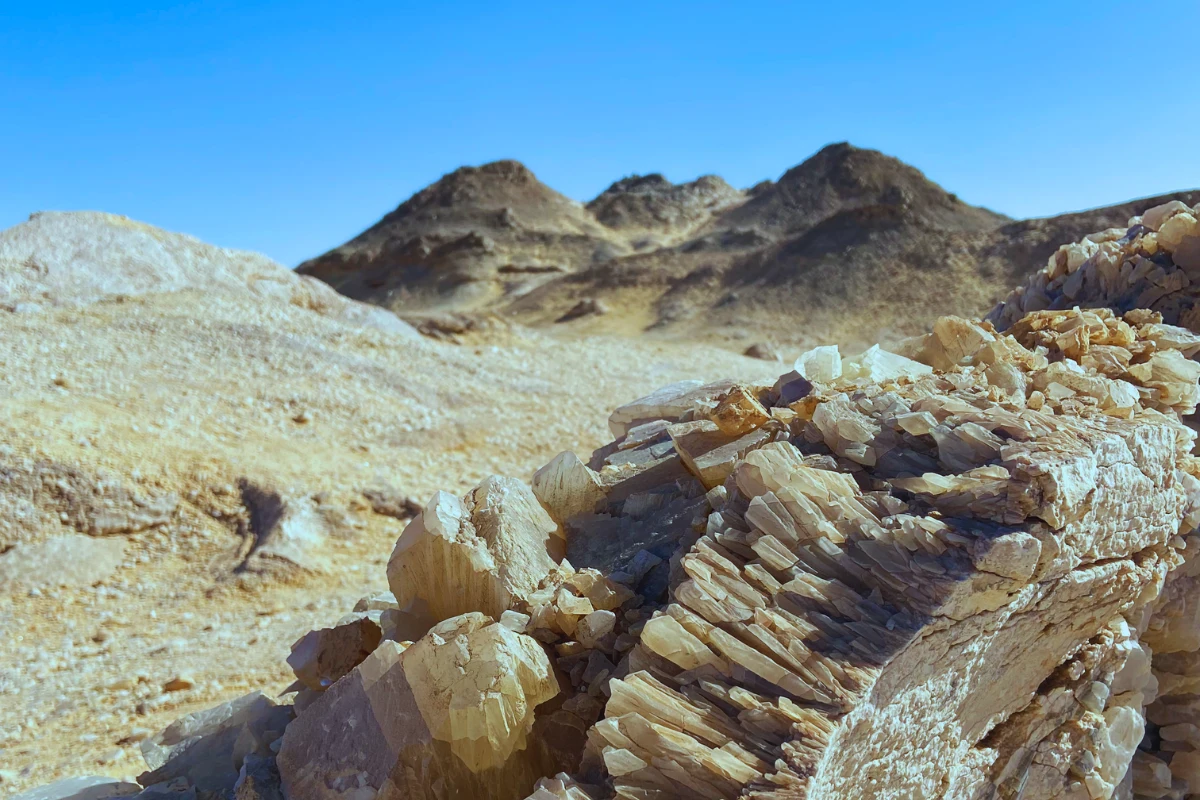
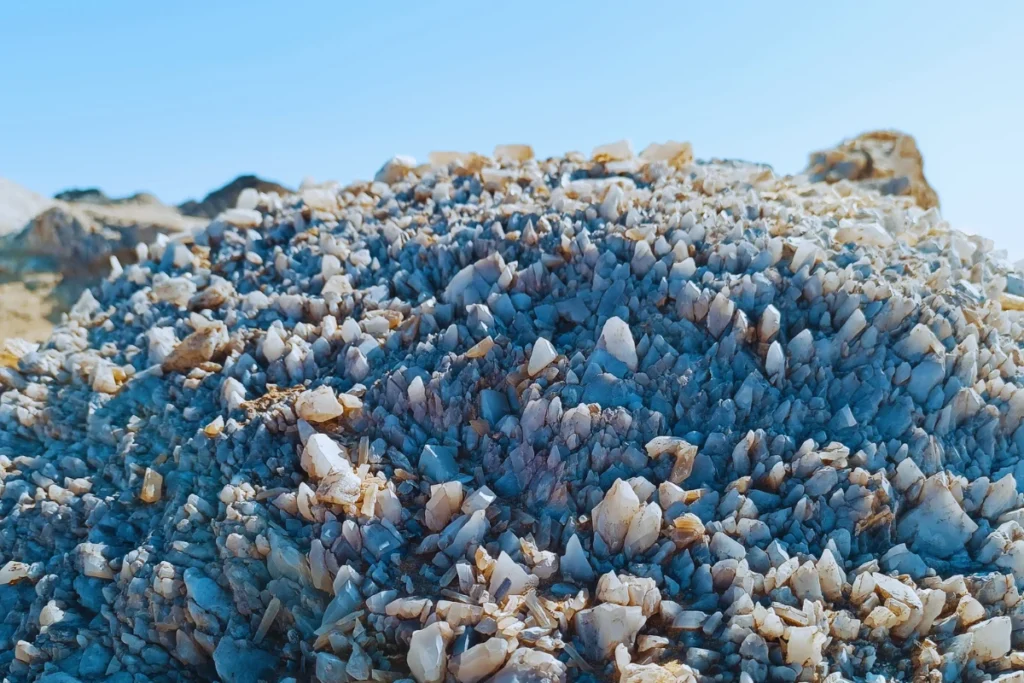
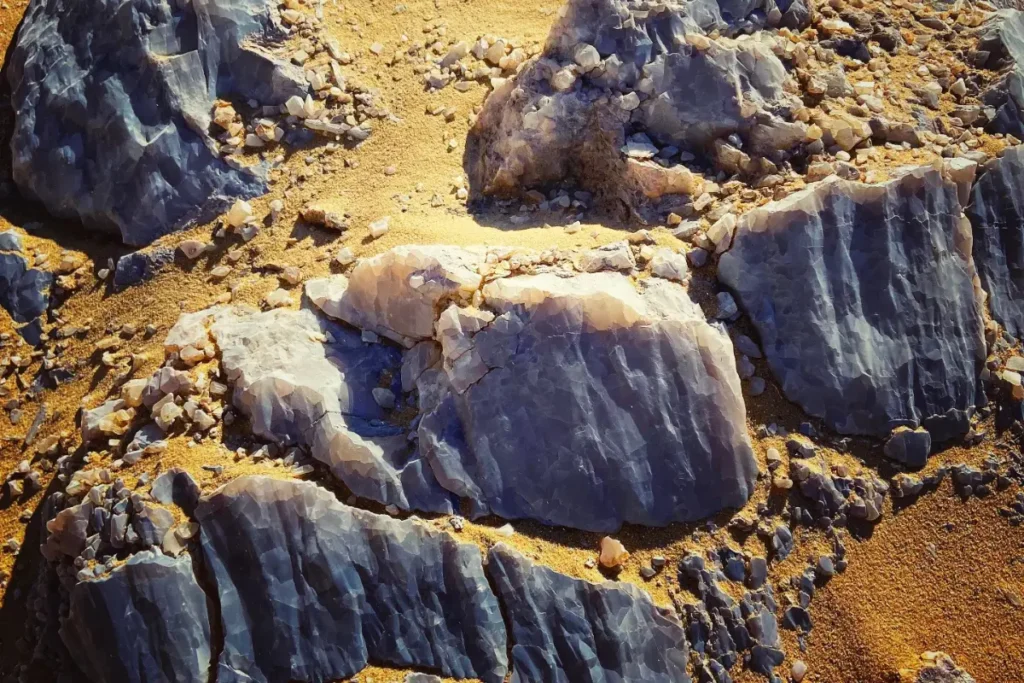
Not in the way sand catches sunlight, which is a diffuse, general shimmer. It catches your eye in sharp, specific points of light scattered across the rock surface, like someone shattered a chandelier and left the pieces for the desert to keep. Except the pieces are not glass. They are natural calcite and quartz formations, created by subterranean forces that rearrange the molecular structure of the earth.
“It is not often that you stand in the middle of a barren desert and find yourself walking across a floor made of light.”
What Happened Here
Local guides often tell travellers that a meteorite struck this section of the western Sahara millions of years ago, melting the sand into crystal. While it is a poetic story, the true geological history is even more fascinating.
Crystal Mountain is actually an exhumed ancient cave system. Millions of years ago, hydrothermal fluid rich in dissolved minerals forced its way through the surrounding Cretaceous limestone. As these hot springs cooled inside underground caverns, minerals crystallised into large, geometric columns of calcite and barite. Over eons, wind and sand eroded away the weaker limestone cave ceiling, exposing the sparkling crystal core directly to the Saharan sun.
The physics produced gemstones in the desert. The difference between this site and a typical museum exhibit is that nobody lets you walk inside a museum display, whereas this ridge receives several 4×4 vehicles full of tourists per day. Each passenger arrives with the same unconscious intent: pick up a crystal, hold it to the light, and decide whether to put it back.
What It Feels Like to Hold One
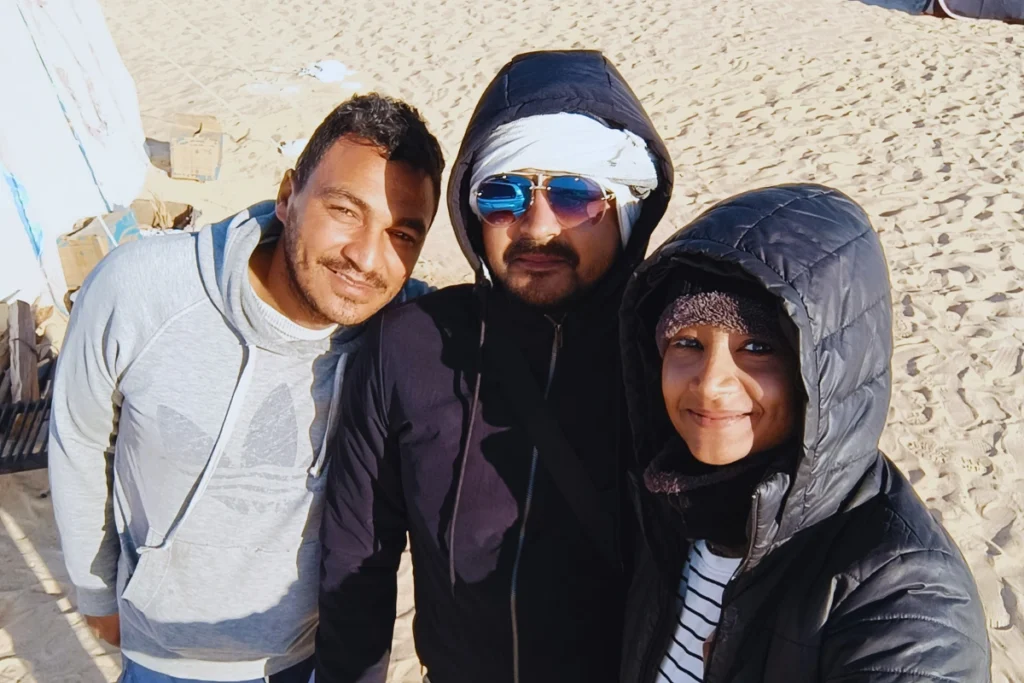
Mahmood, our Bedouin guide, stopped the vehicle and gestured for us to get out. No announcement. No explanation. Just the gesture and the specific half-smile of someone who knows what you are about to discover and is looking forward to watching it happen.
We walked toward the ridge. The ground changed texture. The sand thinned. The rock surface appeared, pale and weathered, and embedded in it, catching the February sun, were the crystals.
Akash crouched, picked up a small piece, and held it to the light.
Rainbows.
The facets split the desert sunlight into vivid, microscopic prisms. It felt surreal holding a rock that spent millions of years forming in subterranean darkness before being exposed to the Saharan air.
We held the crystal for a while. We looked at the facets. We put it back. Not everyone puts it back.
The Problem with Souvenirs
Crystal Mountain has no fence. No ticket booth. No guard. No sign requesting that visitors leave the geology where they found it. The site sits in open desert on a safari route, accessible to anyone with a vehicle and a guide, protected by nothing except the assumption that visitors will exercise restraint.
The assumption has not held up well.
The crystals that remain are small. Palm-sized at best. Most are thumbnail-sized or smaller. Older travellers and local guides report that the site once held larger specimens, some reportedly the size of a fist, with well-defined crystal faces and significant clarity. Those specimens are now on shelves, in drawers, in boxes in apartments across forty countries, slowly accumulating dust beside boarding passes and fridge magnets and all the other objects that once meant “I was here” and now mean “I need to clean this shelf.”
The site is being disassembled one pocket at a time. Each individual crystal is small. The cumulative removal, across decades of safari visitors, is geological erosion accelerated by souvenir culture. The meteorite took millions of years to produce these crystals. Tourism is taking decades to remove them. The math is not encouraging.
We put ours back. We are not claiming virtue. We are noting that the crystal we held, the one that threw rainbows onto a palm in the middle of the Sahara, is still there for the next person who crouches in the same spot. The rainbow is reusable. The crystal is not infinite.
“The desert takes millions of years to build something extraordinary, and human memory needs only fifteen minutes to appreciate it. Leave the stone; take the light.”
Why the Guides Stop Here
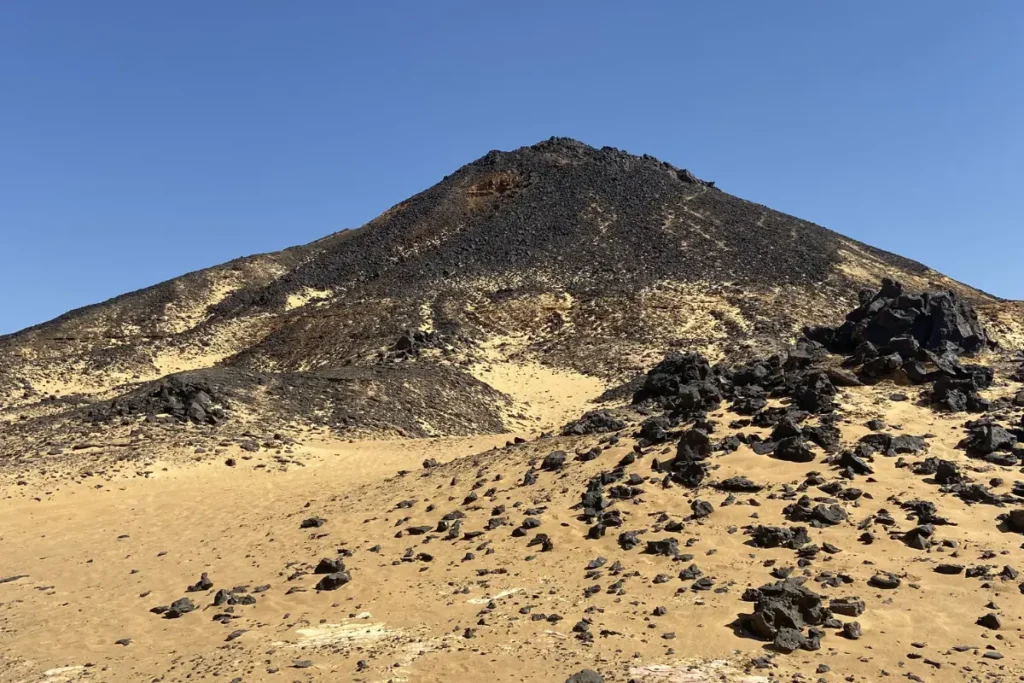
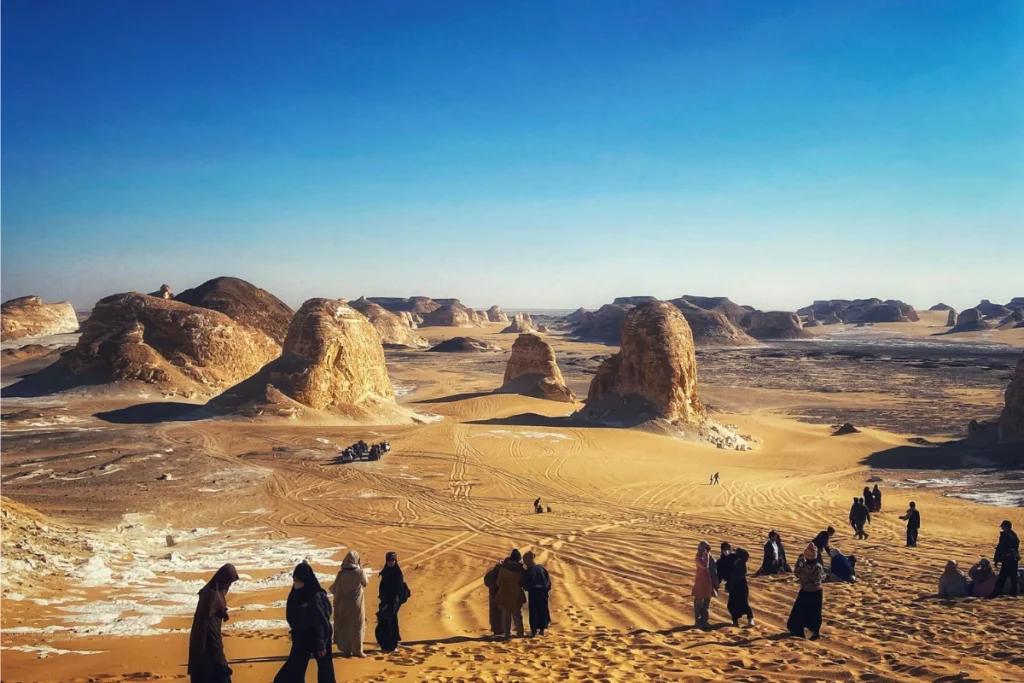
The safari route from Bahariya Oasis to the White Desert passes through four distinct landscapes:
- The Black Desert: Volcanic basalt, dark dolerite hills (~180 million years old).
- Crystal Mountain: Hydrothermal cave structures, glittering crystals.
- The Agabat Valley: Ancient seabed, limestone towers, fossilised shells.
- The White Desert: Wind-sculpted chalk formations (~75 million years old).
Crystal Mountain sits between the first and third of these, at the midpoint of the day’s driving, at the moment when the Black Desert’s volcanic darkness has left your visual memory and the Agabat Valley’s white formations have not yet replaced it. The stop lasts fifteen to twenty minutes. Long enough to walk the ridge, find the crystals, hold one to the light, take a photograph, and get back in the vehicle.
The guides stop here because it works as a transition. The geology shifts from igneous (volcanic) to metamorphic (impact-altered) to sedimentary (marine chalk). The colour shifts from black to glitter to gold to white. Crystal Mountain is the hinge between the two halves of the day, and the glitter provides a sensory punctuation mark between the vastness of the Black Desert and the surrealism of what comes next.
Mahmood stopped here with the same ease he brought to every part of the route: no lecture, no narration, just the stop and the smile and the wait for the crystals to do the talking. The crystals are good at talking. They do not require a translator.
What You Should Know
Duration: Fifteen to twenty minutes is standard on a 4×4 route. You could spend an hour if the crystals hold your attention and the guide is patient. Most guides factor in twenty minutes.
What to bring: A camera with macro capability if you want to photograph individual crystals. The details are small and a phone camera at arm’s length will produce a photograph of a grey rock. A close-up will produce a photograph of a geological miracle. The difference is approximately thirty centimetres of lens distance.
Footwear: The ridge surface is rocky and uneven. Walking shoes recommended. The crystals embedded in the rock surface are sharp. Sandals are inadvisable.
The ethical question: Take photographs. Leave crystals. The site has no protection and no enforcement. Your restraint is the only conservation mechanism it has. The rainbow will appear in your memory without a physical specimen to trigger it. Probably. If it does not, the memory of putting the crystal back is its own kind of souvenir, and it weighs nothing in your luggage.
Combine with: Crystal Mountain is not a standalone destination. It is a stop on the 2-day Black and White Desert safari from Bahariya Oasis. Every standard safari itinerary includes it. You do not need to plan for it. You need to be ready for it, which means being ready to step out of the vehicle and discover that the desert floor is throwing light at you from several million years in the past.
There is a particular category of travel experience that does not scale rtwith time spent. Some places need five days to reveal themselves. Hampi is one. Cappadocia is another. Crystal Mountain is the opposite. Fifteen minutes is enough. Fifteen minutes is correct. The ridge is small. The crystals are small. The rainbows are small. The event that produced them, a rock from space striking the Earth with enough force to rearrange the molecular structure of the ground, is not small at all.
“Put it back when you are done. Someone else is coming tomorrow. They deserve the same fifteen minutes you got.”