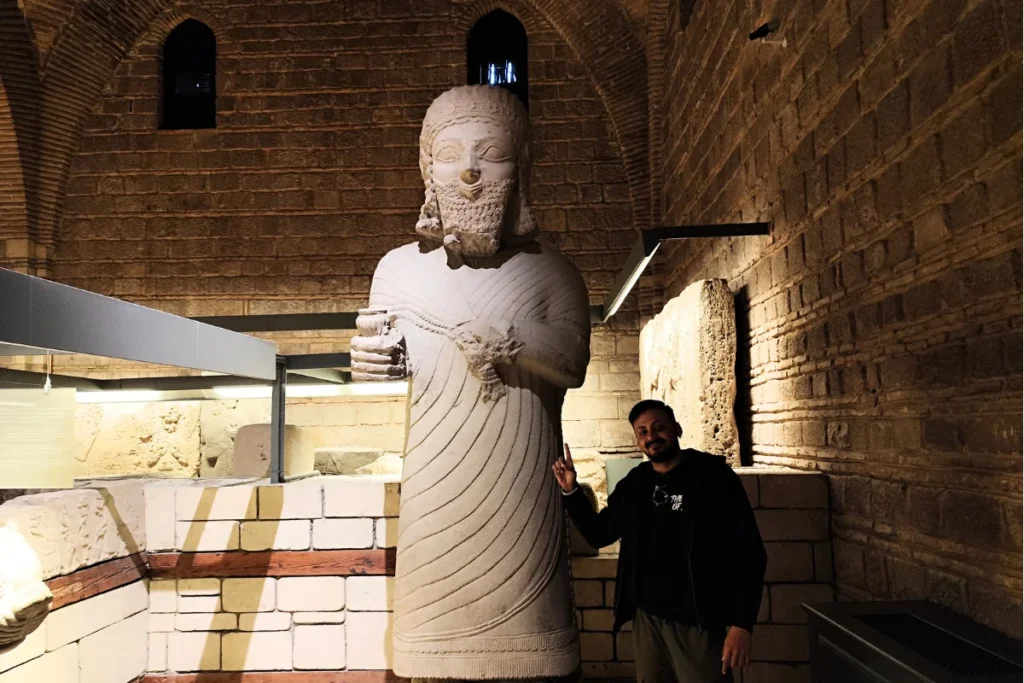
This Museum of Anatolian Civilisations guide is built from our visit on Day 3 of our Turkey road trip, April 19th 2025, after a stressful drive from Istanbul, a steep uphill sprint through Ankara, and the discovery that the museum closes at 7 PM, not 5.
We arrived at the Rest Hotel in Ankara at 4:45 PM.
Google Maps said the museum closed at 5 PM. The hotel staff confirmed it. We had fifteen minutes. We looked at each other, put down nothing, grabbed only our wallets, and ran out of the hotel.
Ankara’s Citadel district is not flat. The streets climb. We ran uphill, out of breath, clutching a water bottle, past closed shopfronts and bemused local residents, and arrived at the museum ticket counter panting.
The ticket seller looked at us with mild surprise and said the museum was open until 7 PM.
Not 5. Seven. We had two hours and fifteen minutes.
We bought the tickets (1,040 Lira for two), caught our breath on the steps outside, and walked into the building that had been on our itinerary since before we had booked flights to Turkey.
“We had added this museum to our itinerary before we had even booked our flights. Standing inside it, exhausted from the drive, we understood why.”
Why This Museum Was on the List Before the Trip
In late 2024, we watched The Gift on Netflix. The Turkish thriller used the archaeological sites of Anatolia… Göbekli Tepe, the Neolithic landscapes, the deep civilisational layers of this particular piece of land… as the backdrop for a story about human continuity across time. We were not the first Indians to have this experience. The series found an audience in the subcontinent, specifically among people who had an existing interest in ancient history and spiritual heritage.
The Gift sent us into a months-long research period. We started with Göbekli Tepe, moved to Karahan Tepe, found Hattusa, and then found the Museum of Anatolian Civilisations. While the monumental stone totems of Göbekli Tepe and Karahan Tepe are housed down south in the Şanlıurfa Archaeological Museum, the institution in Ankara holds the sweeping chronological foundation for all of it. In one building, it preserves the broader Anatolian timeline… from the 8,000-year-old mother goddesses of Çatalhöyük to the Hittite royal reliefs… setting the stage for every ancient landscape the series had referenced. We added it to the itinerary before Cappadocia. Before Nemrut. Before anything else concrete had been planned.
By the time we arrived, we had spent months with the photographs of the artefacts. The Hittite sun disk. The mother goddess figurines. The Phrygian bronzes. The storm god relief. We knew what we were coming to see. What the photographs had not conveyed was the building.
The Building Itself
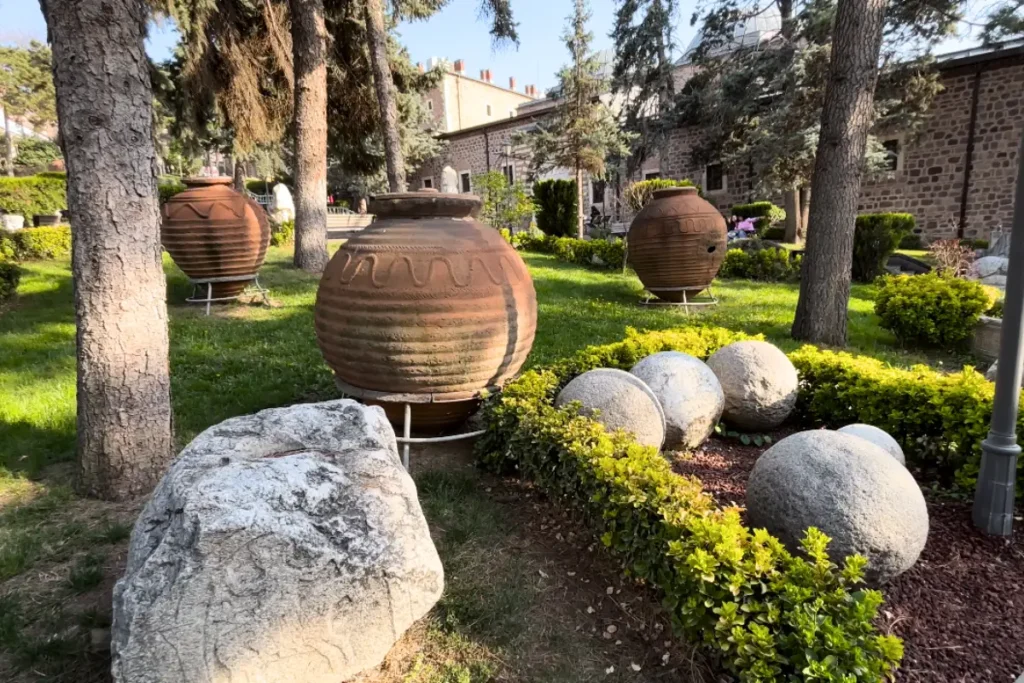
The Museum of Anatolian Civilisations occupies a restored 15th-century Ottoman bedesten: a covered market building, originally used by merchants to store and trade valuable goods under vaulted stone ceilings. The main building features a prominent rectangular central hall topped by ten stone domes, wrapped in a perimeter of vaulted storage spaces that have been converted into display galleries.
This is an unusual choice for a museum of ancient artefacts. The covered market atmosphere, with the warm amber lighting falling on the display cases from the Ottoman vaulted ceiling overhead, creates a different quality of encounter from the white-walled neutrality of a purpose-built museum space. You are looking at 12,000-year-old figurines inside a 600-year-old building that was itself significant before it became a container for things significantly older. The layers accumulate.
The museum was awarded the Council of Europe Museum Prize in 1997. It is consistently ranked among the top museums in Turkey and among the most important prehistoric collections in the world.
The Collection: What You Walk Through
Palaeolithic and Neolithic Halls
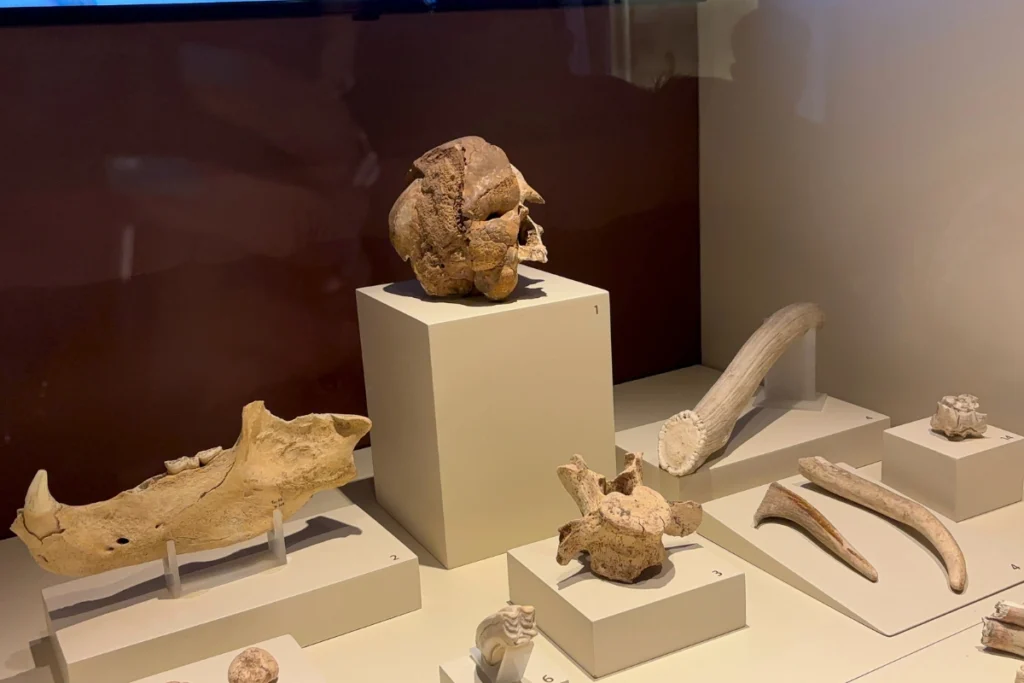
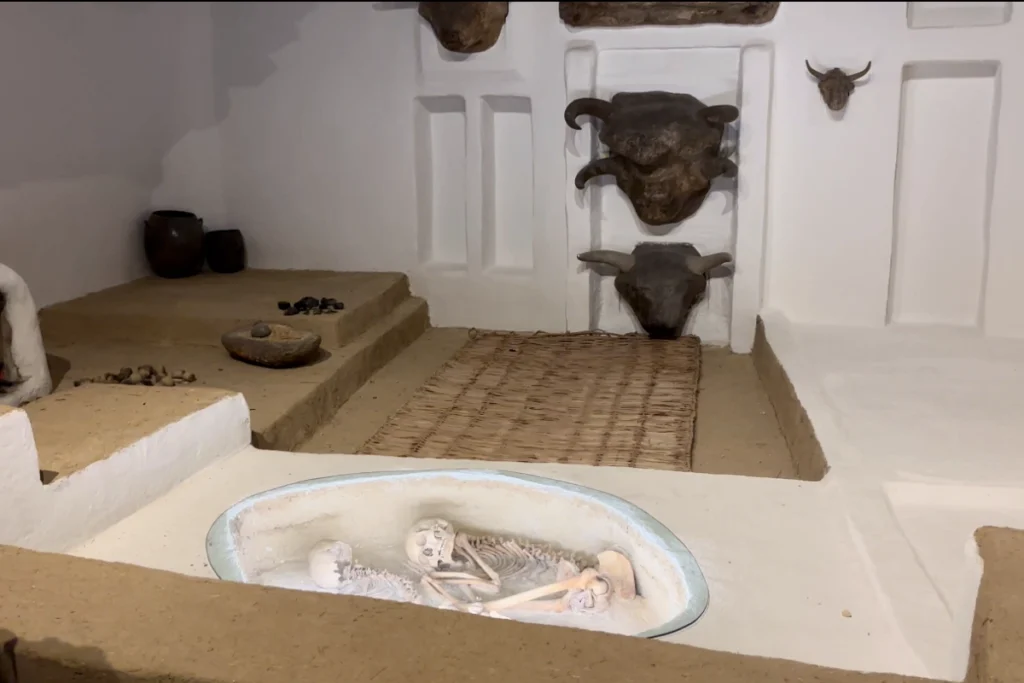
The chronological circuit begins at the oldest end. Palaeolithic flint tools. Obsidian blades knapped from volcanic glass. The stone-on-stone technology of people who lived here 400,000 years ago, before farming, before language as we know it, before almost every category through which we understand human civilisation.
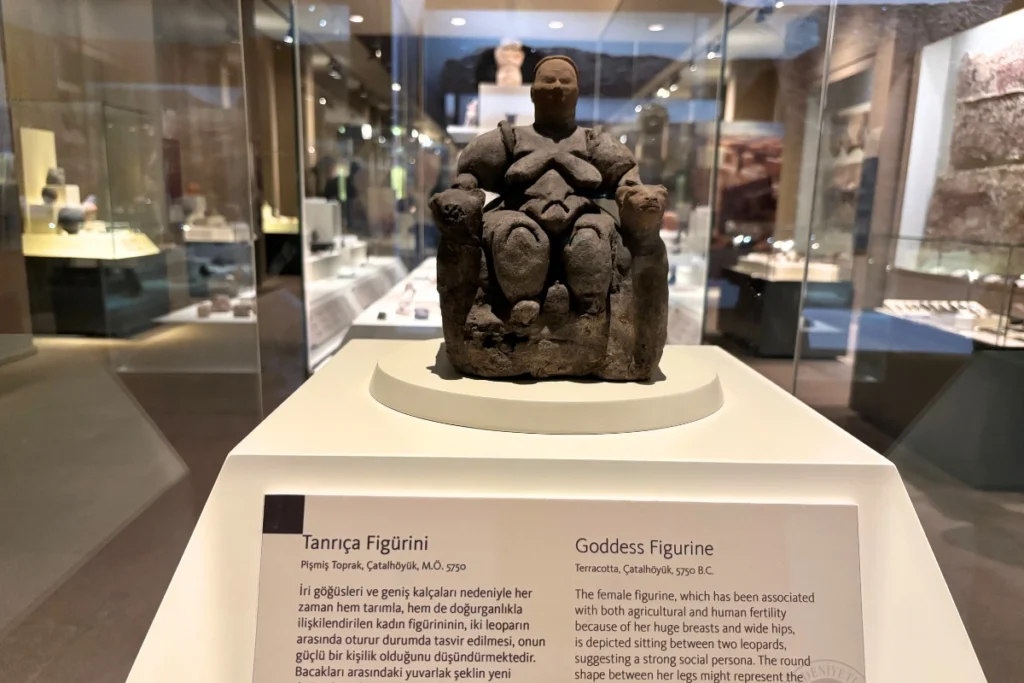
The Neolithic hall is where the emotional weight begins. The Çatalhöyük figurines: small clay and stone goddess figures from the 7th and 8th millennia BCE, found in the proto-city of Çatalhöyük in south-central Anatolia. The most famous is the Seated Goddess: a voluptuous female figure on a throne, her hands resting on two leopards flanking her on either side. She was found in a grain bin, associated with storage and abundance. She is approximately 8,000 years old. She looks at you from the display case with an authority that the glass does not diminish.
Hundreds of such figurines line the Neolithic cases. Some are abstract, barely human in form. Some are so naturalistically rendered that the word ‘statue’ feels more accurate than ‘figurine.’ The consistent presence of the female form across millennia of Anatolian pre-history, in site after site, in material after material, produces a specific kind of evidence about what early Anatolian civilisations considered sacred: not a doctrine, not a written theology, but 8,000 years of the same idea, shaped again and again by different hands in different places.
The Copper and Early Bronze Age
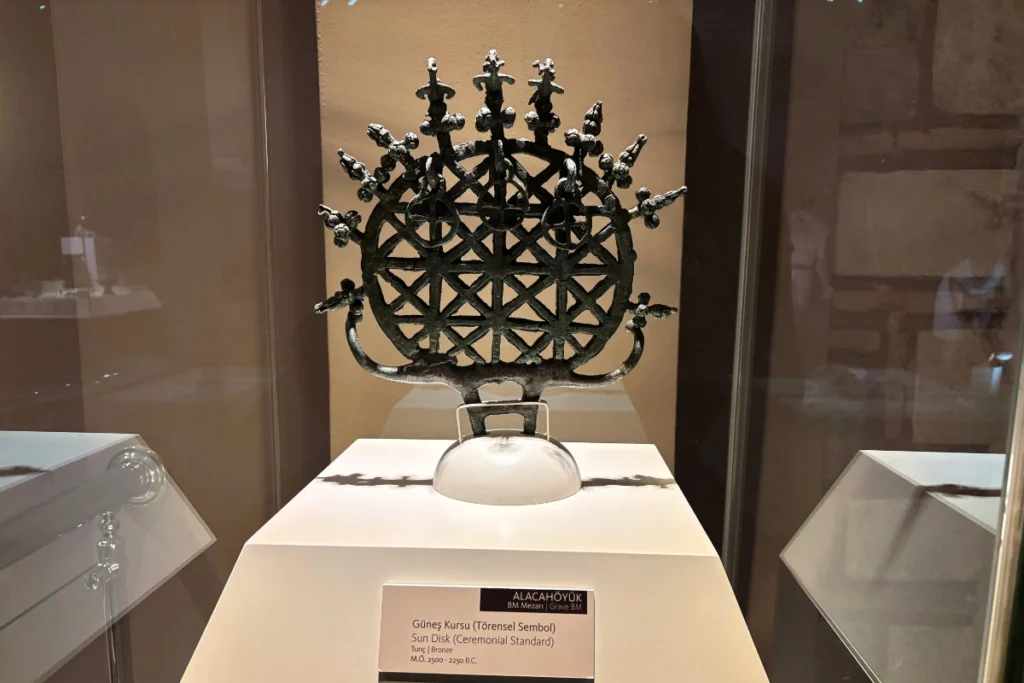
The technology shifts are visible as physical objects in sequential cases. Copper gives way to bronze alloys. The tools become more precise. The weapons become more functional. Drinking vessels appear — not just for storage, but for ceremony. Deer-shaped ritual vessels, animal-headed rhytons, and the early sun disk symbols that would become the signature motif of the Hittite civilisation begin to appear in this section. You are watching the Hittites arrive in the material record before their empire exists.
The Hittite Hall
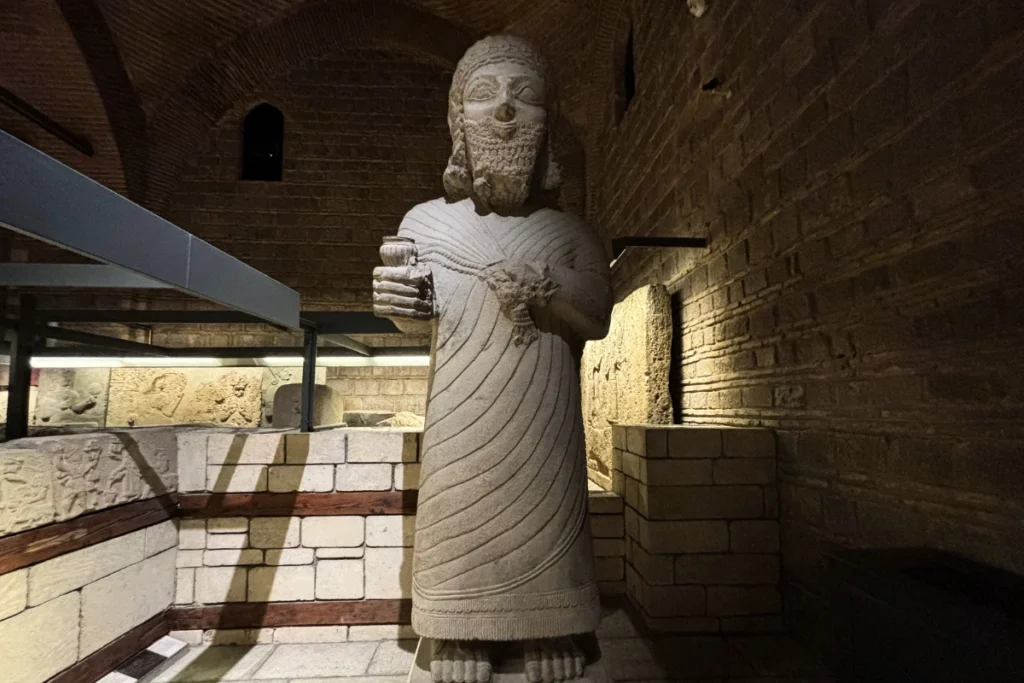
The Hittite hall is the centre of the museum and the reason most people who plan their visit the way we planned ours come here specifically.
The Hittite Empire was the dominant power of the ancient Near East from approximately 1650 to 1200 BCE. At its peak, it controlled most of Anatolia and was the primary rival of Egypt: the Battle of Kadesh in 1274 BCE between Ramesses II and the Hittite king Muwatalli II was the largest chariot battle in recorded history, and its aftermath produced the world’s first known peace treaty, a copy of which hangs at the United Nations entrance in New York.
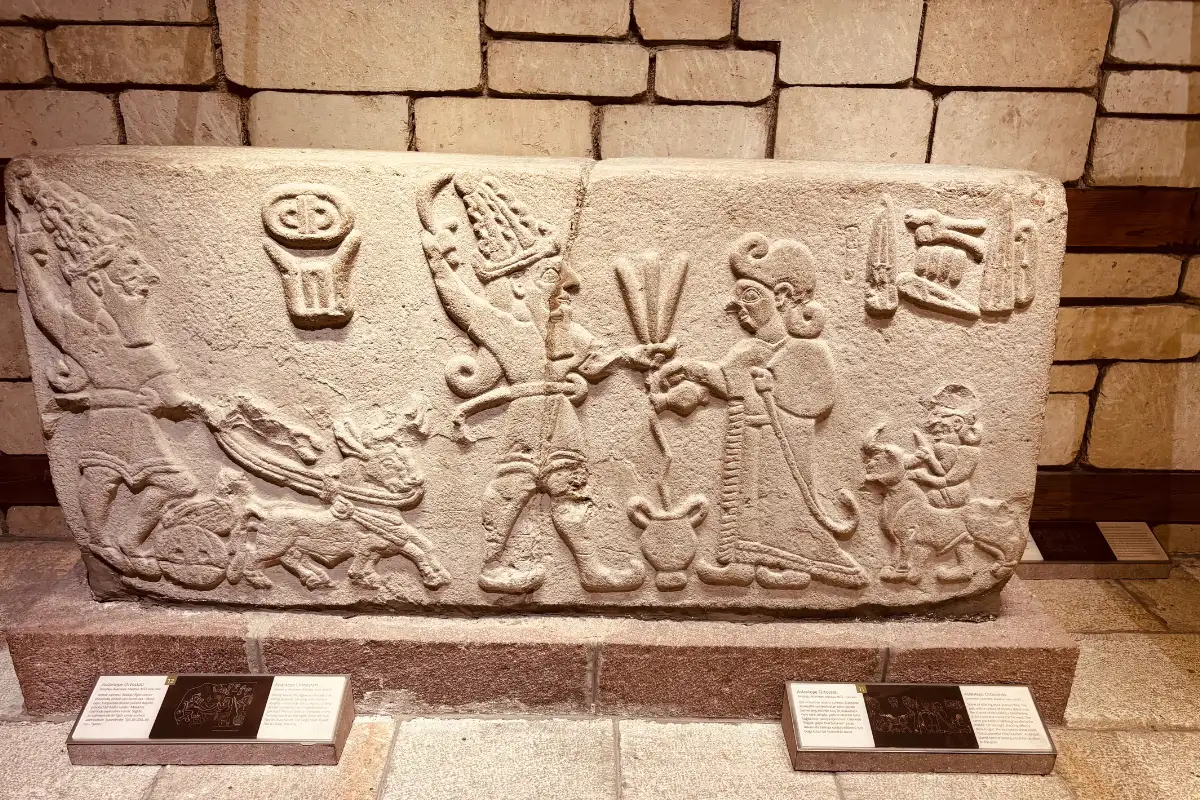
The museum holds the Hittite state’s most important surviving artefacts. The great sun disks (symbols of the Hittite royal house, used in religious ceremonies). The orthostat reliefs: carved stone panels depicting gods, kings, hunts, and mythological scenes that decorated the gates and walls of Hittite cities. The storm god figures: Teshub (the Hurrian storm deity adopted by the Hittites), shown as a warrior holding lightning bolts, equivalent in function to the Vedic Indra and the Greek Zeus. The warrior gods in their multiple iterations across three centuries of Hittite religious production.
“Teshub holds lightning bolts in Anatolia. Indra holds the vajra in India. Zeus holds the thunderbolt in Greece. Three cultures, three names, one shared ancient idea.”
Phrygian and Urartian Collections
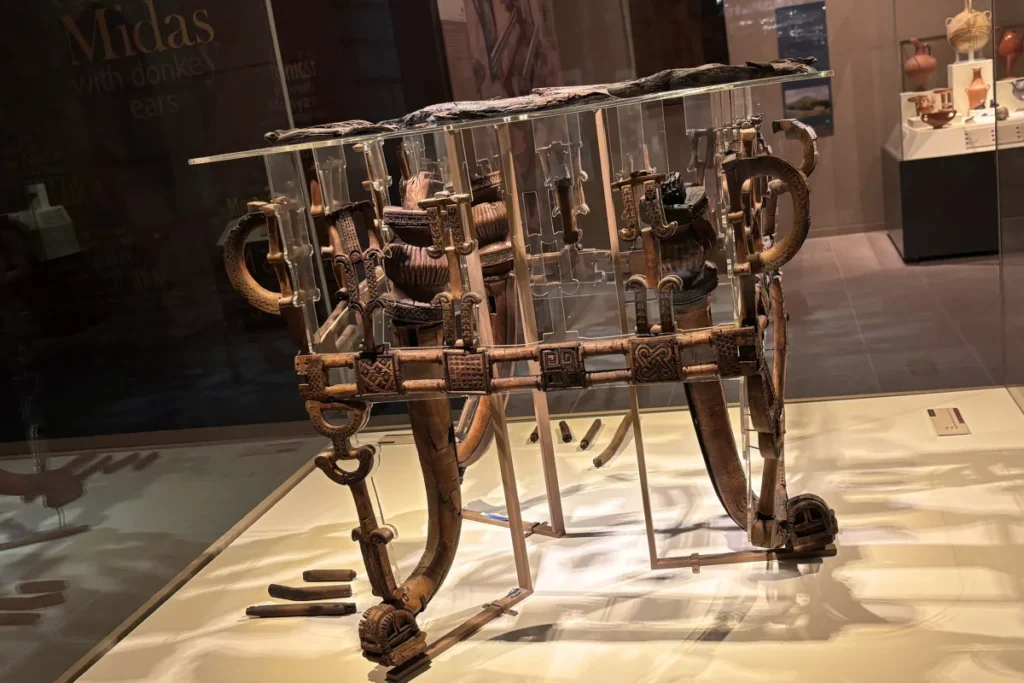
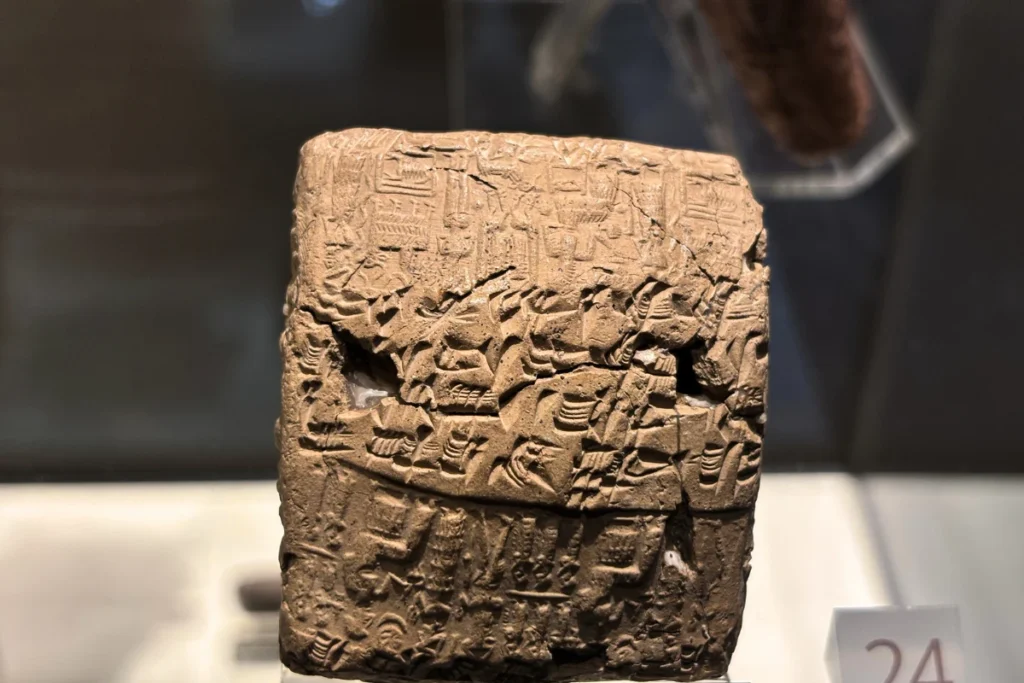
After the Hittite hall, the collection moves through the successor cultures that occupied Anatolia after the Late Bronze Age Collapse of approximately 1200 BCE destroyed the Hittite Empire along with most other major Eastern Mediterranean civilisations in a cascade of connected failures that archaeologists are still debating.
The Phrygians, who built their capital at Gordion and gave us the Gordian Knot legend (and the real King Midas who ruled a historical Phrygian state), are represented by intricate bronze fibulae (decorative clasps), pottery, and wooden furniture fragments preserved by exceptional burial conditions. The Urartians, who built a powerful state around Lake Van in eastern Anatolia between approximately 860 and 590 BCE, are represented by extraordinary bronze cauldrons with bull-head handles, bronze belts, and a corpus of metalwork whose technical sophistication places Urartu among the finest bronze-working cultures in the ancient world.
Both cultures are largely unknown to general audiences. In the museum, they occupy their own halls with collections that would be significant anywhere. Here they are somewhat overshadowed by the Hittite material. They should not be. Give them time.
The Classical and Hellenistic Sections
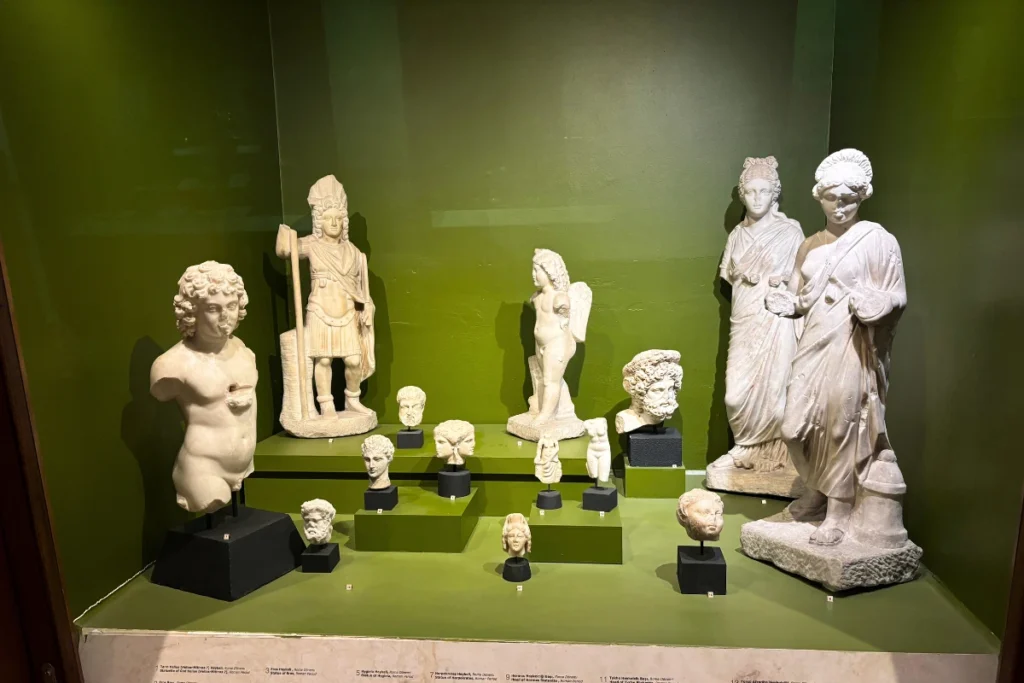
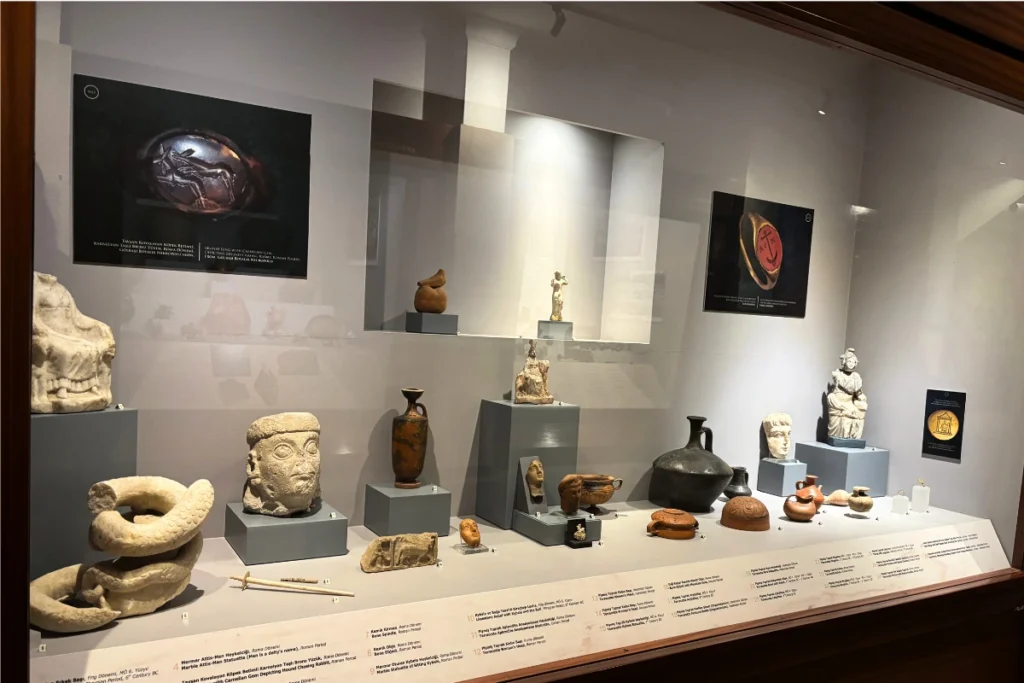
The circuit ends in classical antiquity: Greek and Roman-era Anatolian material, including marble statuary, ceramic collections, coins, and the evidence of the long Hellenistic culture that followed Alexander the Great’s eastern campaigns. By this point in the circuit, you have walked through approximately 12,000 years of human activity in a single building. The progression from obsidian flint tools to marble emperors is the same distance in the same room.
The India Connections That Stopped Us
We want to be careful about how we frame this section. Some of the connections below are well-documented and accepted by mainstream scholarship. Some are observed parallels that we noticed as Indians and that produced a recognition we cannot attribute to documented connection. We are sharing both, clearly labelled.
The Storm God Convergence
The Hittite storm god Teshub… depicted with lightning bolts, commanding the sky, defeating a chaos serpent (Illuyanka)… is structurally identical in function to Vedic Indra (who defeats Vritra, the chaos serpent, with his vajra lightning weapon) and to the Greek Zeus (who defeats the serpent Typhon with his thunderbolt). Three civilisations, three names, one mythological structure.
This parallel is well-documented in comparative mythology. It is generally attributed to the shared Proto-Indo-European cultural heritage of the Hittites, Vedic Indians, and Greeks… all of whom descended, linguistically and culturally, from the same ancestral population that spread across Eurasia between roughly 4,000 and 2,000 BCE. The similarity is not a coincidence. It is ancestry.
Standing in front of the Teshub relief, knowing we were going to Hattusa the following day and had already read about the Mitanni kingdom’s Sanskrit-speaking rulers and the Vedic deity names embedded in a 1380 BCE treaty, made the storm god not a foreign object but a recognisable form from an unexpected angle.
The Mother Goddess and the Sacred Feminine
The Çatalhöyük Seated Goddess on her leopard throne is one of the most discussed figurines in the archaeology of religion. Comparable female figures, some on animal thrones, some in birthing postures, appear across the ancient world… in the Indus Valley Civilisation, in early Mesopotamia, in the Aegean. Whether these represent a connected tradition, independent parallel developments, or migrations of a shared iconographic idea is actively debated.
As Indians who grew up with Durga Ma seated on her lion, the Çatalhöyük goddess on her leopards produced a specific visual recognition. We are not claiming a direct connection. We are noting that the icon of the seated goddess flanked by large felines is not alien to us. It is familiar in a way that requires no translation.
The Hattusa-India Treaty Connection
This is confirmed historical fact, not observed parallel. The Mitanni kingdom, a Hurrian state that controlled northern Mesopotamia from approximately 1500 to 1300 BCE and was a significant Hittite ally, contained a ruling elite who worshipped Vedic deities. A treaty between the Mitanni king Shattiwaza and the Hittite king Shuppiluliuma, dated to approximately 1380 BCE, invokes the gods Mitra-Varuna-Indra-Nasatyas as divine witnesses. These are Vedic deity names, in a text from northern Syria, written in cuneiform, from the same period as the Hittite Empire whose artefacts fill this museum.
The Mitanni ruled directly next door to the Hittites. While their primary language was Hurrian, their royal elite spoke a dialect infused with Indo-Aryan roots, leaving behind unmistakable Sanskrit loanwords in political and cultural texts. Their chariot horses were trained using a famous manual written by Kikkuli the Mitanni… discovered in the Hittite royal archives at Hattusa… which uses technical Indo-Aryan terms like aika-vartana (one turn), tera-vartana (three turns), and panza-vartana (five turns) to specify training laps. The Vedic world and the Hittite world were not separated by the vast distance modern geography implies. They were connected through the Mitanni intermediary at the height of both civilisations.
We visited Hattusa the next day and stood in front of the Lion Gate and the Sphinx Gate and the Yerkapı tunnels knowing this. The museum in Ankara had given us the context. Hattusa gave us the physical scale.
The Evening: Vermicelli in the Rain
We walked out of the Museum of Anatolian Civilizations at exactly 7 PM, when the staff began closing the galleries around us.
Akash had needed to sit on the museum benches several times during the visit. The day had been stressful: the drive from Istanbul, the uncertainty about arriving in time, the uphill sprint through Ankara. The museum had demanded sustained attention for two hours in that condition. He pushed through. We saw every gallery.
By the time we walked back down the hill to the Rest Hotel, Ankara had changed. The sun had set. Every shop in the neighbourhood had closed… simultaneously, completely, in the way that traditional Turkish neighbourhoods operate in the evening. There was no restaurant open. There was no food option within walking distance. We cooked instant vermicelli noodles in the hotel room, listened to rain tap against the window, and fell asleep in the capital city in a profound and specific silence.
This is the kind of evening that travel produces without planning. A stressful day, an unexpected gift (the museum open until 7), a physical depletion, an empty city after sunset, noodles in a quiet room, rain. Nothing about it was what we had imagined when we planned the trip. All of it was exactly right.
“Out on the quiet streets of Ankara after 7 PM, the city had shut down for the night. Instant noodles in a silent hotel room while rain tapped against the glass—it was the perfect ending to a day owned by history.”
How to Visit
- Location: Gözcü Sokak, Ulus, Ankara. In the Ankara Citadel (Ankara Kalesi) district. The citadel area sits above central Ankara and the streets leading to it are steep. Allow time for the climb, especially in summer.
- Opening hours: the museum is open 8:30 AM to 7 PM (verify current hours before visiting). Google Maps and some hotel staff may have incorrect information about closing time. We were told 5 PM by the hotel. It was 7 PM. Verify directly.
- Entry fee: 1,040 Lira for two people (April 2025). Verify current pricing.
- Time required: minimum two hours for the main circuit. Allow an additional 30 to 45 minutes if you want to read the display texts carefully. We spent two hours and fifteen minutes and moved at a considered pace.
- Position in the Turkey itinerary: visit before Hattusa and Göbekli Tepe, not after. The museum provides the artefact-level context that makes the sites comprehensible. The sequence we followed: Museum of Anatolian Civilizations (Day 3) → Hattusa (Day 4) → Göbekli Tepe and Karahan Tepe (Day 10). The museum’s chronological logic informed every subsequent visit.
- The neighbourhood: the Citadel district around the museum has Ottoman-era architecture and a slower pace than central Ankara. There are small restaurants and tea houses in the area, though the neighbourhood closes early in the evening, as we discovered.
- Photography: generally permitted in the main galleries. Flash restrictions apply near certain sensitive pieces. We took dozens of photographs across the two hours.
What It Costs
| Item | Cost (April 2025) |
| Museum of Anatolian Civilizations, two people | 1,040 Lira / INR 2,392 / USD 29-30 |
| Rest Hotel, Ankara (per night) | 1,620 Lira / INR 3,726 / USD 45-46 |
| Dinner (what was available) | Instant vermicelli noodles from the room |
The museum entry is reasonable for what it contains. The neighbourhood dining deficit was the one genuine inconvenience of the Ankara stop, and it is worth planning around by eating before you visit or keeping snacks at the hotel.
“We had spent months following a trail of ancient clues from Netflix screens to research papers. Standing inside an Ottoman bedesten surrounded by 8,000-year-old mother goddesses and Hittite storm gods, we realized Turkey doesn’t just show you its past… it forces you to recognize how deeply connected we’ve always been to it.”