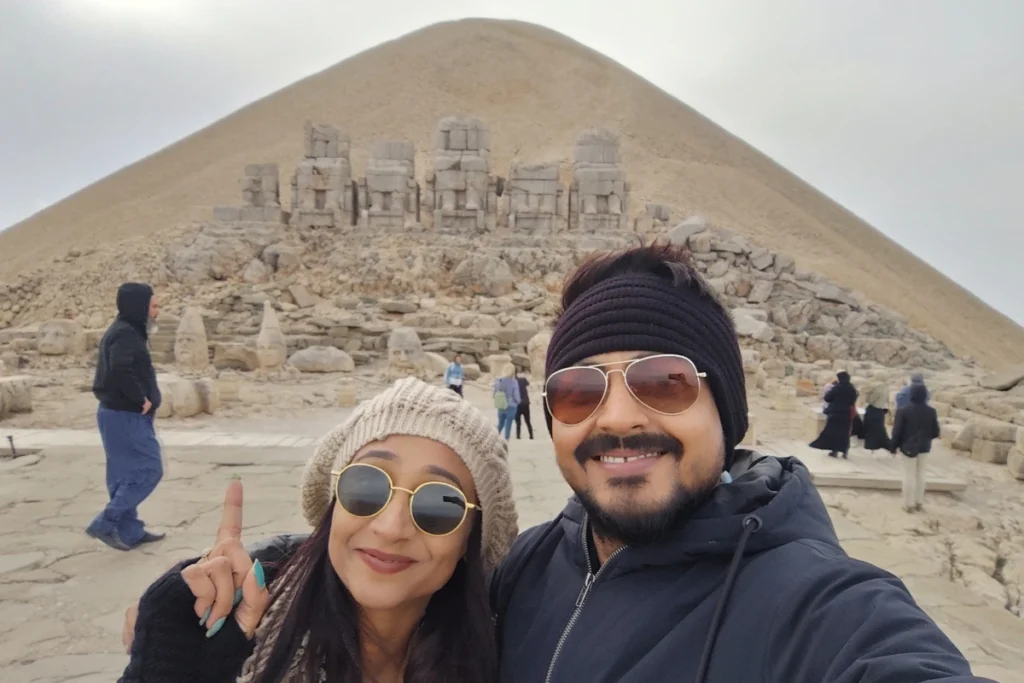
This Mount Nemrut guide is built from our visit on Day 8 of our 14-day Turkey road trip, April 24th 2025, after a 509 km drive from Cappadocia and a final approach that tested whether our car would make it.
The tyres lost grip on the final bend.
Loose gravel shifted under the wheels. Our rental Citroën C3, which had handled 509 km of Turkish highway without complaint, slid sideways on the narrow mountain road. No guardrail. The slope fell away to the valley below. The cliff face above was shedding stones onto the road surface. We saw the stones. We drove through them. We were continuously chanting Om Namah Shivaya under our breath as the tyres slipped against the loose gravel, holding onto that rhythm while the late afternoon light turned the rock gold and the car decided whether physics would allow it to continue climbing.
It continued. We reached the summit parking area with the engine hot, our hands stiff, and the specific silence that follows a stretch of driving where the outcome was genuinely uncertain. We had driven the most dangerous roads of the entire 14-day road trip to get here. Rocks had fallen from the cliffs above and were lying on the road surface. The network signal had been gone for over an hour. We were not entirely sure, on the final approach, that we were going the right way.
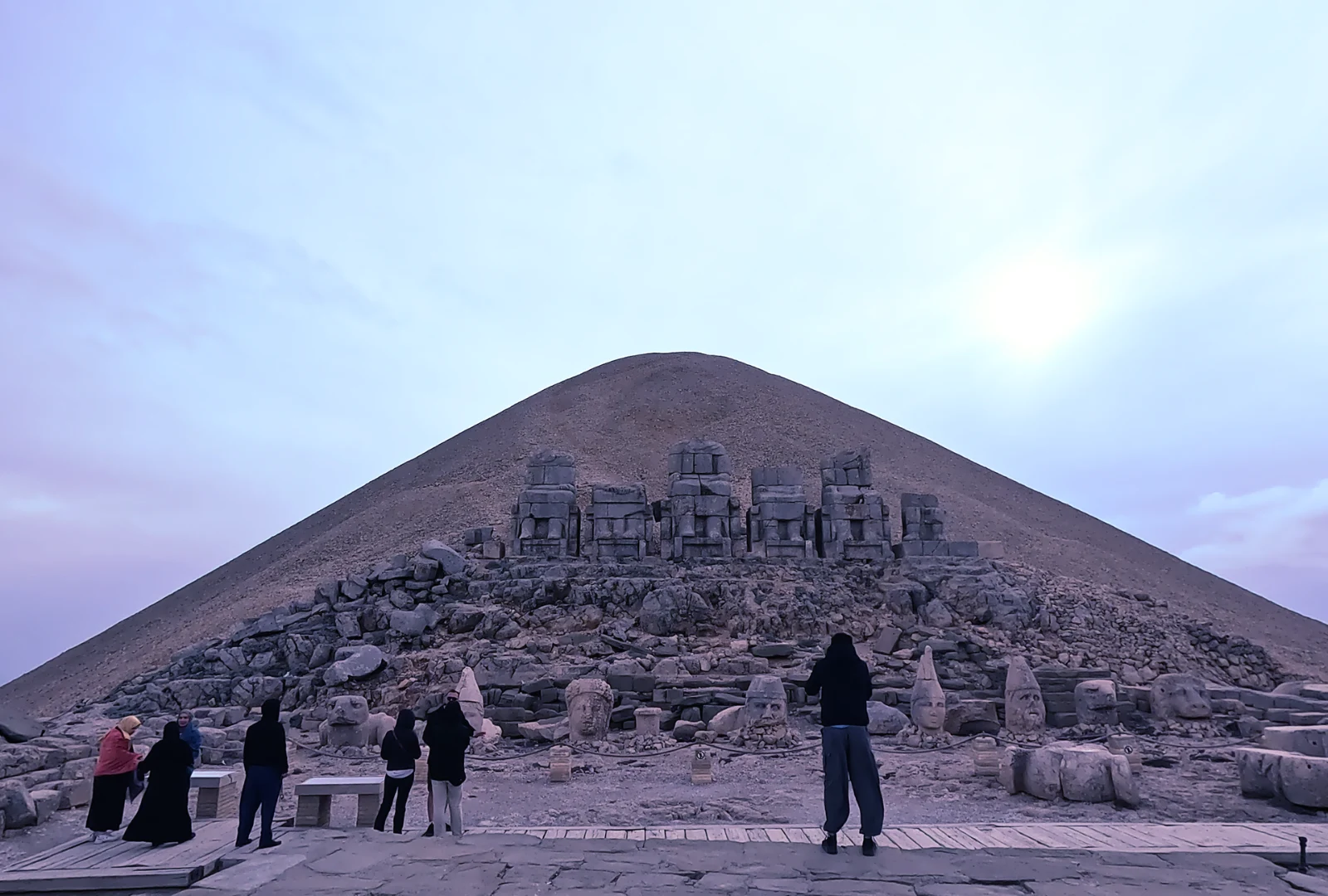
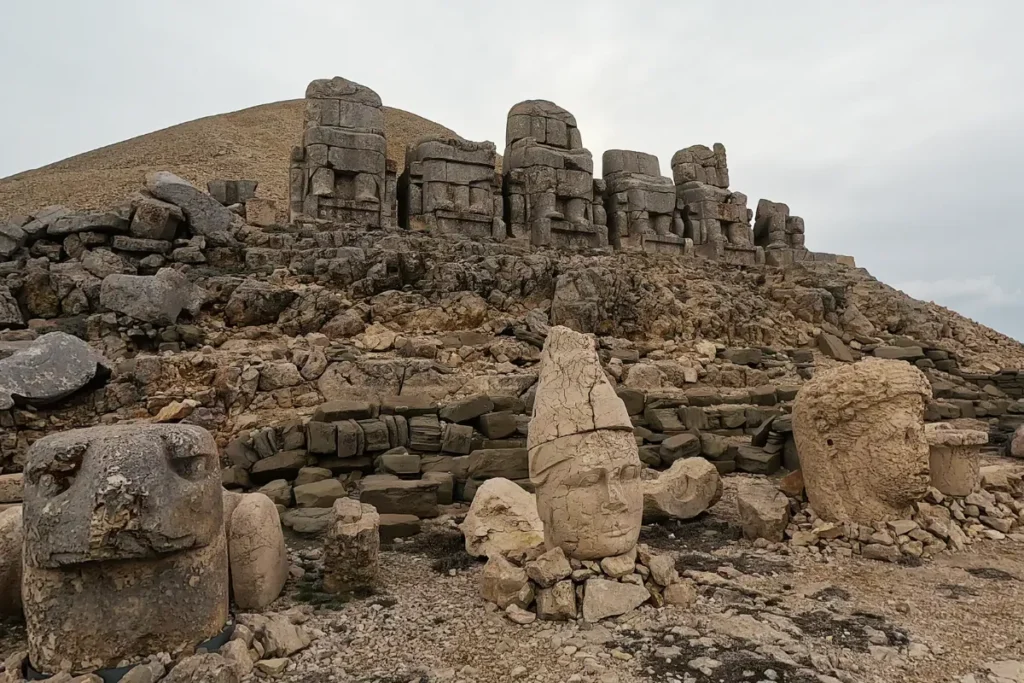
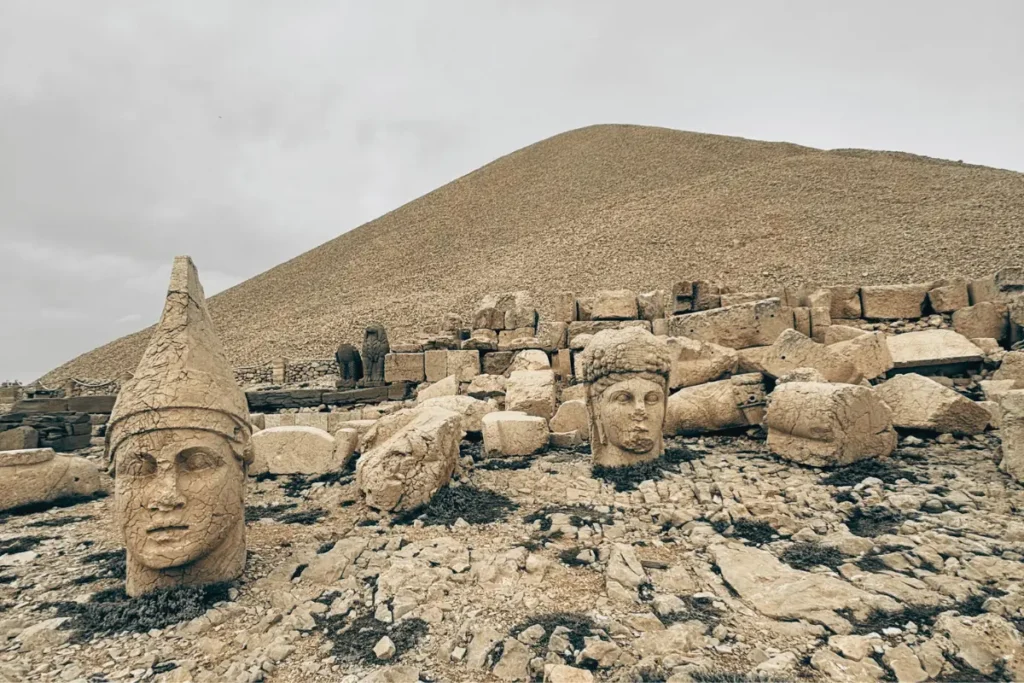
We stepped out into cold air. The temperature at 2,134 metres was a different temperature from the valley. We walked the final path to the east terrace. The cloud sat low and shifting around the summit. Through a gap in the grey, the heads appeared.
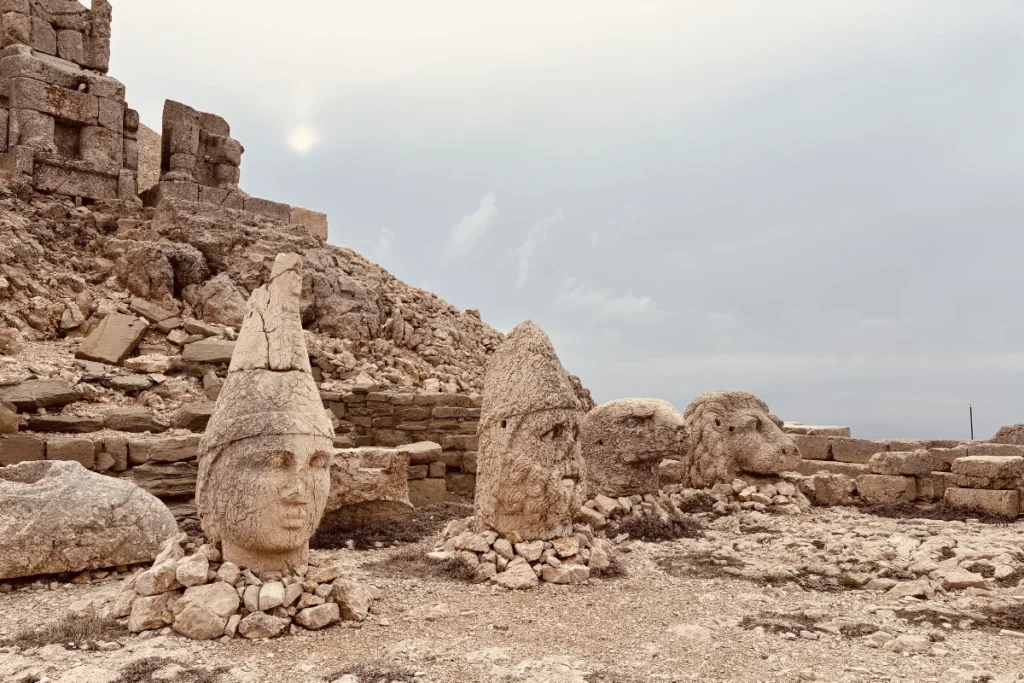
Five massive carved faces, each roughly the height of a person, lying on the rubble of a terrace that a king built 2,100 years ago because he believed he was divine. They had once been nine metres above us, attached to seated bodies on thrones, arranged to face the sunrise. The earthquakes and centuries of frost had separated them from their bodies. Now they rested at ground level, looking outward, expressions intact, watching whatever arrived at the summit with the same patience they had maintained since the bodies beneath them lost their heads.
We are two people from Bengaluru who grew up watching historical documentaries and reading about places we thought we might never reach. We were, by the account of the people at Karadut Pension, the first Bengali Indian visitors they had seen at Mount Nemrut. We do not know if that is accurate. It felt significant regardless. Standing on that summit, in the cloud, among the heads of a 1st-century BCE king’s syncretic pantheon, we understood what it means to go far enough that the place does not expect you.
“This was the destination we had circled on the map before any other on the route. The destination that had pulled us to eastern Turkey in the first place, after watching The Gift on our TV screen in Bengaluru and thinking: we have to stand there. We stood there. The cloud was cold. The heads were enormous. The summit earned every kilometre of the drive.”
Who Was Antiochus?
Antiochus I Theos Dikaios Epiphanes Philoromaios Philhellenos. The full name is a programme of self-description: God, Just, Illustrious, Friend of Rome, Friend of Greece. A king who required five honorifics to carry the weight of what he believed himself to be.
He ruled the Kingdom of Commagene from approximately 70 to 36 BCE. Commagene was a small Anatolian state in what is now southeastern Turkey, positioned between the expanding Roman Empire to the west and the Parthian Empire to the east. It survived not by military power but by diplomatic dexterity, playing larger empires against each other from the mountainous terrain above the upper Euphrates.
Antiochus claimed descent in two directions simultaneously. Through his father, he traced his bloodline to Darius I of Persia, the Achaemenid emperor. Through his mother, he traced it to Alexander the Great, through the Seleucid dynasty. Persian royal blood and Greek royal blood, converging in one body, producing a king who believed he sat at the intersection of the two greatest civilisations the ancient world had produced.
This dual ancestry was not incidental to what he built on Mount Nemrut. It was the entire point. The sanctuary at the summit is a materialisation of that claim: neither Greek nor Persian, but both, fused into a religious system that Antiochus designed for himself and for a kingdom whose mythology needed to be larger than its territory.
“He was not confused about his gods. He was designing a religion. Every deity in his pantheon carried both a Greek name and a Persian name, because Antiochus believed his bloodline carried both lineages. The summit was where he planned to spend eternity, seated among them, as one of them.”
What He Built at the Summit
The Tumulus
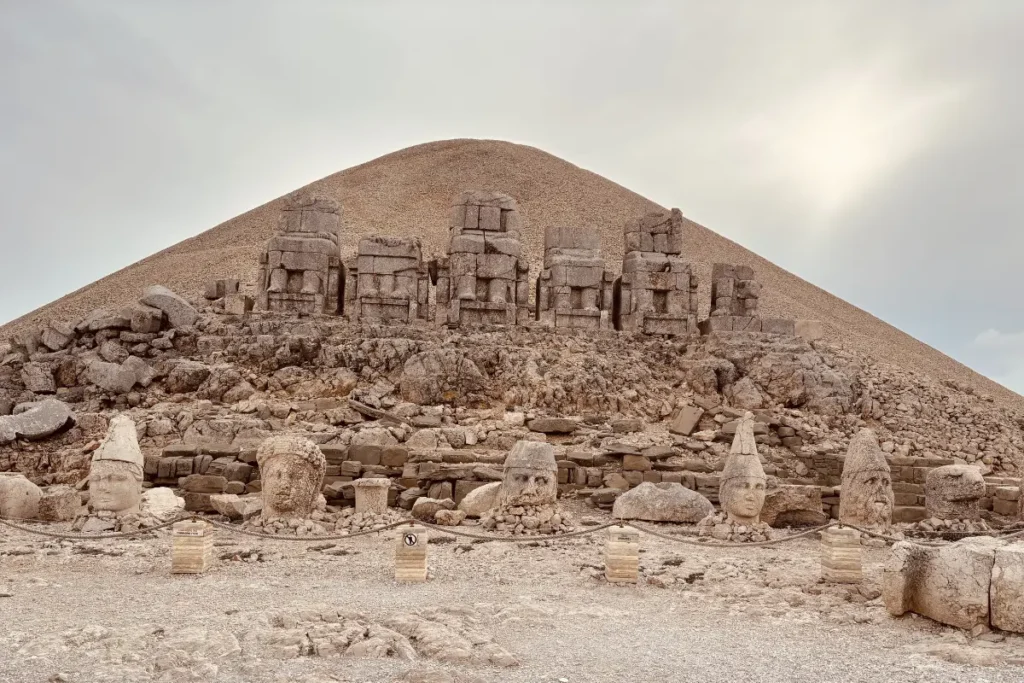
At the centre of the summit stands an artificial mound of crushed limestone approximately 50 metres high and 150 metres in diameter. Antiochus’s tomb is believed to be inside or beneath it. Nobody has opened it.
The mound is self-healing. Antiochus engineered it from loose, fist-sized stones rather than packed or mortared material. When archaeologists or tomb raiders have attempted to dig tunnels into it, the loose limestone has shifted to fill the passage, collapsing inward and threatening to bury whoever made the attempt. Expeditions have used dynamite. The mound absorbed the disturbance. The interior remains sealed.
This may be the most successful tomb protection in the ancient world. Every other royal burial of comparable ambition… the pyramids, the Valley of the Kings, the tumuli of the Lydian kings… has been opened. Mount Nemrut has not. What is inside, whether that is gold, inscriptions, the body of Antiochus, religious objects, or nothing at all, remains unknown.
The East Terrace
The east terrace faces the sunrise. Five colossal seated statues, originally eight to nine metres tall, were positioned in a semicircle facing east. Earthquakes have separated the heads from the bodies. The bodies, still seated on their thrones, remain on the terrace as headless torsos. The heads rest at their feet.
The five figures: Antiochus himself, seated as an equal among his gods (the audacity of the composition is itself a statement). Zeus-Oromasdes, the fusion of Greek Zeus and Persian Ahura Mazda. Apollo-Mithras-Helios-Hermes, a quadruple fusion combining the Greek god of light and prophecy, the Persian solar deity, the Greek personification of the sun, and the Greek messenger of souls. Commagene-Tyche, the kingdom itself personified as a goddess. Heracles-Ares-Artagnes, merging Greek heroism, Greek war, and Persian victory.
The syncretism is systematic. Every deity carries a Greek name and a Persian name. The religion was engineered to reflect the king’s dual ancestry and to make both traditions equal in the eyes of whatever divine authority might be watching.
The West Terrace and the Lion Horoscope
The west terrace mirrors the east, with the same five statues facing sunset. We did not reach the west terrace fully. The cloud and the fading light pushed us toward the east side, where the heads are more immediately visible, and we did not have enough daylight left to walk both terraces properly. This is our honest disclosure: we saw the east terrace and not the west.
The west terrace contains one of the most significant artefacts on the mountain: a stone relief of a lion with a crescent moon at its chest and three planets marked above its back. The planets are labelled: Mars, Mercury, and Jupiter. The moon sits between the lion’s front paws.
Researchers who have analysed this relief interpret it as an astronomical date encoded in stone. The specific conjunction of Mars, Mercury, and Jupiter in the constellation Leo, with a crescent moon in a particular position, matches a sky configuration that would have occurred on July 7, 62 BCE. If this interpretation is correct, the relief records either the date of Antiochus’s coronation, the start of construction at Nemrut, or a celestial event of astrological significance to the Commagene royal house.
This makes the lion relief one of the earliest known attempts to encode a specific calendar date through astronomical positioning. It is not a general decorative motif. It is a timestamp.
We include it here at length because any visitor to Nemrut who reads about the lion horoscope before visiting will experience the west terrace with a different quality of attention than we managed to bring to it after a 509 km drive and a tense ascent. Go to both terraces. Bring the context. We did not.
The Drive That Earns the Summit
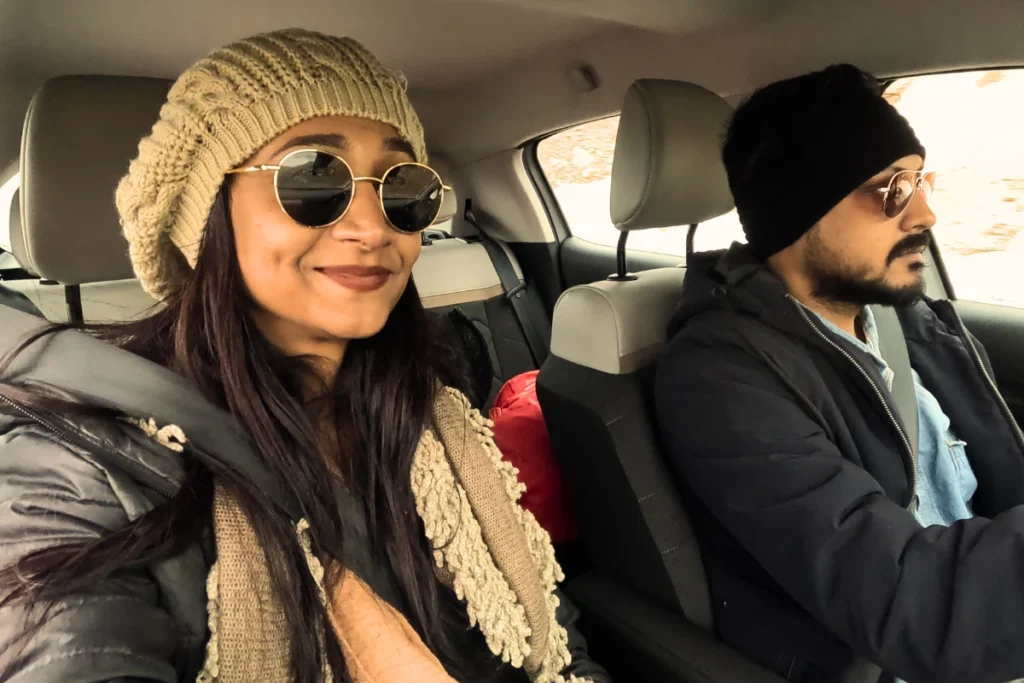
We left Cappadocia early on the morning of April 24th and drove 509 km southeast. The highway was smooth and fast. The landscape shifted from the fairy chimney terrain of central Anatolia into the increasingly mountainous east. The farms grew sparser. The peaks grew closer. By the time we reached the Adıyaman province, the road was climbing consistently.
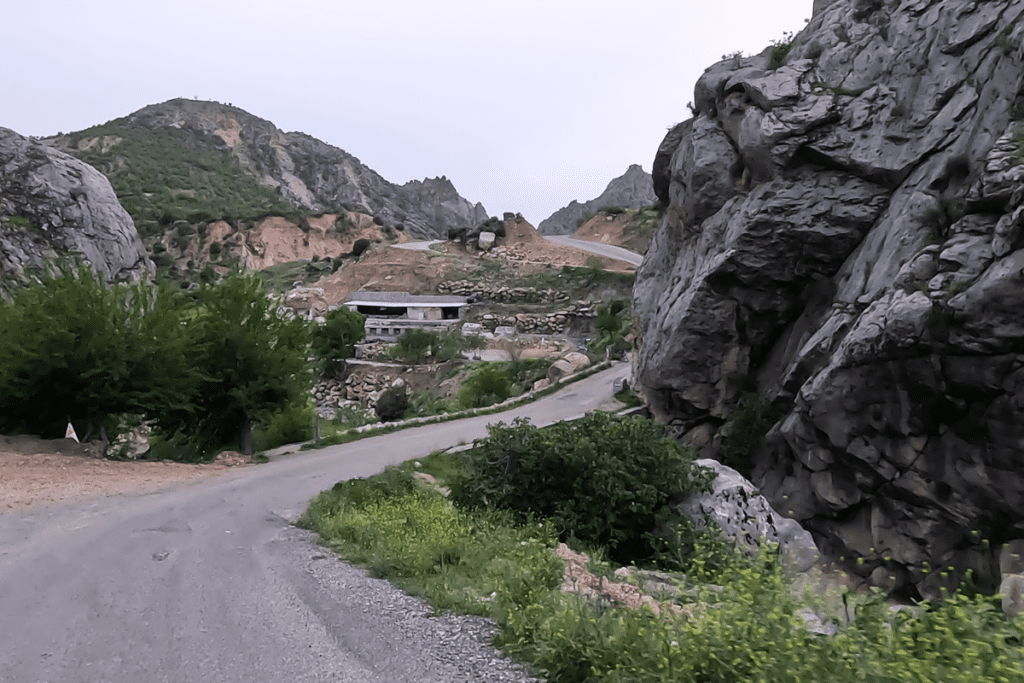
The final approach from the village of Karadut to the summit parking area is what the trip notes describe as “one hell of a drive.” The paved surface ends. The road becomes steep, narrow, and loose. Stones that have fallen from the cliff faces above lie on the driving surface. The slope drops away with no guardrail between the car and the valley.
We drove this in the late afternoon. We had no signal. We were not certain we were going the right direction. The stones on the road were real. The gravel that caused the tyres to lose grip was real. The specific absence of any other vehicle, any sign of human habitation, and any evidence that the road would widen at any point was the landscape we drove through for the final thirty to forty minutes of the ascent.
At the summit, we stepped out of the car and stood still for a moment. The engine was hot. Our hands needed a few seconds before they were fully relaxed. The cold arrived. The cloud shifted. The heads appeared through a gap, and all of it was immediately, completely worth it.
In our trip notes, there was a simple question: Would we do the drive again? The answer recorded there is: ‘100 per cent. Anytime.’
A Quick Note on the Routes: Coming from Cappadocia, Maps routed us via the northern approach from Malatya… a tense, step-free gravel slope that brings you straight near the top. After visiting the summit, we descended down the southern side to Karadut village for the night. If you prefer a smoother, paved approach with built-in stone steps, route your arrival via Adıyaman / Kâhta instead.
Karadut Pension: The Night Below the Mountain
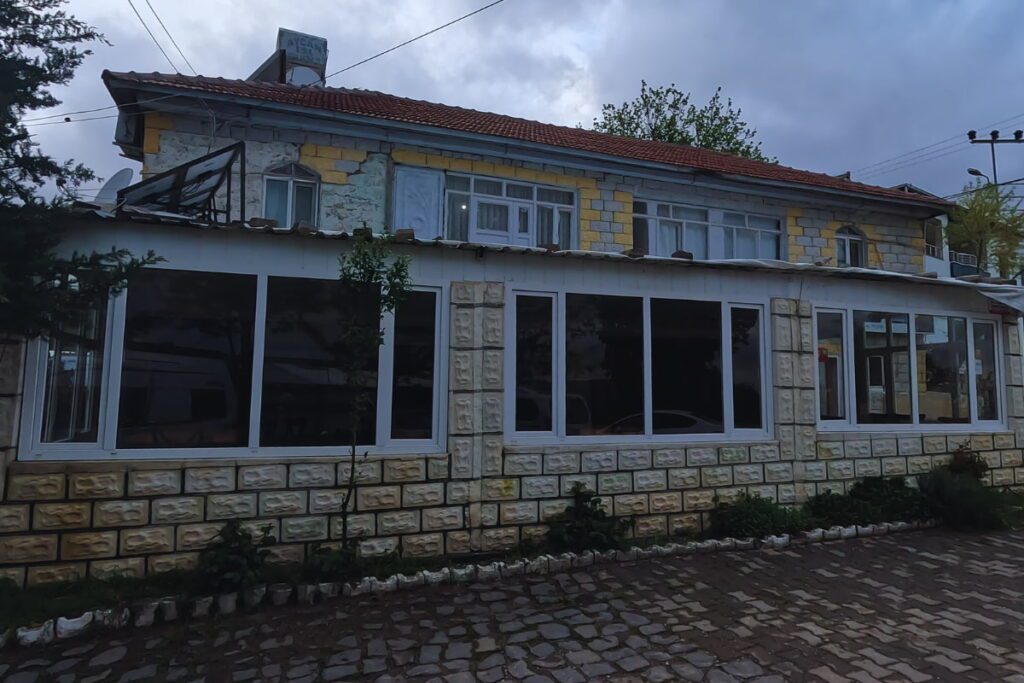
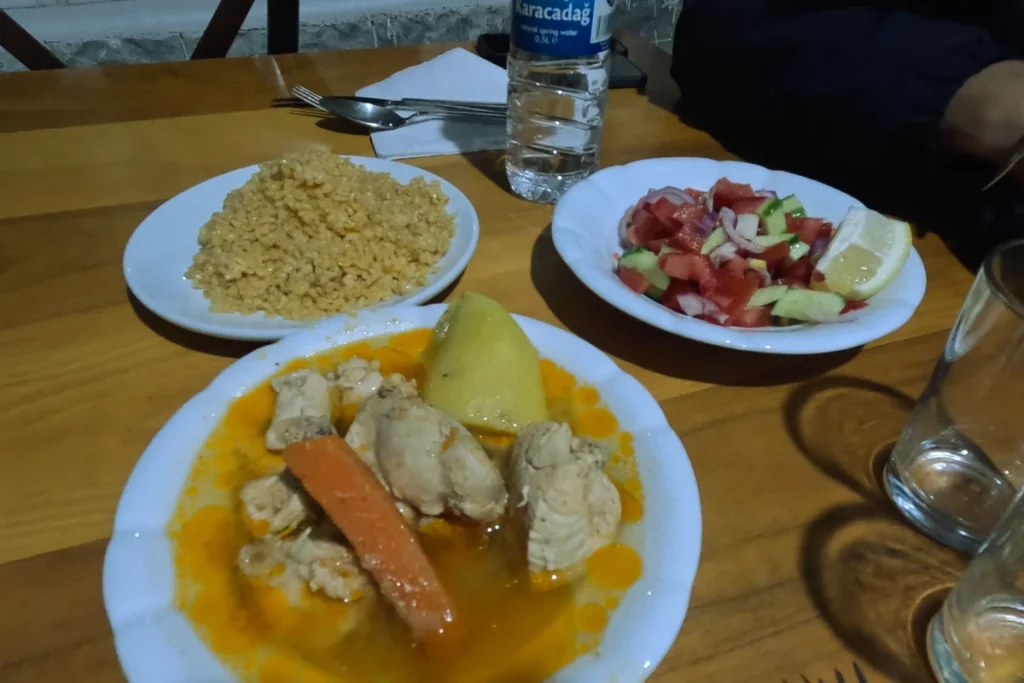
We descended before dark. The trip notes are explicit about this decision: the road at night, with no light, only rough mountains, falling rocks, and no guardrails, was not a risk we were willing to take. We came off the mountain while we could still see.
The Karadut Pension in the village at the base: TRY 1,580 / INR 3,634 / USD 39 for the room including dinner. The family was warm in a way that consistently characterises the hospitality of southeastern Turkish guesthouses. They served chicken soup, fresh bread, and rice. The wind was audible outside. The dining room was small and lit warmly against the mountain dark.
After the tense ascent, the uncertain road, the cold at the summit, and the emotional weight of standing among the heads of a 2,100-year-old royal sanctuary, a bowl of chicken soup in a warm room was not a minor thing. It was exactly what we needed then. We ate, we discussed what we had seen, and we slept in a building at the base of a mountain that has been keeping a king’s secrets for two millennia.
The Karadut Pension is the standard base for Nemrut visitors. Several family guesthouses cluster here, all offering dinner and breakfast with the room. Prices are among the lowest we encountered in Turkey. If you are visiting Nemrut, plan to stay overnight: this allows a sunset visit to one terrace and a sunrise visit to the other, which is the experience the mountain was designed to provide.
The Shift to Mardin: Siverek Basalt Columns
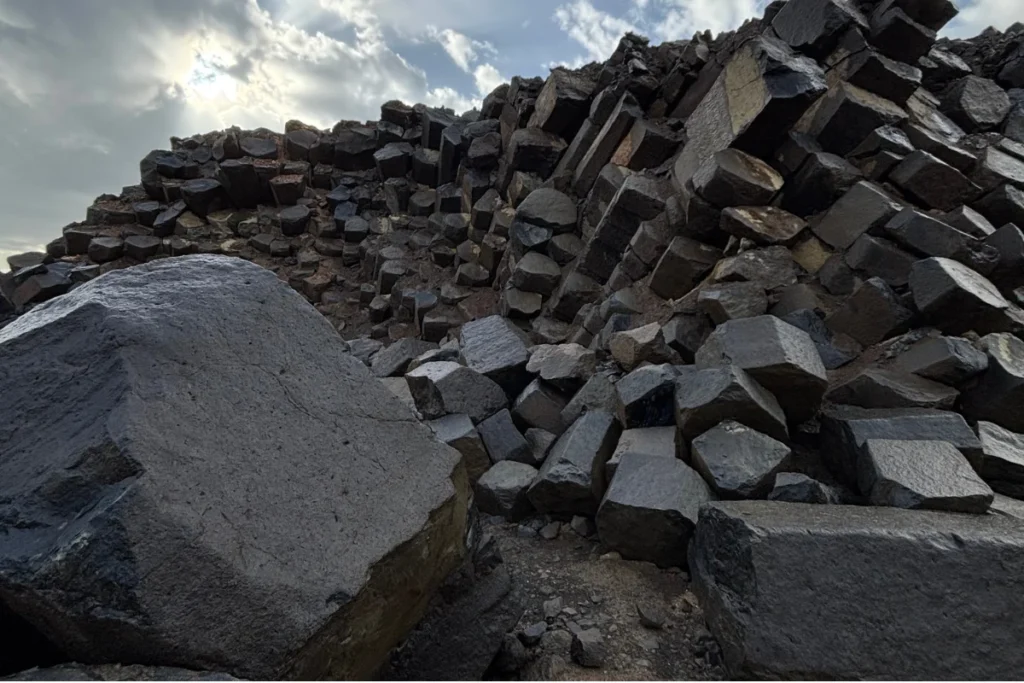
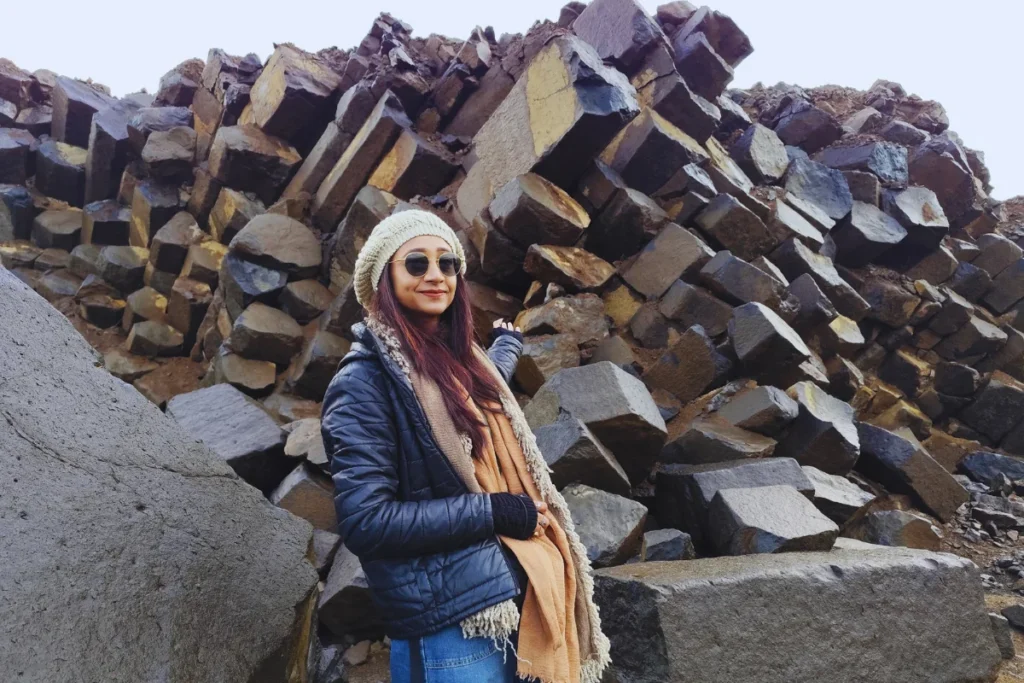
The next morning, we checked out early and started driving towards Mardin. Before hitting the open highway, we took a short detour to the Siverek basalt columns. Emerging unexpectedly out of the rolling landscape, these stark, hexagonal volcanic pillars felt like a surreal geological intermission between the man-made wonders of Commagene and the ancient stone streets of Mardin… a quiet reminder of how much raw, unscripted beauty lies hidden in the valleys of southeastern Anatolia.
What Antiochus Achieved and What He Did Not
He did not achieve divinity. He was a mortal king of a small state. Commagene was absorbed by the Roman Empire within decades of his death. His dynasty ended. His syncretic religion, designed with careful theological intent, died with the kingdom that hosted it. No living tradition carries the worship of Zeus-Oromasdes or Apollo-Mithras-Helios-Hermes.
He achieved something more durable than he planned for. He built a sanctuary at 2,134 metres that requires commitment to reach, in a location that ensures the summit is never overwhelmed by casual visitors. He engineered a tomb that no technology available to us has managed to open. He carved heads that have outlasted every political and religious system that might have claimed authority over them. And he chose a mountain high enough that the site he built is, at regular intervals, wrapped in cloud… which is not a disadvantage. It is the best possible atmosphere for the experience he designed.
UNESCO inscribed Mount Nemrut as a World Heritage Site in 1987. The inscription acknowledges the “unique artistic achievement” and the ambition of Antiochus’s religious syncretism. What it does not convey, because no document can, is the experience of standing at 2,134 metres in cloud, among heads that are as tall as your chest, on the terrace of a man who wanted to spend eternity here.
He is spending it here. The tomb, wherever it is in the tumulus, is intact. Whatever remains of Antiochus I Theos Dikaios Epiphanes Philoromaios Philhellenos is on this mountain. The man who wanted to be a god is inside the hill that everyone who visits the summit has to walk past. That is a kind of eternity, even if it is not the one he intended.
How to Visit
- From Malatya (nearest major city): approximately 90 km, 2 hours. Malatya has a domestic airport with direct flights from Istanbul and Ankara. This is the shortest approach.
- From Cappadocia (as we did): 509 km, approximately 7 to 7.5 hours. Depart early. The mountain approach road requires daylight.
- From Nemrut to Mardin: Approximately 270 km, 3.5 hours. We drove the Nemrut-to-Mardin route the following morning, making a brief and worthwhile stop at the Siverek basalt columns along the way.
- Entry fee: TRY 680 for two (April 2025). Verify current pricing.
- Accommodation: Karadut Pension and similar family guesthouses at the base. TRY 1,580 for room plus dinner (April 2025). Book in advance in peak season (May to October).
- Sunrise vs sunset: the east terrace faces sunrise, the west terrace faces sunset. Stay overnight and visit both. We visited in late afternoon and missed the west terrace. We recommend not repeating this.
- The road: the final section from Karadut village to the summit is steep, narrow, and surfaced with loose gravel. A vehicle with good ground clearance handles it more confidently than our Citroën C3, which made it but struggled. Do not attempt the road in rain, after dark, or without a full tank of fuel. There are no services on the approach.
- What to bring: warm layers regardless of season. The summit is cold. Wind. A headlamp if visiting for sunrise. Water. Snacks. The summit has no food service.
- Time on the summit: allow two to three hours if visiting both terraces. One hour per terrace minimum.
What It Costs
| Item | Cost (April 2025) |
| Mount Nemrut entry fee (two people) | TRY 680 / INR 1,564 / USD 18.50 |
| Karadut Pension (room + dinner, two people) | TRY 1,580 / INR 3,634 / USD 39 |
| Fuel, Cappadocia to Nemrut (509 km) | Estimate: TRY 950 – 1,150 / INR 2,200 – 2,650 / $26 – $31 USD |
| Siverek basalt columns (nearby, next day route toward Mardin) | Free |
The summit itself is inexpensive. The cost of reaching it (fuel, the rental car, the distance from any other destination) is the real budget consideration. If you are on a cross-Turkey road trip, Nemrut slots naturally between Cappadocia and Mardin. If you are visiting specifically, Malatya is the efficient base. In either case, the one night at Karadut Pension is not a luxury. It is the correct structure for the visit.
“Antiochus built a sanctuary at 2,134 metres to ensure he would never be forgotten, but what stays with you isn’t his bid for immortality… it’s the sheer weight of standing in the mountain cold, watching twenty centuries of silence stare right back at you.”