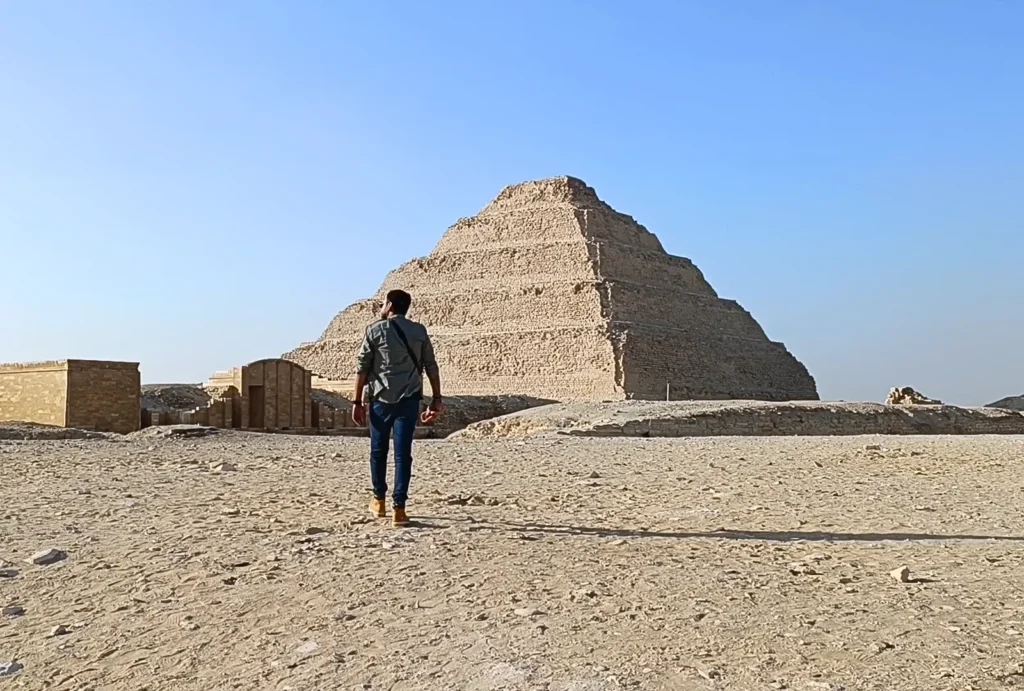
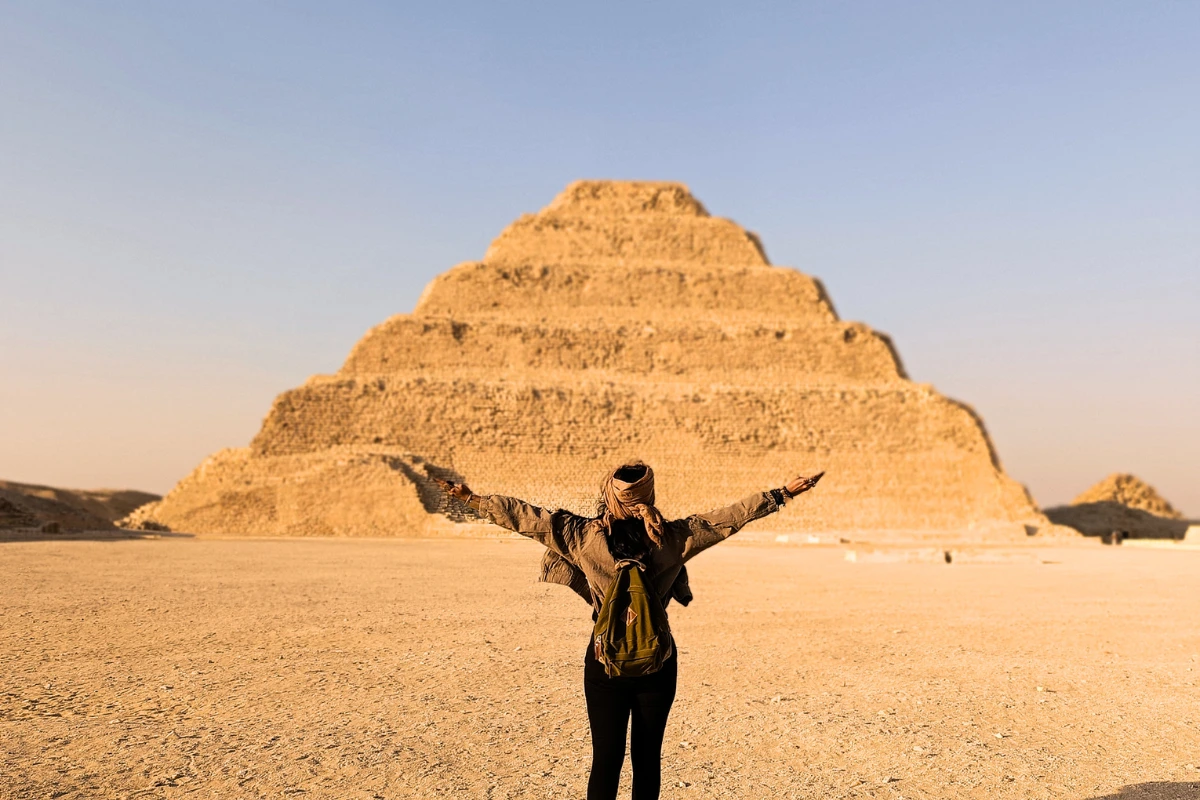
Most travel stories are born from perfect itineraries, but this Saqqara pyramid guide was born from a race against the setting sun on Day 1 of our Egypt trip. It is the result of a tight one-hour time crunch, the sharp sting of a specific travel regret, and the deep dive into the history we simply didn’t have the hours to see.
We arrived at Saqqara with approximately one hour of daylight left and the complex about to close.
This was Day 1 of our Egypt trip, February 18, 2022. We had already visited the Red Pyramid, the Bent Pyramid, and the Black Pyramid at Dahshur that day with our driver Ramy. Dahshur had taken longer than expected. The Red Pyramid’s internal chamber, at the bottom of a 63-metre descending passage that smells of ammonia and millennia, does something to your sense of time. We got to the entrance, felt the dark close in, and came back up.
By the time Ramy drove us through the complex gates, the afternoon was gone. Entry fee: 180 EGP per person in 2022. We walked the courtyard as quickly as we could. The Step Pyramid was visible from the open ground, six tiers rising from the sand. We found the entrance to the burial chamber closed. We were too late. We checked the area and left.
We walked the exterior, absorbed what we could, and left with the specific frustration of knowing we had been inside the most important pyramid complex in Egypt without giving it what it required.
This article exists because of that frustration. Not as a detailed trip report. As the guide we needed: what Saqqara is, why it matters more than Giza in the history of human architecture, what the complex contains, and why you must give it the time we did not.
“There is a specific kind of heartbreak that comes with standing on the edge of the ancient world and realising your watch is ticking faster than the gates are closing. We left Saqqara with dust on our shoes and a heavy sense of what we had missed… and this guide is the blueprint to ensure your timeline doesn’t repeat our mistake.”
Why Saqqara Matters More Than Giza
Every tourist in Egypt goes to Giza. The Great Pyramid of Khufu. The Sphinx. The postcard. The bucket list. The photograph.
Comparatively, very few people visit Saqqara. The tour buses drive past it on their way to Giza, twenty kilometres further north. Standard itineraries do not include it. Travel agencies do not promote it. The name does not carry the same weight in the global imagination.
This is one of the most significant omissions in tourism.
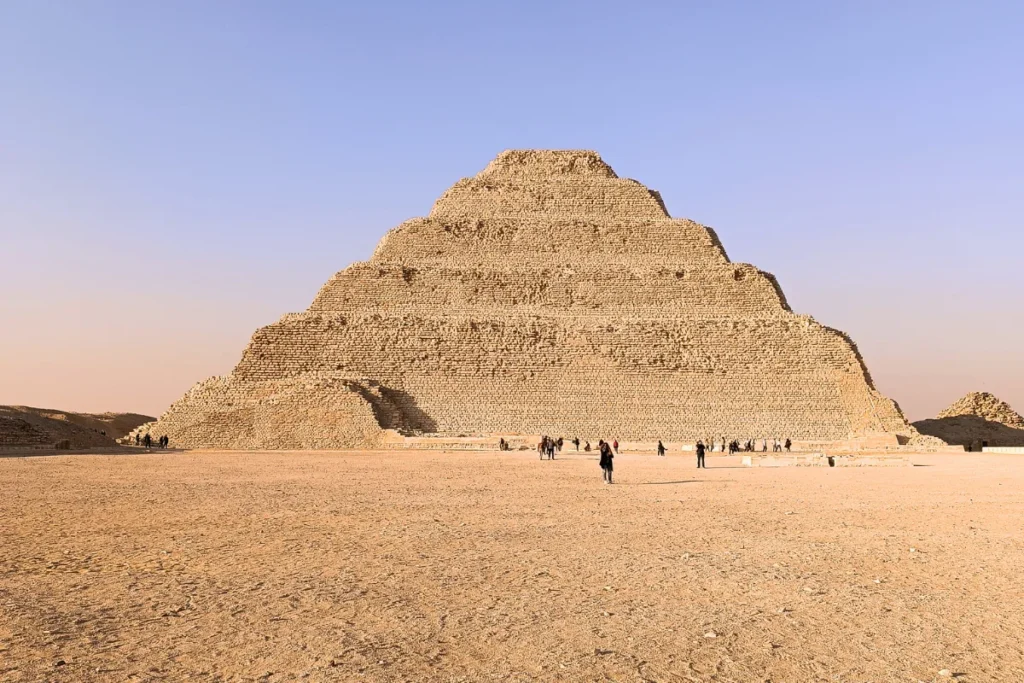
The Step Pyramid of Djoser at Saqqara, built approximately 2,670 BCE, is the oldest monumental stone structure in the world. Not the oldest pyramid. The oldest large-scale stone building constructed by human beings anywhere on Earth. Before Djoser’s pyramid, monumental architecture was built from mudbrick. After it, everything changed. The Great Pyramid of Khufu at Giza, the one everyone photographs, was built approximately a century later. It was a refinement of what Saqqara started.
Giza is the perfected version. Saqqara is the invention. Visiting Giza without visiting Saqqara is like studying the smartphone without studying the transistor. The later achievement is more impressive. The earlier one is more important.
Imhotep: The Architect Who Became a God
The Step Pyramid was designed by Imhotep, and his story is one of the most extraordinary in ancient history.
Imhotep was not a pharaoh. He was a commoner. He served as vizier, architect, and physician to Pharaoh Djoser during Egypt’s Third Dynasty. He designed the Step Pyramid, which began as a traditional flat-roofed mastaba tomb and was expanded, layer by layer, into the six-tiered stepped structure that stands today. Each expansion was a decision to go higher, to do something that had never been done, using stone where mudbrick had always been used.
The achievement was so extraordinary that Imhotep was elevated, over the centuries following his death, from a mortal architect to a demigod and eventually to a full deity. He was worshipped as the god of medicine, architecture, and wisdom. The Greeks identified him with Asclepius, their own god of healing. A commoner who designed a building so unprecedented that civilisation made him a god. He is the first architect in recorded history whose name we know. His building is the one most tourists drive past.
“To the ancient Egyptians, he was not merely the builder of the first pyramid; he was the master of secrets, the patron of healers, and a man so brilliant that history eventually forgot he was born a mortal and remembered him only as a god.”
What the Complex Contains
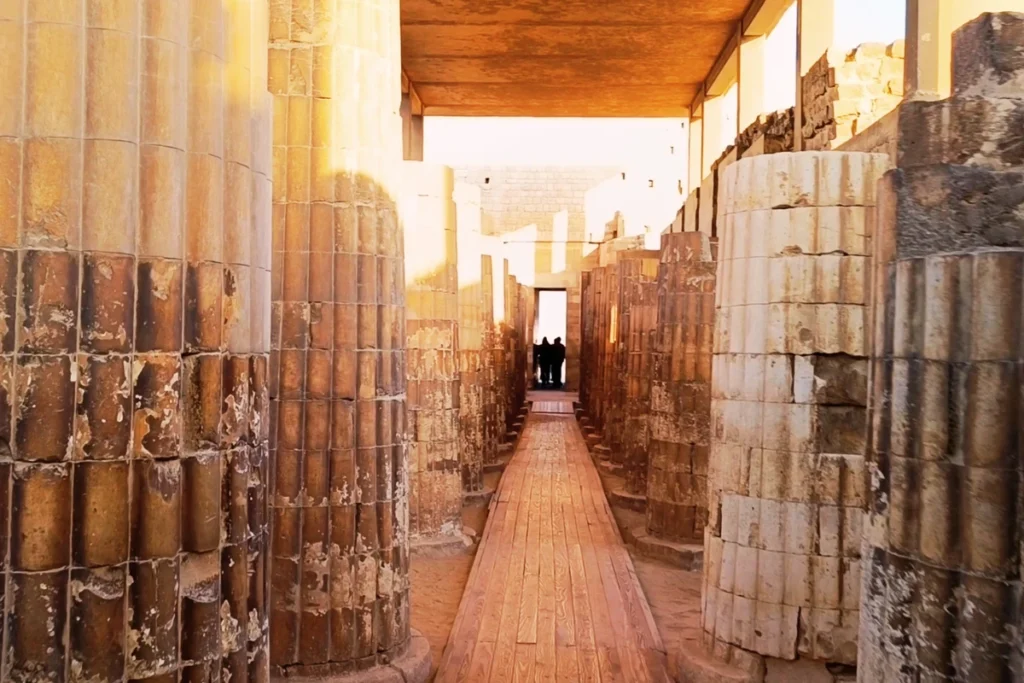
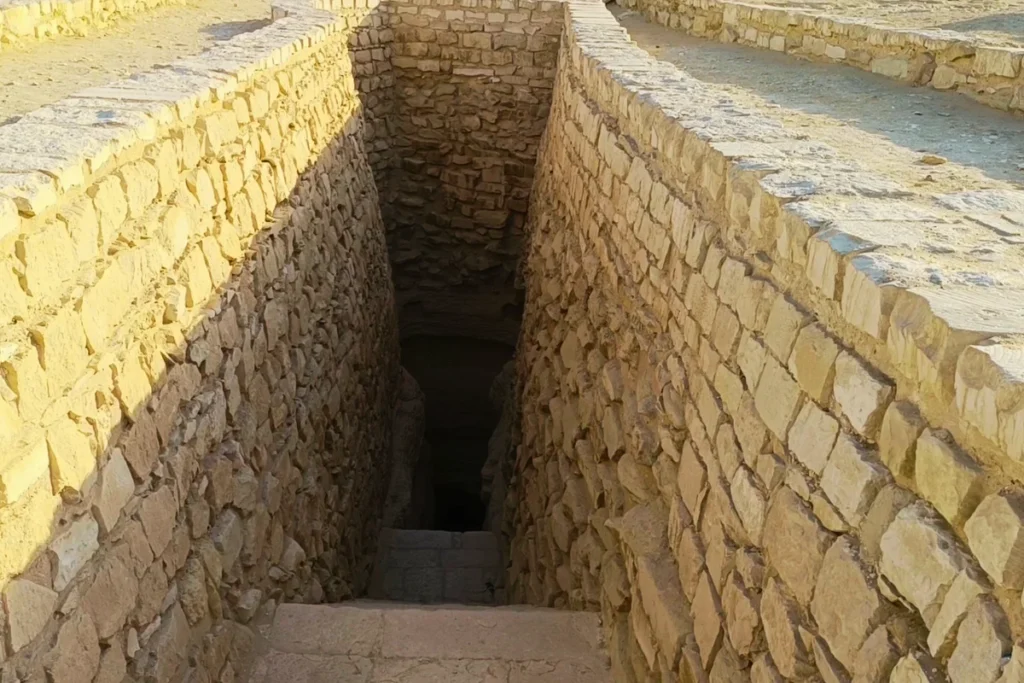
The Step Pyramid does not stand alone. It is the centrepiece of a vast funerary complex enclosed by a 10.5-metre-high limestone wall stretching over 1.6 km in perimeter. The complex was designed as a complete world for the pharaoh’s afterlife: not just a tomb but a city of the dead, with courtyards, temples, chapels, and symbolic buildings that replicate in stone the structures Djoser used in life.
The Colonnaded Entrance Hall
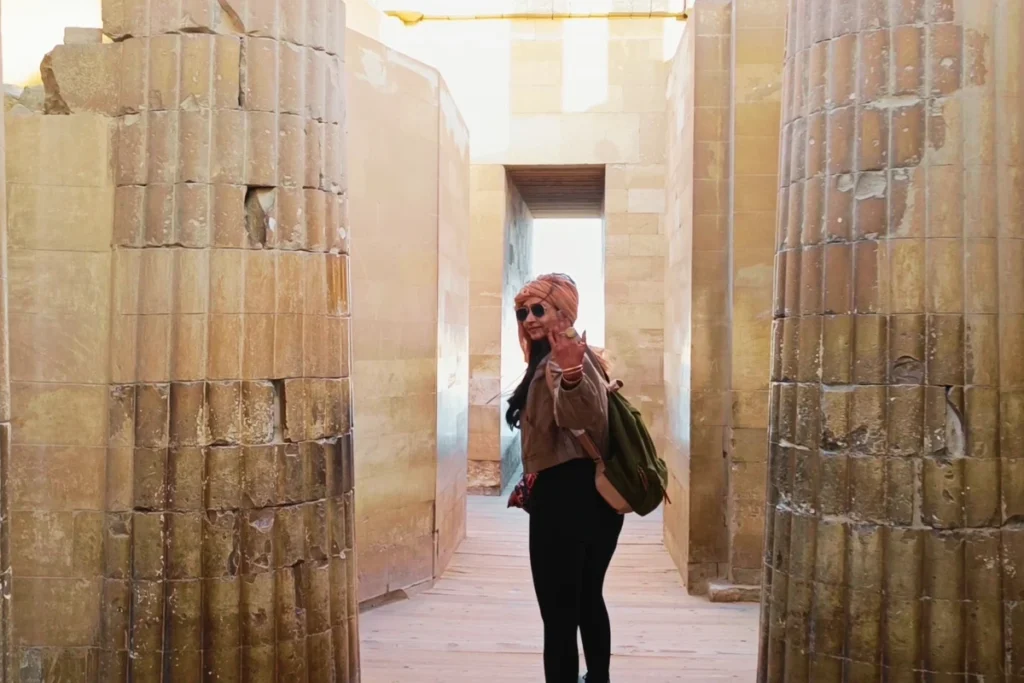
Entry to the complex is through a narrow corridor of 40 limestone columns, each carved to resemble bundled papyrus reeds. These are the oldest known stone columns in the world. They are not freestanding. They are attached to the walls, as though the builders did not yet fully trust stone to stand on its own. This hesitation is visible in the design: the idea is correct, the confidence is still developing. Walking between columns that were carved 4,700 years ago by people who were inventing monumental stone architecture as they went produces a feeling that Giza’s polished perfection does not. At Giza, you see what mastery looks like. At Saqqara, you see what courage looks like.
The Heb-Sed Court
Beyond the entrance hall, an open courtyard contains a series of dummy buildings: chapel facades carved from stone that have no interiors. These replicate the structures used in the Heb-Sed festival, a jubilee ceremony where the pharaoh renewed his right to rule by performing physical feats before the gods. The stone replicas ensured Djoser could perform the Heb-Sed in his afterlife, eternally renewing his sovereignty.
The buildings have doors carved from stone that do not open. Windows carved from stone that do not admit light. Walls with no rooms behind them. The entire courtyard is a permanent theatre set for a ritual that will be performed by a dead king forever. The concept is as architecturally radical as the pyramid: these are buildings never meant to function as buildings. They were meant to function as symbols.
The Serdab
Near the northern face of the Step Pyramid sits a small, sealed stone chamber with two small holes drilled through the wall at eye level. If you look through the holes, you see a painted limestone statue of Pharaoh Djoser staring directly back at you. The statue has been sitting in this sealed chamber for 4,700 years, looking out through those two holes.
The statue is not a portrait in the modern sense. It is a vessel for Djoser’s ka, his spiritual double. The holes allow the ka to see out, to watch offerings placed in front of the chamber, to observe the rituals performed in the courtyard. The ka requires sustenance: food, drink, prayers. The holes allow the ka to receive these through sight.
The experience of looking through those two holes and meeting the painted eyes of a 4,700-year-old statue is one of the most singular moments available in Egyptian archaeology. It is not dramatic or large-scale. It is a quiet, intimate encounter between a living person and a dead king’s spiritual proxy, separated by a wall and connected by two small holes. This moment is available only at Saqqara. Giza has nothing comparable to it.
“In the theology of the Old Kingdom, stone was the ultimate trap for the soul. The Serdab wasn’t built to hide the king away, but to anchor his spiritual double (ka) to the living world forever through two tiny holes in the dark.”
What Surrounds the Step Pyramid
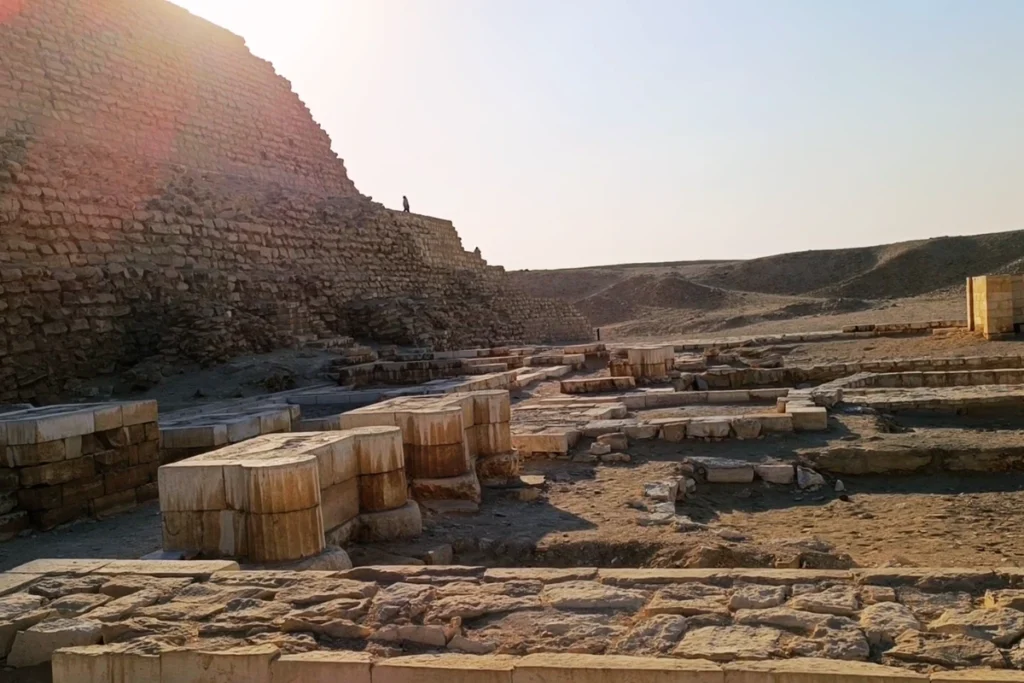
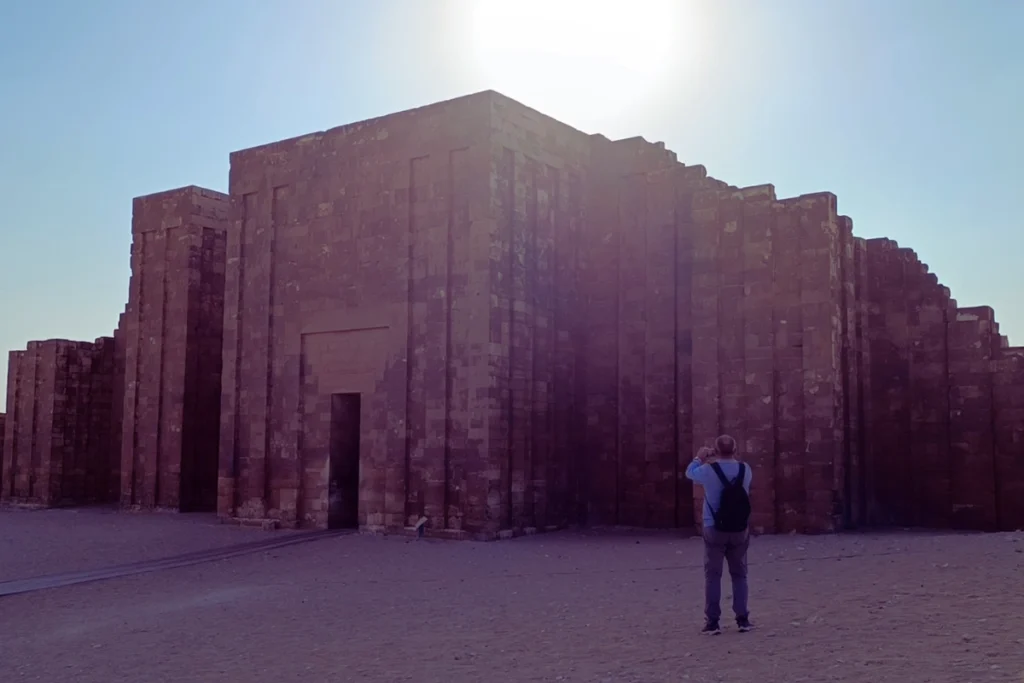
Saqqara is not one pyramid. It is a necropolis stretching seven kilometres along the desert plateau above Memphis, ancient Egypt’s capital. The Step Pyramid is the most famous structure, but the surrounding area contains monuments spanning over two thousand years of Egyptian history.
The Pyramid of Unas
The last pharaoh of the Fifth Dynasty. His pyramid is smaller and partially ruined from the outside, but contains the earliest known Pyramid Texts: religious spells carved directly into the burial chamber walls approximately 4,350 years ago. These are the oldest known religious writings in the world, describing the pharaoh’s journey through the afterlife: ascending to the sky, joining the stars, becoming one with the gods. The Valley of the Kings tombs we visited on our Nile cruise, painted with scenes from the Book of the Dead, are the descendants of what was first written inside this pyramid at Saqqara. The source material is here, a thousand years earlier.
The Serapeum
An underground complex of massive stone sarcophagi, each weighing up to 70 tonnes, built to house mummified Apis bulls. The Apis bull was a living god: a specific bull identified by sacred markings, worshipped as the earthly manifestation of the god Ptah during its lifetime. The Serapeum’s tunnels extend deep underground. The sarcophagi are carved from single blocks of granite, polished to a mirror finish, fitted with precision that engineers find difficult to explain given the tools available. How a civilisation without cranes or engines quarried, transported, and lowered 70-tonne stone boxes into underground tunnels with no margin for error remains an open question. The Serapeum is as unsettling as it is impressive, and most Egypt itineraries do not include it.
The Mastaba Tombs
The plateau around the Step Pyramid is scattered with mastaba tombs: flat-roofed rectangular structures that were the standard tomb format before Imhotep invented the step pyramid. Several contain remarkably preserved painted reliefs depicting daily life in ancient Egypt: farming, fishing, hunting, cooking, dancing, and domestic scenes that the temple walls, which focus on gods and pharaohs, do not show. The mastabas of Ti and Kagemni are two of the most decorated, providing the most vivid surviving images of how ordinary Egyptians lived nearly five thousand years ago.
What We Saw in One Hour
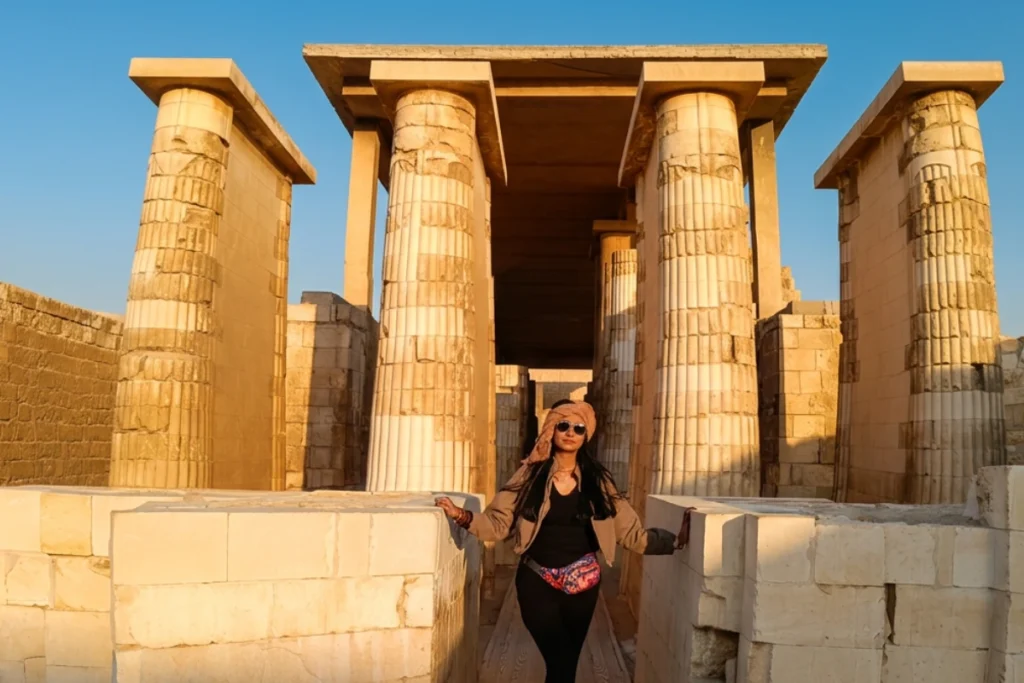
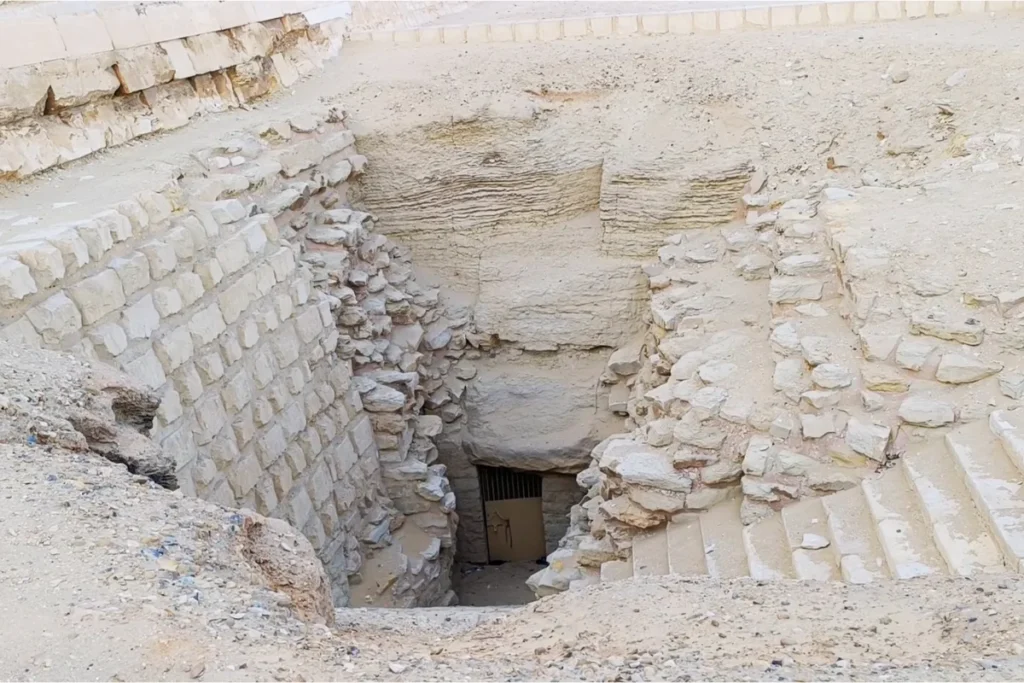
We arrived at the Saqqara entrance at approximately 3:45 PM. Entry fee: 180 EGP per person. We walked the complex as fast as we could. At the burial chamber entrance: closed. Too late to enter.
What we saw was enough to understand what we had missed. The Step Pyramid from the courtyard: six tiers rising from the sand, weathered and unmistakable, older than every other pyramid we would visit over the following days. At 62 metres it is not Giza-scale, but significance is not measured in metres. Giza’s Great Pyramid is the tallest structure humans built for nearly four thousand years. Saqqara’s Step Pyramid is the structure that made Giza’s Great Pyramid imaginable.
What we did not see: the Serdab, the Serapeum, the mastaba paintings, the Pyramid of Unas. Approximately eighty percent of the complex. We paid 180 EGP per person for a twenty percent visit.
One thing we did receive: the silence. At Giza the next day, camel riders, souvenir vendors, and tour groups fill the space with commercial noise. At Saqqara in the closing minutes of that February afternoon, the courtyard was quiet. The pyramid sat as it has sat for forty-seven centuries: without commentary, without explanation, without need for either. That quiet alone justified the entry fee. It did not justify the thirty minutes.
What You Should Do Differently
Do not do what we did. Do not arrive at Saqqara with thirty minutes.
- Give Saqqara a full morning. Arrive when the complex opens. Begin with the Imhotep Museum at the entrance, which provides the historical context that makes everything inside comprehensible. Walk the colonnaded entrance slowly. Stand in the Heb-Sed court and understand what the dummy buildings represent. Find the Serdab and look through the holes. Then stand in the courtyard and look at the pyramid that started everything.
- Combine Saqqara with Dahshur on the same day, not with Giza. They are geographically close and chronologically connected: Saqqara is the first step pyramid, the Red and Bent Pyramids at Dahshur are the first attempts at smooth-sided pyramids, Giza is the perfected form. Visiting them in this sequence, across two days, gives each site the time it requires. We used this sequence. The logic was correct. The timing at Saqqara was the failure.
- If combining Saqqara and Dahshur, start with Saqqara, not Dahshur. We started at Dahshur and ran out of time. The Red Pyramid’s interior is genuinely worth entering (if you can handle a 63-metre descent in near-darkness), but it takes longer than you expect. Start at Saqqara; leave Dahshur for the afternoon.
- Hire a guide or research deeply before arriving. The colonnaded entrance looks like a corridor without context. With context, it is the oldest stone colonnade in the world. The dummy buildings in the Heb-Sed court look like facades. With context, they are eternal stage sets for a ritual of divine sovereignty. The Serdab looks like a stone box with two holes. With context, it is a portal between the living and the dead.
- On unofficial payment requests: our driver Ramy specifically warned us not to pay anyone extra at the pyramid entrances. Pay only the official entry ticket, purchased at the official ticket window. If the interior requires a separate ticket, buy it at the official counter, not at the pyramid door.
What It Costs
All fees from our February 2022 visit. Egyptian monument fees have increased significantly since then. Verify current prices before budgeting.
| Item | Our 2022 Cost |
| Saqqara Step Pyramid complex entry, per person | 180 EGP |
| Dahshur pyramids (Red, Bent, Black) combined, per person | 60 EGP |
| Serapeum (verify if separate ticket required at time of visit) | Verify current pricing |
| Guide for Saqqara (recommended) | ~300 to 500 EGP |
Ramy, our driver that first day, picked us up from Cairo airport, drove us to Dahshur and Saqqara, and dropped us at Tahrir Square in the evening. He was one of the most honest people we encountered on the entire Egypt trip: he warned us not to pay anyone extra at the entrances, and he never asked for a tip himself, though we gave him one because he had genuinely earned it.
The India Connection at Saqqara
The Egyptian Temples article on this site documents the archaeological evidence for ancient India-Egypt contact: Tamil traders in the Red Sea port of Berenike, Kerala pepper in the nostrils of Ramesses II, Tamil-Brahmi inscriptions in the Valley of the Kings.
Saqqara predates all of this. The Step Pyramid was built approximately 2,670 BCE. The earliest documented India-Egypt contact dates to approximately 1,213 BCE. There is no specific evidence connecting India to Saqqara.
But consider the timeline from the other direction. Tamil merchants who stood in the Valley of the Kings in the 1st to 3rd centuries CE stood in a civilisation that traced its roots back to this plateau. The Pyramid Texts carved inside the Pyramid of Unas at Saqqara were the source material for the Book of the Dead that decorated those Valley of the Kings tombs. The traders who carved their names into the walls of royal tombs were in a tradition that stretched back here, to this courtyard, to this step pyramid, to Imhotep.
We cannot prove that any of the Tamil merchants who came to Egypt during the Roman period visited Saqqara. What we know is that they traveled from the Malabar Coast to Alexandria, and some traveled further inland. Whether those journeys brought anyone to this desert plateau is unknown. Standing here as two Indians who grew up in Kolkata, in a country whose traders were once a significant presence in this ancient world, what connects us to Saqqara is not direct, but it is not imaginary either. It is the long arc of history that this pyramid, the oldest stone building in the world, stands inside.
“Giza shows us what ancient Egypt became when it possessed absolute mastery over the earth. But Saqqara is where humanity first realised that stone could outlast mortality… it is not the monument of a finished empire, but the exact coordinates where the future began.”