This Hampi Ruins Guide is built from multiple days on foot, one midnight drive from Bengaluru, and the particular quality of a place that quietly dismantles whatever schedule you arrived with.
By the third morning, we had stopped setting alarms.
This is what Hampi does. It takes whatever schedule you arrived with and quietly dissolves it. Not through inconvenience. Through the specific quality of a place where every direction you walk contains something that makes you stop, recalibrate your understanding of what the next hour should hold, and then walk toward something else entirely.
We drove from Bengaluru at midnight, as we do for almost every road trip. Roughly 350 kilometres through the dark. By the time we checked into our cottage on Hippie Island, the exhaustion from the overnight drive was already competing with the desire to start walking. We had breakfast near the Virupaksha Temple, and then we walked for days.
The Virupaksha Temple at sunrise. The Vittala Temple’s musical pillars in the afternoon heat. The underground Prasanna Virupaksha Temple, dark and full of bats, where a stone Nandi stares at you from an angle that feels less like sculpture and more like attention. The Queen’s Bath, where a sudden rainstorm during 38-degree heat changed the light so completely that the stone arches looked momentarily alive. The Hazara Rama Temple, where a thousand carvings of Rama cover every wall surface, each one a different scene from the epic, each carved by a hand that believed absolutely in what it was making.
The boulder fields at dusk, when the light turns gold and the scattered ruins cast long shadows and you cannot tell whether you are looking at a fallen wall or a natural formation. It does not matter.
Hampi keeps asking a question. It asks it through every crumbling gate, every silent bazaar, every temple that still functions while the empire that built it has been gone for five centuries. The question is: how does an empire disappear while the stones remain?
We did not find the answer. We are not sure the answer exists. But the question, asked in person by the stones themselves, is worth every kilometre of the midnight drive.
“By the third morning, we had stopped setting alarms, stopped consulting maps, and started following whatever direction the light suggested. That is not a decision. It is something the place does to you.”
- What Is Hampi?
- Why the Ramayana Calls This Kishkindha
- What Was the Vijayanagara Empire?
- What You Will See at Hampi
- The Musical Pillars: What Nobody Has Fully Explained
- What Happened in 1565
- Viewpoints: Sunrise and Sunset
- Hippie Island: The Other Face of Hampi
- How to Visit Hampi
- What It Costs
- Before You Go: What Actually Matters
- Frequently Asked Questions About Hampi
What Is Hampi?
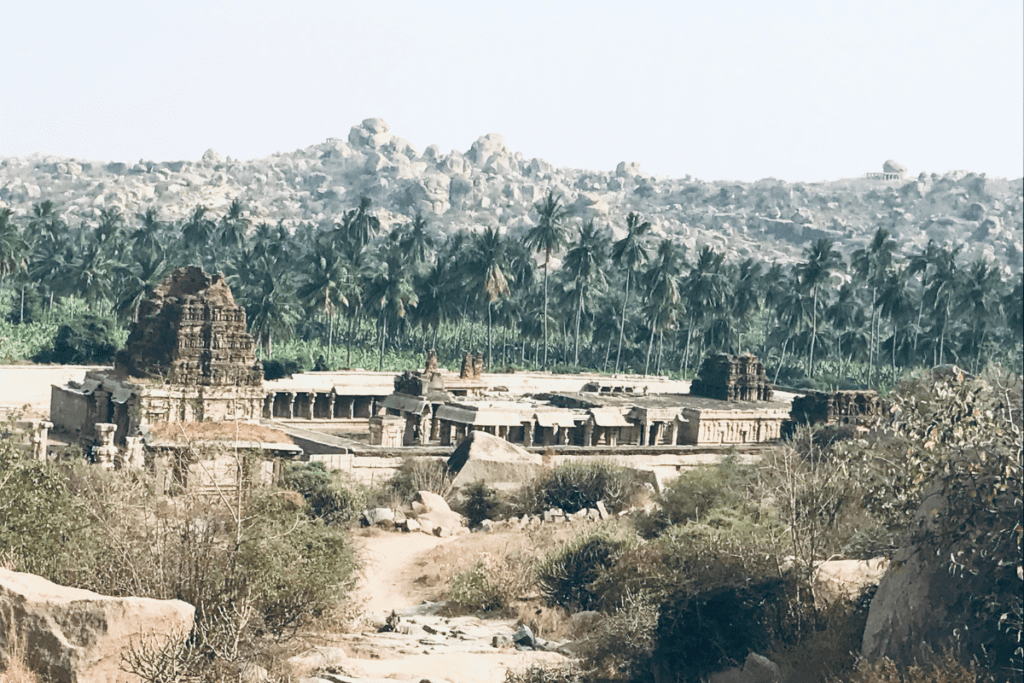
Hampi is a UNESCO World Heritage Site on the southern bank of the Tungabhadra River in northern Karnataka, approximately 350 kilometres north of Bengaluru. It contains the ruins of Vijayanagara, the capital of the Vijayanagara Empire, which at its 15th and 16th century peak was one of the largest and wealthiest cities in the world. The site spans over 26 square kilometres of temple complexes, royal enclosures, market streets, waterworks, and fortifications, set within a landscape of massive rounded granite boulders that predates human habitation by hundreds of millions of years.
Designated a UNESCO World Heritage Site in 1986, over 1,600 surviving structures have been identified across the Hampi landscape.
But the history of this place begins long before any empire.
Why the Ramayana Calls This Kishkindha
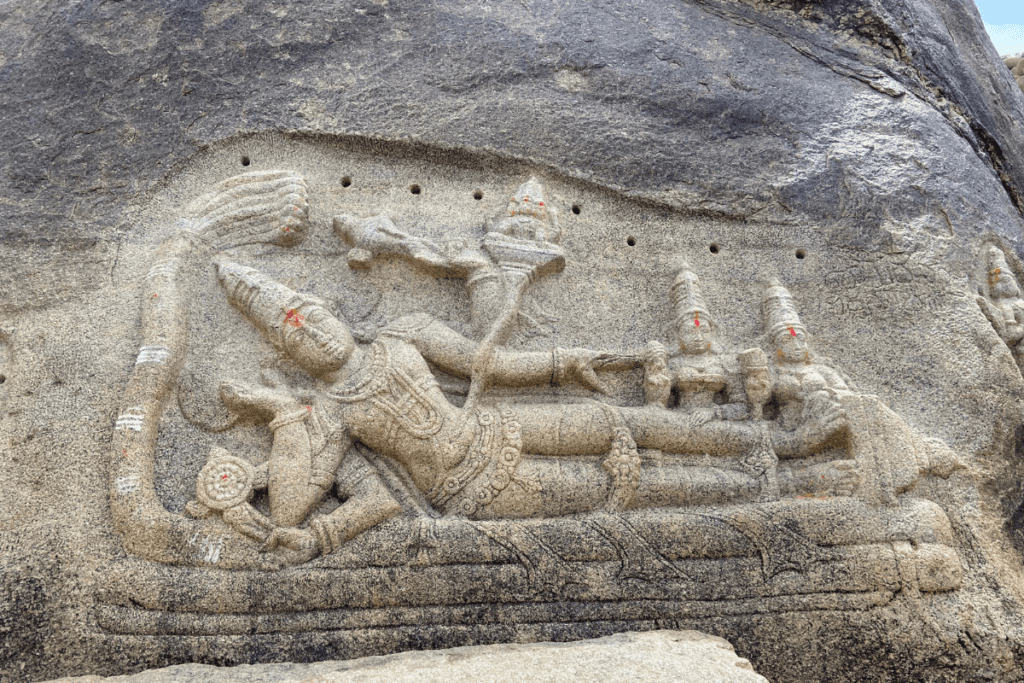
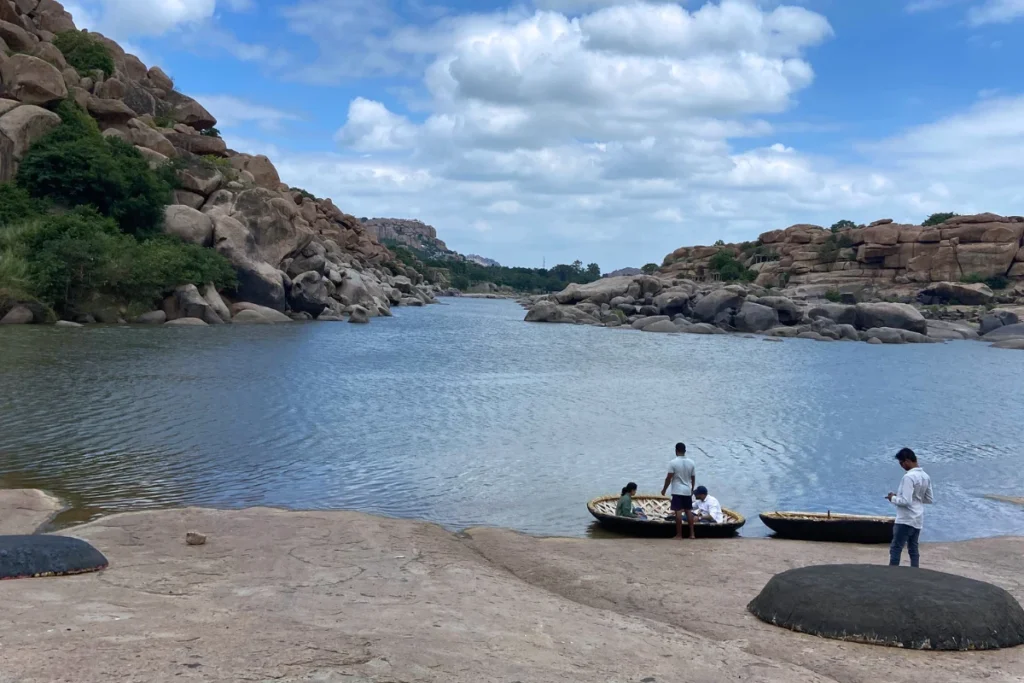
This is the layer that most Hampi guides treat as a footnote. For us, it was the foundation.
According to the Ramayana, this boulder-strewn landscape along the Tungabhadra River is Kishkindha: the kingdom of the Vanaras. This is where Rama, during his exile, met Hanuman for the first time. This is where Sugriva, the exiled Vanara king, formed the alliance with Rama that would lead to the war against Lanka. This is where the army that marched south to rescue Sita was assembled.
The identification is not casual. Specific sites across the Hampi landscape carry specific Ramayana names. Anegundi, the village across the river, is traditionally identified as the capital of Sugriva’s kingdom. Rishyamukha Hill, where Rama and Hanuman first met, is visible from multiple points within the ruins. Malyavanta Hill…where we watched the sunset from the Raghunatha Temple…is where Rama is said to have waited during the monsoon season before beginning the march to Lanka.
The boulders themselves carry mythological weight. Local tradition holds that Brahma stored his creative energy within these stones, which is why they have survived every invasion, every empire, every century, without moving. When you stand among them, the scale is difficult to process. These are not rocks. They are massive rounded formations, some the size of small buildings, balanced on top of each other in configurations that look deliberate but are the product of geological processes spanning hundreds of millions of years.
Here is the question mythology raises and geology does not resolve: why did the Vijayanagara rulers choose to build their capital in this exact location? There were flatter, more practical sites available. The boulders made construction more difficult. But they chose Kishkindha. They chose the place where Rama walked. And they built an empire on top of it.
Was the site chosen for strategic reasons, or sacred ones? The boulders protected the city for two centuries. Then they did not. The boulders remain.
What Was the Vijayanagara Empire?
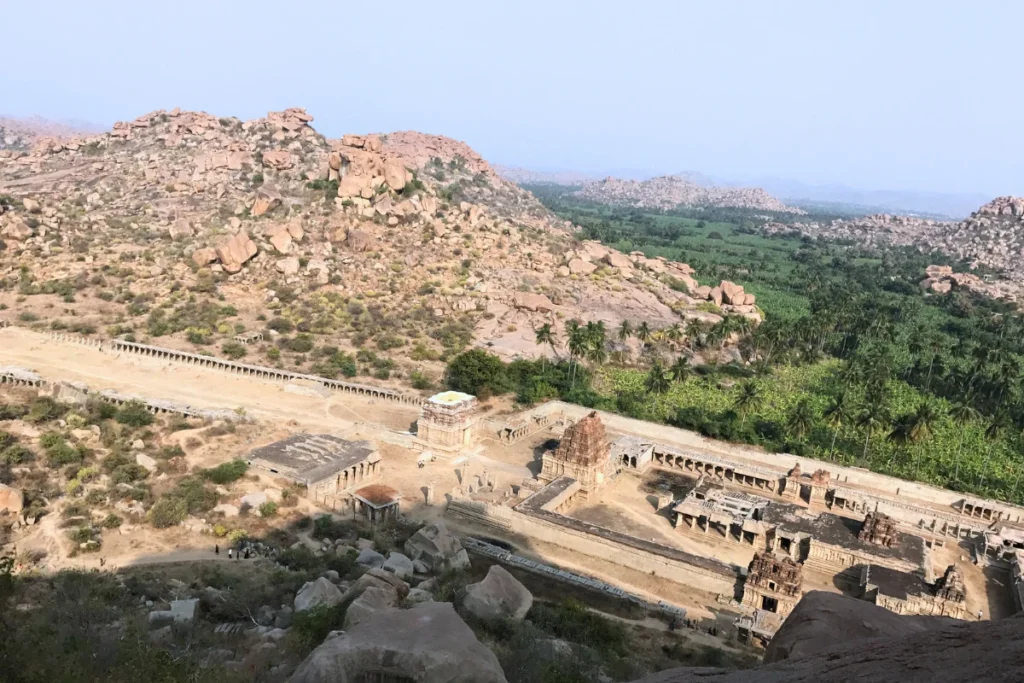
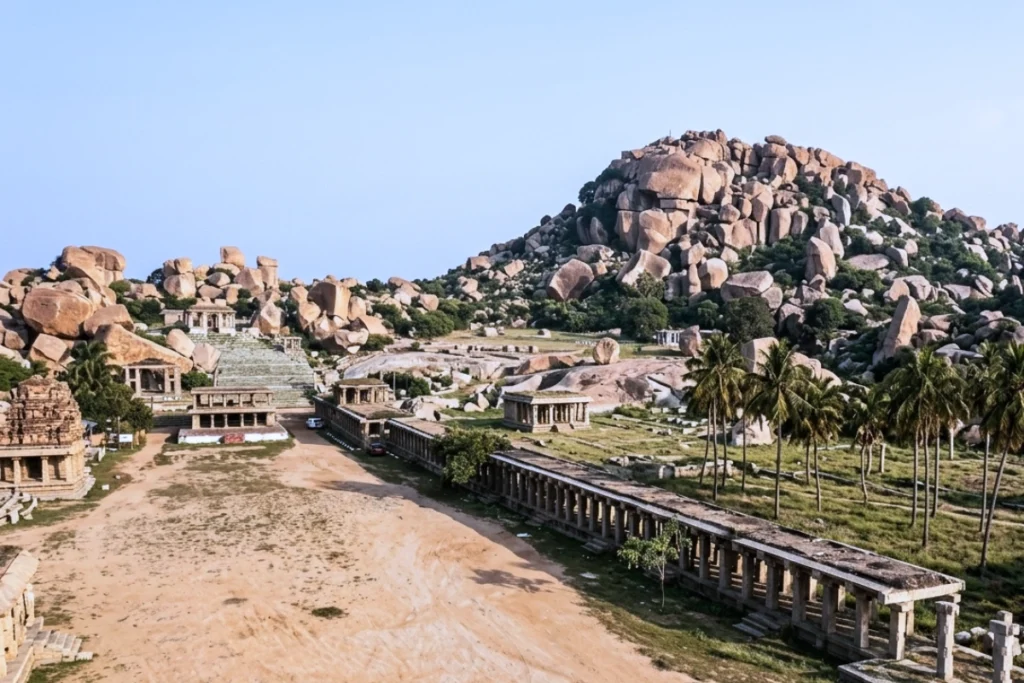
Persian ambassadors who visited in the 15th century described a city where precious stones were sold by weight in open markets, where the royal processions stretched for kilometres, and where the wealth was so concentrated that the capital was considered one of the largest and most magnificent cities in the world.
Founded in 1336 and lasting until 1565, the Vijayanagara Empire at its peak under Krishnadevaraya controlled most of peninsular India. The empire was built on trade, military strength, and an extraordinary investment in temple construction and hydraulic engineering that made the arid Deccan plateau capable of sustaining a massive urban population.
The Tungabhadra River was the lifeblood. Elaborate canal systems, aqueducts, and water tanks distributed river water across the city. The Royal Enclosure contained administrative buildings, audience halls, and the Mahanavami Dibba…a massive stepped platform where the king watched nine-day festival processions, animal fights, and military parades. The Queen’s Bath maintained a constant flow of fresh water using gravity-fed channels, no pumps, no modern technology. The engineering precision that produced the musical pillars also produced a hydraulic system that still partially functions today.
The wealth that funded all of this came from spice trade, diamond mines, and the taxation of one of the most productive agricultural systems in medieval India. When the empire fell, the wealth was seized or scattered. The engineering remains.
What You Will See at Hampi
The site divides naturally into three zones. Understanding this before you arrive saves significant time.
The Sacred Centre
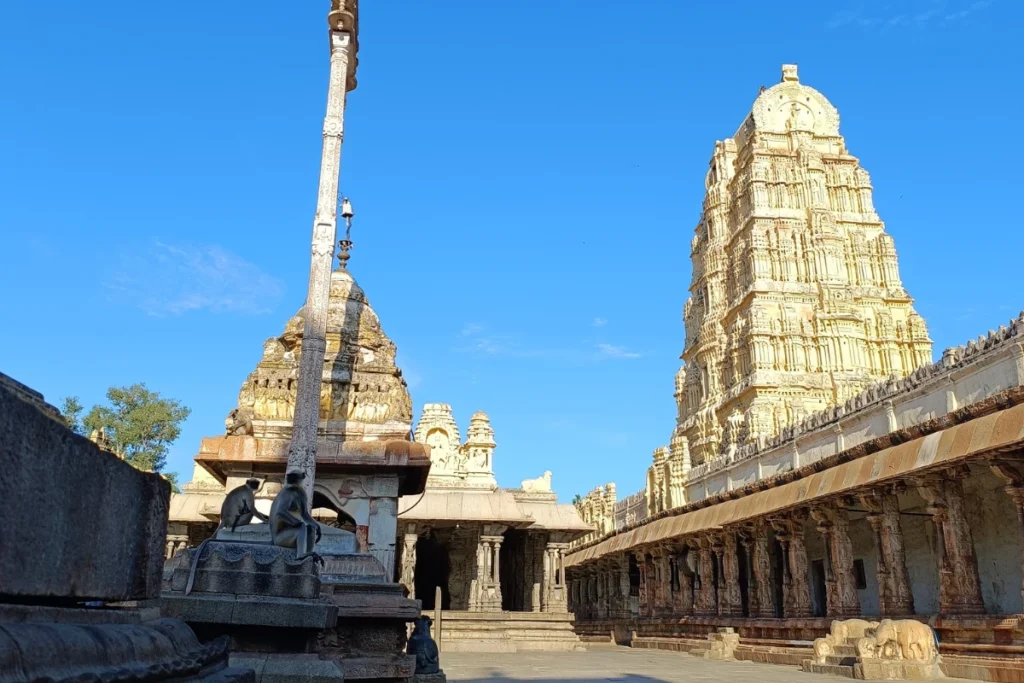
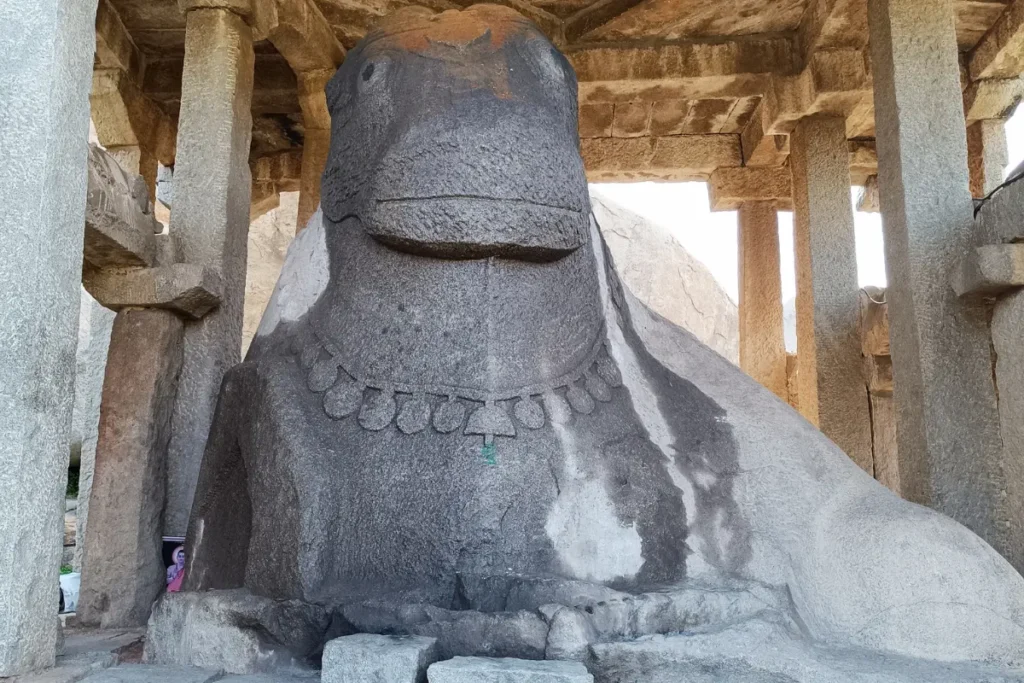
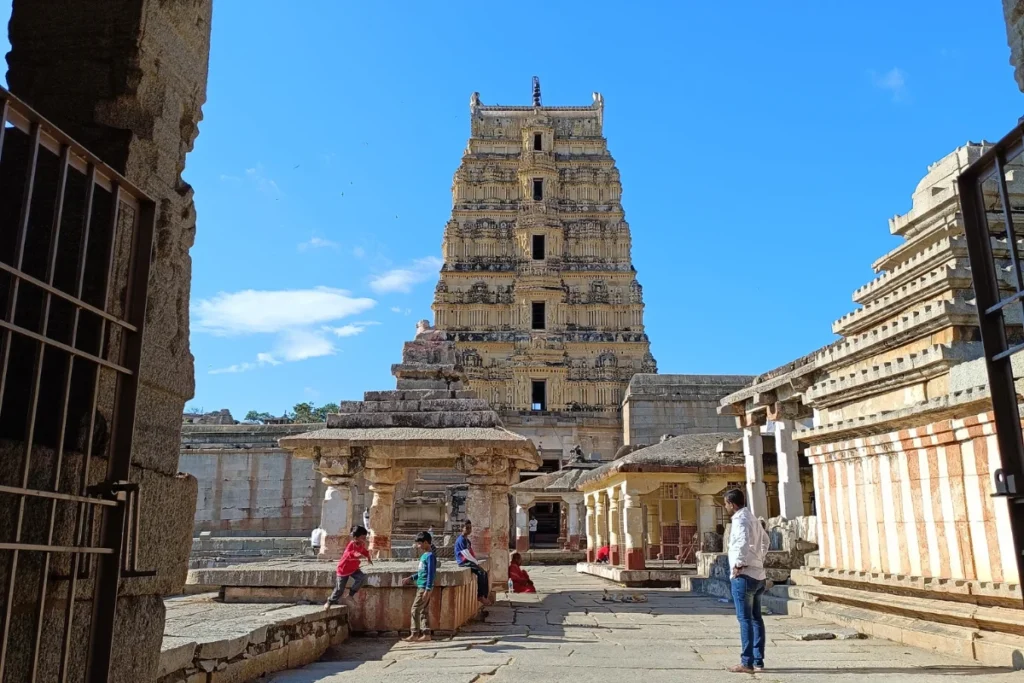
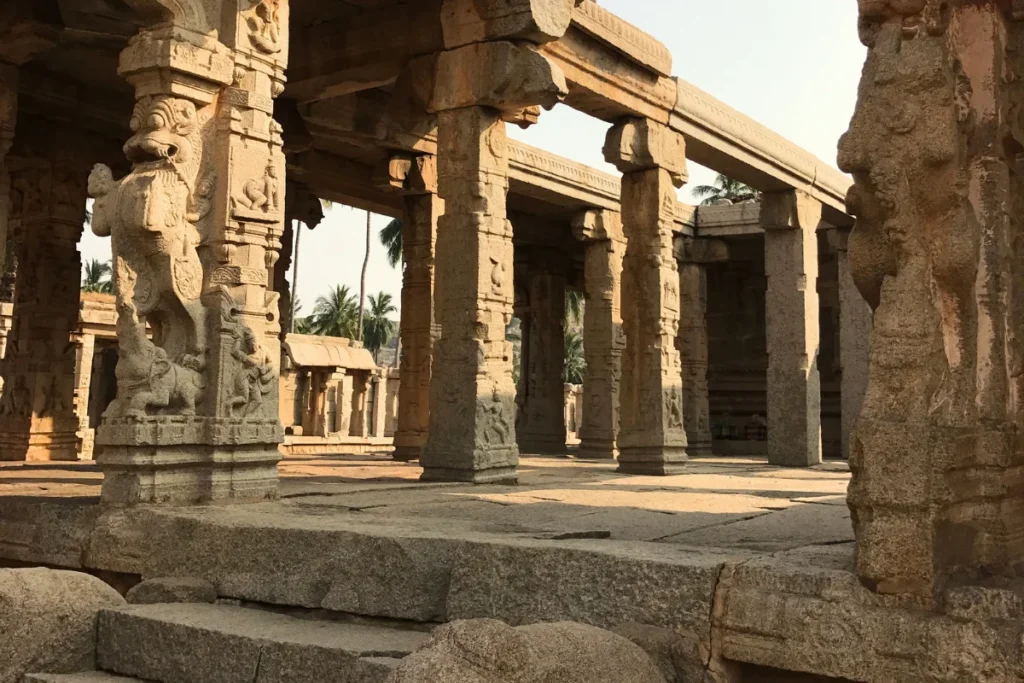
The Virupaksha Temple, dedicated to Lord Shiva, has been in continuous worship for over a thousand years. It survived 1565 because the invading armies largely spared active religious sites. Walking through its corridors, past the painted ceilings and carved pillars, you feel the unbroken thread of devotion connecting this temple to the present. The temple elephant Lakshmi receives visitors with blessings each morning.
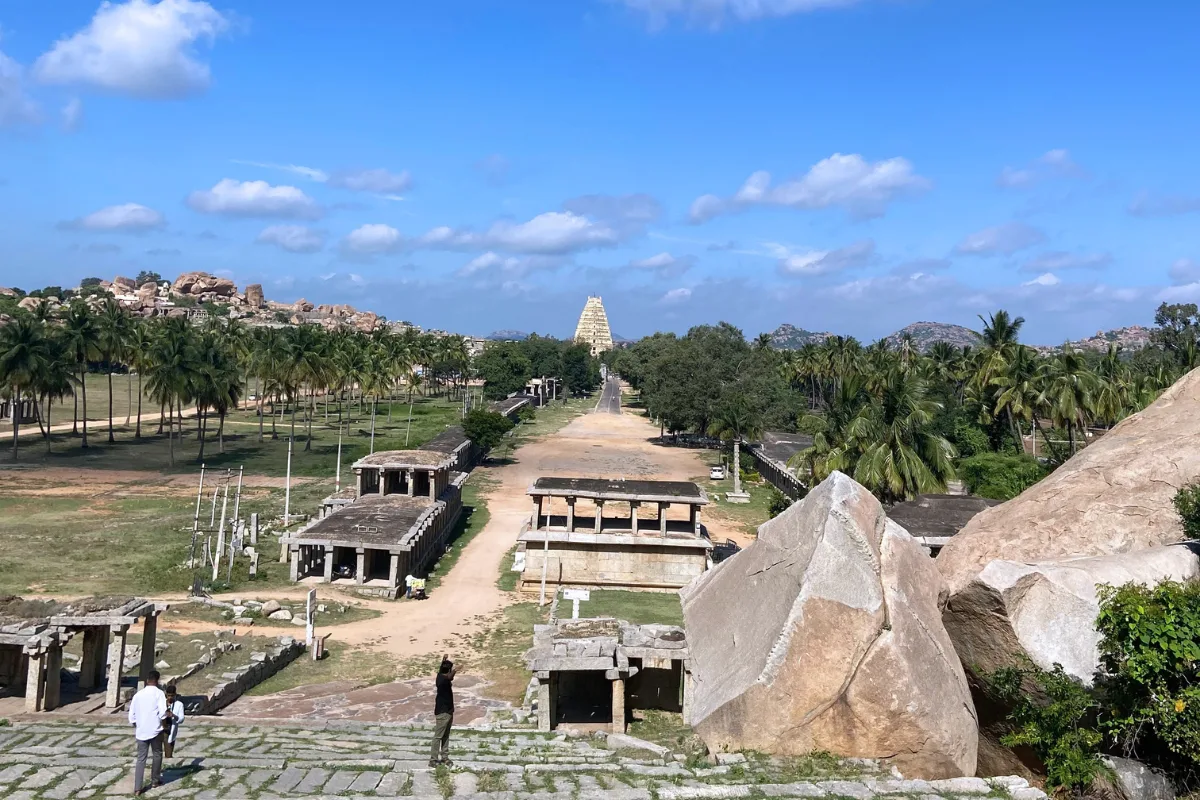
From Virupaksha, the ancient Hampi Bazaar stretches east toward the Tungabhadra. This was once a market so prosperous that Portuguese traders described it in letters home as comparable to the great bazaars of the Middle East. Today, the colonnaded ruins line both sides of a wide stone avenue, and the ghost of the commerce is visible in the scale of the architecture.
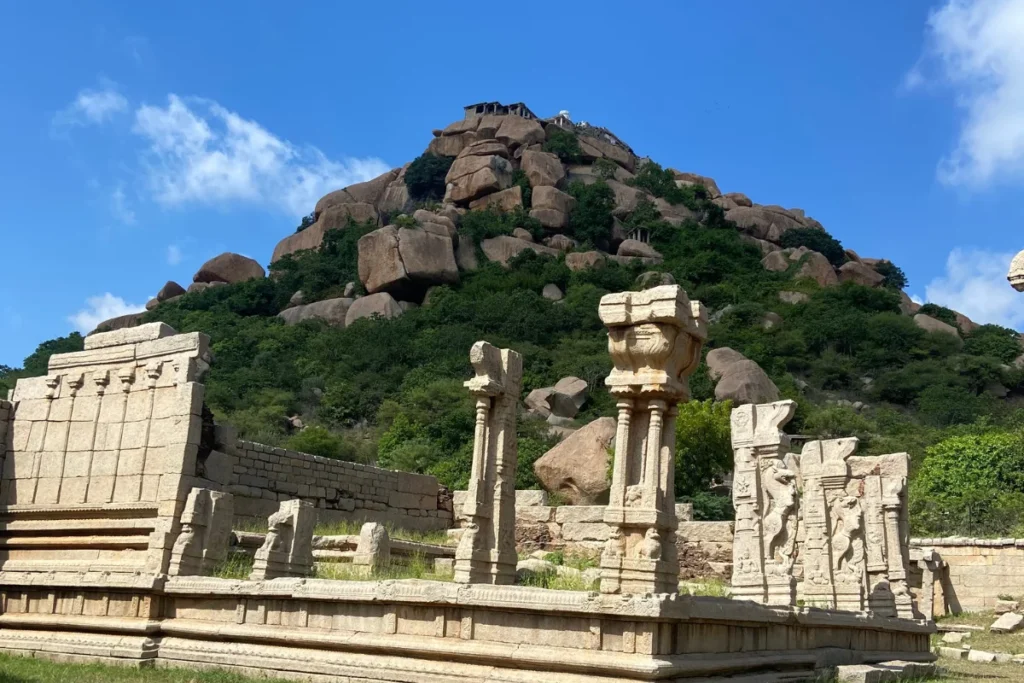
The riverside walk from Hampi Bazaar toward the Vittala Temple is one of the most beautiful walks in India. The Tungabhadra on one side, boulders and ruins on the other. Achyutaraya Temple, dedicated to Lord Vishnu and nestled between Matanga Hill and Gandhamadana Hill, is less visited and more peaceful than the main circuit. We took our time there.
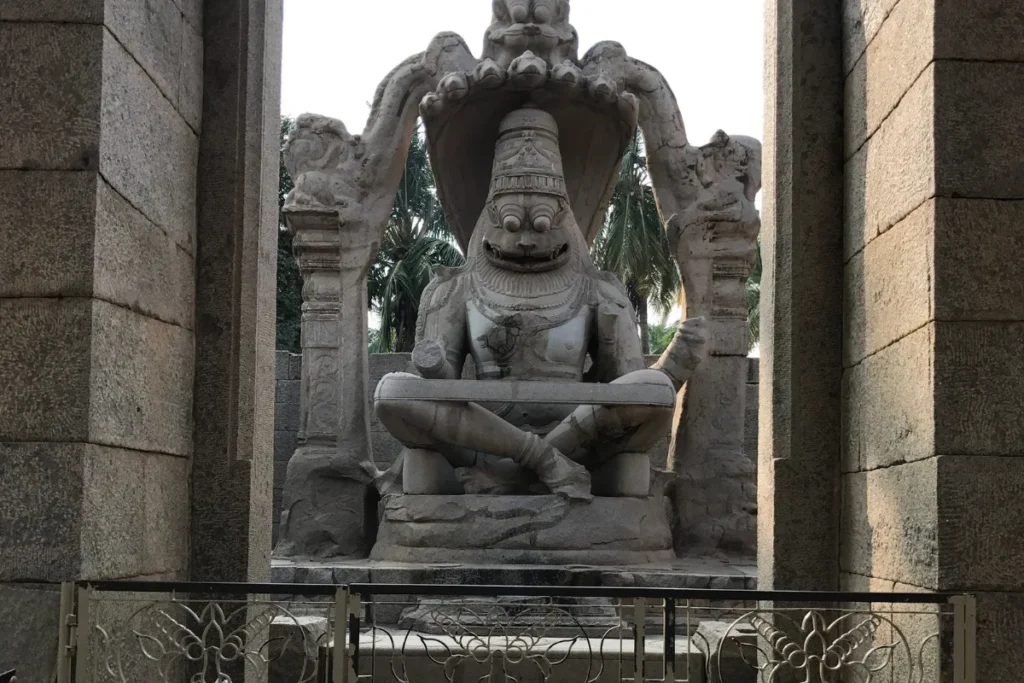
The Monolithic Bull…a large Nandi carved from a single stone…sits in the open, photogenic from every angle. Nearby, the Badavi Lingam, the largest Shiva Lingam in Hampi, sits partially submerged in water. The Lakshmi Narasimha, a massive sculpture of Vishnu’s fierce half-man half-lion form carved from a single boulder, has a scale you cannot capture in a photograph. You need to stand in front of it.
The Underground Temple
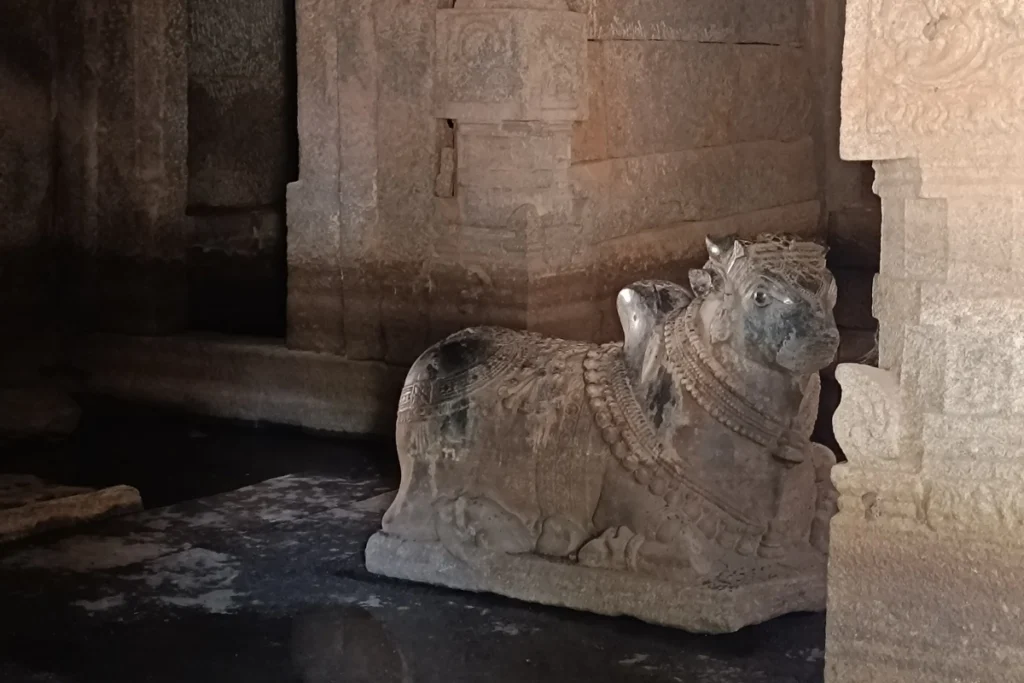
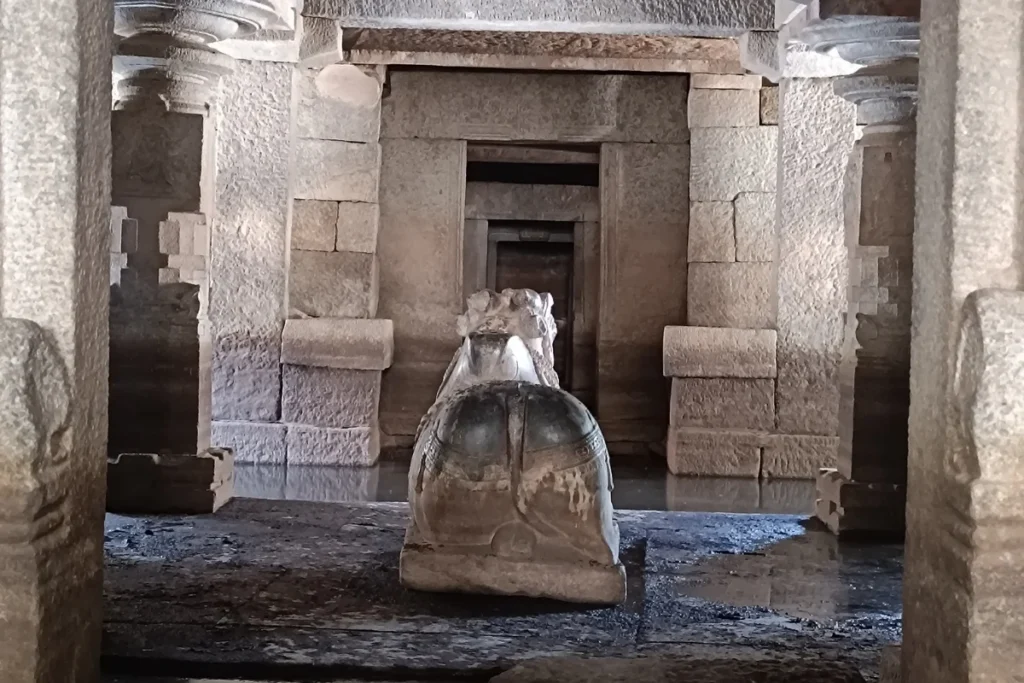
The Prasanna Virupaksha Temple, also called the Underground Shiva Temple, is partially buried below ground level. You descend stone steps into a dark, cool chamber. The air changes. The light disappears. Bats move through the shadows above.
At the centre, in the low light, a stone Nandi faces the sanctum. From a certain angle, the Nandi does not look like it is facing a shrine. It looks like it is watching you. The gaze is calm, heavy, and difficult to shake. We stood in that chamber for a long time, in the dark, in the silence, and the feeling was less like visiting a ruin and more like interrupting a conversation that had been going on for centuries without us.
The Royal Enclosure Zone
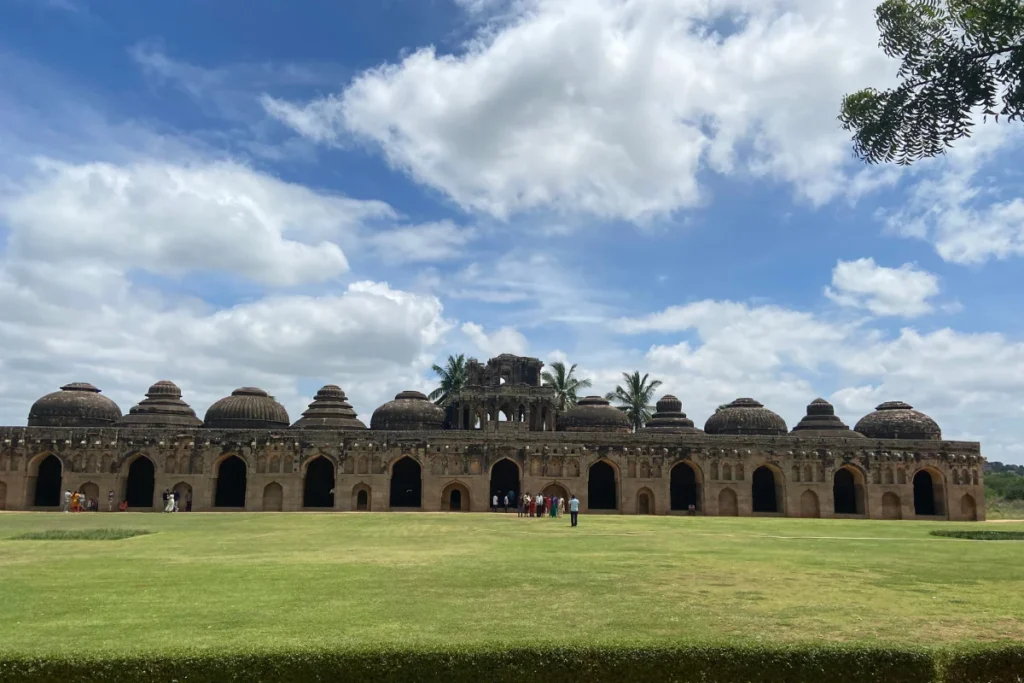
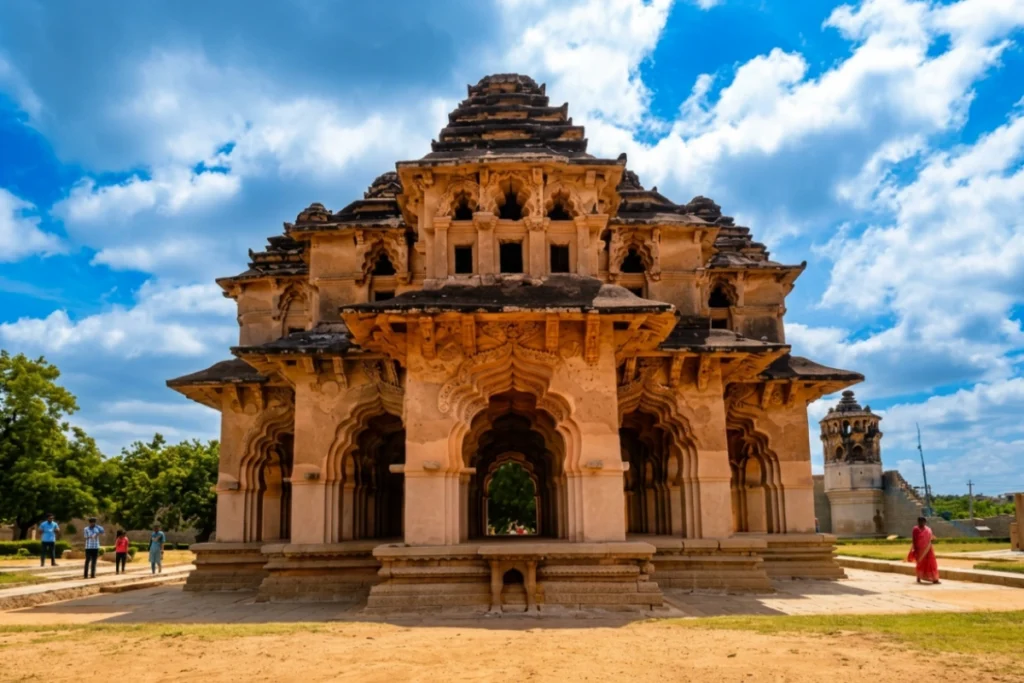
The Zenana Enclosure, the Lotus Mahal, the Elephant Stables, the Queen’s Bath, the Hazara Rama Temple, the Mahanavami Dibba, the stepped tanks, the watchtowers. All walkable in a half day, but you will want a full day to give each structure the attention the engineering deserves.
The Hazara Rama Temple…whose name means “a thousand Ramas”…was the private worship space of the royal family. Every outer wall surface is covered with bas-relief carvings depicting scenes from the Ramayana: processions of elephants, horses, dancers, and soldiers marching in an unbroken narrative that wraps around the entire building. It is the Ramayana as architecture.
The Lotus Mahal inside the Zenana Enclosure blends Hindu and Islamic architectural styles with arched windows designed to channel breeze into the interior. The Elephant Stables, a row of domed chambers with distinct architectural styles for each stall, housed the royal war elephants. Standing inside the individual stalls, you understand both the scale of the animals and the care the empire invested in their maintenance.
The Queen’s Bath was where it rained on us. 38 degrees, open stone, and then the sky opened. The heat broke, the light changed, and for a few minutes the stone arches looked alive in a way that clear skies would not have produced. Some of the best experiences in India require the weather to break your plans first.
The Musical Pillars: What Nobody Has Fully Explained
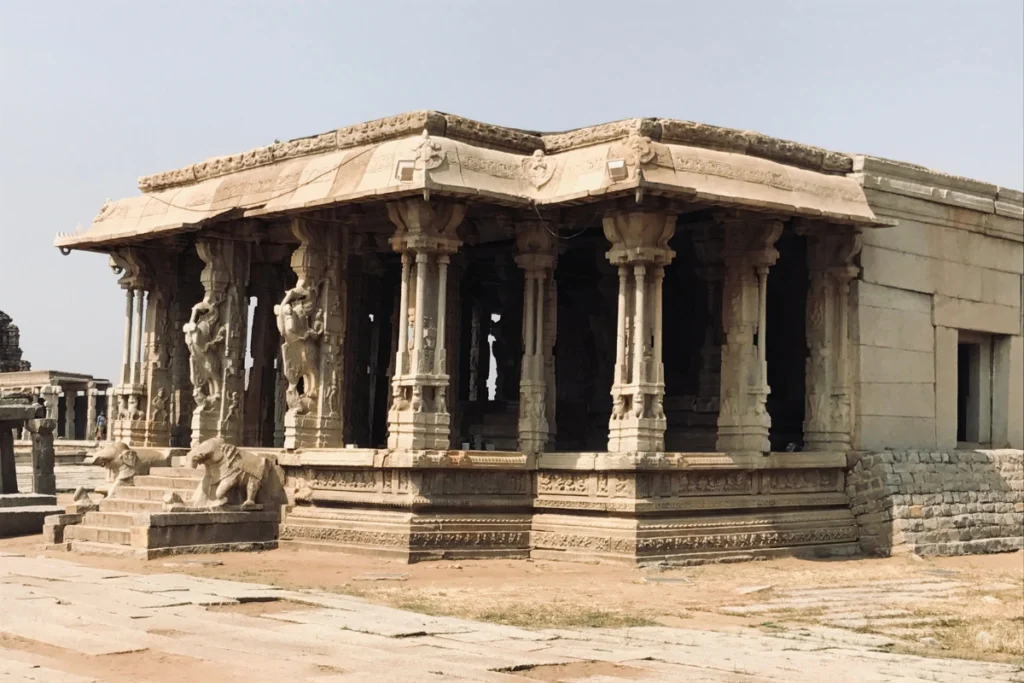
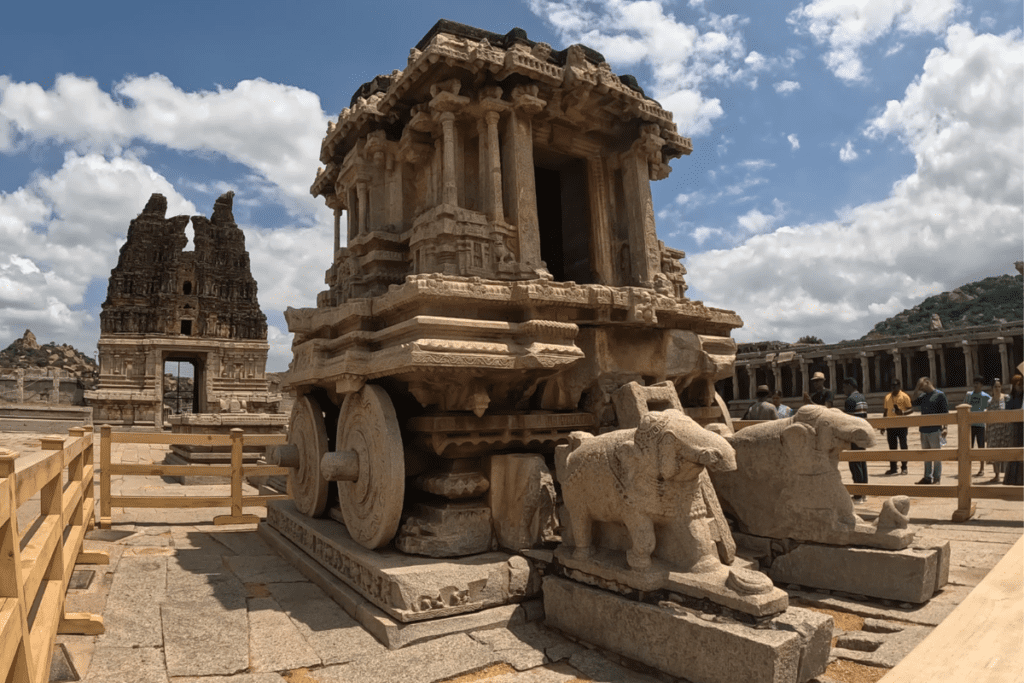
The Vittala Temple complex, reached by walking the riverside path from Hampi Bazaar, is the architectural crown of the entire site.
The Stone Chariot in the courtyard…a miniature shrine built to resemble a temple chariot, with stone wheels that originally turned on their axles, featured on the old Indian 50-rupee note…is the postcard image of Hampi. It is beautiful. It is not the most extraordinary thing here.
The musical pillars are.
The main hall of the Vittala Temple contains 56 pillars, each carved from a single piece of granite, each producing a distinct musical note when struck. Some produce the sounds of drums. Others produce tones of stringed instruments. Others produce bell-like resonances. The notes are not accidental vibrations. They are tuned.
Acoustic engineers have studied these pillars for decades. The leading explanation is that the Vijayanagara craftsmen understood the relationship between the internal structure of the stone…the grain direction, the density variations, the mineral composition…and the sound it would produce when shaped to specific dimensions. Each pillar was carved to exploit these properties, essentially tuning stone the way an instrument-maker tunes wood.
But the explanation remains incomplete. The precision required to achieve distinct, reproducible musical notes from granite using hand tools and empirical methods, without modern measurement instruments, is extraordinary. The British reportedly cut into one of the pillars to investigate the source of the sound and found nothing inside that explained it. The cut pillar is still visible, damaged and silent.
The mystery is not that the pillars make sound. Many stone structures resonate when struck. The mystery is that they make specific, intended sounds, and that 56 of them were tuned to work as a collective system.
We stood in that hall in the afternoon heat, tapped a pillar gently with a knuckle, heard the note ring through the stone, and understood that what it sounded like when all 56 were played together is one of the things lost when the empire fell.
“56 pillars. 56 notes. Carved from granite with hand tools. The British cut one open to find the source of the sound. They found nothing that explained it. The cut pillar is still there, silent.”
What Happened in 1565
The Battle of Talikota. January 26, 1565. A coalition of the Deccan Sultanates defeated the Vijayanagara army in a single decisive engagement. The king was captured and killed. The victorious armies turned south toward the capital.
What followed was not a single act of destruction. It was six months of systematic dismantlement. The coalition armies occupied Vijayanagara and spent half a year destroying temples, pulling down structures, looting treasuries, and burning what could be burned. The population fled. The city was abandoned.
Two centuries of construction. Six months to undo it.
Except it was not fully undone. The boulders could not be moved. The river could not be redirected. The temples that survived…the Virupaksha, several smaller shrines…survived because they were too sacred to destroy or too difficult to dismantle. The musical pillars survived because cutting them produces no treasure.
What remains at Hampi is not a ruin in the usual sense. It is a ruin that still contains the shape of what it was. The bazaar street is still a street. The royal enclosure is still enclosed. The hydraulic engineering still channels water. The city is gone, but the skeleton is intact enough that you can see the body.
That is what makes Hampi different from Göbekli Tepe, where the original form is buried, or Hattusa, where the form must be pieced together from foundations. At Hampi, the form is visible. The absence is visible too. Both occupy the same space.
Viewpoints: Sunrise and Sunset
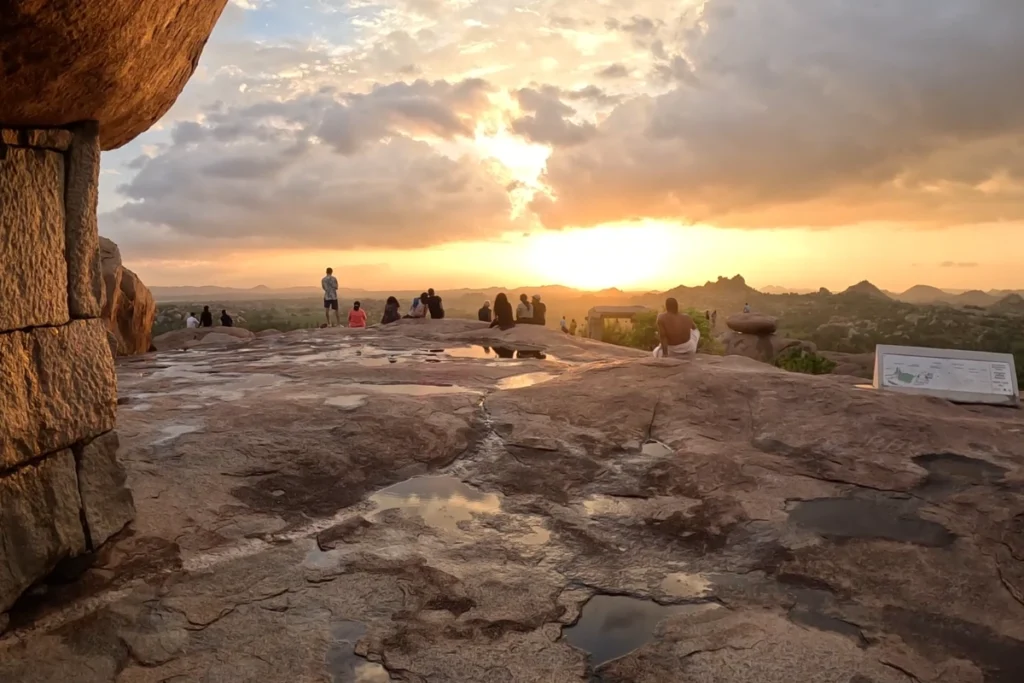
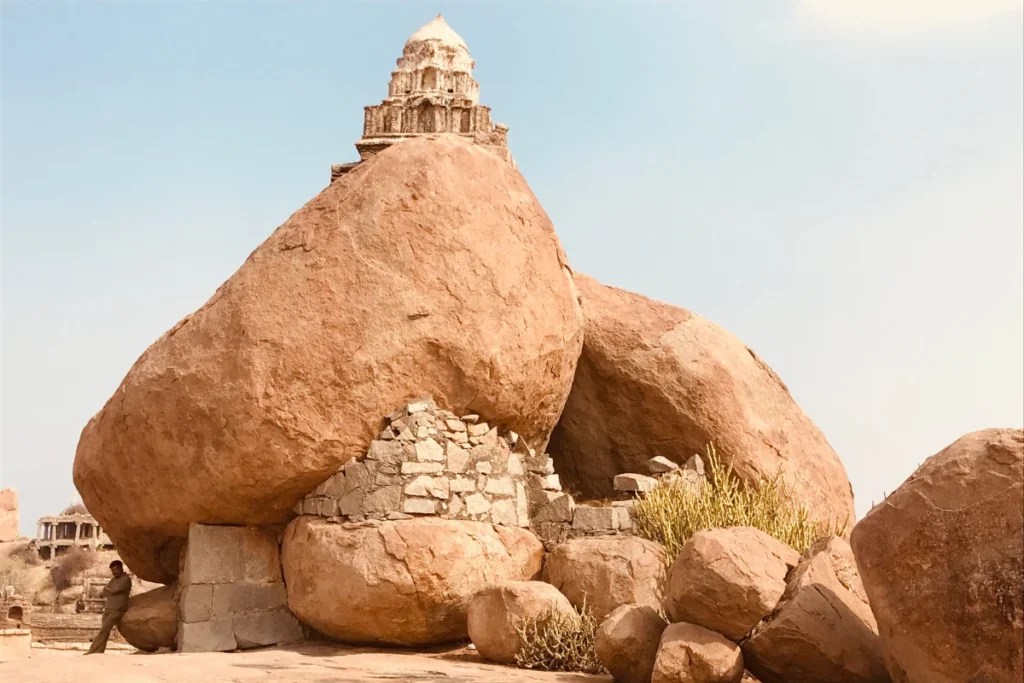
Hampi’s light is what the site is built for. The boulders at golden hour produce a colour that photographs cannot quite capture and that you will spend the walk back to your accommodation trying to describe.
On the morning of Day 2, we watched the sunrise from the road on the Tungabhadra River before driving to the Chandikeswara Temple and then to Virupaksha. The river at dawn, the light coming sideways across the water, the boulders just beginning to warm: this is Hampi before the day has started.
Matanga Hill gives a 360-degree view of the entire boulder landscape with temples emerging from the rock in every direction. The climb is steep and rocky. The reward is proportional.
Malyavanta Hill and the Raghunatha Temple give the sunset view across the valley. We drove there after the Queen’s Bath, after the rain, and the evening light on a landscape that had just been washed was the correct way to end a day in Hampi. The panoramic views are breathtaking. We are not people who use that word lightly.
Hippie Island: The Other Face of Hampi
We stayed on Hippie Island…the area across the Tungabhadra River from the main ruins…at Gravity Café by Stay Chill Hampi. The choice was deliberate. Accommodation near the temples is limited and prices are on the higher side. The island side has more options at lower costs, set among boulders, rice paddies, and hills. Peaceful, quiet, and beautifully scenic. Nothing to do after dark, no markets nearby. That is not a drawback. It is the point.
Getting to the main ruins from Hippie Island takes 30 to 45 minutes by road. We drove. You can also cross by coracle boat, a round wicker vessel that is as improbable as it sounds and works perfectly.
Hippie Island is Hampi’s quieter face. Whether you stay there or simply visit for an evening depends entirely on what kind of traveller you are. We would stay there again without hesitation.
How to Visit Hampi
From Bengaluru: Approximately 350 km, six to seven hours by car. We drove at midnight. An overnight bus from Bengaluru’s Majestic Bus Stand to Hospet is the budget alternative.
By train: The nearest railway station is Hospet Junction (now officially Vijayanagara), approximately 13 km from Hampi. Auto-rickshaws and local buses connect Hospet to Hampi village.
By air: The nearest airport with regular flights is Hubli (approximately 160 km). Bengaluru airport with a connecting drive or bus is more practical for most travellers.
Getting around: The site spans 26 square kilometres. Walking covers the Sacred Centre and the area around Virupaksha. For the Vittala Temple (3 km from Virupaksha), the riverside walk takes 45 minutes each way and is the best approach. Bicycles rent for INR 100 to 200 per day. Auto-rickshaws connect the main zones. We drove a car, which gave us the flexibility to reach the underground temple and Malyavanta Hill without losing time. Parking is available near the Virupaksha Temple.
What It Costs
Figures below are estimated current ranges. Entry fees at ASI-protected sites are reviewed periodically and may have changed since our visit. Always verify current rates before you travel.
| Item | We Paid (Sep 2023) | Estimated Now | Notes |
| Entry to most sites (Indian nationals) | INR 40 person | INR 40 – 100 | ASI fees reviewed periodically…verify before visiting |
| Entry to most sites (foreign nationals) | INR 600 per person | INR 600 – 1,100 | Verify current rate at ticket counter |
| Virupaksha Temple entry | INR 10 per person | INR 10 – 20 | Active place of worship; entry fee nominal |
| Accommodation — Gravity Café by Stay Chill Hampi, Hippie Island (per night) | INR 1,315 | INR 1,200 – 3,500 | Wide range by season and property on the island |
| Accommodation — mid-range, temple side (per night) | — | INR 3,500 – 7,000 | Limited options; book ahead |
| Bicycle rental (per day) | INR 100 – 200 | INR 150 – 300 | Available in Hampi village |
| Auto-rickshaw Hospet to Hampi | INR 200 – 300 | INR 250 – 400 | Negotiate before boarding |
| Coracle boat to Hippie Island (per person) | INR 50 – 100 | INR 50 – 150 | Seasonal; may not operate in all conditions |
Hampi is one of the most affordable heritage destinations in India. The 2023 prices are what we paid; estimated current figures are alongside them for planning. Prices shift over time…always verify before you travel. The one cost that does not change: three days is the minimum worth giving this places in India. The entry fees are minimal. Food is inexpensive. The primary cost is time…and three days is the minimum worth giving it.
Before You Go: What Actually Matters
- Three days minimum. Most tour groups allocate one day, which is a disservice to both the site and the visitor. Three days covers the Sacred Centre, the Royal Enclosure, the Vittala Temple, and allows time for the boulders, the river, and the sunsets. We spent longer and do not regret a single extra hour.
- October to February is optimal. We visited in peak heat…38 degrees on open granite with minimal shade. We survived. But the winter months offer clear skies, comfortable walking temperatures, and the golden light that makes Hampi’s photography extraordinary.
- Carry water and sun protection throughout the day. The distances between sites are significant and many temple areas have no shade.
- Sunrise from Matanga Hill. Sunset from Malyavanta Hill. These are the two viewpoints that define Hampi’s light. Matanga requires a steep rocky climb. Malyavanta is accessible by car and rewards with panoramic valley views.
- Walk the riverside path to the Vittala Temple, not the car park route. Tour buses drop visitors at the Vittala car park. Walking the Tungabhadra path from Hampi Bazaar passes through the landscape rather than skipping it. The temple appears gradually as you approach. The experience is incomparably better.
- Hire a guide for the Vittala Temple and the Royal Enclosure. Without context, the musical pillars are interesting. With context, they are extraordinary. The Hazara Rama carvings, understood scene by scene, become a narrative rather than a surface.
- Do not skip the Prasanna Virupaksha Underground Temple. Most visitors drive or walk past it. The experience inside…the darkness, the bats, the Nandi’s gaze…is unlike anything else at the site.
- Hampi is a living site. The Virupaksha Temple holds daily worship. Local communities live within the landscape. Treat the space accordingly.
“By the third morning, we had stopped setting alarms. Hampi does that. The India Travel Guide links to every destination we have written about across the country…Karnataka, Odisha, the east coast roadtrip, the Nilgiris. If Hampi is on your list, give it five days. Two if you must. One if you have no choice. Just know that one day is not enough to hear the question it is asking.“