Uncovered on the central Anatolian plateau, the Alacahöyük royal tombs from the Bronze Age represent some of the most extraordinary metalwork, gold jewellery, and ceremonial sun discs ever discovered in Turkey. Dating to roughly 2500 BCE, these thirteen elite graves predate the Hittite Empire by centuries. Here is your guide to understanding the archaeological mystery, ritual animal sacrifices, and museum treasures of Alacahöyük.
Think about what you would place beside someone you loved if you were burying them four and a half thousand years ago.
Not what you own. What you would give up. Because that is the real question the royal tombs of Alacahöyük ask. Somebody, around 2500 BCE, in central Anatolia, took finely worked bronze, ornaments of gold, vessels of silver, and objects whose purpose we can no longer name, and placed them permanently into the ground beside a body. They added the head and foot bones of sacrificed animals. They arranged everything with care, performed a ceremony whose words are gone, and then they covered it all with earth and walked away, leaving wealth in the ground that could have been passed to the living.
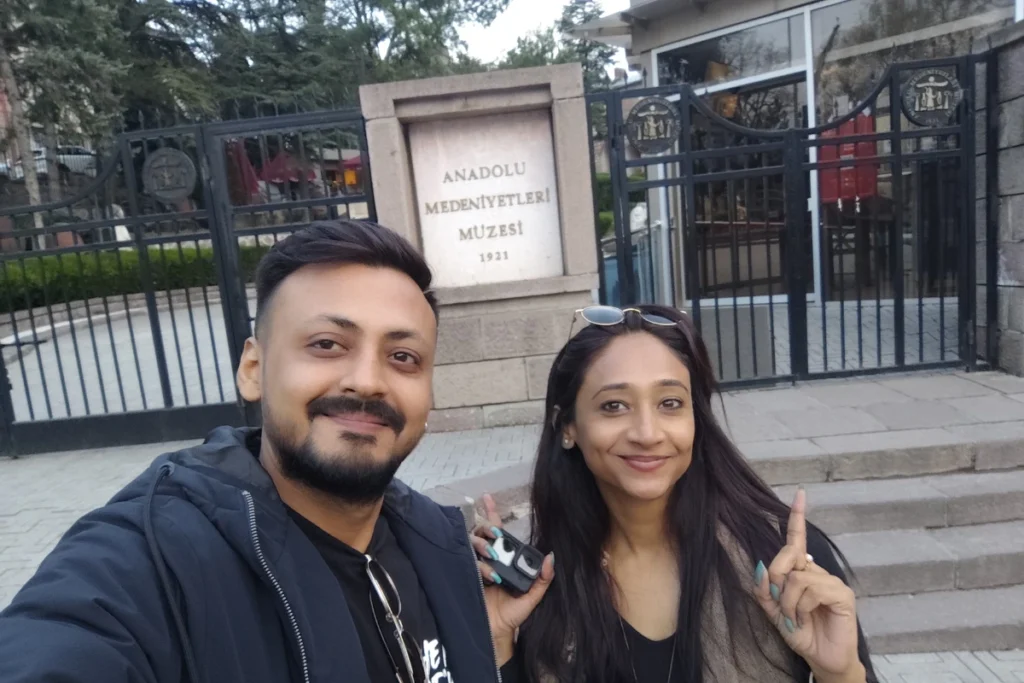
We saw what they left in the Museum of Anatolian Civilizations in Ankara, in a display that holds some of the most extraordinary metalwork of the Bronze Age world.
And standing in front of it, we found ourselves thinking less about the people who made these objects and more about the people who chose to bury them. The craftsmanship is astonishing. But the decision is what stays with you. Someone decided that these things should go into the ground rather than remain in the world. That decision is the whole mystery, and it is a mystery that two people from a culture with its own intense relationship between the living and the dead could not look at without feeling something.
“True wealth in antiquity was not measured by what a community kept for the living, but by what it was willing to surrender permanently to the earth for those it loved.”
What Alacahöyük Is
Alacahöyük sits in present-day Çorum Province in Turkey, not far from Hattusa, the Hittite capital we would reach later on our road trip. But the royal tombs predate the Hittites by a long way. They belong to the Early Bronze Age, roughly 3000 to 1950 BCE, centuries before the Hittite Empire rose on the same Anatolian plateau.
This was a period of transformation. Settlements grew more complex. Trade reached across distances. Bronze technology changed what people could make: tools, weapons, ornaments, and ceremonial objects of a sophistication that earlier ages could not produce. Gold and silver were worked into intricate forms. The craftspeople of Alacahöyük were not primitive. They were masters working at the edge of what their technology allowed.
Excavations uncovered thirteen Early Bronze Age tombs, and they became famous for what was inside them. Bronze, gold, silver. Ornaments, vessels, weapons, figurines. The bones of animals. The assemblages are rich enough that the burials are called “royal tombs,” though the exact identities and titles of the people buried in them are not established. We do not know their names. We do not know whether they were kings, chieftains, priests, or something our vocabulary has no word for. What we know is that whoever they were, their community had the resources to bury extraordinary wealth with them, and the will to do it.
The richness points to individuals of real importance. The tombs reveal a society that could produce remarkable objects and, more tellingly, could decide to take those objects out of circulation entirely by placing them underground.
Why Bury Gold at All
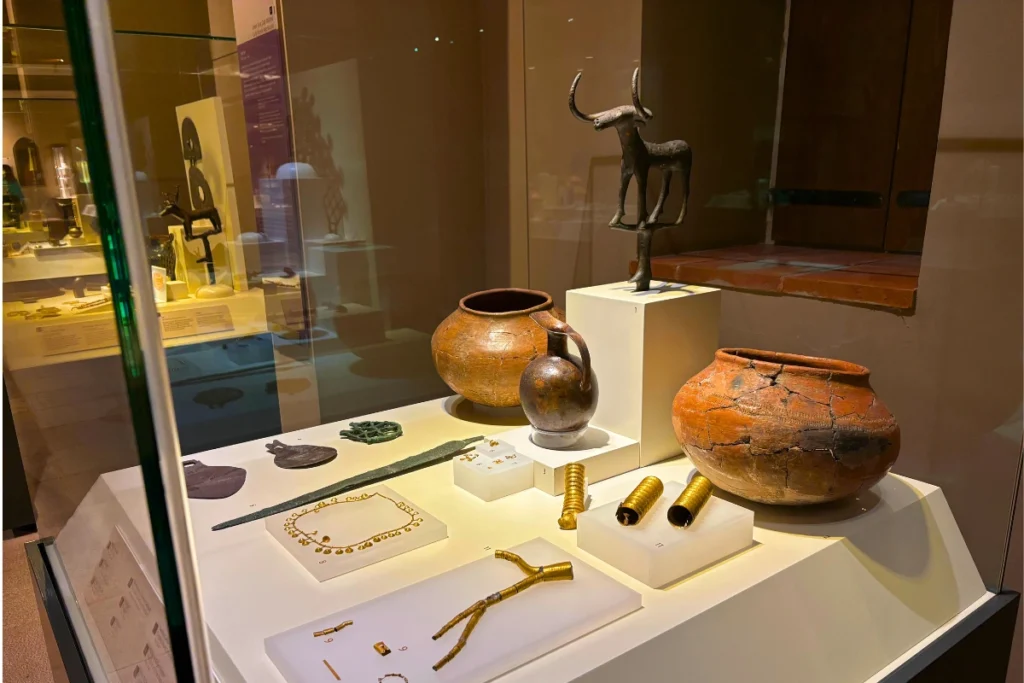
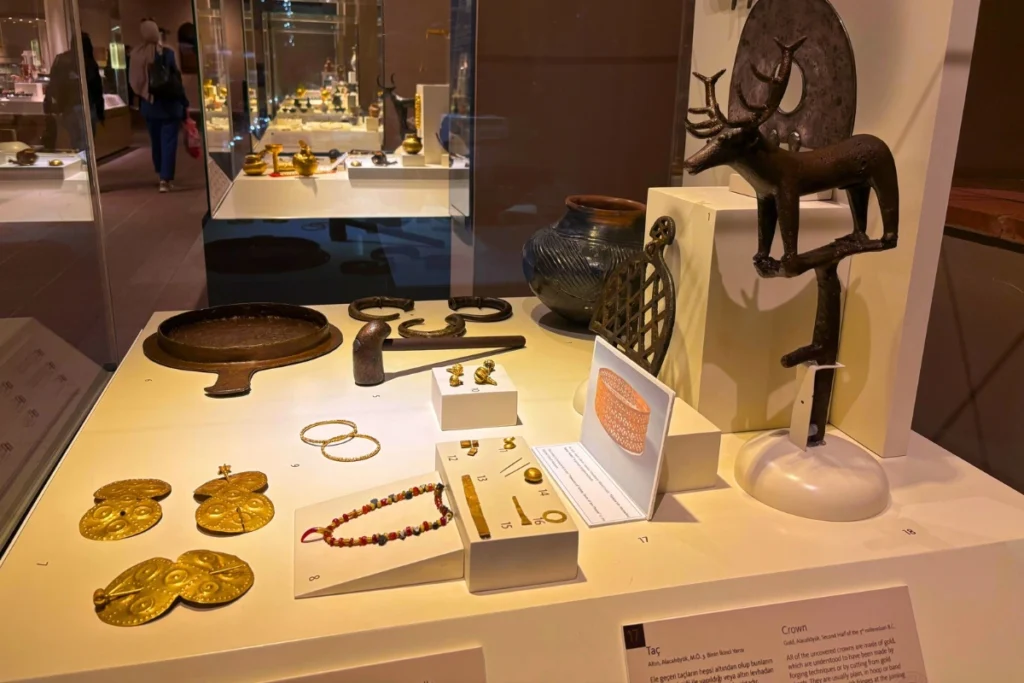
This is the question that an Indian cannot help but sit with, because the instinct to hold onto gold runs deep in our own culture. In India, gold is not buried. It is saved, worn, passed down, pledged, and guarded across generations. A family’s gold is its memory and its insurance. The idea of placing it permanently into the ground, beyond any possibility of recovery, runs against something we understand almost at the level of reflex.
And yet at Alacahöyük, that is exactly what they did.
There is no single answer for why. The honest archaeological position is that several explanations may have operated together, and we cannot be certain which.
One possibility is status. In a society where wealth and authority gathered around certain individuals, a lavish burial could broadcast that importance to everyone watching. The grave goods would not be for the dead at all. They would be a message to the living, delivered at the graveside: this person mattered, this family can afford this, remember it.
Another possibility connects to belief. Many ancient societies buried objects, food, and ornaments with their dead as part of practices expressing a relationship between the living and the dead, or a journey the dead were expected to take. If the people of Alacahöyük believed the dead continued in some form, the objects may have been provisions, possessions, or offerings for whatever came next.
A third possibility is that a single object did several things at once. A ceremonial standard might have marked a person’s rank while also playing a role in religious observance. Meaning in the ancient world was rarely tidy, and the objects did not have to mean one thing.
What makes the tombs so compelling is that material wealth and possible ritual meaning appear together, inseparable. These objects were not valuable only for their gold. Their significance may have come equally from who held them, how they were used, and where they finally came to rest. The value was in the biography of the object, not just its material. That is a very Indian way to think about an object, which is perhaps why the display held us the way it did.
“In our own tradition, gold is saved, worn, and passed down as family memory… the decision to place fine gold permanently into the earth, beyond recovery, asks a question modern eyes can barely answer.”
The Sun Disc
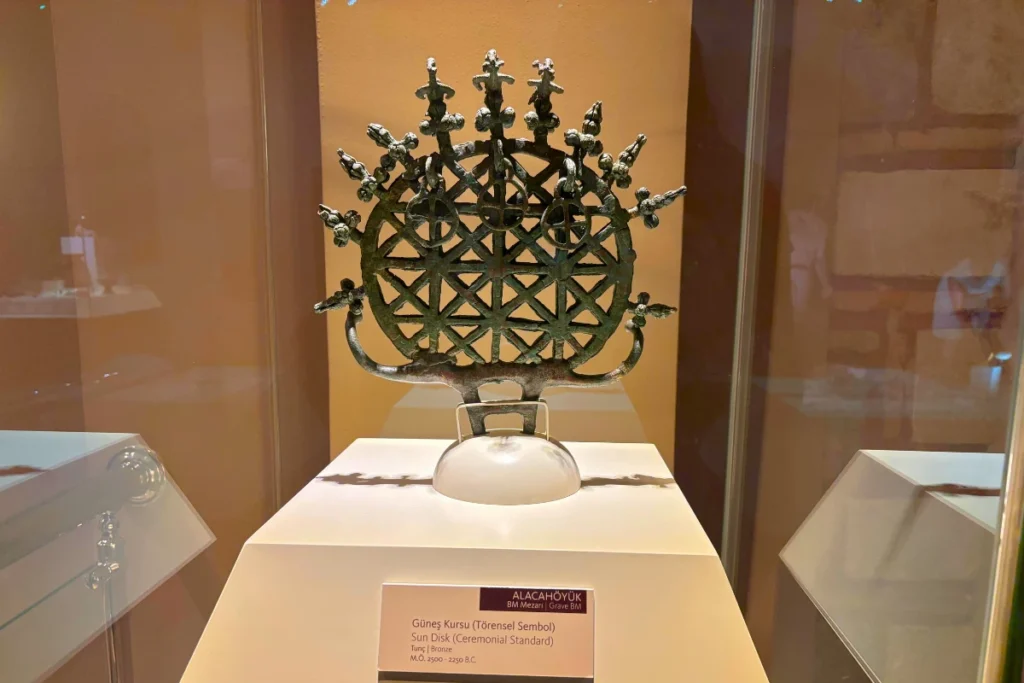
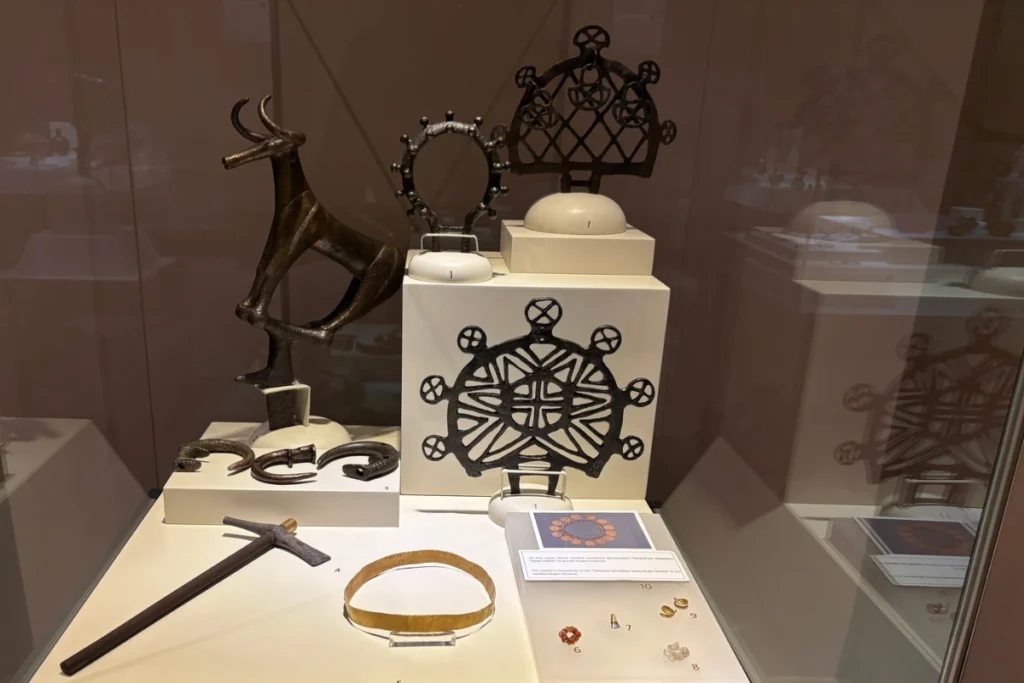
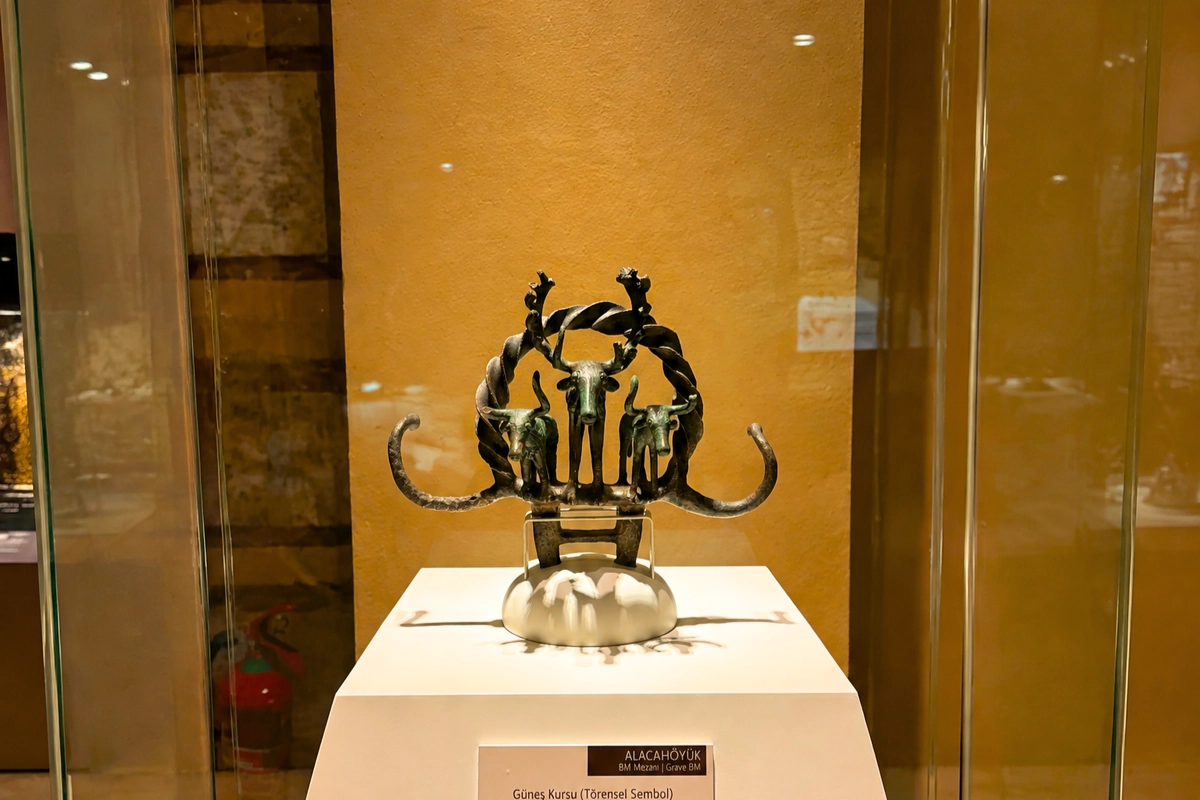
The most striking objects associated with Alacahöyük are the ones the museum calls ceremonial standards, better known as the sun discs.
The examples in the museum date to roughly 2500 to 2250 BCE, placing them squarely in the world of the royal tombs. Many are bronze; some are silver. They are openwork discs, often circular or semicircular, worked with geometric patterns, and some carry small animal figures: bulls, deer. Their shapes are unlike anything made for ordinary domestic use, which tells you immediately that they were made for something else.
One of these sun discs became the symbol of modern Ankara. You see its form on municipal signage across the city. It is one of the defining images of Bronze Age Anatolia, and it came out of a grave.
But why place a ceremonial standard in a burial?
Nobody is certain, and the uncertainty is the interesting part. If a sun disc was carried or raised during ceremonies, it may have been tied to the identity, authority, or religious life of a person or a community. Burying it could have reflected that importance, taking the symbol of a person’s standing into the ground with them. Alternatively, the disc may have had a specific role within the funerary practices themselves, something done with it at the graveside that mattered in the moment of burial.
Standing in front of one in the museum, we tried to imagine it in use. Carried at the front of a procession. Raised above a gathering. Catching sunlight at the centre of a ceremony whose purpose everyone present understood and nobody wrote down. These are possibilities, not documented events. But they push you toward a larger question that the disc asks better than almost any object we saw in Turkey: what happens to the meaning of a thing when it passes from the world of the living into a tomb?
Maybe its meaning did not end when the earth covered it. Maybe the act of burying it was itself the point.
The Bull and the Deer
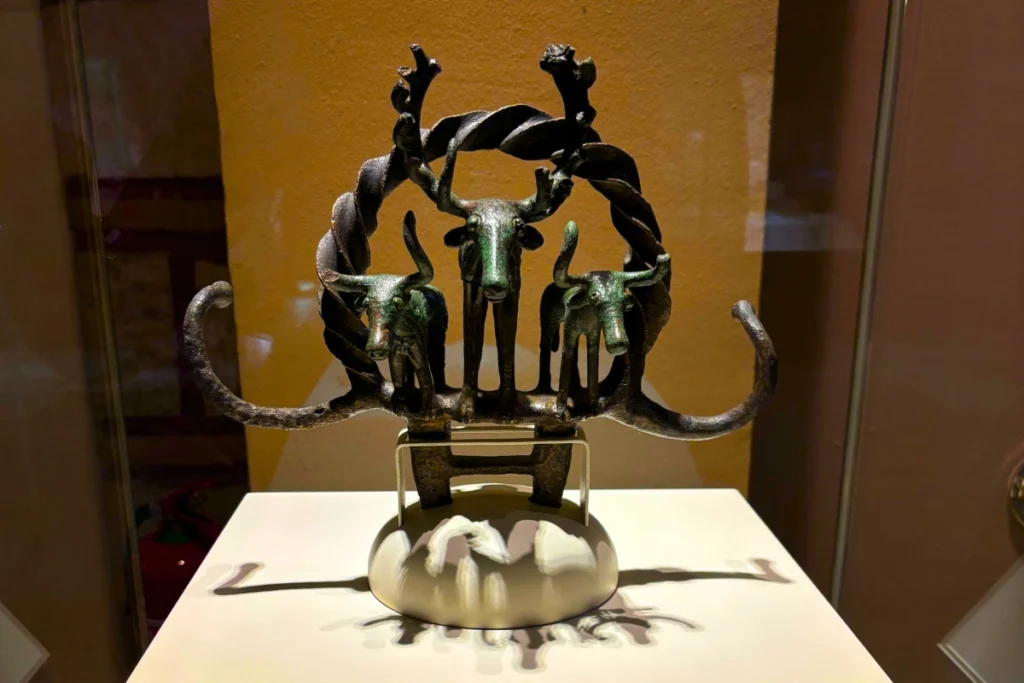
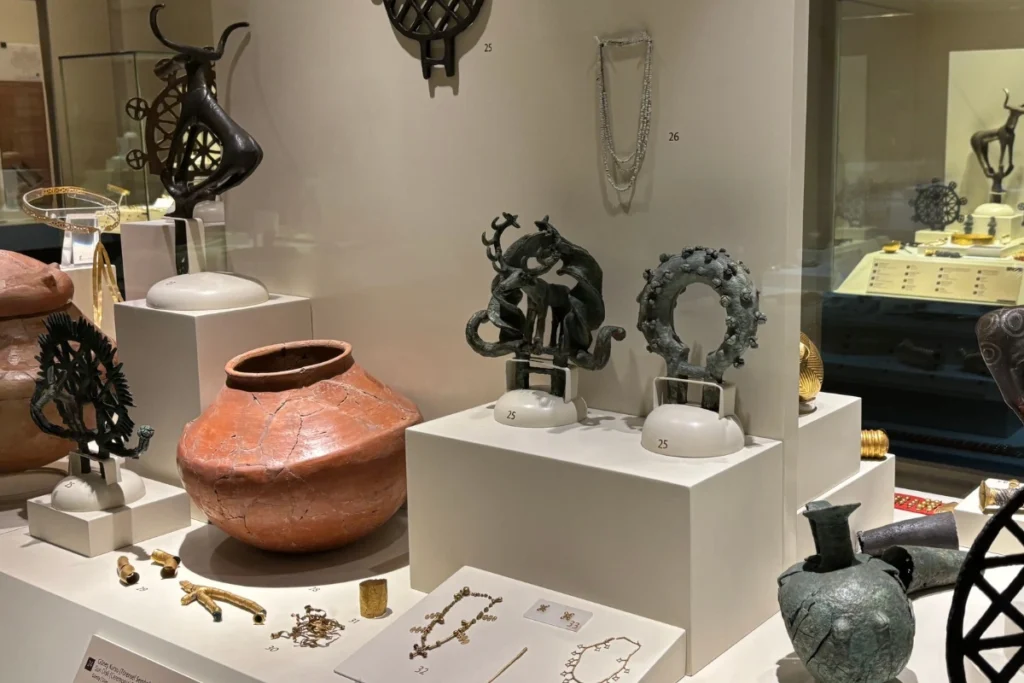
The animals on the sun discs open another door.
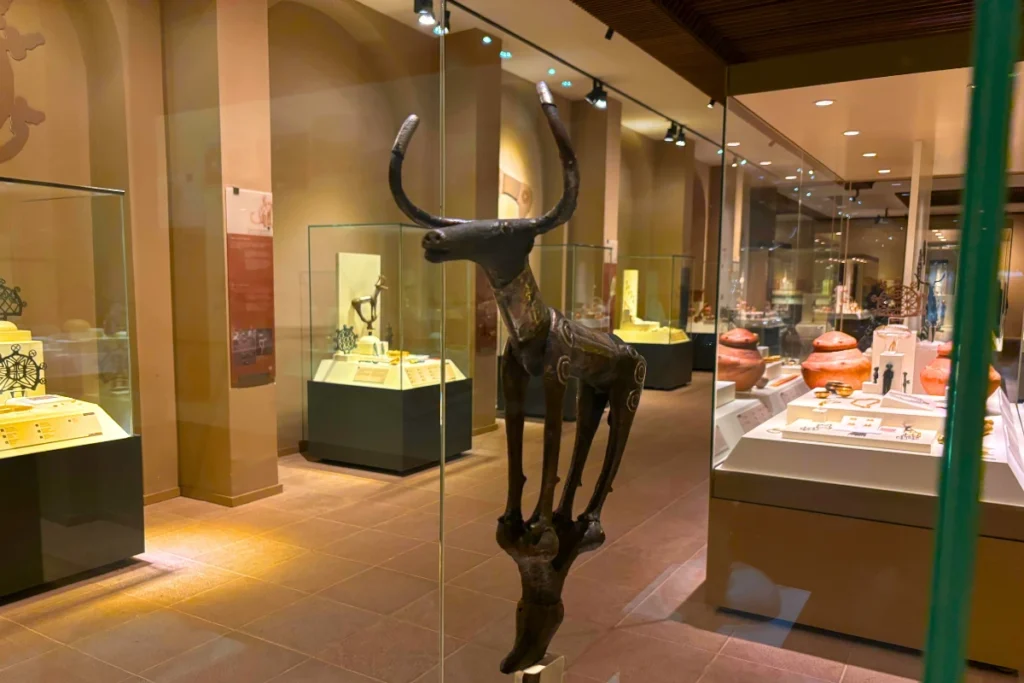
Bulls and deer appear on some of these ceremonial standards, bringing the natural world into the visual language of the metalwork. For a Bronze Age community, animals were everywhere in daily life: food, materials, labour in the fields. But animals could also carry symbolic weight, appearing in art tied to identity, power, or religious practice.
The bull is easy to read, at least on the surface. Its strength, its horns, its sheer physical presence make it a natural emblem of power and vitality across countless cultures. The deer, with its distinctive form and its connection to the wild landscape, may have held its own significance.
But here we have to be careful, and the care is worth more than a confident guess. We cannot automatically identify the bull with a specific god, or decide the deer stood for a particular religious idea, without evidence the tombs do not provide. The bull’s meaning at Alacahöyük is not the bull’s meaning at Çatalhöyük, where bull skulls were plastered into house walls two thousand years earlier, and neither is necessarily the bull’s meaning in any later tradition. Similar images in different cultures do not share a single meaning. The resemblance is real. The shared significance is an assumption.
What we can say is that these animals were considered important enough to appear on objects associated with the most elaborate burials the society produced. Their presence raises questions about how the people of Alacahöyük saw the natural world, which creatures they held significant, and whether animal imagery linked ceremonial authority to something sacred. The tombs kept the images. The stories that explained them did not survive.
The Bones in the Grave
The animal remains in the tombs add a dimension that the gold and bronze cannot.
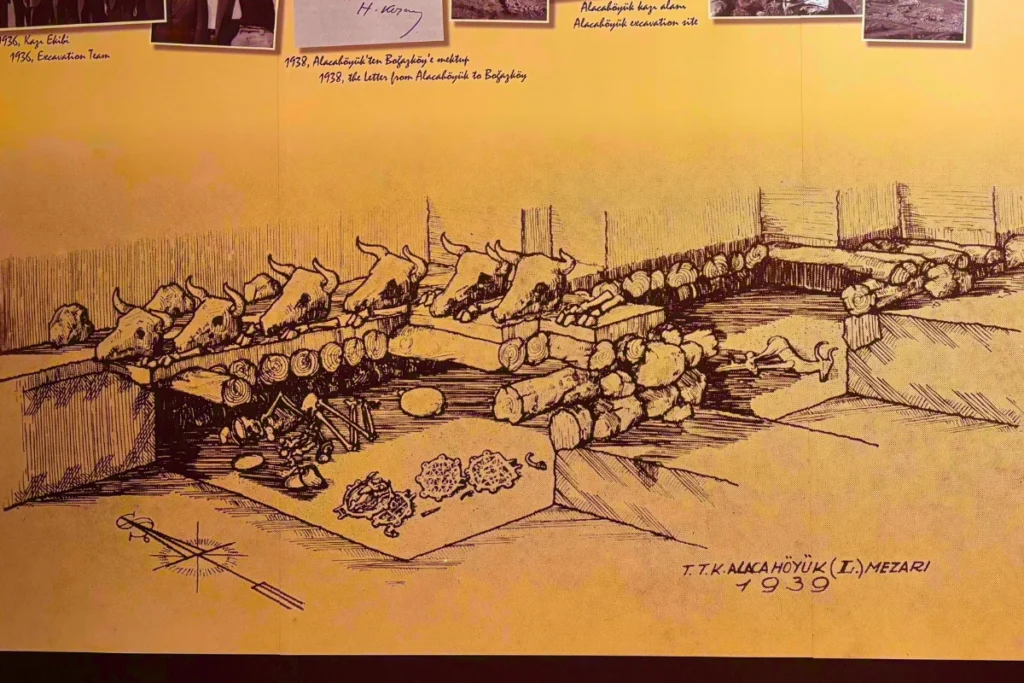
The museum describes the head and foot bones of sacrificed animals among the burial material. This is important evidence, and it points toward something beyond the placement of objects. It points toward actions. Toward a ceremony that involved living beings, not just precious things.
Animal remains in ancient burials can be connected with several practices: offerings, funerary feasting, sacrifice, or other forms of ritual. If animals were deliberately killed as part of the burial ceremony, then the treatment of the dead at Alacahöyük was not a matter of arranging objects in a grave. It was an event. Something was done, by people, with living animals, as part of marking a death.
But evidence and interpretation are not the same thing, and the gap between them deserves respect. The presence of animal bones does not tell us when the animal was killed, who killed it, or what belief drove the act. The bones are the fact. The ceremony around them is a reconstruction.
Even so, the combination of sacrificed animals and elaborate grave goods suggests these burials were organised, deliberate events with many material elements. You can begin to picture the preparation: the objects chosen, the grave arranged, the animals brought, the people gathered to mark the loss. We cannot recover the exact ceremony. But the remains make one thing clear. Death at Alacahöyük was not a private matter handled quietly. It was a moment when a community gathered and spent its resources and its effort, which means death was a moment when the community expressed what it valued.
That, at least, we recognise completely. In our own tradition, death is never a solitary administrative event either. It gathers people. It demands rituals, offerings, specific acts performed in a specific order. The particulars could not be more different from Bronze Age Anatolia. The underlying truth, that a community reveals itself in how it handles its dead, is the same.
Did They Believe in Another World?
This is the question the tombs pull you toward, and it is the question they refuse to answer.
The gold beside the body. The provisions, if that is what they were. The sacrificed animals. All of it seems to point toward a belief that death was a journey, that the dead continued somewhere, that they would need these things. The temptation to conclude this is strong.
But grave goods do not prove a belief in an afterlife. This is the discipline the tombs demand. The objects could have expressed status. They could have commemorated the person. They could have fulfilled a ceremonial obligation that had nothing to do with an afterlife at all. Several reasons could have operated together. And without written accounts from the people themselves, we cannot reconstruct what they actually believed about death.
In Sanatan Dharma, the ideas around death form an enormous and varied landscape: rebirth, karma, the soul’s long journey, moksha. These concepts are diverse, debated across traditions, and impossible to reduce to a single belief. It would be dishonest to project any of them onto the people of Alacahöyük, who lived thousands of years before and thousands of kilometres away, inside a world we can barely see.
So the most responsible conclusion is also the most human one. The people of Alacahöyük found meaningful ways to respond to death. They cared enough to spend extraordinary resources on it. Whether that care came from belief in another world, obligation to ancestors, the demands of social authority, or all of these together, we cannot say. But the care itself is beyond doubt. The dead mattered to the living. The tombs prove that much, even as they keep the reasons buried.
What the Tombs Say About Power
The richness of the royal tombs is also evidence about how the society was organised.
Producing this metalwork took skilled craftspeople, access to precious materials, and time. The decision to bury such objects, rather than keep them in use, meant a community could afford to remove significant wealth from circulation for funerary purposes. Not every community could. Not every burial received this treatment.
Which raises the questions archaeologists use these tombs to investigate. Who controlled the gold and silver? Who commissioned the objects? Who decided how they were used? And who held the authority to receive a burial this lavish while others were buried simply?
The contrast between the richly furnished graves at Alacahöyük and more modest burials elsewhere is itself the evidence. It points toward a society with real hierarchy, where some individuals or families commanded resources that others did not, and where that difference persisted even into death. A ceremonial object raised at a gathering could set a person apart in life. A grave filled with gold could preserve that distinction forever.
The tombs, in this reading, tie three things together: the skill of the craftspeople, the status of the powerful, and the symbolic world that made certain objects worth burying. The objects are beautiful. But their beauty may have been the least important thing about them. They belonged to a society where owning, using, and finally burying the right objects sent messages about who mattered and how much.
Reading a Civilisation That Left No Explanation
Archaeology is the strange art of asking questions of things that cannot answer.
A bronze sun disc cannot tell you who carried it. A gold ornament cannot explain why it went into the ground. Animal bones cannot describe the ceremony they were part of. And yet each object is evidence, and patient work can draw real knowledge from silent material: the method of manufacture, the decoration, the find-location, the relationship to other objects, the comparison with other sites and periods.
Some conclusions stand on firm ground. Others remain tentative. And the discipline of keeping those two categories separate matters most exactly when the subject is ancient ritual, because ritual is where the temptation to invent is strongest. It is so easy to turn an unusual object into a symbol with a confident meaning, to borrow a later religion’s explanation for an earlier object, to fill every silence with a story. The royal tombs of Alacahöyük are fascinating precisely because they hold knowledge and uncertainty in the same hand. They show remarkable skill, elaborate funerary practice, and a society capable of extraordinary things. They leave the beliefs and the ceremonial meanings largely unknown.
The honest response is not to fill every gap with imagination. It is to marvel at how much can be known while respecting what cannot.
What We Carried Out of the Museum
What you see in a museum case is only one stage in the long life of an object.
Today we preserve these things so people can study them, admire them, and learn about the societies that made them. Four and a half thousand years ago, they lived in a completely different world of meaning. They may have been worn, carried, raised in ceremonies, or kept as treasured possessions before they were ever placed in a grave. Their burial preserved them, by accident, for archaeologists to find. The museum is the final chapter of a story that began at a forge and passed through a human life before it ever reached the ground.
The sun discs, the ornaments, the vessels, the animal figures: they once belonged to a living society. Made by skilled hands. Held inside relationships and traditions and events that are now almost entirely lost. The royal tombs make that connection unusually powerful. They bring you close to people who lived in a world nothing like ours, while reminding you that human communities have always found ways to mark loss, to honour an individual, and to give death a significance beyond the simple fact of a body in the ground.
We do not know what the people of Alacahöyük believed waited beyond the grave. But the care they took, the resources they gave up, the ceremony they performed, all of it tells us that how they treated their dead mattered to them enormously.
And that, in the end, was the most moving part of standing in front of their gold. The objects survived. The people who buried them are gone. Their words and their beliefs are lost. But their actions left a trace, and the trace still speaks, four and a half thousand years later, to two travellers from a country on the other side of the continent who understood, without needing it explained, that burying treasure with the dead is never really about the treasure.
“The objects sitting in museum cases today were never meant for our eyes… they were meant for the dark, for eternity, and for a conversation between the living and the dead that ended four and a half thousand years ago.”