What drives human beings across millennia to carve physical shapes for the divine? Exploring Anatolian idols and the murti: giving form to the sacred, this reflection examines the 5,000-year-old Bronze Age figurines at Ankara’s Museum of Anatolian Civilisations through the lens of living Indian ritual traditions. Here is what these abstract stone and metal forms reveal about archaeology, devotion, and the universal instinct to visualise the unseen.
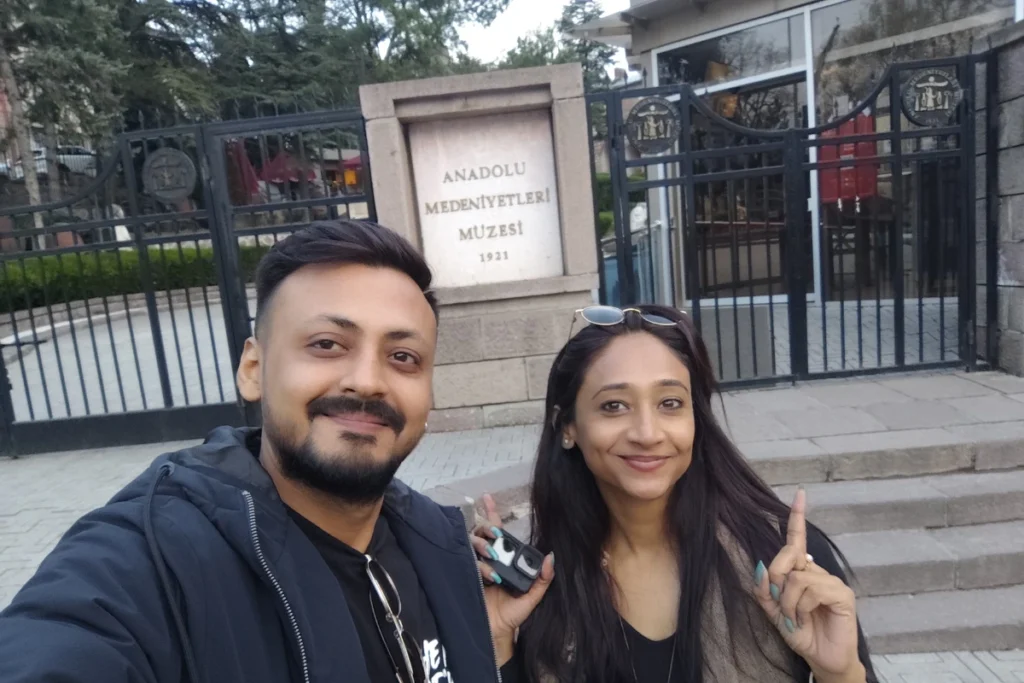
In the middle of the Museum of Anatolian Civilisations in Ankara, between the overwhelming Hittite reliefs and the Neolithic figurines, there is a display case that most visitors walk past.
We almost walked past it too.
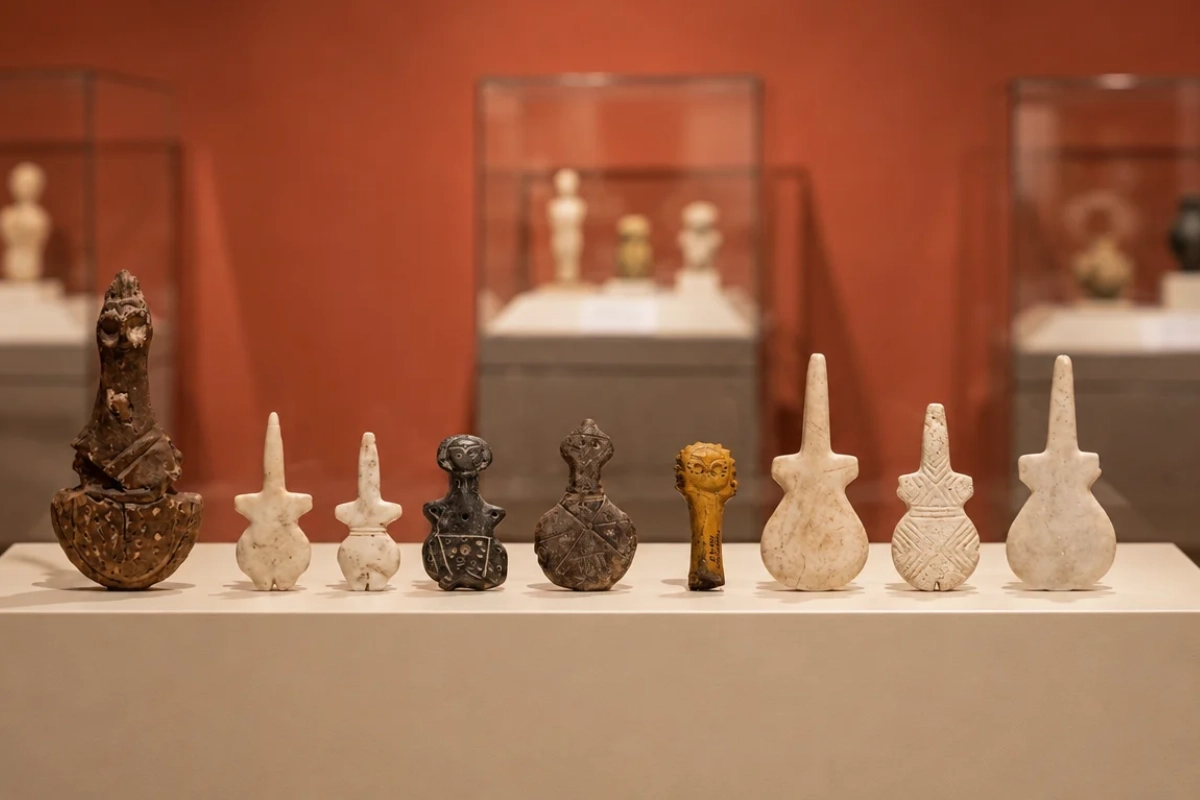
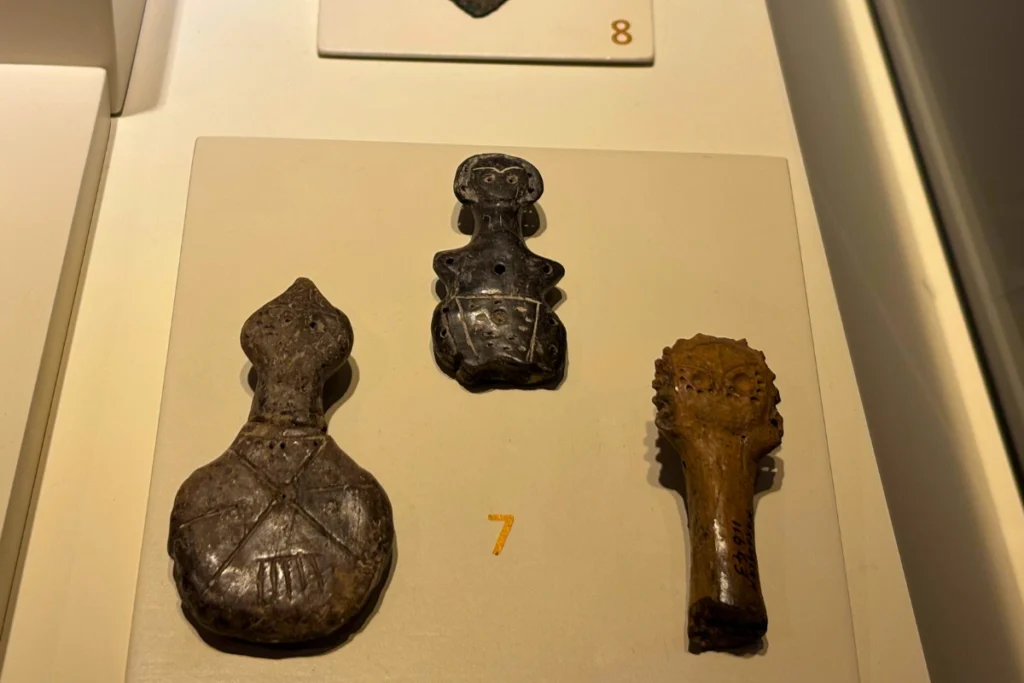
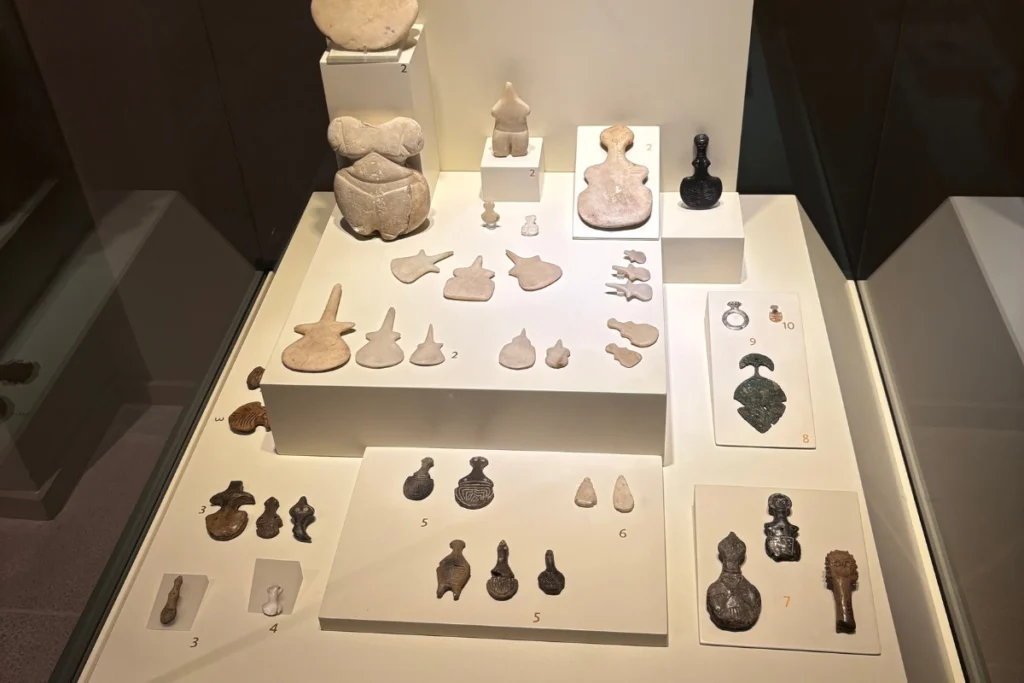
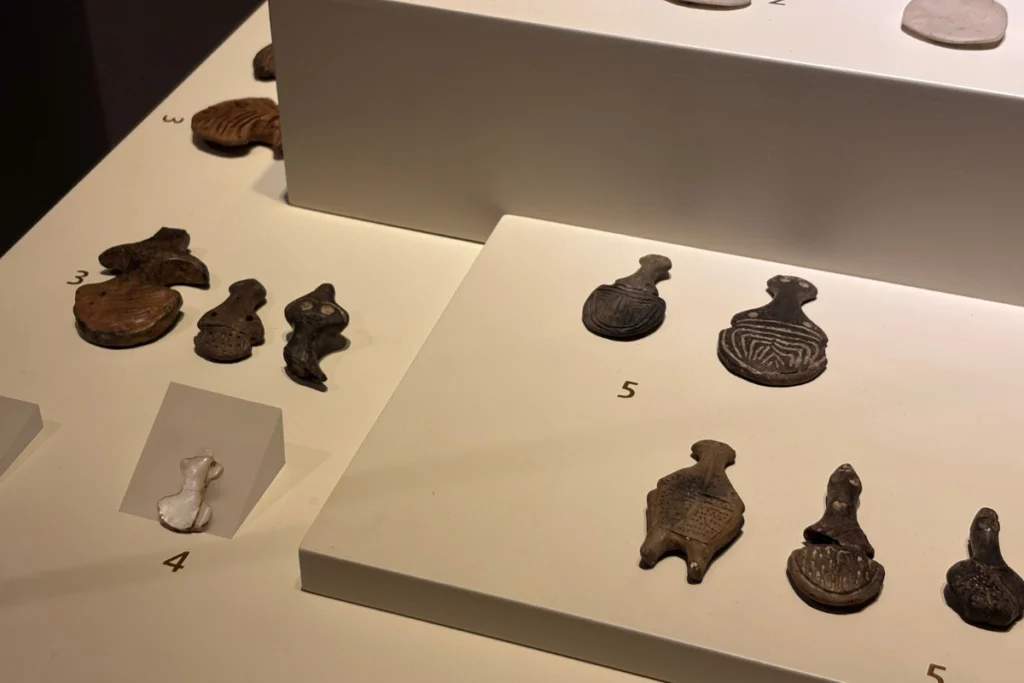
Inside the case are eleven small objects. Some are carved from alabaster, pale and polished. Others are fired terracotta. One is mother-of-pearl. Three are metal: bronze, silver, and gold. They are small enough to hold in a palm, and their forms are strange. Some have broad, flat, disc-shaped heads on narrow necks. Some are shaped like violins, with tapering bodies and small triangular shoulders. One has a figure-eight outline, the head and body pinched into two rounded shapes.
They are not realistic. The people who made them, five thousand years ago, did not attempt to reproduce the human body. They reduced it. A few curves. A few deliberate proportions. Enough to suggest a figure without describing one.
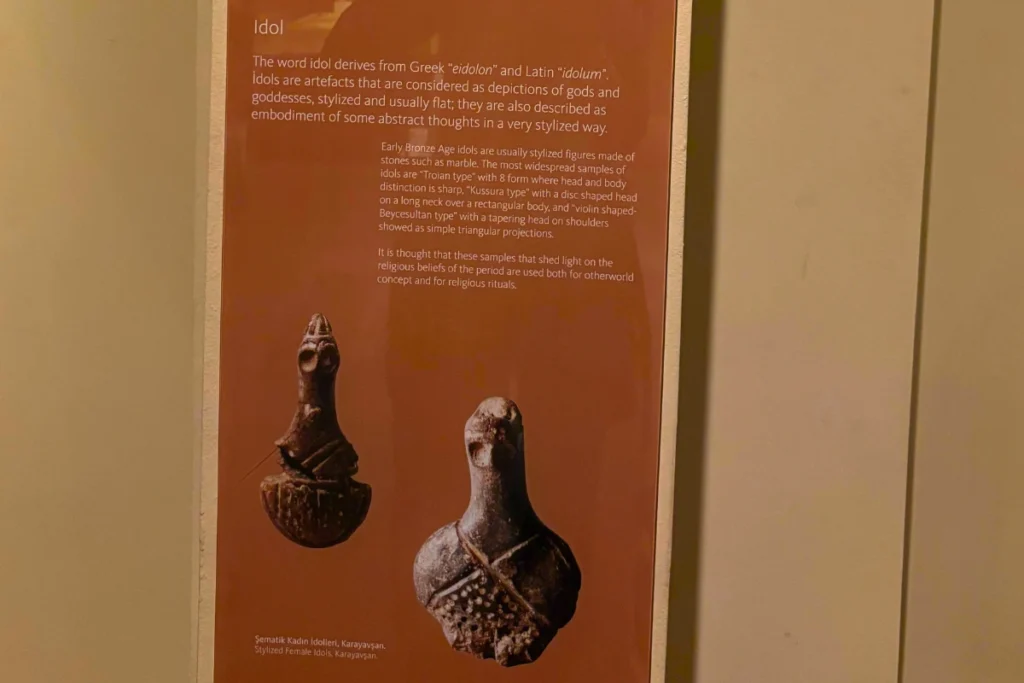
The museum label calls them idols: objects believed to depict gods and goddesses, or to embody abstract ideas in stylised form, possibly connected with religious ritual or beliefs about the world beyond death.
We stood in front of the case longer than we had planned to. And as two Indians, standing in a museum in central Turkey, looking at five-thousand-year-old objects that someone had made to represent something sacred, our thoughts went somewhere specific. They went home. To the murti.
“Standing before five-thousand-year-old stone figures in central Turkey, we realised that giving a visible form to the invisible is not an ancient relic… for an Indian, it is simply Tuesday.”
Why an Indian Stops at This Case
In India, the practice of giving the divine a physical form is not history. It is Tuesday.
In temples and homes across the country, a sacred image sits at the centre of daily devotion. A murti of Shiva, Vishnu, Devi, Ganesha, Durga, or any of the countless forms through which the divine is approached. People stand before these images. They offer flowers. They light a lamp. They present water, food, incense. They recite prayers. They sit quietly. The image is the focus, the point where attention gathers and devotion becomes tangible.
We grew up with this. For a Bengali, the most intense version arrives once a year, when Mother Durga comes home for a few days in October, and an entire city builds her a form, worships it, and then carries it to the river to dissolve it back into water. The form is made. The form is worshipped. The form is returned. The cycle is older than memory.
So when we looked at these Anatolian idols, the question arrived on its own: why have human beings, across cultures separated by thousands of kilometres and thousands of years, felt the need to give a visible form to something they consider sacred?
It is a tempting question to answer badly. It would be easy, standing there, to decide that these ancient figurines were early murtis, that the people of Bronze Age Anatolia were doing what Hindus do today, that we had found some deep shared root connecting the Konya plain to a Kolkata puja pandal.
That answer would be wrong. And the reasons it is wrong are more interesting than the shortcut.
What These Idols Actually Are
The Early Bronze Age in Anatolia runs from roughly 3000 to 1950 BCE. It was a period of settlements, metalworking, and trade routes connecting distant regions. Craftspeople worked clay, stone, and precious metals into objects for daily life, personal adornment, and ceremony.
Technology is easy to read from the archaeological record. A pot tells you how it was made. A bronze tool reveals the skill of its maker. Religion is harder. A figurine does not explain itself.
Was it a god? A goddess? A fertility symbol? A protector? An ancestor? Was it used in a ritual, kept in a house, or buried with the dead? Sometimes the archaeological context offers a clue. Often the original purpose has simply been lost, and the honest archaeological answer is a shrug dressed up in careful language. The museum’s phrase “possibly connected with religious ritual” is doing a great deal of quiet work. It means, roughly, “we found it, we think it mattered, and we cannot be certain why.”
That uncertainty is not a weakness in the display. It is the display. These objects belong to a world of questions, and the museum is honest enough to present them as questions rather than answers.
The eleven idols in the case come from different sites and different centuries. We photographed the labels, which tell their own story of variety:
| No. | Site | Material | Approximate Date |
|---|---|---|---|
| 1 | Karataş–Semayük | Alabaster | 2700–2500 BCE |
| 2 | Beycesultan | Alabaster | 3000–2500 BCE |
| 3 | Ahlatlıbel | Terracotta | 3000–2750 BCE |
| 4 | Ahlatlıbel | Mother-of-pearl | 3000–2500 BCE |
| 5 | Etiyokuşu | Terracotta | 2600–2400 BCE |
| 6 | Etiyokuşu | Alabaster | 2600–2400 BCE |
| 7 | Karaoğlan | Terracotta | 2750–2500 BCE |
| 8 | Lakes Region | Bronze | 2250–2000 BCE |
| 9 | Lakes Region | Silver | 2250–2000 BCE |
| 10 | Lakes Region | Gold | 2250–2000 BCE |
| 11 | Kalınkaya | Terracotta | 2250–2000 BCE |
Eleven objects. Seven sites. A span of roughly a thousand years. Materials ranging from fired clay to gold. This was not one belief in one place at one time. It was a wide and varied practice of making small sacred forms, carried out across a landscape by people who did not leave us the instructions.
The gold figurine is not necessarily more sacred than the terracotta one. We assume gold means importance because we live in a world that prices gold. The people who made these may have chosen materials for reasons we cannot recover: what was available, what was traditional, what a particular ritual required, what a particular family could afford. The variety asks more questions than it answers, which by now you will recognise as the recurring theme of this display case.
The Language of Shape
What struck us most was how little these figures try to look like people.
Archaeologists sort them into types. The Trojan type has the pinched figure-eight outline, head and body clearly separated. The Kusura type has a disc-shaped head, a long neck, and a rectangular body. The Beycesultan type, the violin-shaped one, narrows at the head and shoulders, with the arms sometimes suggested by nothing more than small triangular projections.
None of these forms attempts to reproduce a face, a hand, an expression. They emphasise an outline. A silhouette. A shape that can be recognised at a glance and remembered afterward.
Why reduce a human being to a violin?
We do not know, and neither does anyone else, but the possibilities are worth sitting with. Perhaps the simple forms were easier to make. Perhaps they followed an artistic convention so established that a maker who deviated would have been producing the wrong thing. Perhaps the meaning lived not in the appearance but in the idea, and a few curves were enough to carry it.
This is where our minds, as Indians, went back to the murti, because Indian sacred art makes a related move constantly. A Shiva lingam is not a portrait of Shiva. It is a form, abstract and deliberate, that holds meaning far beyond its shape. The abstraction is not a failure to represent. It is a choice about what representation is for.
We are not claiming the Anatolian violin-idol and the Shiva lingam are the same thing, or that one led to the other. They did not. But both traditions understood something that realistic art sometimes forgets: a simple form, shaped with intention, can carry more than a detailed one. A few lines can hold a universe, if the people looking at them agree that it does.
An Idol Is Not a Murti (and Why That Matters)
Here is the distinction that the whole reflection depends on.
In everyday English, “idol” gets used loosely for any figure representing a deity. The word comes from the Greek eidolon and the Latin idolum. In archaeology, it describes stylised figures interpreted as representations of gods or abstract ideas. It is a label applied from the outside, by scholars, to objects whose makers are long gone.
The Sanskrit word murti belongs to an entirely different world. It means form, embodiment, manifestation. And crucially, a murti exists inside a living tradition that explains it. There are texts. There are rituals. There are theological frameworks that stretch across millennia and remain in daily use. A murti is not just an object that looks sacred. It is an object embedded in a practice that makes it sacred.
In many Hindu traditions, a murti becomes a focus of the divine presence through a consecration rite, prana pratishtha, which establishes the deity within the image for worship. The details and explanations vary enormously across regions and schools of thought. But the principle is clear: the significance of the image comes not only from the stone or the metal, but from what is done with it, believed about it, and offered to it.
This is why calling the Anatolian figurines “early Hindu murtis” would be nonsense. There is no evidence connecting these particular objects to Sanatan Dharma. The people who made them did not perform prana pratishtha. They did not do puja as any Hindu would recognise it. They lived five thousand years ago on the other side of a continent, inside beliefs we can barely glimpse.
And yet the comparison is not useless. It is the opposite of useless. It is a way of asking a better question.
“An idol in a display case is an object without its relationship… a form stranded in history, like a murti without its puja or a letter written in a language no one living can read.”
What Puja Teaches About These Objects
Puja, in Sanatan Dharma, is not the act of looking at a statue. This is the thing that outsiders most often miss.
A simple home puja might be a lit diya, a flower, an offering of water or food, a few words of prayer. An elaborate temple ritual might be a long sequence of prescribed actions performed by trained priests. The practices differ across every region and community in India. But in all of them, the image is one part of a relationship. The worship is the relationship. The object is where it gathers.
This is the insight that an Indian brings to the Anatolian display case without having to be taught it. For a Hindu, it is obvious that an object can acquire meaning through the practices and beliefs that surround it, rather than through its material alone. A rupee coin and a consecrated murti might be made of similar metal. Nobody confuses the two, because the difference was never in the metal.
For an archaeologist, this is a useful reminder. Understanding one of these Anatolian idols requires knowing how it was used, not just describing how it looks. And since the “how it was used” is mostly lost, what survives is the object without its relationship. The murti without its puja. The form without the devotion that gave it meaning.
That is the quiet sadness of the display case. These objects were almost certainly the centre of something. Someone made them with care, for a reason that mattered. And the reason is gone, leaving the form behind like a letter in a language nobody reads anymore.
Goddesses, Fertility, and the Temptation to Assume
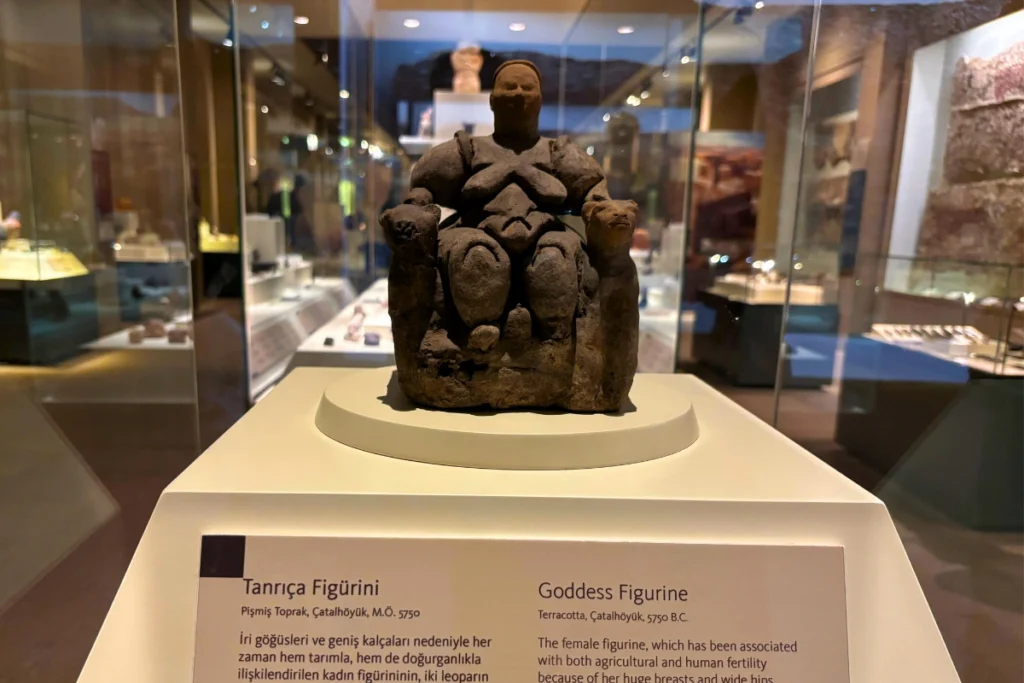
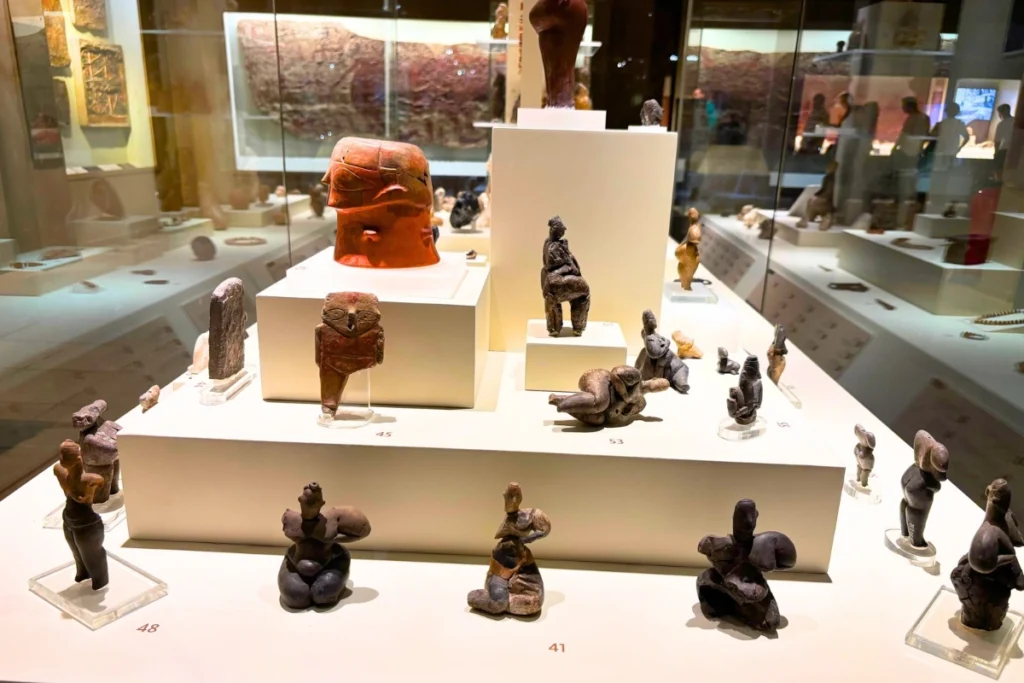
A question that always arrives with ancient figurines: are these goddesses? Mother figures? Symbols of fertility?
The temptation, especially for an Indian, is strong. India has one of the richest goddess traditions in the world. Devi, Shakti, the divine feminine in a thousand forms. Looking at an ancient female figurine, it would be easy to see Shakti looking back.
But a stylised human form does not automatically represent a goddess, and a female-looking figurine does not automatically represent a mother goddess or a fertility deity. Archaeologists investigate these questions through the figure’s shape, where it was found, what was buried alongside it, how it compares to other finds. A resemblance in form proves nothing about a shared identity.
So the responsible position, the one that keeps curiosity alive without forcing a familiar answer onto an unfamiliar object, is this: both the ancient Anatolian figurines and the Hindu images of the divine feminine raise questions about how sacred power is represented. But their specific meanings belong to their own worlds. The resemblance is an invitation to think, not evidence of a connection.
We find this more satisfying than a false certainty. A forced link would close the question. The honest uncertainty keeps it open, and open questions are more interesting to carry around than closed ones.
The Objects Buried with the Dead
The museum notes that some of these idols may be connected with the concept of the otherworld, with beliefs about death and what lies beyond it.
This is the detail that stayed with us longest.
Why place an object in a grave? To accompany the dead? To protect them? To express who they were? To serve some role in a ceremony we can no longer reconstruct? The answers depend on the context of each find; not every figurine was buried, and a figurine in a grave does not automatically reveal a specific belief about an afterlife.
But the possibility gives these small objects a weight they would not otherwise carry. Someone, five thousand years ago, lost a person they loved, and in response they placed a carefully made form into the ground. Whatever they believed, they believed it enough to act on it. The act survives. The belief does not.
In Sanatan Dharma, death opens onto an enormous landscape of ideas: rebirth, karma, moksha, the soul’s journey across lifetimes. These concepts are diverse, debated, and explained differently across traditions. It would be dishonest to project any of them onto Bronze Age Anatolia.
Yet the human question underneath is not confined to one culture. How have people, in every age, used objects and rituals to respond to death, to uncertainty, to the hope that life means something beyond the visible? The Anatolian figurines do not answer this. They remind us that the question is old, that it was asked long before any of our religions were named, and that the asking leaves traces in the ground even when the answers do not.
One Question, Many Worlds
Standing at that display case, we found ourselves moving between two ways of seeing.
One was archaeological. Where were these found, when were they made, what materials, what forms, what can they tell us about Early Bronze Age Anatolia? This way of seeing is careful, evidence-bound, and comfortable with saying “we do not know.”
The other was personal. As two Indians raised around the murti, the puja, the lamp and the flower and the form at the centre of devotion, we could not help reflecting on the human impulse to make the sacred visible. This way of seeing is warmer, rooted in our own lives, but it cannot tell us what the ancient makers believed.
Both ways enrich each other, as long as we do not confuse them. History goes wrong when every resemblance is treated as proof of a connection. It goes right when resemblances are used to ask better questions.
The Anatolian idols and the Hindu murti belong to different worlds. Their forms, meanings, and rituals should be studied in their own settings. We are not descended, spiritually, from the people who carved these violins into alabaster. But we share something with them that is not ancestry and does not need to be: the old human instinct to take ordinary material and shape it into something that holds meaning beyond itself.
That instinct runs from a Bronze Age grave on the Konya plain to a riverbank in Kolkata where a clay goddess dissolves back into water every autumn. Not the same practice. Not the same belief. The same instinct, wearing different clothes across five thousand years.
“History goes wrong when every resemblance is claimed as proof of a shared root; it goes right when resemblances are used to ask better, deeper questions about what it means to be human.”