Yes, visiting Kaymaklı underground city is worth it, but it rewards you with subterranean engineering rather than surface visual drama… think one-tonne rolling stone doors, 50-metre ventilation shafts, and a wine press built into a siege shelter. It’s the gentler of Cappadocia’s two major underground cities, making it the ideal choice for anyone managing claustrophobia. Budget 30–45 minutes and go before the Göreme tour buses arrive.
The fairy chimneys, the cave churches, the balloon-filled dawn, the sunset valleys: Cappadocia above ground is a landscape designed for eyes looking upward. Everything competes for your attention visually… the formations are dramatic, the colours shift, and the scale is built for photographs.
Kaymaklı inverts that experience entirely. You descend a staircase. The ceiling drops. The walls narrow. The temperature changes. And within five minutes, you are standing inside a problem that the people of Cappadocia solved with sheer human ingenuity: how to survive when the surface, with all its beauty, becomes the most dangerous place to be.
When invaders arrived, communities descended, sealed the passages, and waited.
“Above ground, Cappadocia demands you look up at its spectacle. Underground, it demands you realise how a civilisation engineered its own survival.”
What You Walk Into
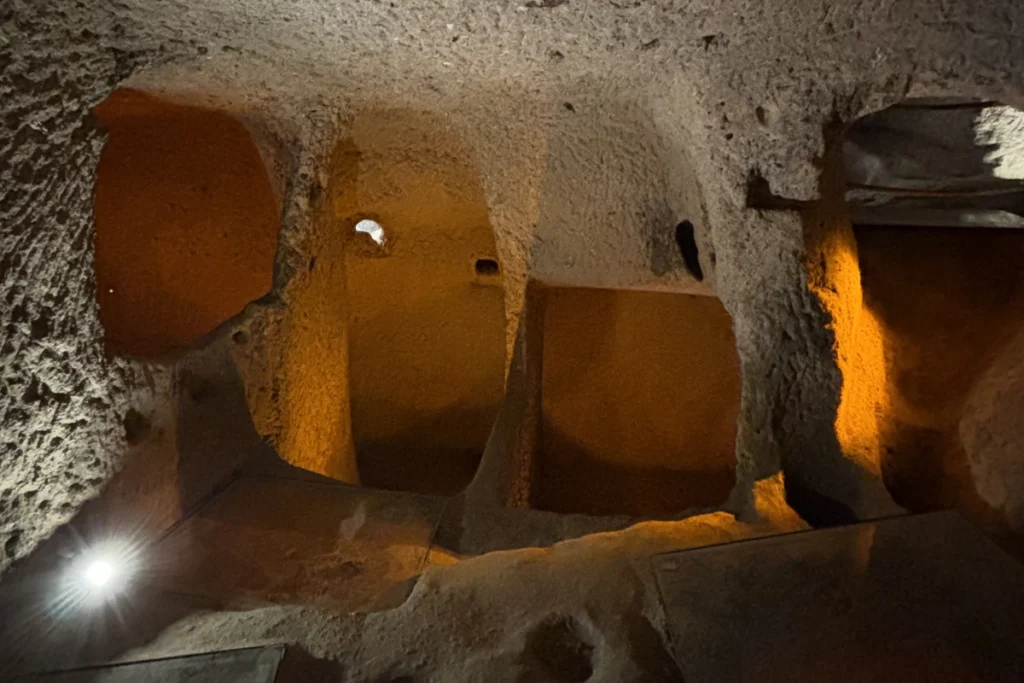
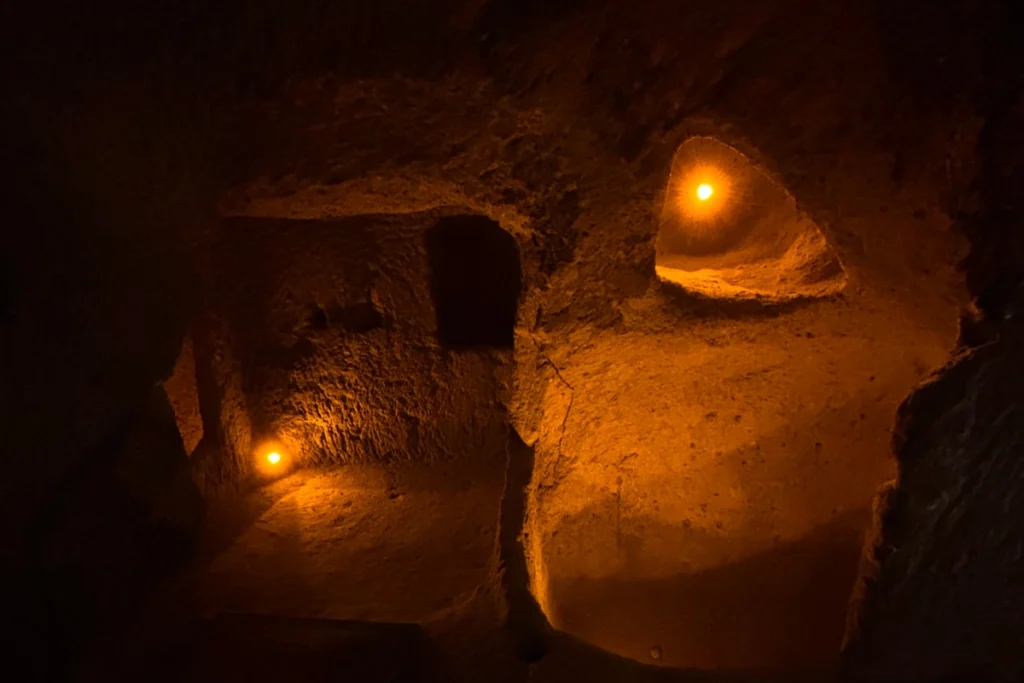
Kaymaklı is a multi-level underground settlement carved into volcanic tuff, with four levels currently open to visitors. The circuit is a one-way route through rooms built for storage, defence, and daily survival… a subterranean network engineered directly out of volcanic tuff.
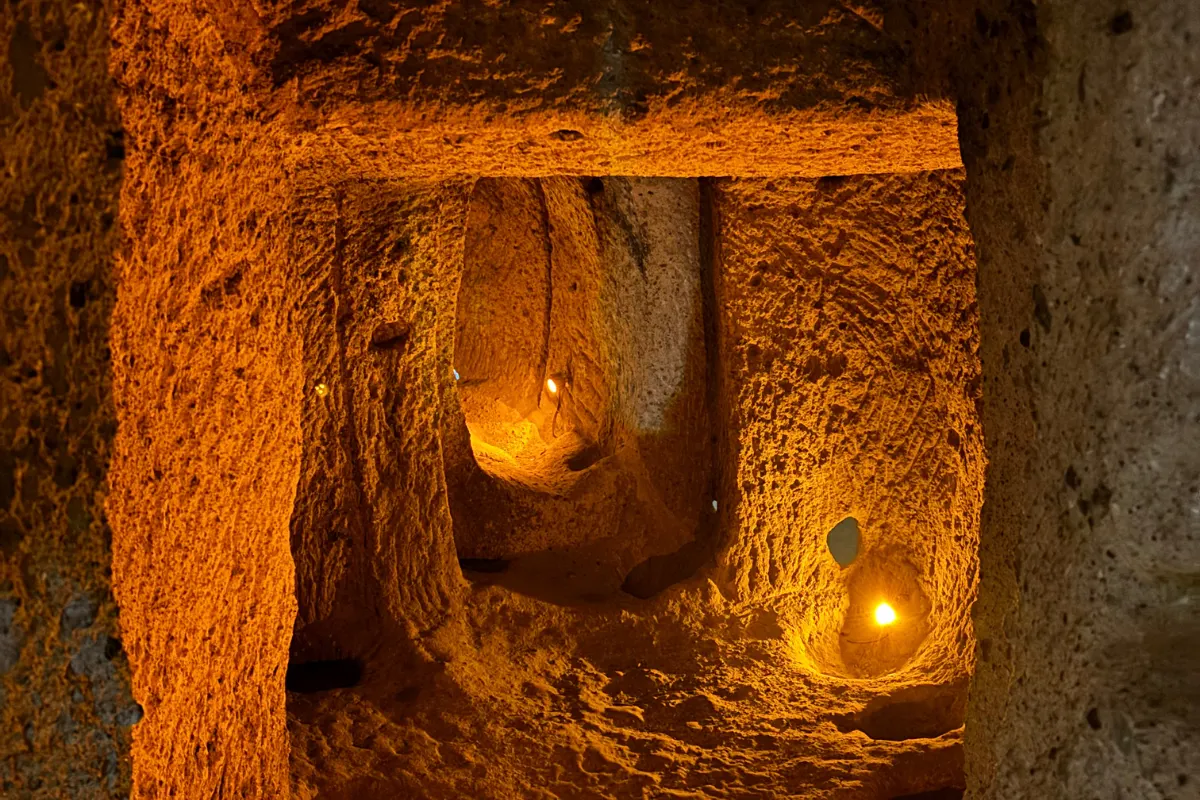
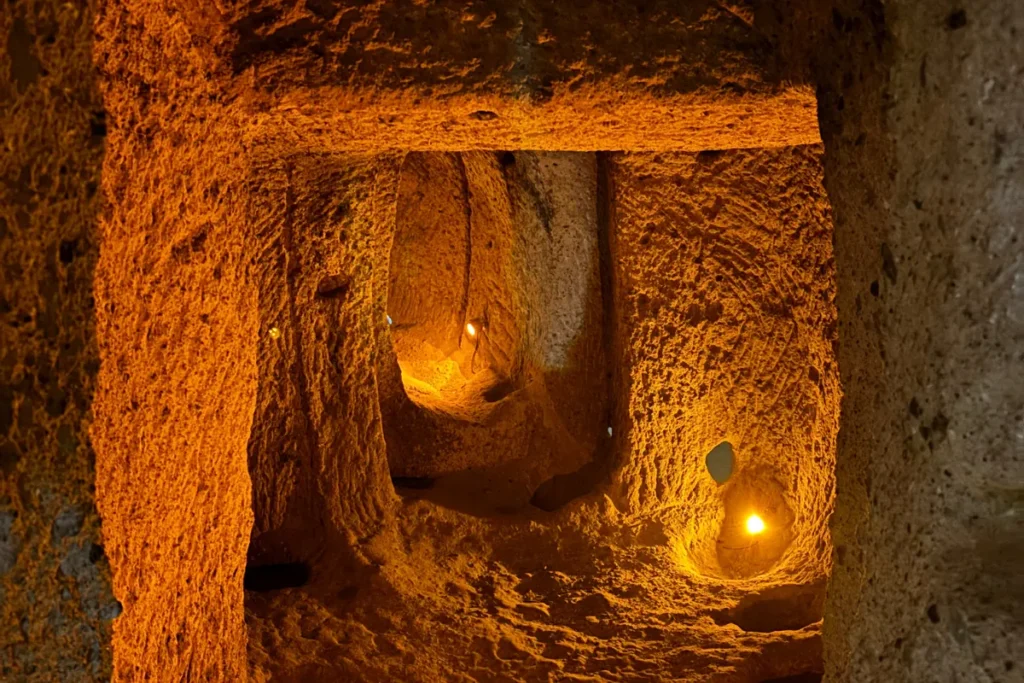
A narrow staircase descends from the ticket counter into the earth. Within the first minute, the world above disappears. The rock walls close to shoulder width in places. The ceiling height drops to approximately 1.7 metres in the connecting passages, which means anyone above average height is ducking continuously. The air cools noticeably. The sound changes from the open hum of a Cappadocia afternoon to the muffled, absorbed quiet of stone on all sides.
The route follows a single direction through the accessible levels. You walk through rooms that served specific functions, identifiable by their shape, their fixtures, and their position within the underground layout.
What the circuit reveals is not a cave. It is a city designed with the same organisational logic as a surface settlement, compressed into rock. The people who carved these spaces did not retreat underground in panic. They planned. They engineered ventilation, water access, food storage, and defence as a single system… one that, according to the Turkish Ministry of Culture and Tourism’s official listing for Kaymaklı, was expanded and adapted across roughly a thousand years of intermittent use.
“Within sixty seconds of stepping off the staircase, the open hum of the Cappadocian sun gives way to the heavy, absorbed silence of solid rock.”
Three Things That Change Your Understanding
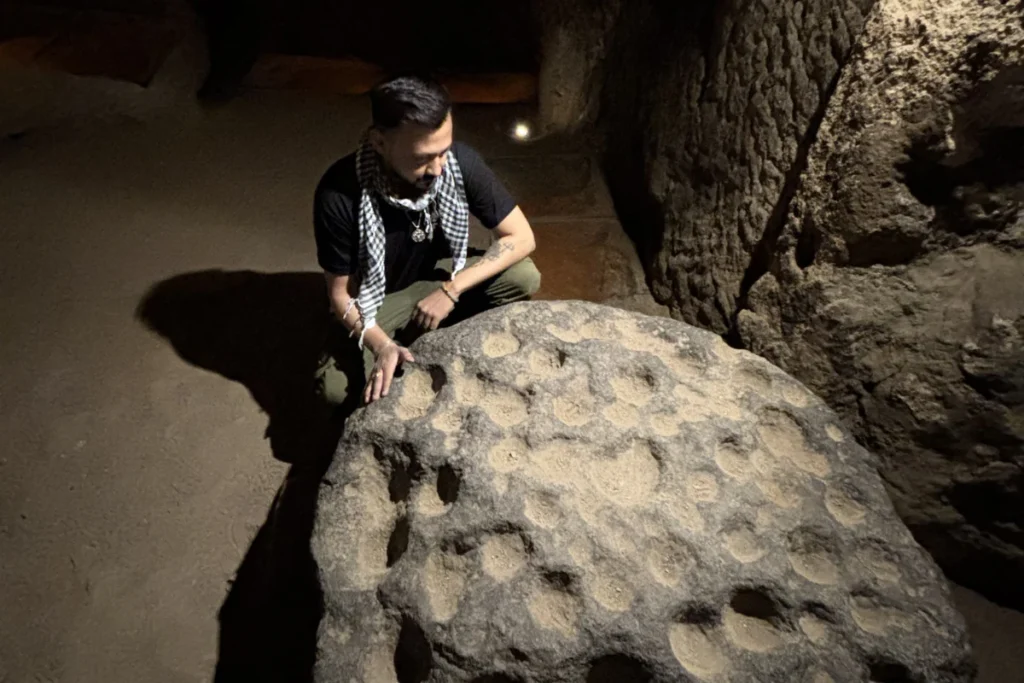
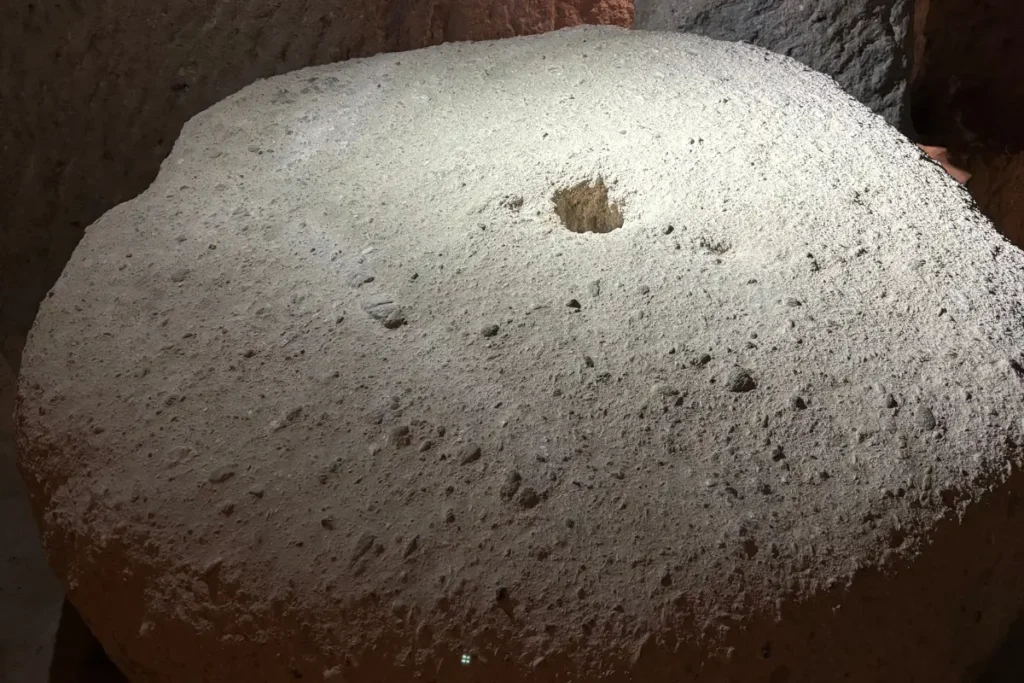
The stone doors. Circular, weighing approximately one tonne each, carved from single blocks of volcanic tuff. They were designed to be rolled across passages from the inside. Once in position, a stone door seals the corridor completely. It cannot be opened from the other side. A small hole in the centre, approximately five centimetres in diameter, allowed defenders to monitor the sealed passage without exposing themselves. The engineering is not primitive. It is elegant. A single mechanism, requiring only human muscle and a slight downhill gradient carved into the floor, transforms a corridor into a wall.
The ventilation system. Vertical shafts extending from the deepest levels to the surface, some dropping over 50 metres through solid rock. These shafts provided fresh air to hundreds of people sealed underground during sieges that could last weeks. The shafts also served as water wells: the deepest ones reached the water table. Looking down a ventilation shaft with a phone flashlight and seeing the depth disappear into blackness communicates the engineering ambition more directly than any information panel.
The wine press. On one of the lower levels, a stone basin carved into the floor with a drainage channel leading to a collection vessel. Grapes were crushed here, underground, during periods when the community could not access the surface vineyards. The presence of a wine press in a siege shelter tells you something about the people who built it that the defence doors do not: survival, for them, included the production of something that was not strictly necessary for staying alive but was apparently necessary for remaining human while doing so.
The Claustrophobia Question
Sumana experiences claustrophobia. This is the reason we chose Kaymaklı over Derinkuyu.
Derinkuyu extends deeper (approximately eight levels compared to Kaymaklı’s four accessible levels). The passages are narrower. The descent is steeper. The feeling of being deep underground with rock above, below, and on all sides is significantly more intense. Multiple travel forums describe Derinkuyu as a difficult experience for anyone with confined-space anxiety.
Kaymaklı is the more manageable option. The passages are slightly wider. The accessible depth is shallower. The circuit moves through rooms that open up periodically, providing psychological relief from the corridors between them. The compression is real but intermittent. You are squeezed in the passages and released in the rooms, then squeezed again.
The honest assessment from the claustrophobic member of this pair: it was uncomfortable in the narrow sections. Not unmanageable. Not panic-inducing. Uncomfortable enough that awareness was constant but not overwhelming enough to require leaving. The room-to-corridor-to-room rhythm helped. Knowing the circuit was one-way and would eventually return to the surface helped more.
If your claustrophobia is mild to moderate: Kaymaklı is doable. If your claustrophobia is severe: consider whether the discomfort is worth the learning, and know that skipping the underground city does not diminish the rest of your Cappadocia experience.
“Kaymaklı doesn’t trap you in a tunnel; it breathes. The rhythm of tight corridors opening into wide rooms keeps space anxiety manageable.”
Kaymaklı or Derinkuyu?
Both are legitimate choices. They serve different visitors.
| Factor | Kaymaklı | Derinkuyu |
| Depth | 4 accessible levels | 8 accessible levels |
| Passage width | Slightly wider | Narrower |
| Claustrophobia intensity | Moderate | High |
| Visit duration | 30–45 minutes | 45–60 minutes |
| Crowds | Moderate (fewer tour buses) | Higher (more widely known) |
| Overall intensity | A firm handshake | A full embrace |
Derinkuyu is the more famous of the two and appears more often in guidebooks and tour itineraries. Kaymaklı receives fewer visitors, which means shorter queues and more breathing room in the passages, literally. For a first underground city experience… particularly for travellers with any degree of space anxiety… Kaymaklı delivers the full conceptual understanding at a lower cost to your nervous system. We chose Kaymaklı and don’t regret it for a second. The engineering intelligence was completely visible, the defence logic made immediate sense, and we didn’t need to descend eight levels deeper to appreciate what these communities accomplished.
Practical Details
Entry fee: TRY 570 / INR 1,140 / USD 15 for two (April 2025). Parking: TRY 50 / INR 100 / USD 1.30 additional.
Time required: 30 to 45 minutes for the circuit.
Physical requirements: Ducking through low passages. Walking on uneven stone. Some staircase climbing. Not wheelchair accessible. Not recommended for anyone with significant mobility limitations.
Guide or self-guided: We followed the marked circuit without a guide, shadowing tour groups to overhear explanations at key points. A guide adds context (the specific siege history, the construction timeline, the connection to early Christian communities who may have used the cities for worship during Roman persecution). Without a guide, the stone doors and ventilation shafts speak clearly enough on their own.
When to visit: Morning, before the tour buses arrive from Göreme (approximately 10 to 11 AM). We arrived before the buses and had several rooms largely to ourselves.
What to bring: A phone with a flashlight function. The circuit is lit, but the ventilation shafts and some side passages are not. Pointing a light into the shaft depth is the moment that communicates the engineering scale most effectively. A light jacket: the underground temperature is noticeably cooler than the surface.
Combine with: We drove from Kaymaklı to the Ihlara Valley rim, then to Selime Monastery, then to Uçhisar Castle for sunset. The underground city works as a morning visit before a full afternoon of surface exploration.
The Answer
Cappadocia above ground is a landscape of what nature created. Cappadocia below ground is a landscape of what people created in response. The fairy chimneys were formed by volcanic ash and erosion over millions of years. The underground city was formed by communities who recognised that the same soft volcanic rock that erodes beautifully also carves efficiently, and who turned that recognition into a multi-level refuge complete with defence systems, ventilation engineering, food storage, and wine production.
Visiting only the surface gives you spectacle, but going underground gives you the complete story… a landscape carved in every direction, upward into the chimneys for daily life and downward into the stone for survival. The natural beauty above and the human intelligence below occupy the exact same rock. So, is Kaymaklı underground city worth it? Absolutely. Seeing both is seeing Cappadocia completely.
The visit takes 45 minutes. The cost is modest. The passages are tight. The air is cool. The stone doors are heavy. The wine press is quiet. And the ventilation shaft, when you point your phone’s light down it and the beam disappears into a depth you cannot measure, tells you everything you need to know about the ambition of the people who carved this place with the same chisels they used to carve the churches above.
“The same soft volcanic rock that carved the iconic fairy chimneys above was turned into a multi-level fortress below. Seeing both is seeing Cappadocia completely.”