Most road trips are measured in kilometres, but this Hoysaleshwara temple & Sakleshpura guide maps out a weekend that transitions from ancient stone to mountain mist. Starting from Bengaluru, it traces a perfect two-day loop: the 900-year-old architectural marvel of Halebidu on Day 1, the cool coffee hills, abandoned church, and star-shaped fortress of Sakleshpura on Day 2, and the exact reason an official guide changes the entire way you see the Hoysala dynasty.
We drove from Bengaluru to Hassan on a day that started with no particular plan beyond the temple and ended with a guide pointing to something in the stone that we would never have found on our own.
The sculptor’s face. Hidden in the border frieze of one of the carved panels. Not prominent. Not labelled. Not mentioned in any standard visit. The guide stopped in front of a section of the outer wall, asked us to look carefully at the decorative border where the carving meets the smooth stone, and pointed. There it was: a face, carved into the frieze border, looking out from the surface of the wall. A craftsman who spent years carving deities and celestial beings had found one small, inconspicuous place to carve himself. Nine centuries later, the guide showed it to us. We stood in front of it for several minutes longer than any other carving.
This is what guides do at places like Hoysaleshwara. They do not simply describe the iconography. They tell you where to look for the things the temple does not advertise.
“We arrived expecting to look at a beautiful ancient building. But within ten minutes of walking with our guide, we realized we weren’t just looking at stone… we were reading a book. Without him, it would have been a masterpiece written in a language we couldn’t speak.”
- What Is Hoysaleshwara Temple?
- The Outer Wall: How to Read a Hoysala Temple
- The Carvings: What to Look For
- The Companion Temple: Belur’s Chenna Kesava
- Where We Stayed: Hotel United Kites, Hassan
- Day 2: Shettihalli Rosary Church, Sakleshpura, Coffee Country, and Manjarabad Fort
- The Drive Back: Bengaluru by Evening
- What It Costs
- Before You Go
- Frequently Asked Questions
What Is Hoysaleshwara Temple?
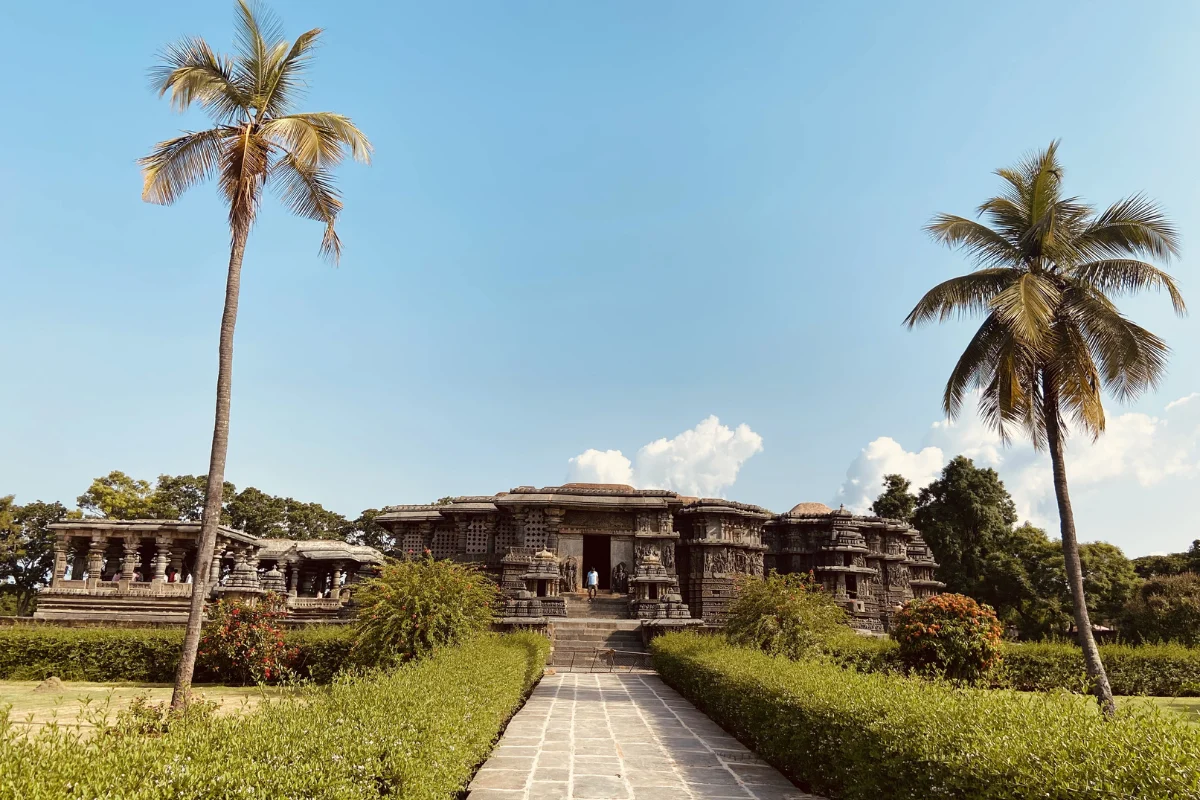
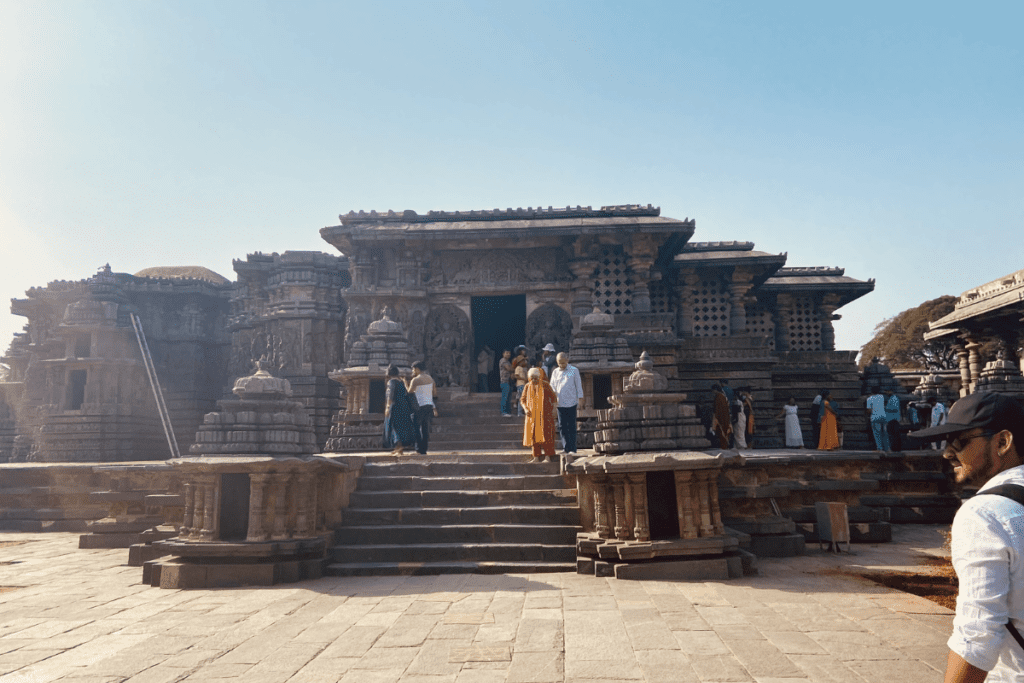
The Hoysaleshwara Temple at Halebidu is a 12th-century Hoysala dynasty temple dedicated to Lord Shiva. It was built during the reign of King Vishnuvardhana, and its construction is dated to approximately 1121 CE. It is one of the finest examples of Hoysala architecture, which is characterised by star-shaped platforms (stellate plans), tower-less structures, and an extraordinary density of decorative carving on every external surface.
Halebidu, the site of the temple, was the capital of the Hoysala Empire for several centuries. The name means ‘old city’ in Kannada. The temple was never completed: it was interrupted by successive raids from the Delhi Sultanate in the 13th and 14th centuries, which destroyed significant portions of the original structure. What survives is the most densely carved surviving section of any Hoysala temple, and one of the densest concentrations of sculptural narrative on any temple exterior in India.
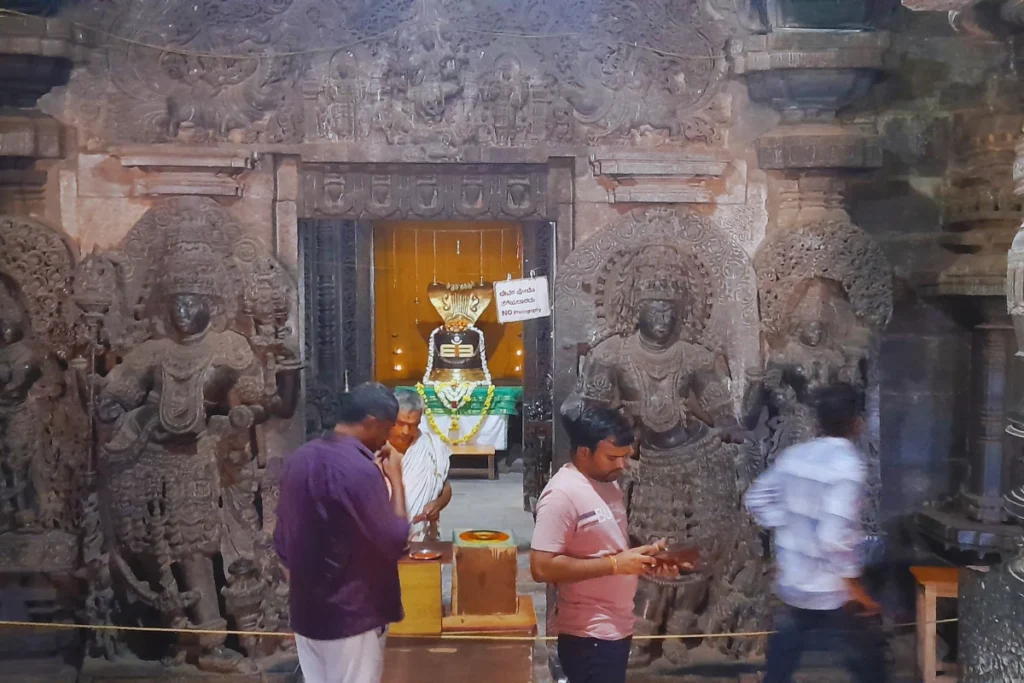
The temple complex contains two shrines: the Hoysaleshwara shrine and the Shanthhaleshwara shrine, each with its own separate sanctuary and hall. They stand on a single platform, connected visually rather than physically, sharing a courtyard and a shared vocabulary of carving that runs continuously across both structures.
Entry: free. Maintained by the Archaeological Survey of India. No photography restrictions in the open areas. The site is uncrowded compared to better-marketed Hoysala temples like Belur’s Chenna Kesava.
The Outer Wall: How to Read a Hoysala Temple
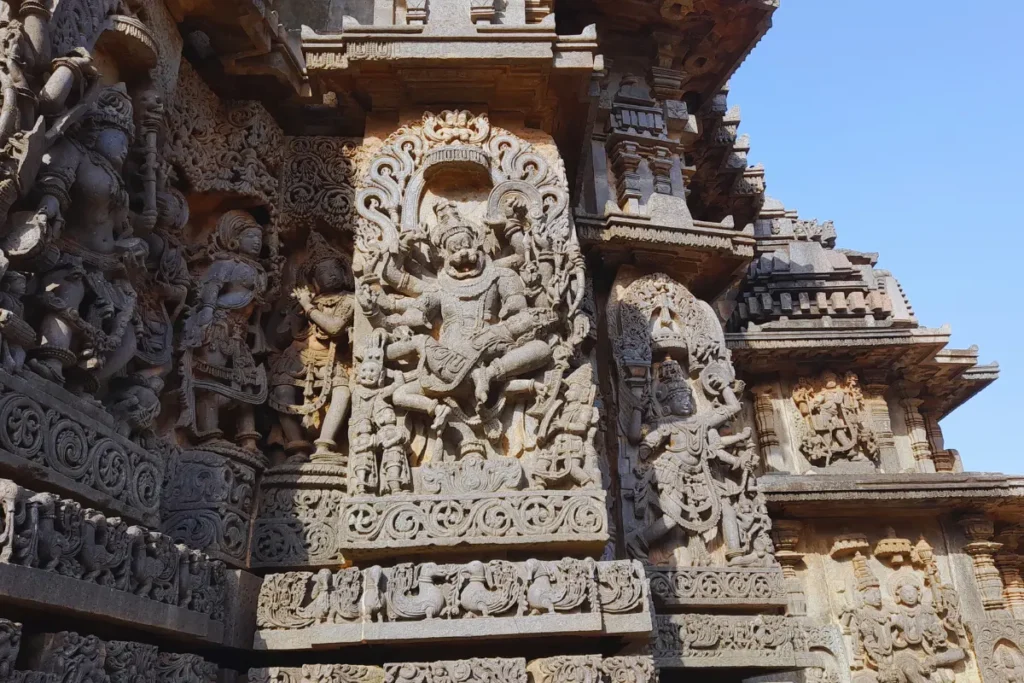
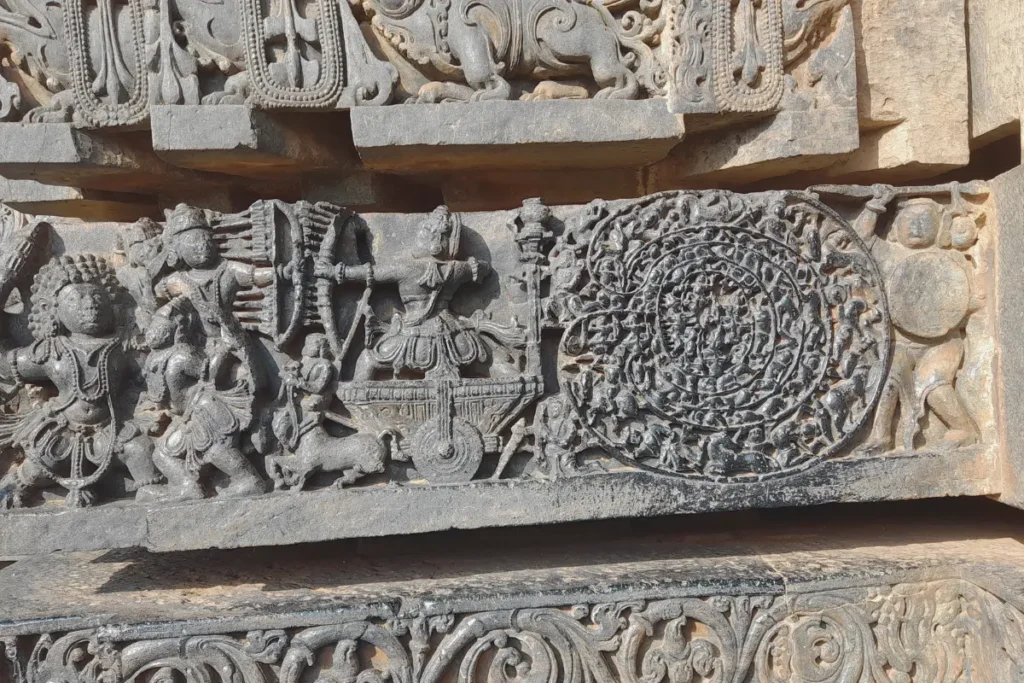
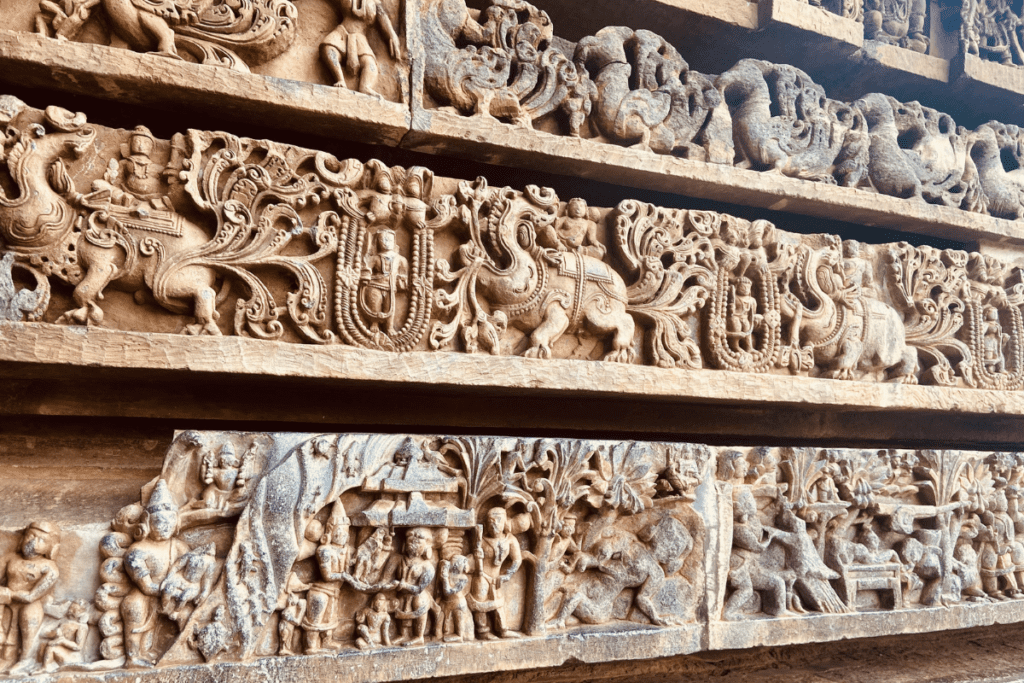
The outer walls of the Hoysaleshwara Temple are the article’s reason for existing. They are covered, completely, from base to the height a person can reasonably observe, with horizontal friezes of carving. Each frieze runs the full circumference of the temple. Each frieze contains a different subject. The friezes stack in a sequence that has meaning, and that meaning is what a guide at Hoysaleshwara explains.
The lowest frieze: elephants. Hundreds of elephants, each slightly different from the others, marching in single file around the full circumference of both shrines. Elephants represent stability. They are at the base because the temple, symbolically, rests on them.
Above the elephants: horses. The symbol of speed and the military power of the Hoysala kingdom.
Above the horses: a frieze of scrolling foliage. Dense, continuous, each scroll different from the adjacent one. Representing the natural world, growth, and the abundance of the earth.
Above the foliage: a frieze of warriors. Battle scenes, hunt scenes, scenes of the Hoysala military narrative.
Above the warriors: geese (hamsa). In Hoysala and broader Hindu iconography, the goose represents the soul in its journey between worlds.
Above the geese: makaras. Mythological sea creatures that represent the boundary between the known world and the cosmic ocean.
Above the makaras: the narrative panels. Scenes from the Ramayana and Mahabharata. Gods in their attributes and vehicles. Celestial beings. The stories that the temple is built to tell.
Seven layers. Each one running the complete circumference of the building. The outer wall of the Hoysaleshwara Temple is not decoration. It is a text. Without someone to read it to you, it is a very beautiful text in a language you do not know.
“The outer wall is less of a structure and more of an archive. Nine centuries ago, these craftsmen managed to lock entire epics, military movements, and the natural world into continuous rings of soapstone… but the stone stays quiet until someone shows you how to read it.”
The Carvings: What to Look For
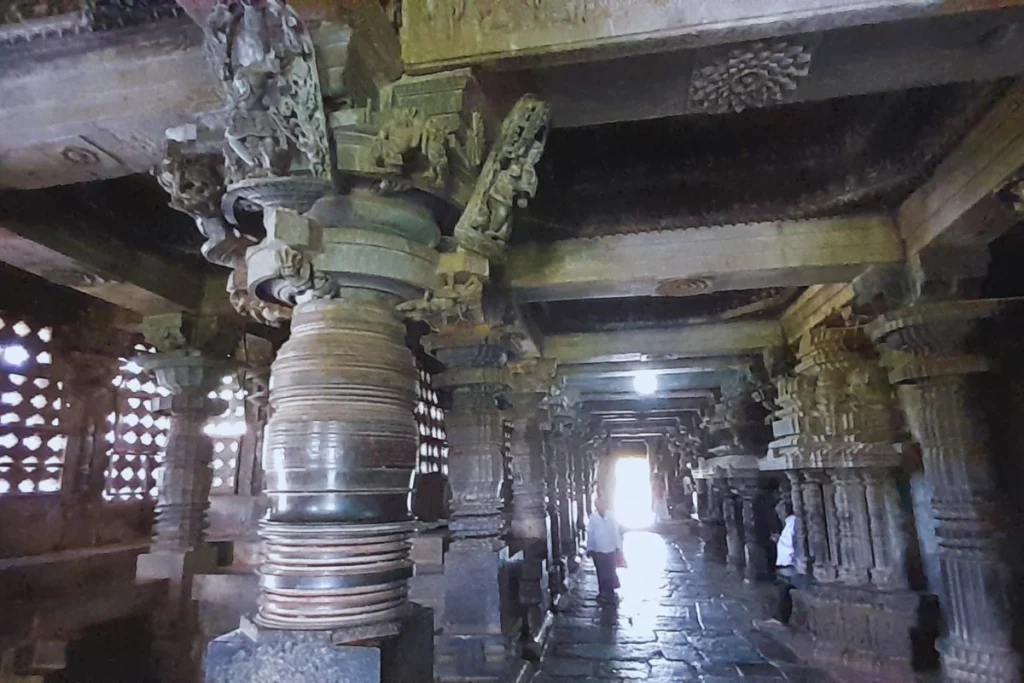
The Lathe-Turned Pillars
Inside the hall (navaranga), the pillars are lathe-turned: perfectly cylindrical, polished to a near-mirror finish, carved with a precision that implies the use of a rotating lathe rather than a hand chisel. This technique, observable in several Hoysala temples, is one of the features that researchers find most technically unexpected for a 12th-century structure. The stone is chloritic schite, a relatively soft stone that hardens with exposure to air, which partly explains the unusual polish. The result, under afternoon light, is that the pillars appear almost metallic. They do not look like stone.
The Narrative Panels
The upper frieze narrative panels depict scenes that run as continuous stories around the temple. The Ramayana sequence shows Rama’s exile, Sita’s abduction, Hanuman’s mission, the bridge construction across the sea, and the battle with Ravana. The Mahabharata sequence shows the Pandavas in exile, the Kurukshetra battle, and scenes from Krishna’s life. Each scene is populated with figures approximately 30 to 45 centimetres high, fully detailed, with facial expressions and hand gestures that carry narrative meaning. These are not generic carvings. They are specific moments in specific stories, carved by artists who knew the texts well enough to select the most visually narratable scenes.
The Sculptor’s Face
The guide stopped at a section of the border frieze between two panels and pointed to the decorative margin at the edge of the carved surface. In the border itself, small and deliberate, was a face. Not a deity. Not a celestial being. A human face, with the proportions of a craftsman’s self-portrait: observing rather than performing, looking out at the viewer rather than into the narrative.
The Hoysala sculptors worked on these temples for years, sometimes decades. The tradition of embedding a self-portrait in an inconspicuous location was a way of signing a work that was, officially, dedicated to a deity rather than to a maker. The sculptor whose face appears in that frieze did not put his name on the building. He put his face in it, in a place that only someone who was looking carefully would ever find.
We would not have found it without the guide. We have not forgotten it since.
The Companion Temple: Belur’s Chenna Kesava
Halebidu and Belur are approximately 16 km apart. Both hold Hoysala temples of equal significance. Belur’s Chenna Kesava Temple, dedicated to Lord Vishnu, was built earlier (1117 CE) and is in some respects the more famous of the two. It is also more crowded, more polished as a tourist destination, and more actively used as a religious site.
We did not visit Belur on this trip. If you have two days and want to cover both, the sequence is manageable: Halebidu on Day 1 afternoon, Belur on Day 2 morning before the drive to Sakleshpura. The two temples are complementary rather than repetitive: different dynasties, different deities, different spatial qualities. Visiting one without the other is a choice that most people make because of time, not because of preference.
Where We Stayed: Hotel United Kites, Hassan
Hassan is the nearest city to Halebidu, approximately 30 km away. The Hoysaleshwara Temple is in Halebidu itself, not in Hassan, but Hassan is the correct base for the weekend: it has better food and accommodation options, and both Halebidu and the Sakleshpura road are reachable from Hassan without doubling back.
We checked into Hotel United Kites in Hassan for INR 1,500 per night. The setup was clean, basic, and entirely functional. The food in the hotel was standard Karnataka fare, which is specifically what two people from Bengaluru who live on idli-dosa need when they are four and a half hours from their home kitchen.
Checked in. Rested. Drove the 30 km to Halebidu. Arrived at approximately 4 PM. The afternoon light on the temple exterior was the kind of warm directional light that makes carved stone three-dimensional in a way that midday overhead light does not.
Day 2: Shettihalli Rosary Church, Sakleshpura, Coffee Country, and Manjarabad Fort
The next morning, we left Hassan on the road toward Sakleshpura.
The road from Hassan to Sakleshpura passes through the Western Ghats. Not through the Ghats via a highway that cuts across the terrain, but through the Ghats at the pace of a road that follows their contours. Coffee plantations press against both sides of the road. The rows of bushes are low and dense. The air smells different at this elevation. The road curves through villages where the houses are built differently from the plains below, the architecture adapting to the slope and the rainfall. We stopped when the view opened. We continued when it closed. The drive itself was the first experience of the morning.
Shettihalli Rosary Church
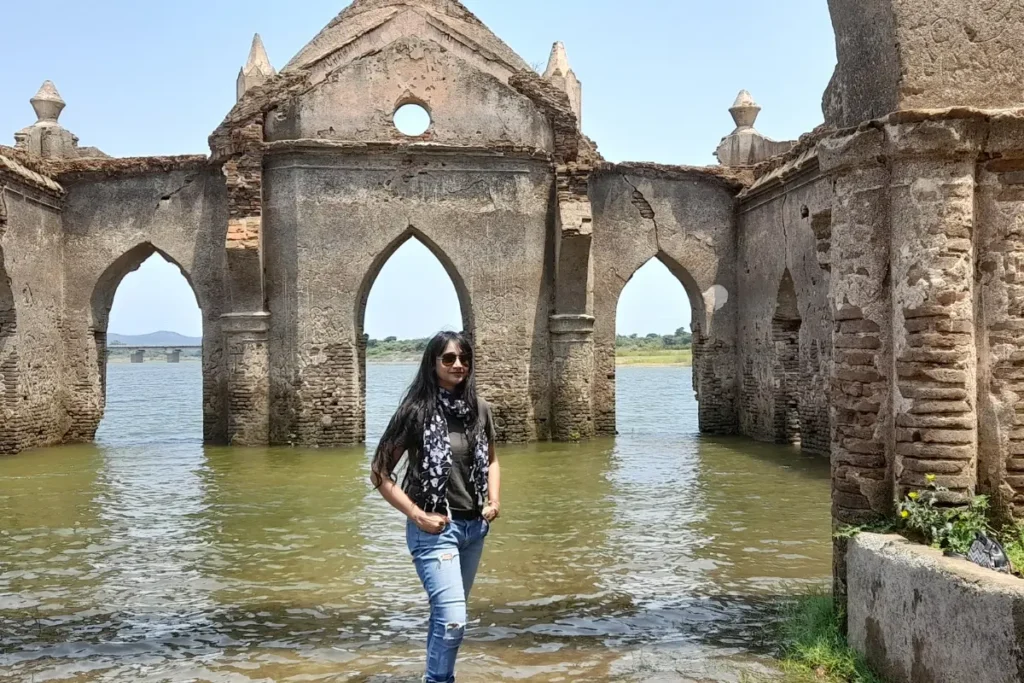
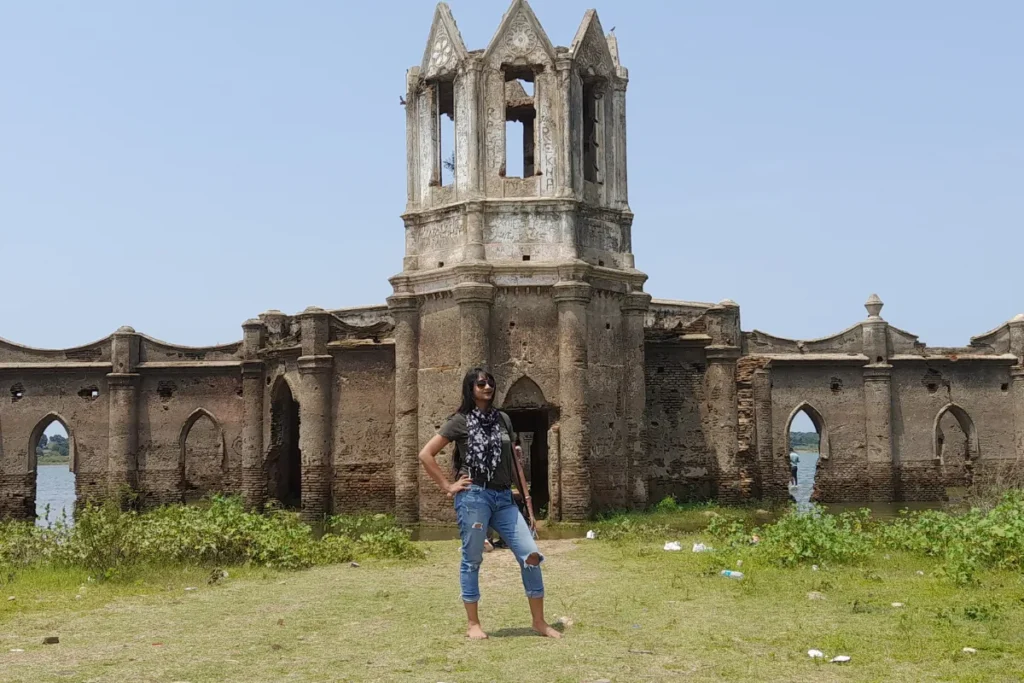
Before the road climbs into the dense elevation of the Ghats, it passes near the Gorur reservoir backwaters. We took a short, twenty-kilometer detour from Hassan to find the ruins of the Shettihalli Rosary Church. Built by French missionaries in the 1860s, this Gothic structure was abandoned a century later when the damming of the Hemavati River submerged the valley.
Depending on the season you drive past, the experience changes entirely: in the monsoons, the structure floats half-submerged in the gray water; on our dry-season trip, the water had completely receded, leaving a skeletal stone shell sitting exposed on the cracked earth. We walked right through the roofless nave. There are no ticket counters, no fences, and no crowds… just the hollow pointed arches of European stone standing silent against the sky. It is a striking, melancholic prelude to the living green landscape that follows immediately after.
The Western Ghats Drive
From the river basin, the road toward Sakleshpura begins its proper ascent into the Western Ghats. Not through the Ghats via a highway that cuts aggressively across the terrain, but through the hills at the slow, deliberate pace of a road following their natural contours.
Coffee plantations press tightly against both sides of the asphalt. The rows of dark bushes are low and dense. The air smells entirely different at this elevation… cooler, damp, and sharp. The road curves through mountain villages where the houses are built differently from the plains below, their deep, sloping rooflines explicitly adapting to the steep terrain and the heavy rainfall. We stopped when the view opened. We continued when it closed. The drive itself was the first great experience of the morning.
Manjarabad Fort
Manjarabad Fort sits above Sakleshpura, accessible via a road that climbs the hill and deposits you at the entrance. Built by Hyder Ali in 1792 CE under the Mysore Sultanate, the fort was originally called Manjarabad (from the French ‘mangalore’ or the local derivation, depending on which account you follow). Tipu Sultan completed and expanded it. The British captured it in 1799 after the fall of Seringapatam.
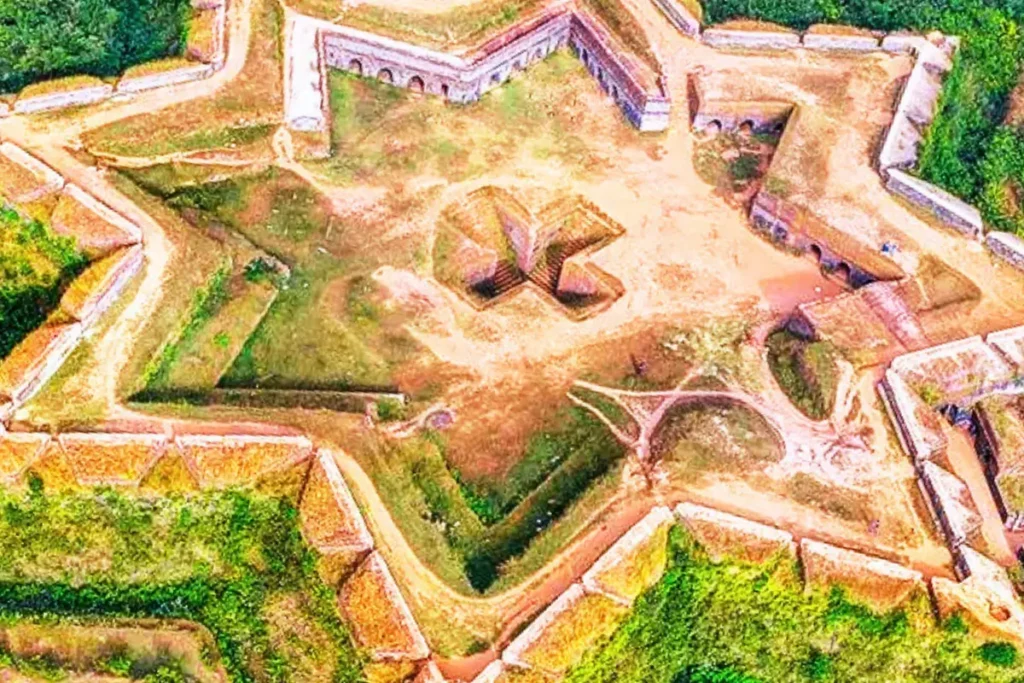
The fort is built in an eight-pointed star design: from above, the walls project outward in alternating angled bastions, creating a form that provides 360-degree defensive coverage with no blind angles. This design was influenced by European star-fort military architecture, which had been introduced to India by Portuguese and later Dutch and French military engineers. The combination of Islamic construction tradition and European defensive geometry produces something that is visually unlike any fort we have visited anywhere else in South India.
We hiked to the ramparts. The view from above: the surrounding hills dropping away in every direction, the coffee plantations visible below, Sakleshpura town visible in the valley, and on a clear morning, the coastal lowlands visible at the far edge of the Western Ghats. The fort is not large. The circumambulation of the ramparts takes twenty to thirty minutes. The view from the ramparts takes longer than that, because the view does not release you immediately.
Looking down from the ramparts at the fort’s star-shaped ground plan, the geometry becomes visible: the eight points projecting from the central hexagonal core, each one angled to provide flanking fire along the walls to either side. It is the difference between seeing a building and understanding it. The fort makes sense only from above.
“Eight pointed angles from a hexagonal core. Each one is angled to eliminate blind spots along the adjacent wall. The geometry is not decorative. It is functional. The people who built this in 1792 understood something about the field of fire that only becomes visible when you are standing at the highest point looking down.”
The Drive Back: Bengaluru by Evening
From Manjarabad Fort, we drove back through Sakleshpura and rejoined the Hassan-Bengaluru highway. The return drive takes approximately four to four and a half hours. We reached Bengaluru by evening, carrying two days of stone and elevation and coffee-scented air back into the city.
The weekend cost for two people, excluding fuel: Hotel United Kites for one night at INR 1,500, the temple guide at approximately INR 500, and food and incidentals. Under INR 6,000 total.
The return on that weekend, measured in what we saw and what we understood: a 12th-century temple read as a text rather than observed as a surface, a sculptor’s face in a frieze that a hundred visitors walk past without seeing, a Western Ghats drive through coffee country that we have not stopped recommending to people who drive, and a star-shaped fort that only reveals itself to people who climb to its highest point.
These are not experiences that required more money. They required a guide, a willingness to drive on a road that curves, and the specific patience of looking at something carefully rather than briefly.
What It Costs
| Item | Cost (Our Visit) |
| Hotel United Kites, Hassan (per night) | INR 1,500 |
| Hoysaleshwara Temple entry | Free (ASI maintained) |
| Guide at Hoysaleshwara Temple | ~INR 500 |
| Manjarabad Fort entry | Free (Nominal parking fee at the base) |
| Fuel, Bengaluru to Hassan return (estimate) | INR 1,500 to 2,000 |
| Food, two days | INR 1,000 to 1,500 |
| Total, two people excluding fuel | Under INR 6,000 |
This is one of the most cost-efficient weekends available from Bengaluru. The Hoysaleshwara Temple is free. The fort is nominal. The hotel is budget. The roads are good. The only thing this weekend requires that money cannot directly purchase is the willingness to arrive at a temple in the afternoon rather than the morning, and to hire a guide rather than saving the INR 500 and walking past a sculptor’s self-portrait without knowing it was there.
Before You Go
- Hire a guide at Hoysaleshwara. This is the single most important practical instruction in the article. The temple is a text. The guide is the translator. Official guides are available at the temple entrance. INR 300 to 500 for a thorough walk through both shrines.
- Arrive in the afternoon. The west-facing exterior catches the golden hour light. Carvings that are flat and ambiguous under overhead light become three-dimensional under low-angle afternoon sun. We arrived at 4 PM and had the right light for approximately ninety minutes.
- Halebidu is 30 km from Hassan. The drive takes approximately forty minutes. A GPS route may suggest the highway route. The minor roads through the landscape between Hassan and Halebidu are manageable and more scenic.
- Belur is 16 km from Halebidu. If your schedule allows two temple visits, Belur’s Chenna Kesava Temple is the complement to Hoysaleshwara. Different deity, different spatial quality, similar carving density. Slightly more crowded than Halebidu.
- The Sakleshpura road is the reward for the next morning. Drive slowly. Stop when the coffee plantation rows catch the light. The road itself is why this combination works as a weekend: heritage on Day 1, nature and elevation on Day 2.
- Manjarabad Fort is best appreciated from the ramparts looking down. The entry to this ASI-protected fort is completely free, though you will pay a small parking fee at the base of the hill. The star geometry is not visible from the road or from the interior. Climb to the highest accessible point and look back at the fort’s layout to understand what you are looking at.
- The return drive from Sakleshpura to Bengaluru through Hassan takes approximately four hours. Leave Manjarabad by early afternoon to reach Bengaluru by evening.
“We often travel far to find grand scales and epic horizons, completely forgetting that true wonder resides in the details. This weekend reminds us that whether it is a single craftsman’s face hidden in a sea of 12th-century stone, or a massive military fort that hides its geometry until you stand above it, the most rewarding landscapes are always the ones that force us to slow down and truly learn how to look.”