This Dubai Travel Guide is built from five days on the ground…the old alleys of Bur Dubai, the desert at sunset, the Burj Khalifa on our anniversary, and the discovery that the city’s best moments cost almost nothing.
This trip started at 3 AM with a question nobody had planned to ask.
We had been preparing to fly to Kolkata for a childhood friend’s wedding. A close friend…the kind whose occasion you rearrange your anniversary around without thinking twice. But in the final days, the behaviour shifted. Distant. Dismissive. The kind of indifference that is worse than rudeness because it confirms what you had not wanted to acknowledge.
At 3 AM, unable to sleep, we turned to each other and said: “We don’t want to go to Kolkata. Can we plan Dubai instead?”
“Yes, we can.”
Our second wedding anniversary was on February 18th. Five days in Dubai were born not from months of planning but from a 3 AM decision between two people who had been disappointed and chose, instead, to choose each other.
Dubai wasn’t entirely new to both of us. Akash had actually lived here between 2008 to 2010, working there for nearly two years. He remembers walking the alleys of Bur Dubai Creek at 18 or 19, eating at local restaurants, learning what it feels like to be young and far from home in a city that is neither gentle nor cruel but simply indifferent to everything except its own forward momentum. More than a decade later, we returned together, this time with a different life, as partners, and a camera, the alleys were still there. Different. More people, more cafes, more polish. The bones unchanged. The skin entirely new.
Coming to Dubai itself was a luxury for us. But the trip did not cost what you imagine it costs, and the experiences we remember most were not the expensive ones.
This Dubai travel guide is for anyone considering Dubai and wondering whether they can afford it.
“Sometimes life takes you in a direction you never expected. And later you realise it was for the best.”
- Why Dubai Is Two Cities in One
- Day One: Arrival, Aaya Universe, and the First View of the Burj Khalifa
- Day Two: Miracle Garden and the Desert Safari
- Day Three: Museum of the Future, Dubai Mall, and the Burj Khalifa at Sunset
- Day Four: Deira Gold Souk, The View at Palm, and the Free Beach
- What Dubai Meant
- What Dubai Costs for Two
- When to Visit Dubai
- Practical Tips
- Frequently Asked Questions About Visiting Dubai
Why Dubai Is Two Cities in One
The social media version of Dubai: the tallest building, the largest mall, the most engineered coastline. Real, but incomplete.
The other Dubai is Bur Dubai and Deira. The Creek. Abra boats that still cross for a few dirhams. Covered spice markets where the air is dense with cardamom and dried rose. Restaurants where dinner for two costs less than a single drink at a Marina bar. This Dubai existed before the oil, before the towers, before anyone decided to build the world’s tallest anything. A fishing village and pearl-diving port that decided, within a single living memory, to become the future.
The speed of that transformation…and the millions of people from every country who came to build it and stayed to run it…is what makes Dubai genuinely interesting if you know which part of the city to spend time in.
We stayed in Bur Dubai for all five days in a hotel near Burjuman Mall. The area is central, well-connected by metro, and surrounded by restaurants where Indian food costs what Indian food should cost. The same meal in the Marina would have cost four times more. That gap is where the Dubai budget question actually lives.
Day One: Arrival, Aaya Universe, and the First View of the Burj Khalifa
Flew with IndiGo Airlines from Bengaluru. Four and a half hours. Landed at 10:50 AM. Cleared immigration quickly…Dubai’s airport processes efficiently in a way that is worth appreciating after India’s busier international terminals.
First food: chicken wings at Wafi City Mall’s food court. Not the Indian lunch we were after, but functional after a morning flight.
Aaya Universe
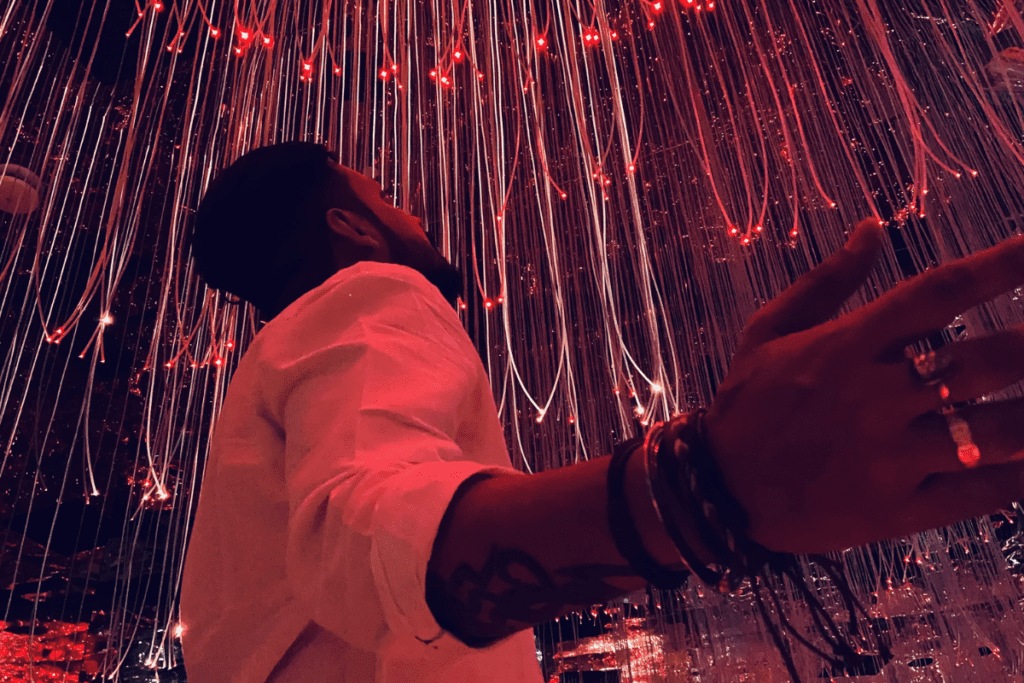
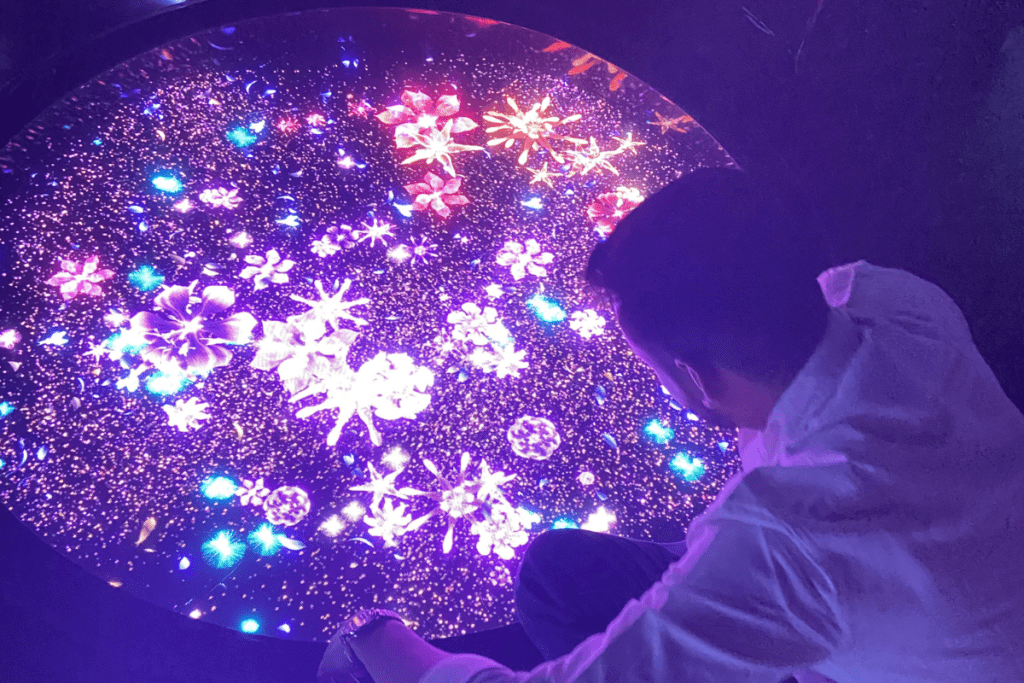
Aaya Universe is a series of rooms that each shift your sensory environment in ways that do not reduce cleanly to either spiritual or technological. One room operates at the frequency of the sound ‘HUM’ — low enough that you feel it in your chest before you register it as sound. Each room creates a different atmosphere, a different texture of experience. When you leave, something has changed. We cannot define what, exactly. The guides describe it as cosmic energy. We experienced it as a sustained disorientation that was not unpleasant.
Tickets: INR 5,088 for two. Worth it if this kind of immersive experience interests you. Not worth it if it does not. There is no middle outcome.
The Burj Khalifa at Night from Address Skyview
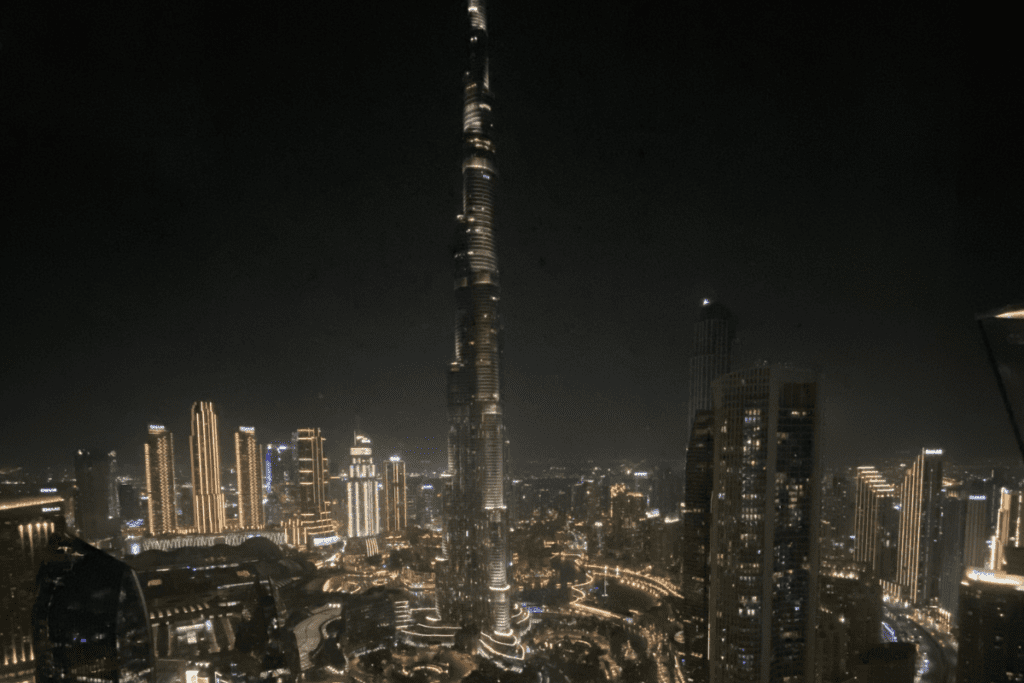
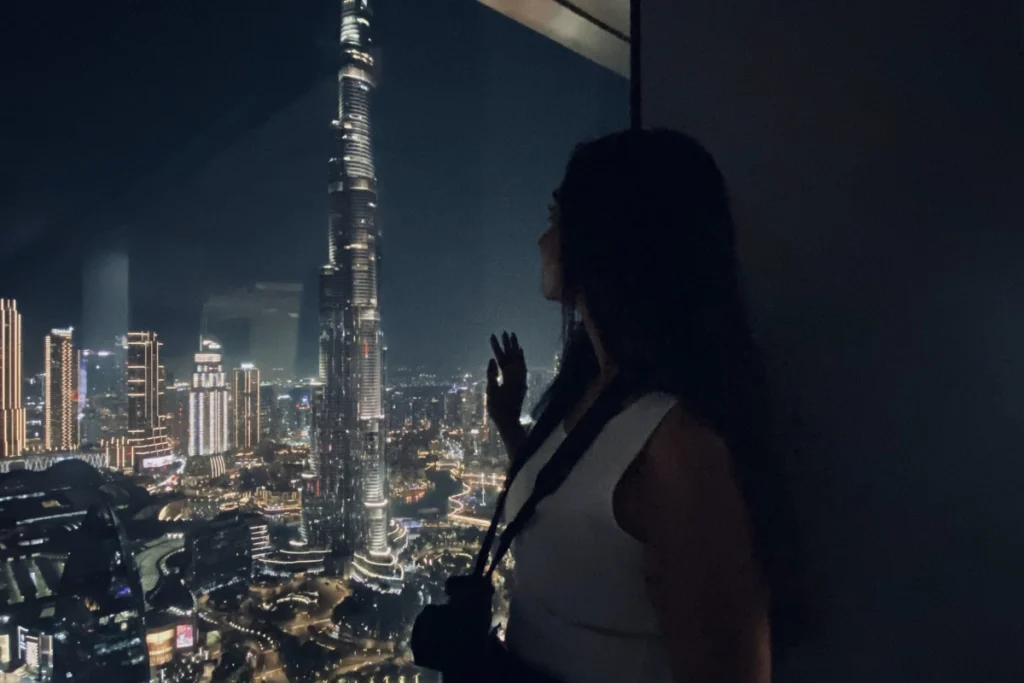
The first evening: the Address Skyview Observatory. The Burj Khalifa illuminated after dark, the city spreading below in every direction. The first time Dubai felt fully real…not the version from photographs but the actual place, with actual scale.
The Burj Khalifa light and sound show at the Dubai Mall fountain was that evening too. The crowd was dense enough that getting a clear sightline required the kind of patience neither of us had predicted needing. Sumana’s approach: keep moving until you find the angle that works. She found it eventually, from the side of the water, away from the main cluster. The show itself was worth the patience. On a phone screen, it looks like a light display. Standing in front of it, you feel the scale differently.
Dinner: a South Indian restaurant around the corner from the hotel. Kerala thali. We have eaten the same meal for four times the price in the same city, two kilometres west.
Day Two: Miracle Garden and the Desert Safari
Miracle Garden
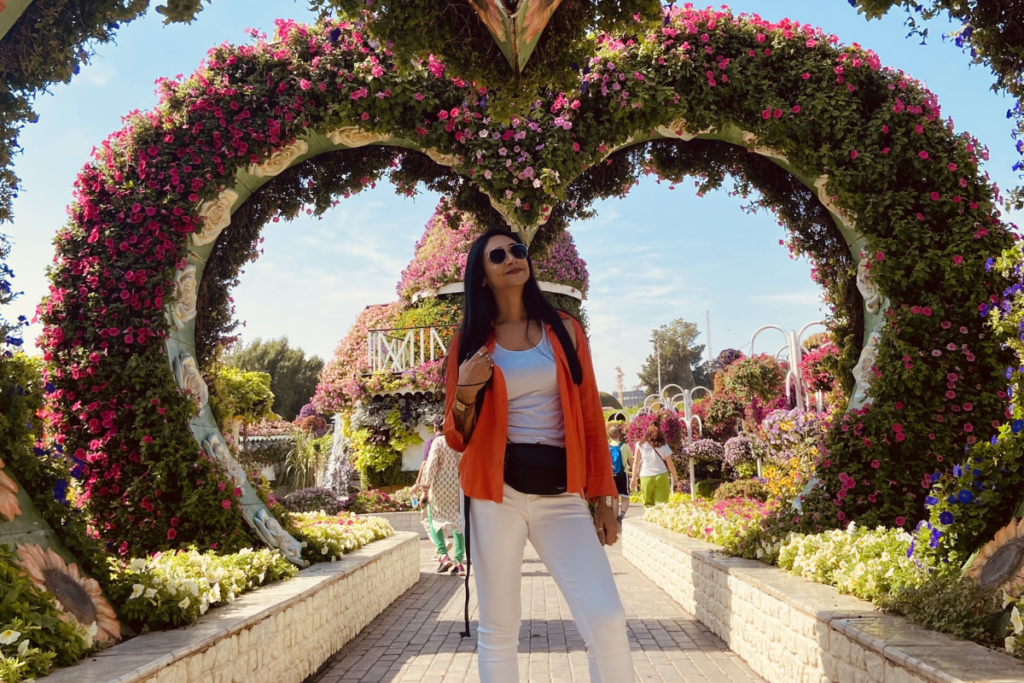
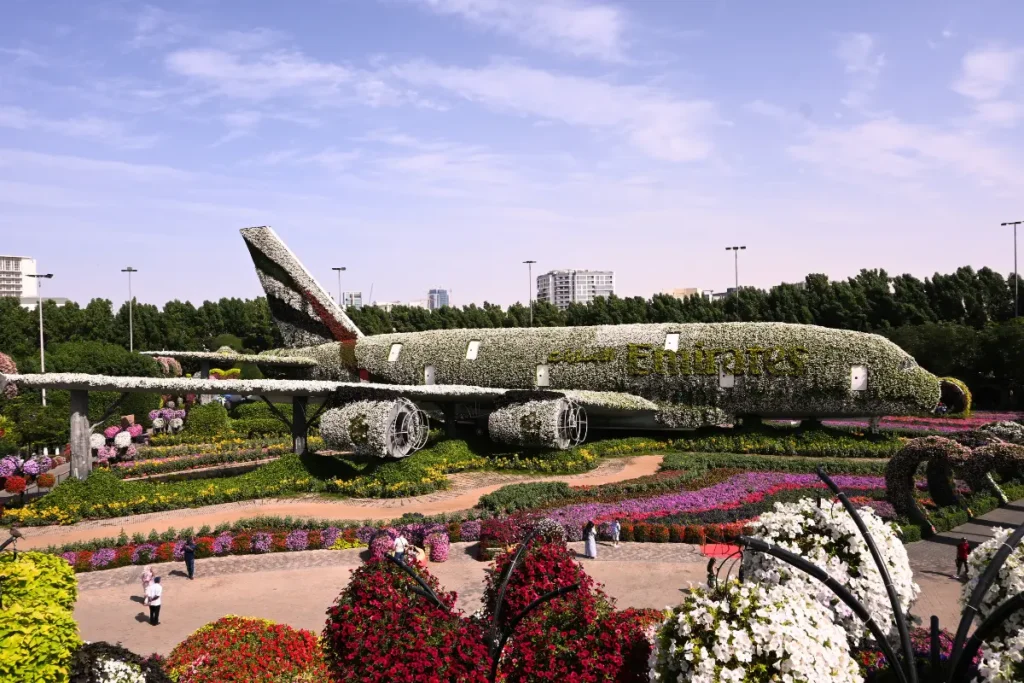
Dubai Miracle Garden opens seasonally…typically November through April. 150 million flowers arranged across a large outdoor space in designs that range from floral versions of the Emirates A380 to full-size houses covered in blooms. It is, genuinely, unlike anything else. The scale of the installation, the completeness of the concept, and the sheer improbability of this much colour existing in a desert city all land differently in person than in photographs.
The Desert Safari: An Honest Assessment
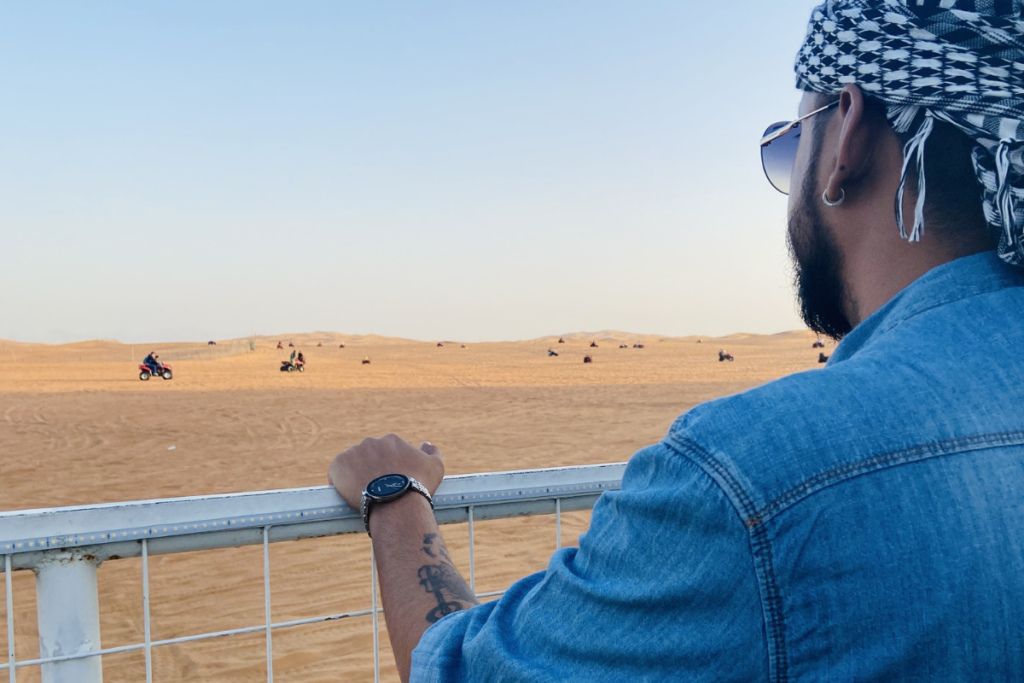
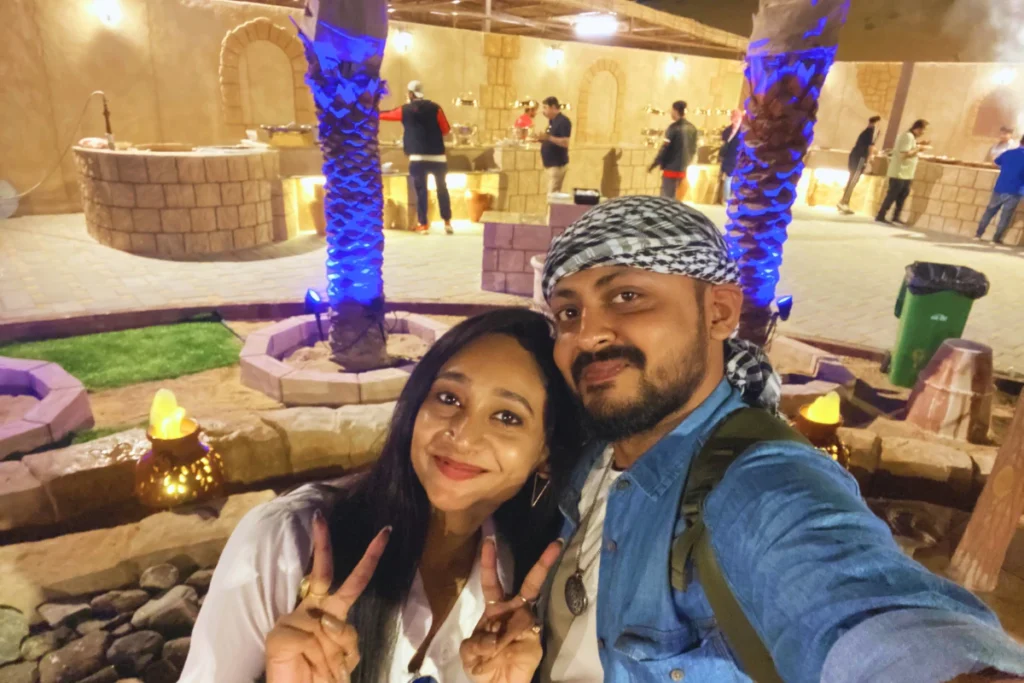
We booked through a Facebook operator rather than a hotel concierge. The quoted price before negotiation was higher. In Dubai, if you do not ask, you pay the first number. If you ask, you frequently do not.
Our driver Zeeshan was Pakistani. Every story either of us had absorbed about India-Pakistan friction was irrelevant within minutes. He was warm, organised, and genuinely good company for the drive into the desert. Dubai does something quietly that the rest of the world has not quite managed: when you come from everywhere to work hard and send money home, there is no energy left over for politics.
The honest assessment of the experience: mixed.
We skipped the quad bikes. Akash had done this same safari in 2009, when it was less commercialised and significantly better. Rather than joining the group for the dune drive, we walked to the edge of the dunes and watched the sunset alone. The desert, in those twenty minutes before the camp, did what it has always done. The crowd, the buffet, the organised chaos of a shared package tour…all of it disappeared. There was just the light dropping over the dunes and the two of us.
The camp itself was crowded. The buffet required determination rather than appetite. One important note: the food labels do not always distinguish which dishes contain beef. If this matters to you, ask before you take.
The fire dancer was exceptional. For the minutes he performed, the chaos of the camp became irrelevant. Genuinely talented. Worth the evening for that alone.
The camel ride was brief and photogenic. The dune drive in the vehicle was aggressive…at one point the car tilted forward at an angle that became funny only after it was over.
“We walked to the edge of the dunes and watched the sunset alone. The desert did what it has always done. The crowd disappeared.”
Day Three: Museum of the Future, Dubai Mall, and the Burj Khalifa at Sunset
Museum of the Future
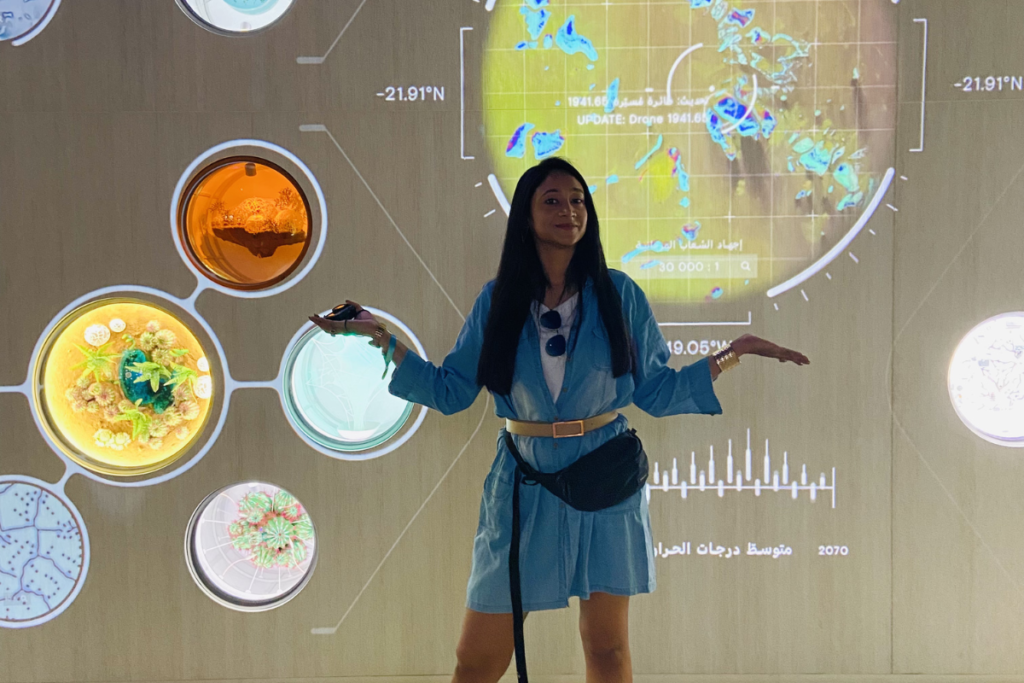
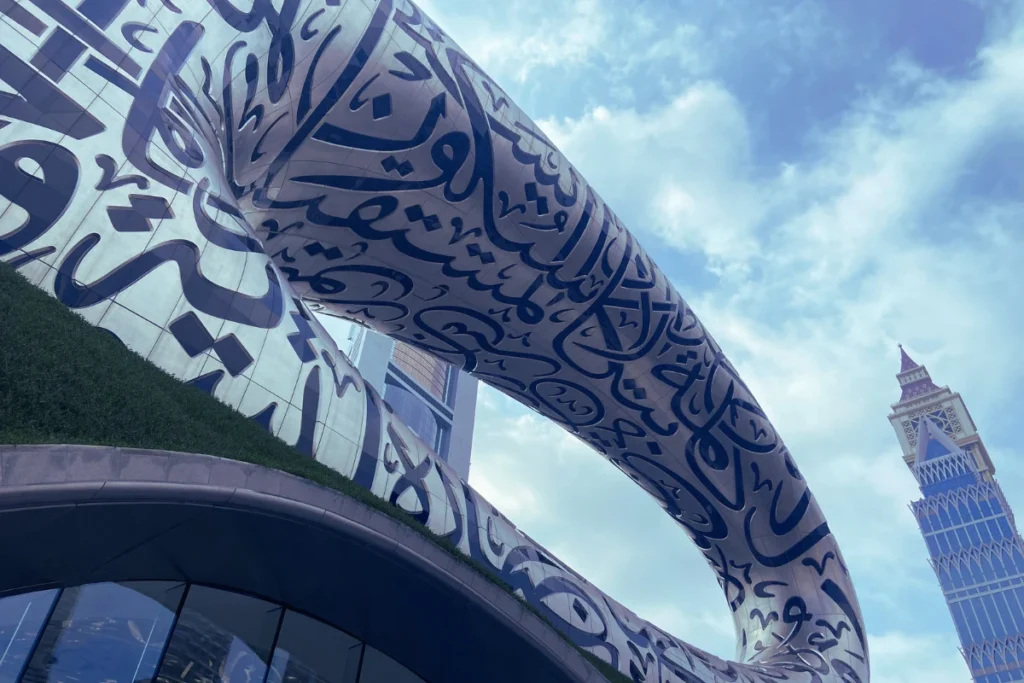
We arrived at 9 AM to beat the crowds. The Museum of the Future is, architecturally, one of the most striking buildings in a city of striking buildings…a hollow torus covered in Arabic calligraphy, which is itself a kind of provocation: a building shaped like a void, inscribed with words.
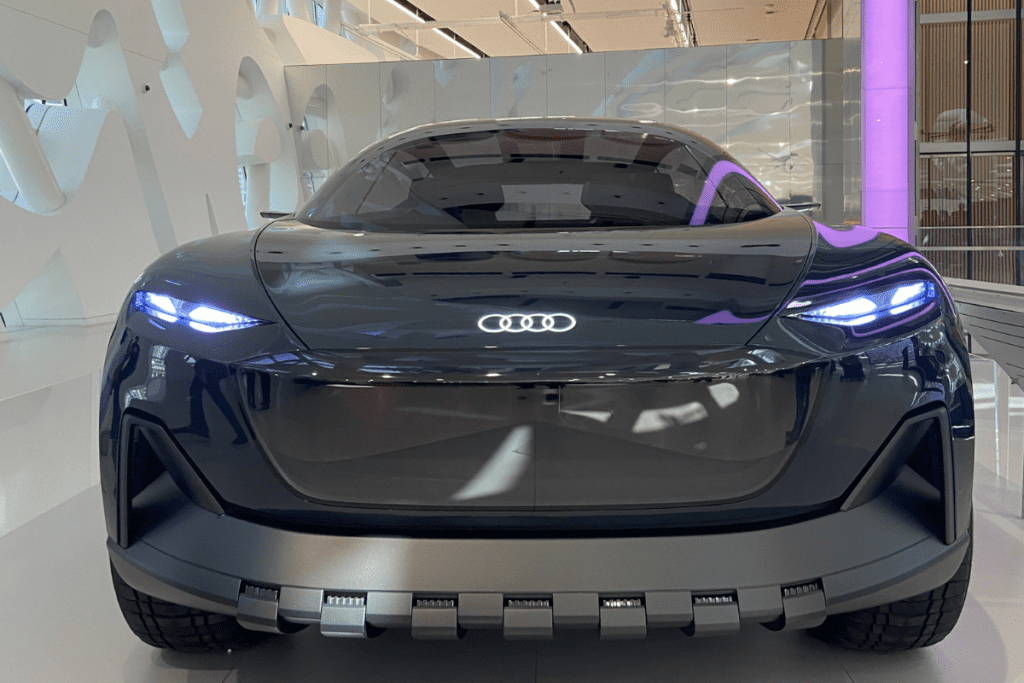
Inside: robots, a robot dog, a future car concept, a room holding thousands of stored DNA samples, and a series of environments designed to show what life might look like in 2071. It is impressive and unsettling in equal measure. The technology on display is genuine. The question it leaves behind…whether the future it shows is something we want, or something we should examine more carefully before we want it…is the one we are still carrying.
Worth it for the building, the experience, and the conversation it starts. Not worth it if you have no patience for speculative futures.
Dubai Mall and the Aquarium
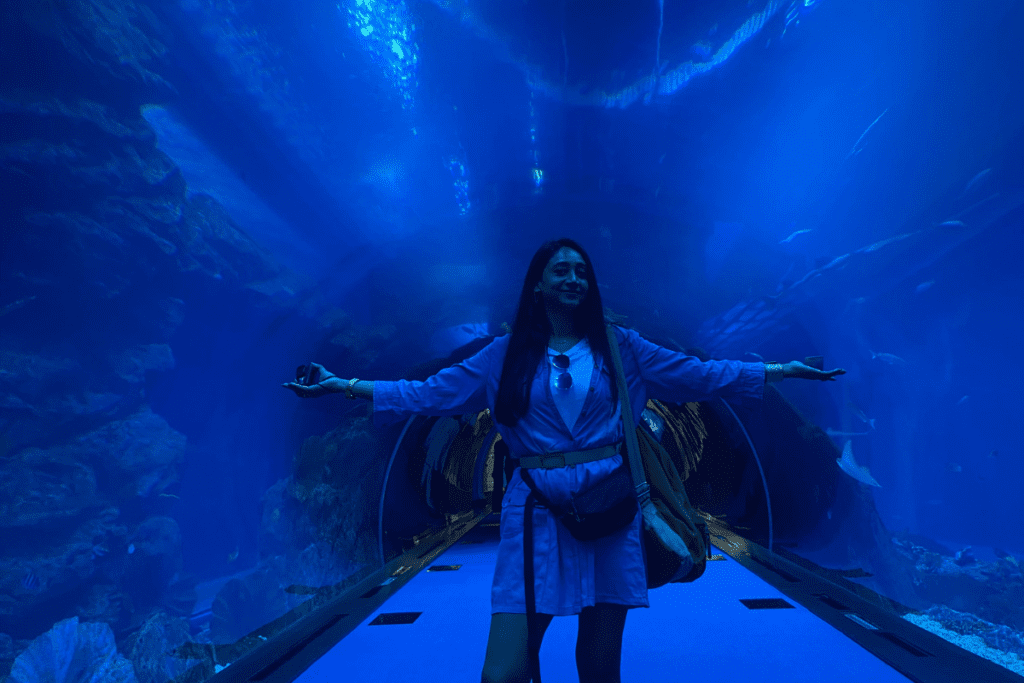
The Dubai Mall is the largest mall in the world by total area. This fact becomes physically real approximately four hundred metres into the walk from one end to the other. Lunch from the food court was the most expensive meal of the trip and still reasonable by any other city’s standard.
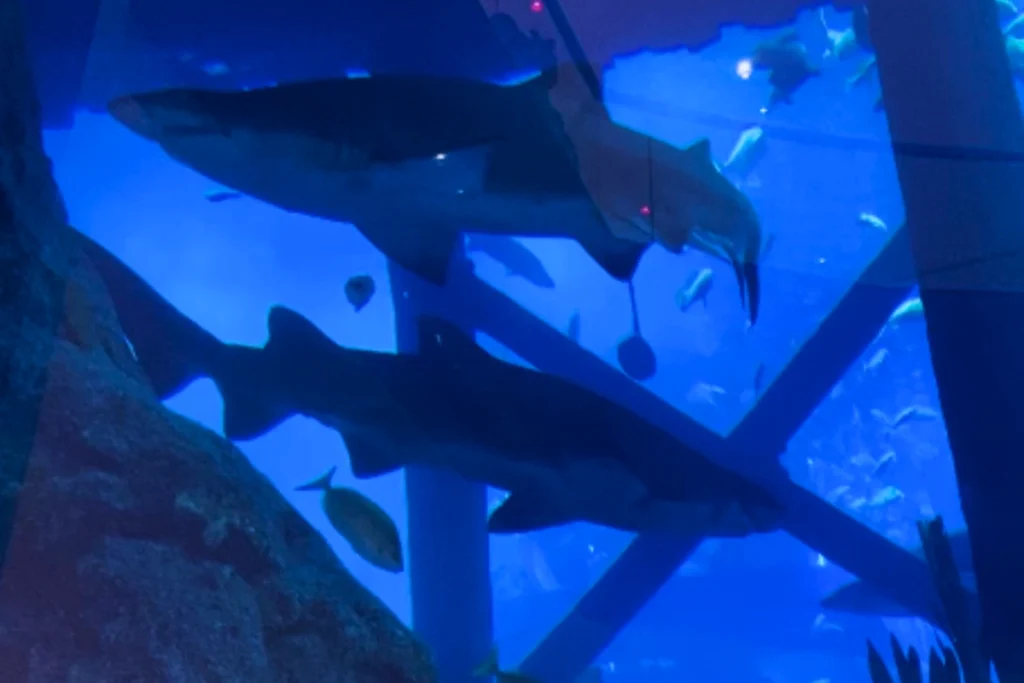
The aquarium inside the mall, a tunnel passing through a tank that holds tens of thousands of marine animals.. Worth seeing once. The tunnel is genuinely impressive. The surrounding retail environment does nothing to help the experience.
Burj Khalifa: 124th Floor at Sunset
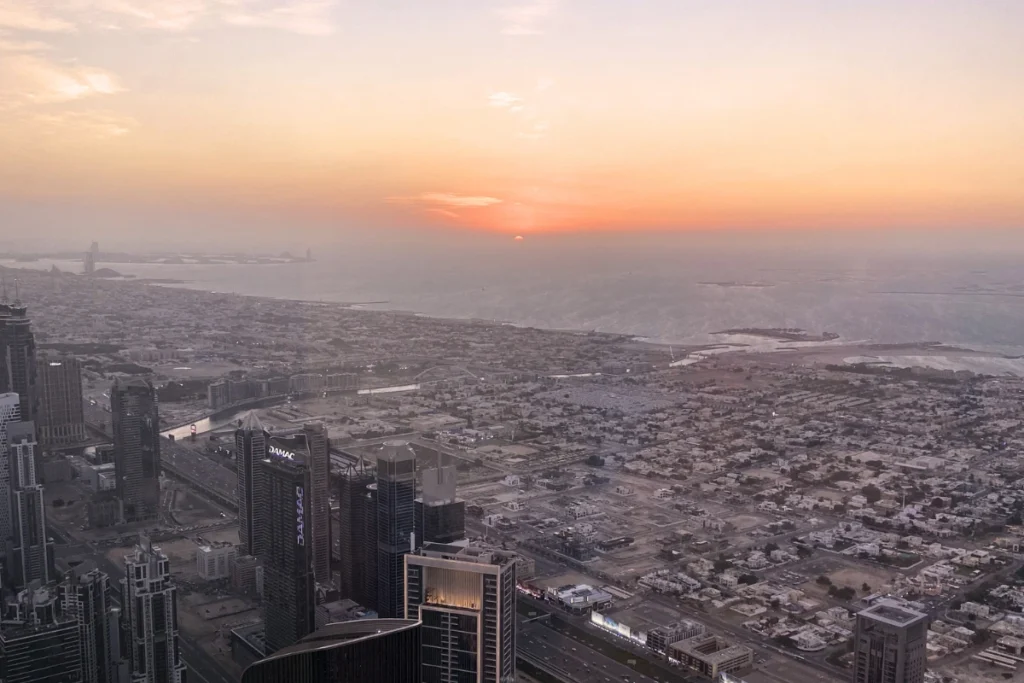
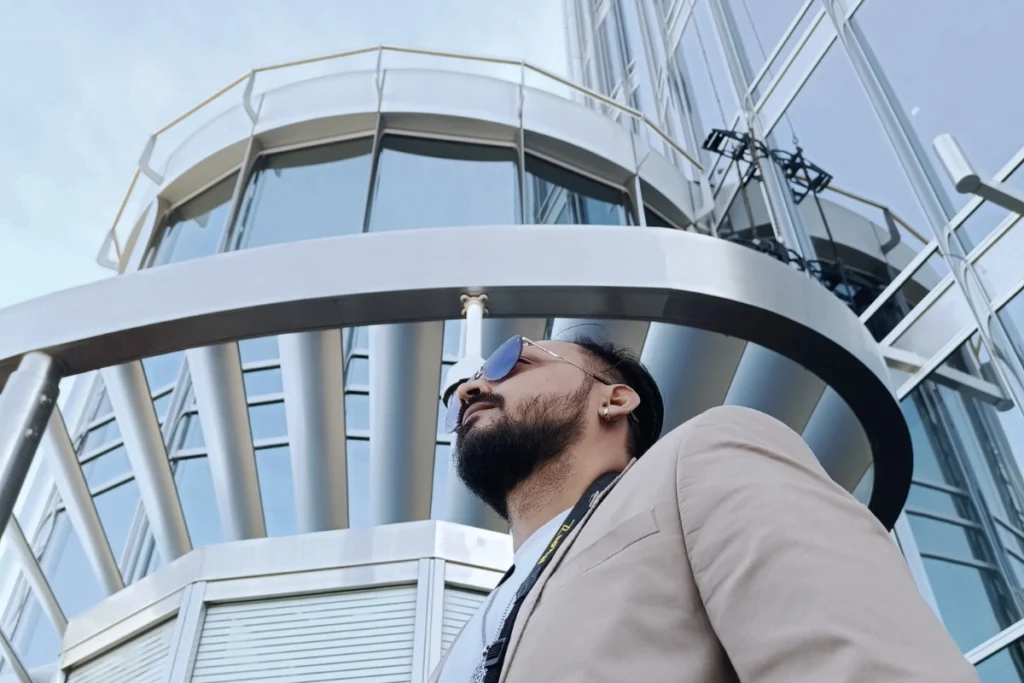
Our second wedding anniversary. February 18th. We had booked the sunset slot…the peak-pricing tier…through Klook before arriving. Access to the 124th and 125th floors, plus one free chocolate muffin from the café.
The muffin was large. We shared it. We are simple people.
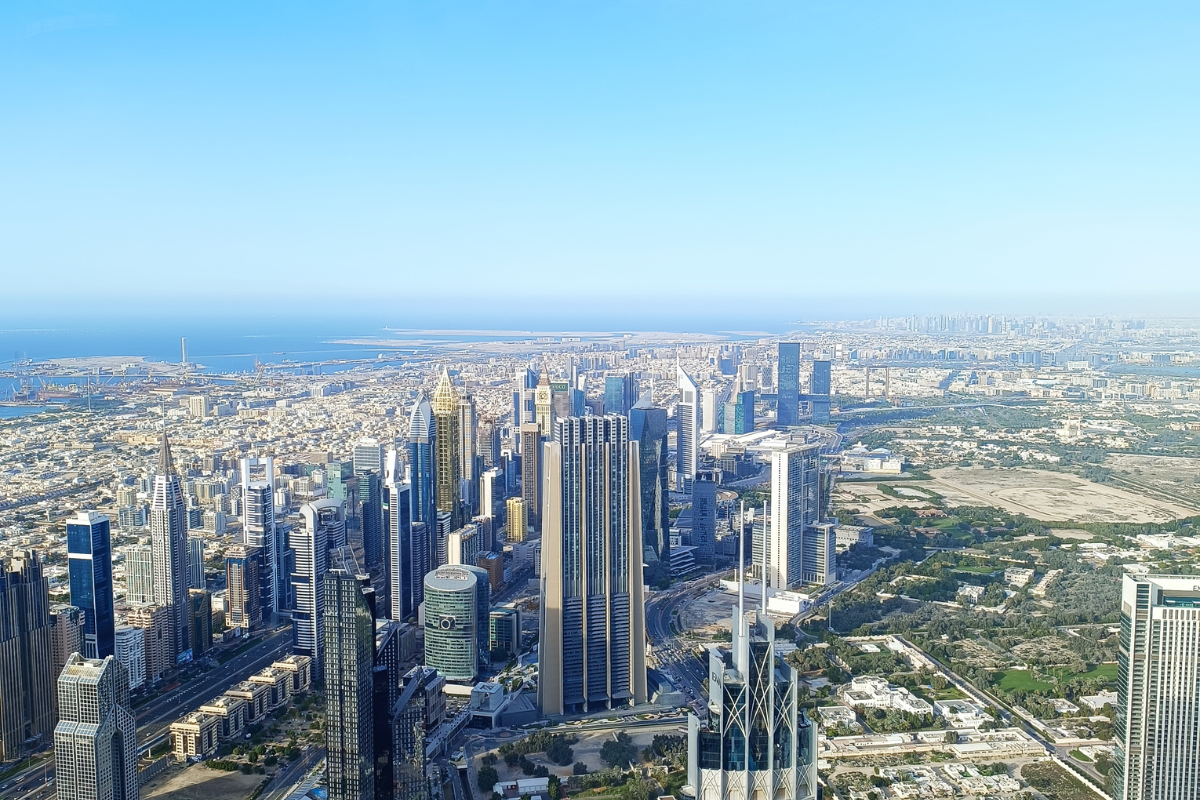
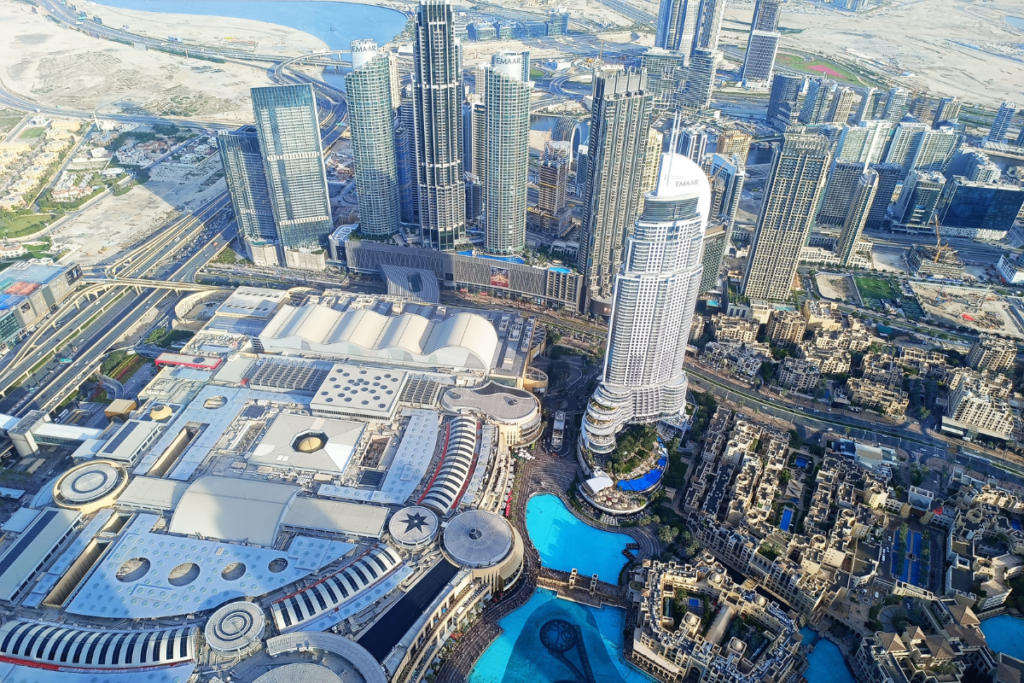
The view at sunset from 124 floors up is not like the view from below. Below, the Burj Khalifa is the tallest object in the skyline. From inside, at the top, the city is everything and the building is nowhere. The sun dropped below the horizon and the city lit up in every direction…the Marina to the west, the desert to the east, the Gulf beyond the palm. For our anniversary, this was the right choice. The price, the crowd, the ticketing…none of it mattered once the light changed.
Day Four: Deira Gold Souk, The View at Palm, and the Free Beach
Deira Gold Souk
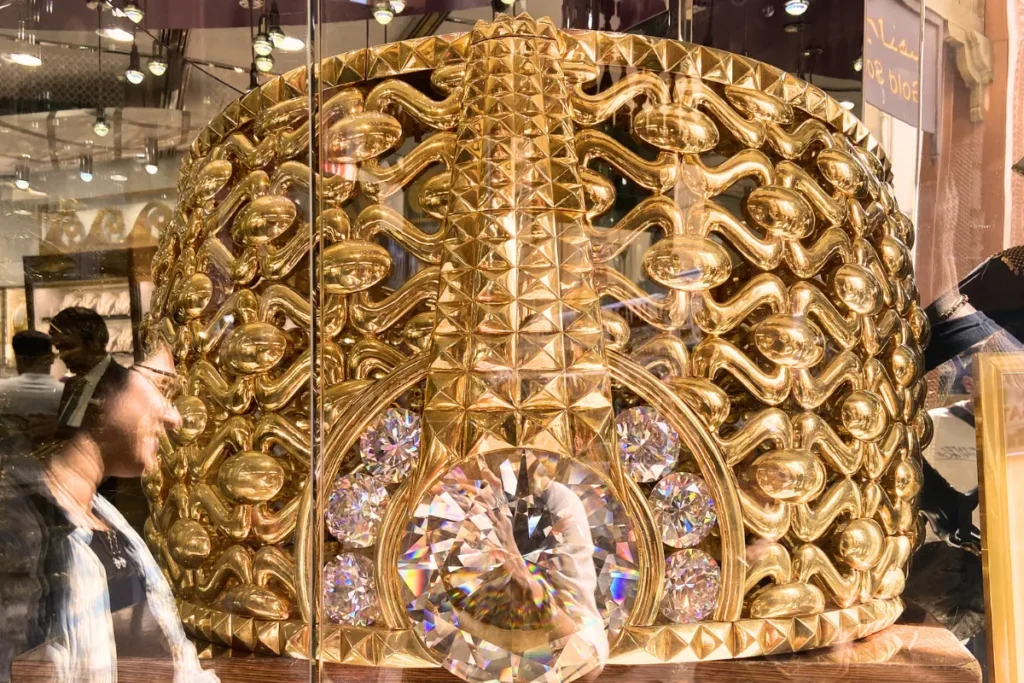
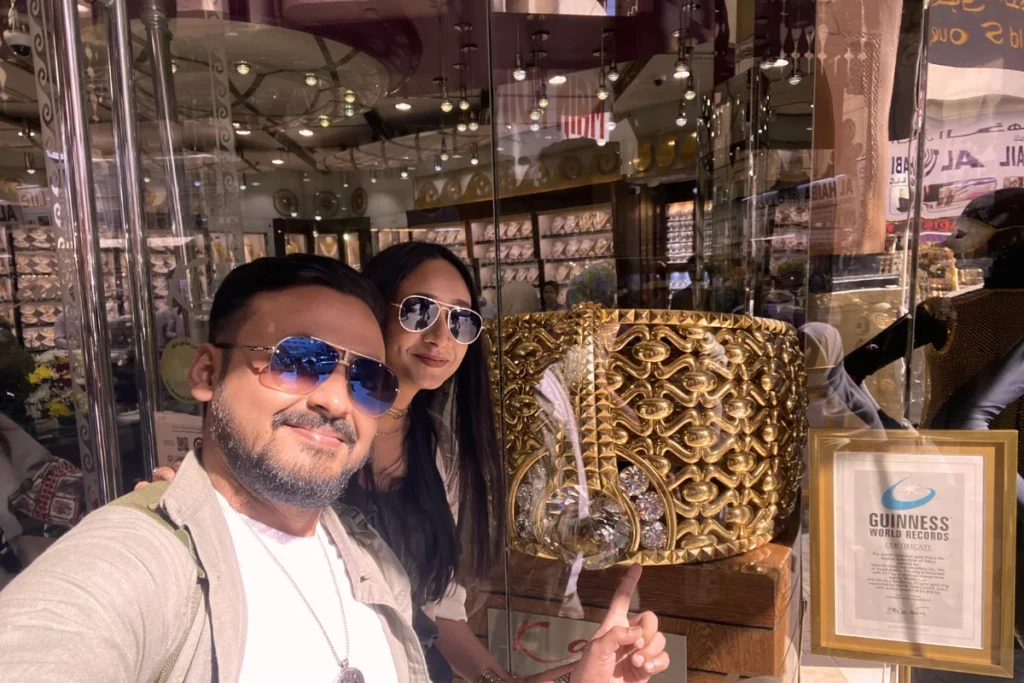
An entire district of narrow covered alleys where gold is sold by weight. The light in the corridors has a specific amber quality that comes from the display cases alone…no designed lighting achieves it. The world’s largest diamond ring, a Guinness record holder, sits in a glass case near the entrance. Free to look at. Free to feel thoroughly outclassed.
Sumana’s response to the Gold Souk was that she was overwhelmed in a way she had not expected. Not because she was looking to buy anything, but because the quantity and scale of what was on display exceeded the imagination’s preview.
The View at Palm
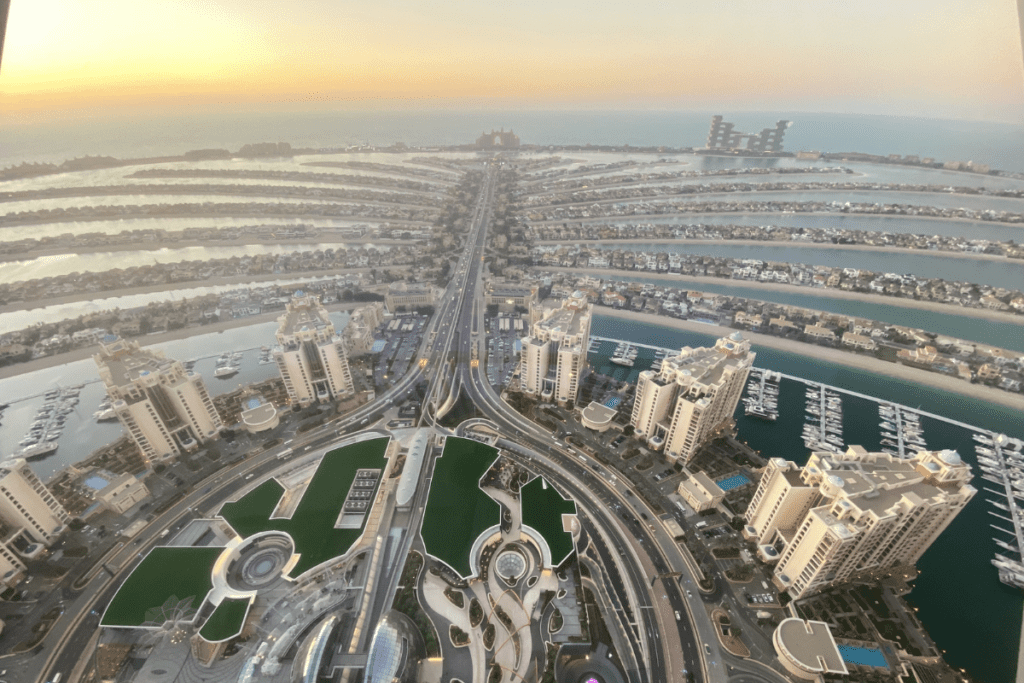
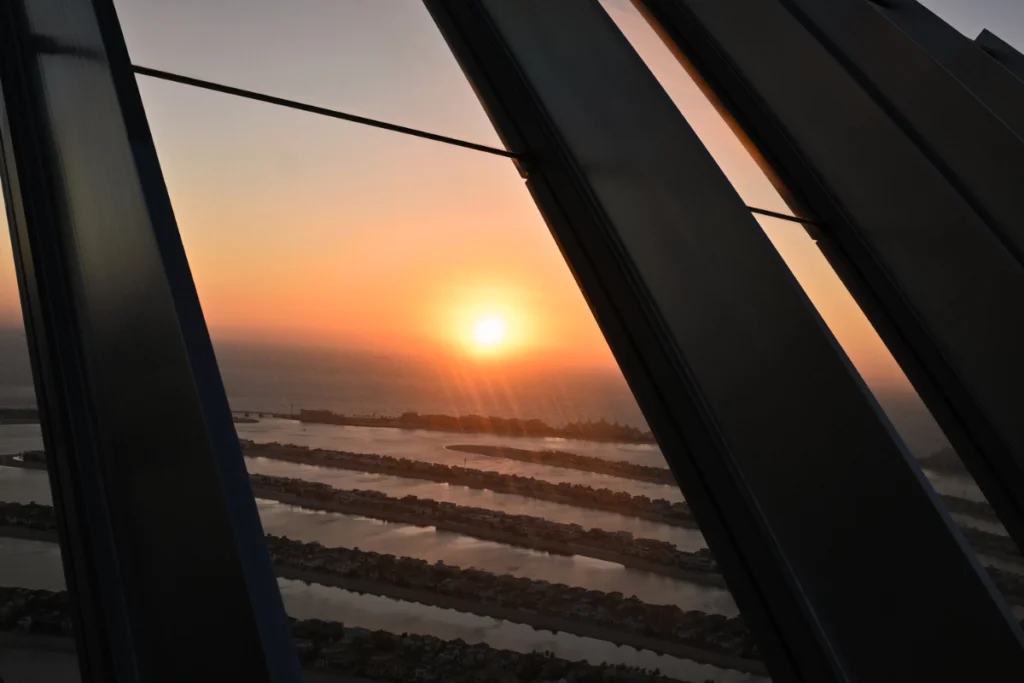
The Palm Jumeirah from above at sunset. The engineered island, which looks like a map projection from street level, becomes legible only from height. The view was worth the price…but crowded. The sunset from the observation deck was genuinely beautiful. The fact that the entire island did not exist thirty years ago, and that it is now visible from space, sits in your chest differently when you are looking down at it from the inside.
Dubai Marina Walk
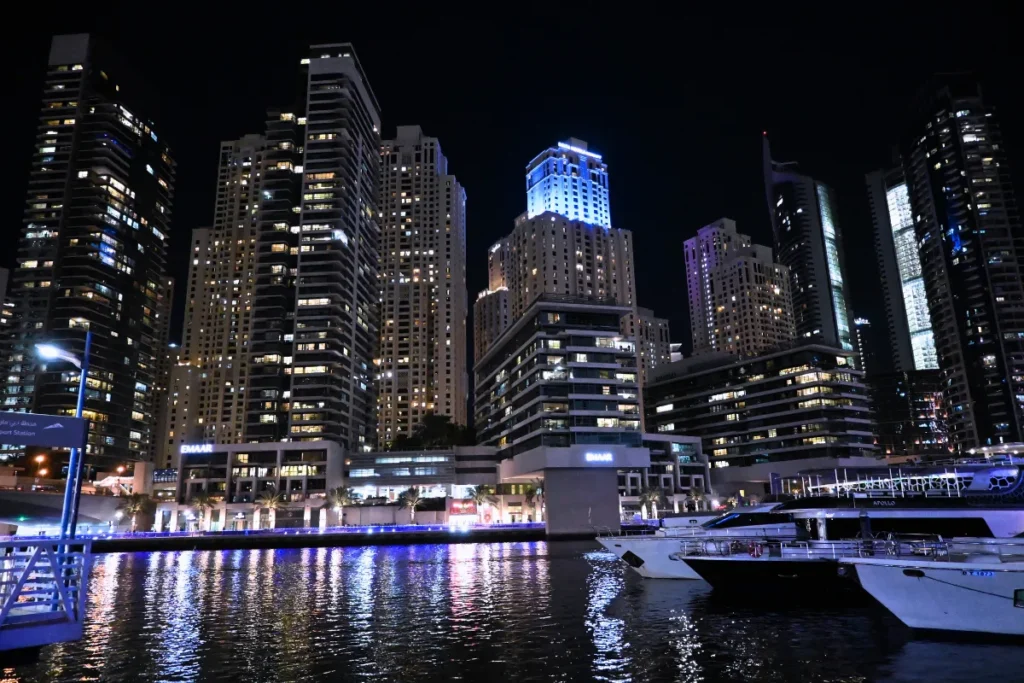
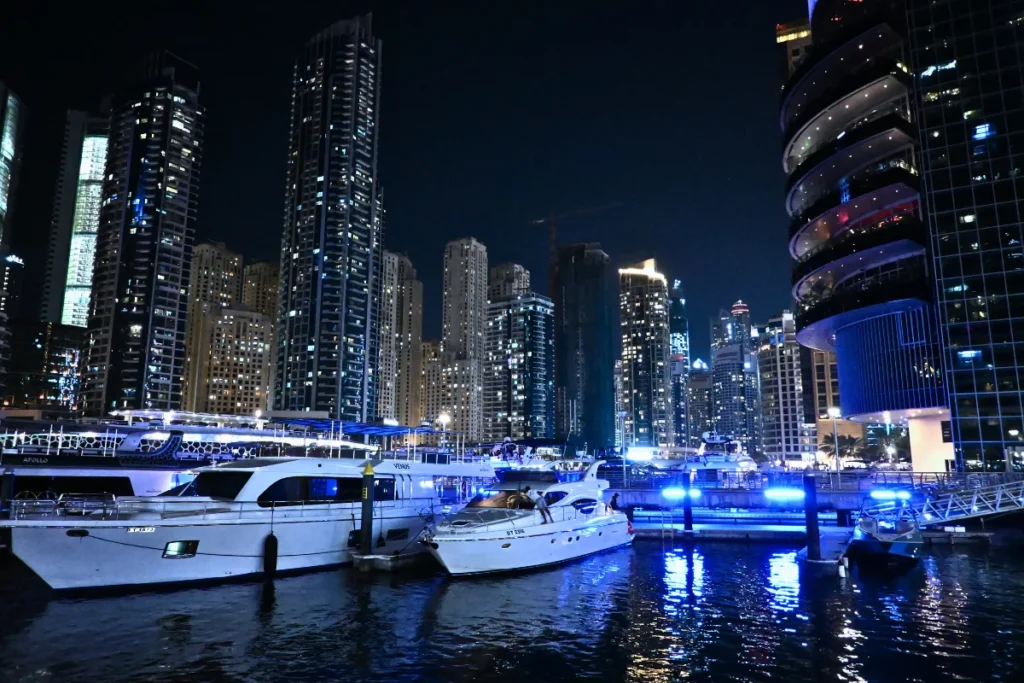
Boats, towers, and the kind of polished surfaces that make everything look slightly aspirational and slightly unreal. We considered a boat ride and declined. We had done the Nile cruise in Egypt…three nights on the water in a context that the Marina’s hour-long tourist circuit cannot meaningfully compete with. Some experiences recalibrate your expectations for everything after. The Nile did that for us.
The Free Beach Near Burj Al Arab
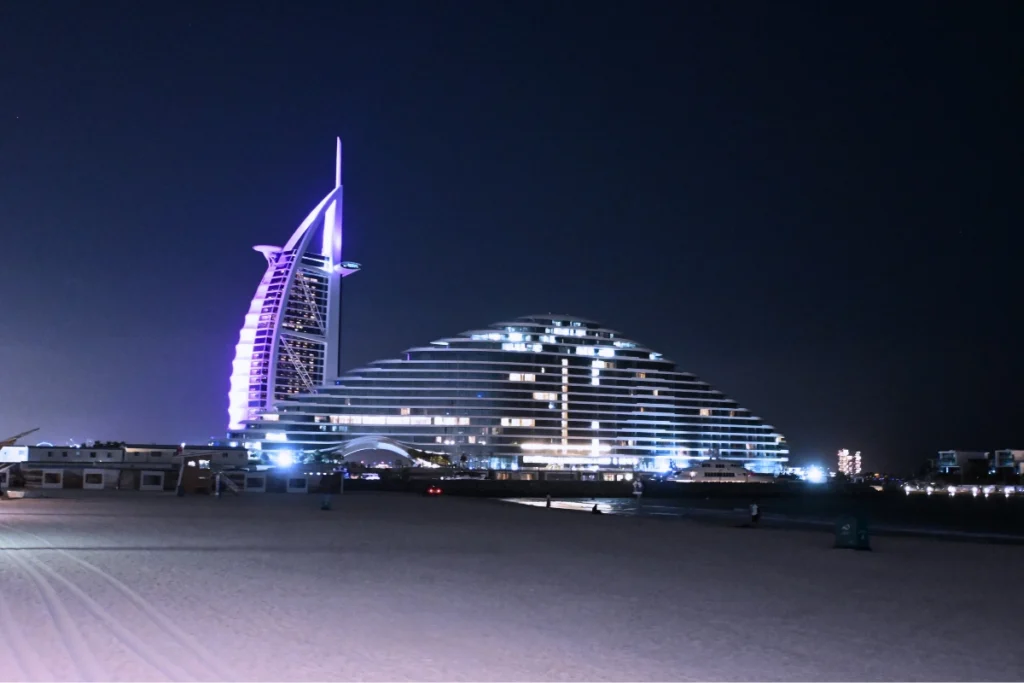
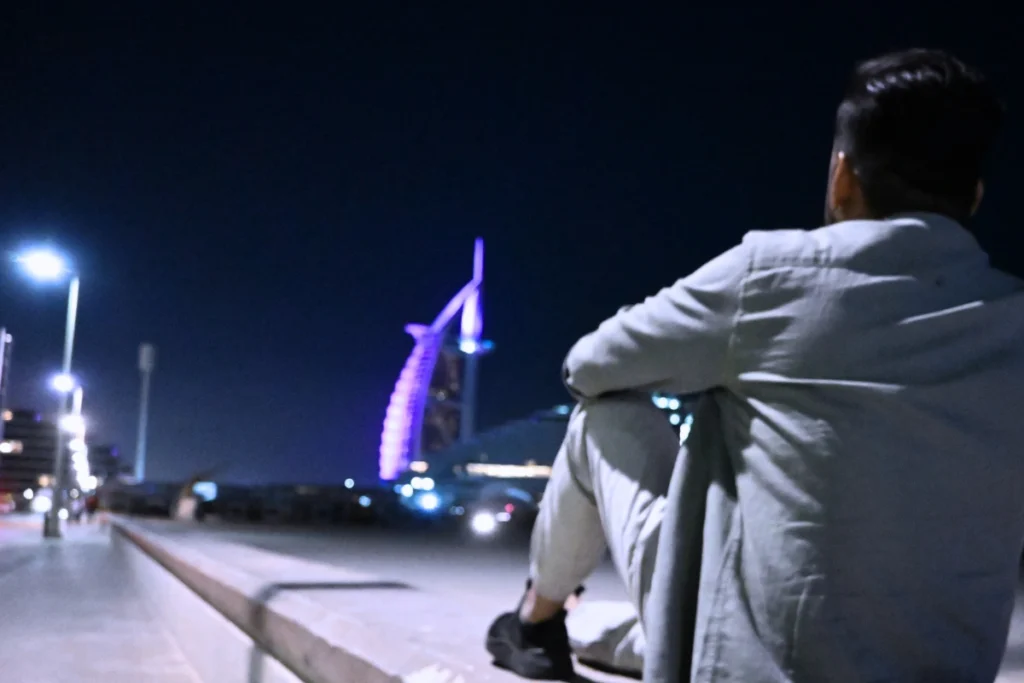
The most surprising moment of the trip.
No ticket required. No reservation. A public beach with a direct sightline to the most photographed hotel in Dubai. We arrived at night, after the Marina walk, without jackets. February nights on the Dubai coast carry a desert chill that nobody mentions in the travel marketing…genuinely cold, wind off the Gulf, temperature that makes you want something you did not pack.
We stood on the sand, freezing, looking at the Burj Al Arab lit up across the water, and both started laughing. Nothing about that moment matched what we had imagined it would be. It was perfect, and it cost nothing.
What Dubai Meant
Walking through the same Creek alleys at 30-something that Akash had walked at 18. Standing on the 124th floor on our anniversary with a free muffin and a sunset that cost considerably more. Freezing on a public beach in front of the most photographed hotel in Dubai.
Nostalgia is a strange compass. It points toward a place that no longer exists in the form you remember, and the gap between memory and reality is where something honest lives. The alleys are different. The people have changed. The bones are the same.
Dubai is spectacular…genuinely, incomprehensibly spectacular in the way that only a city built in fifty years can be. But underneath the glass and the engineering, it is a city of people who came from somewhere else, who work very hard, who send money home, and who have no energy left for anything other than the work in front of them. That story, the human one underneath the spectacular one, is the story we carry longest.
This trip should have been a wedding in Kolkata. It became our second anniversary in Dubai. We believe, looking back, that it was the better version.
What Dubai Costs for Two
Dubai’s costs vary significantly depending on where you stay, how you get around, and which version of the city you choose to participate in. The figures below are rough ranges to give you a sense of scale. Prices shift with season, demand, and how far in advance you book. Always verify current rates before planning. Detailed breakdowns are in the dedicated articles.
| Category | Rough Range (INR) | Approx. USD | Notes |
| Flights (per person, return) | INR 25,000 – 45,000 | ~USD 300 – 540 | Varies widely with airline, booking window, and season |
| Budget hotel, Bur Dubai (per night) | INR 5,000 – 10,000 | ~USD 52 – 105 | Mid-range options in the Marina cost significantly more |
| Desert safari (per person) | INR 2,000 – 5,000 | ~USD 21 – 53 | Negotiate; avoid booking through hotel concierge |
| Major attractions (per person) | INR 2,000 – 5,000 | ~USD 21 – 53 | Burj Khalifa, Museum of the Future, Miracle Garden etc. Book on Klook |
| Taxis – Careem or Uber (per day) | INR 2,500 – 6,000 | ~USD 30 – 72 | Metro cuts this roughly in half |
| Local restaurant meal (per person) | INR 700 – 1500 | ~USD 7 – 16 | Bur Dubai and Deira; tourist zone prices are significantly higher |
Three decisions made the budget work: staying in Bur Dubai rather than the Marina or Downtown; eating at local restaurants rather than near the attractions; and booking everything on Klook before arriving rather than at the door.
The most memorable experience of the trip…standing on a free public beach in the dark, freezing, watching the Burj Al Arab glow across the water…cost nothing. The Creek walk that night cost nothing. The twenty minutes watching the desert sunset before the safari camp cost nothing beyond the safari price. Dubai does not require a large budget. It requires a deliberate one.
When to Visit Dubai
November through March. February was close to ideal for us: clear skies, warm days, genuinely cold nights. Summer in Dubai exceeds 45°C, which makes any significant outdoor activity…including the desert safari…essentially impossible. If your dates are fixed in summer, adjust the itinerary accordingly toward indoor experiences.
Practical Tips
- Book all major experiences on Klook before you arrive. The savings are real, and sunset slots at the Burj Khalifa sell out days in advance.
- Stay in Bur Dubai. The accommodation is cheaper, the food nearby is dramatically cheaper, and the metro connects you to everything.
- Negotiate anything not printed on a fixed menu. Desert safaris, tour packages, and supplementary add-ons are always quoted above what the operator will accept.
- Carry a jacket in February. The coast at night is genuinely cold. We learned this the hard way at the Burj Al Arab beach.
- For transport, taxis via Careem or Uber are the easiest option on a short trip. A metro-first approach cuts transport cost roughly in half if you have time to plan the routes.
- Indian food is available throughout Bur Dubai and Deira at prices comparable to Indian restaurants in Indian cities. Kerala thali, mandi, rogan josh…all available within walking distance of a Bur Dubai hotel.
- At the desert safari buffet: check before you take. Not everything is labelled, and beef dishes are not always clearly marked.
- The Deira Gold Souk is free to visit. The world’s largest diamond ring (a Guinness record holder) is free to look at. The exit, however, requires willpower.
“Dubai does not require a large budget. It requires a deliberate one. The city has two versions. This guide is the one that costs less and stays longer in the memory.”