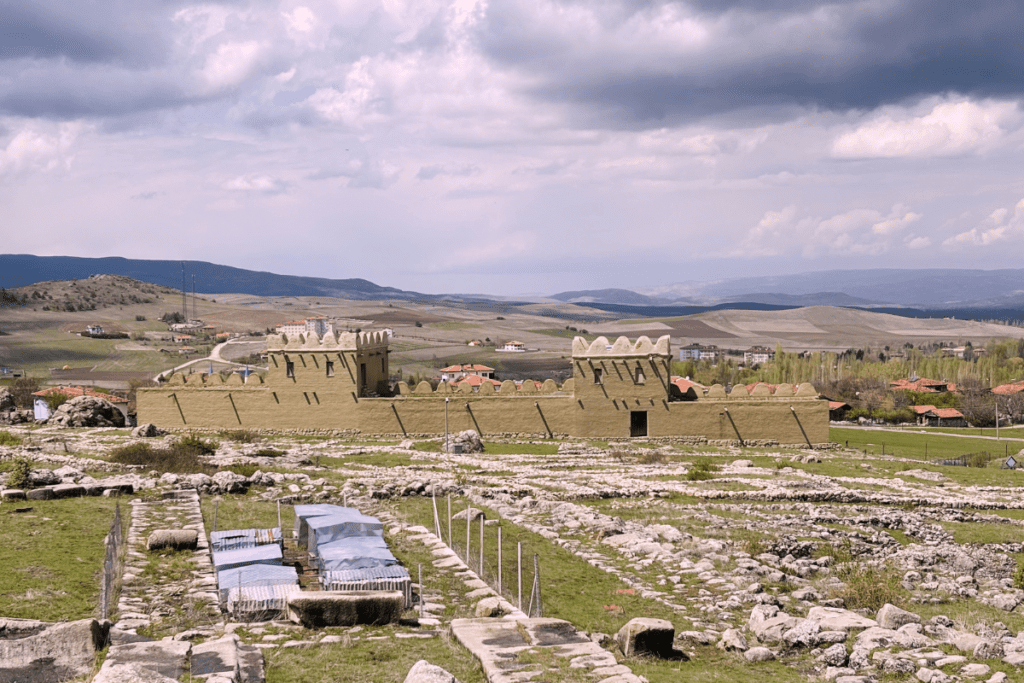
Standing guard over central Anatolia for more than 3,300 years, the monumental Hittite War God relief at Hattusa remains one of the most compelling artistic survivals of the Bronze Age. Located at the King’s Gate in the ancient capital near modern Boğazkale, this 2.25-metre carving provides a direct link between archaeological discovery and real-world military design. Here is your essential guide to understanding the history, misidentifications, and museum connections behind this ancient guardian.
The gate is called the King’s Gate. The figure carved beside it is not a king.
This is the first thing to understand about one of the most striking survivals of the Hittite Empire: the name is wrong, it has been wrong since 1907, and nobody has bothered to change it because by the time the mistake was identified, the name had already stuck to the stone the way names do when enough decades pass without anyone objecting.
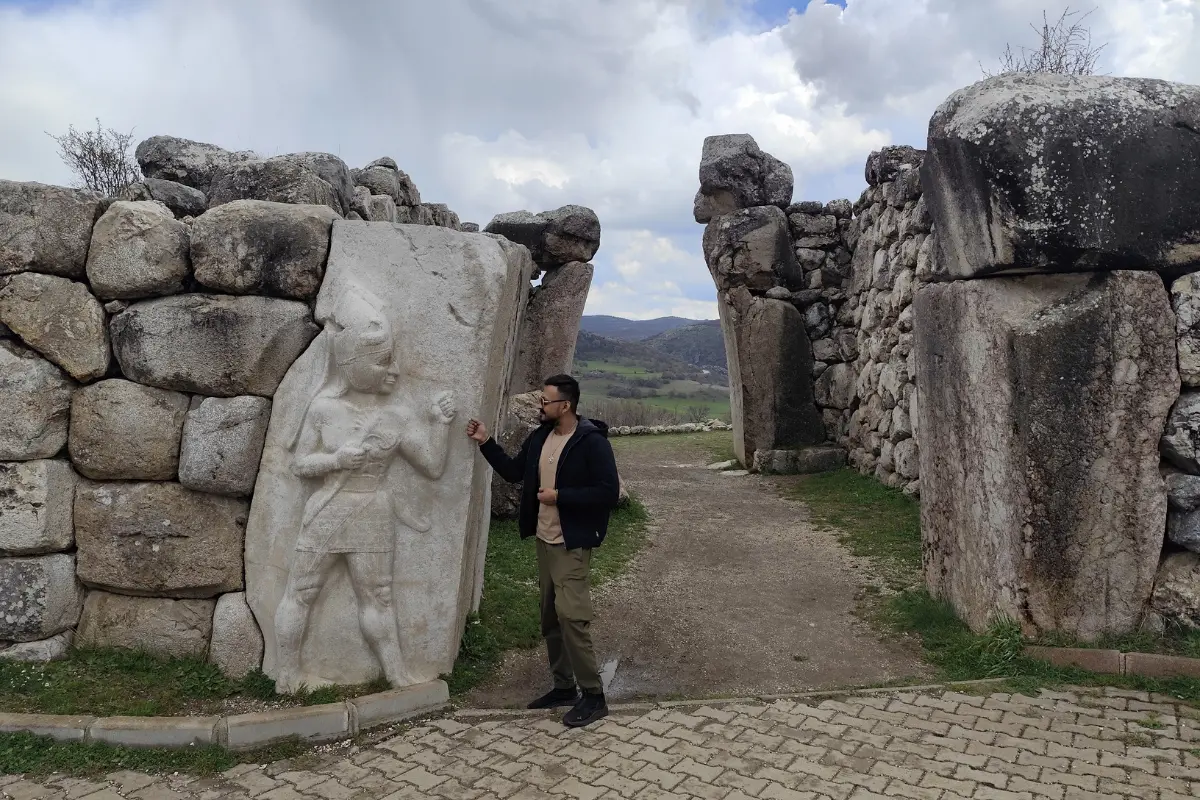
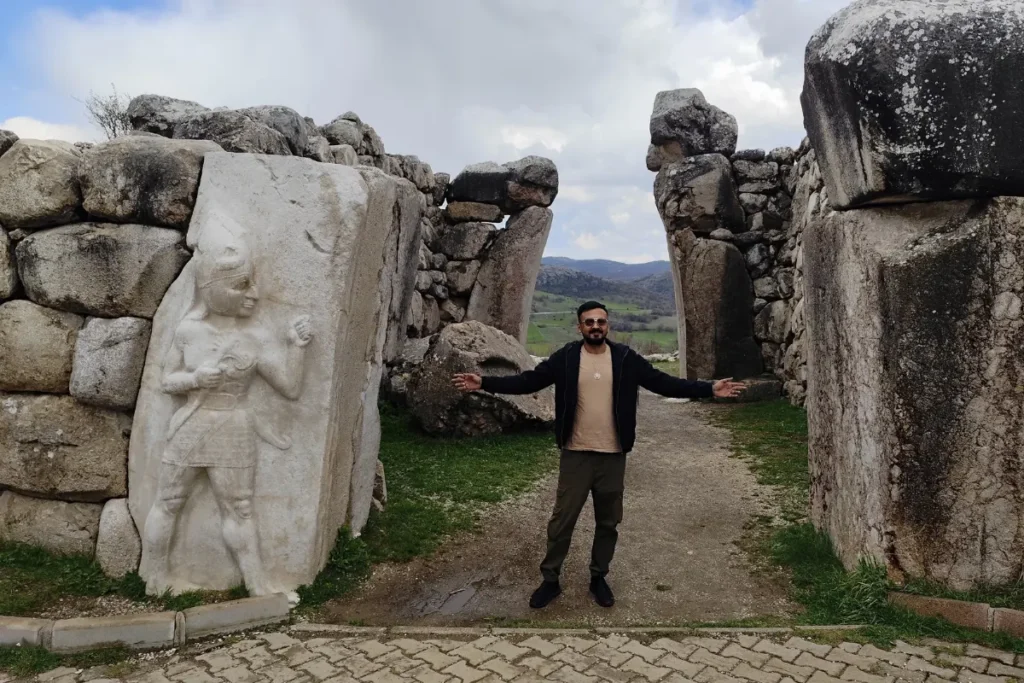
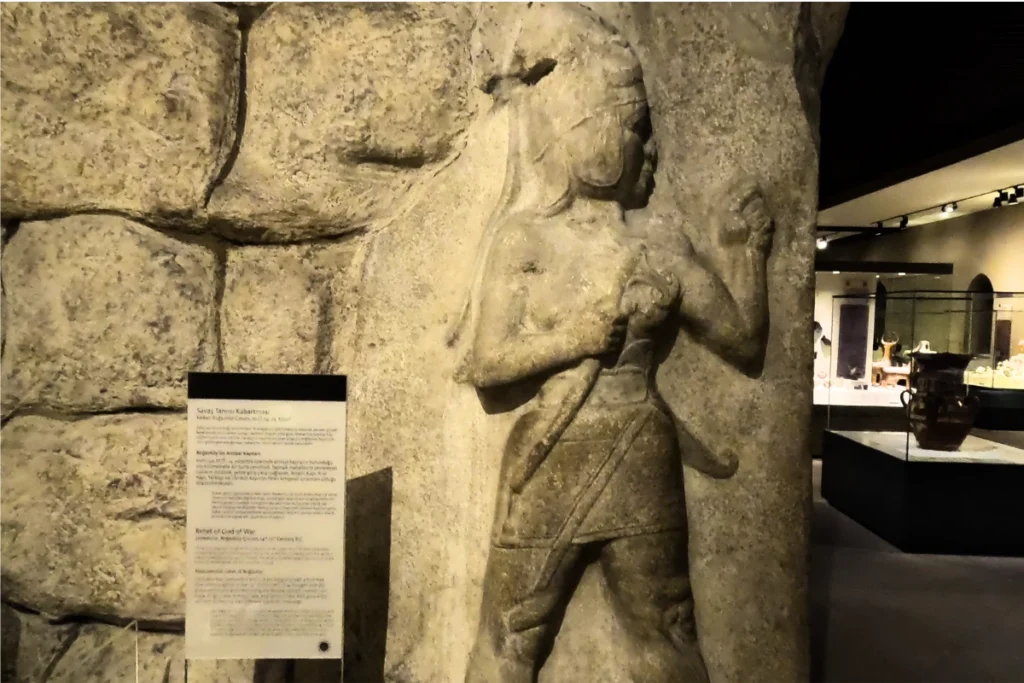
We stood in front of the warrior at Hattusa on Day 4 of our road trip, in the rain, on a plateau in central Turkey where the Hittite capital once held an empire that negotiated with Egypt as an equal. The figure beside the gate is 2.25 metres tall, carved in high relief, holding an axe, wearing a horned helmet, dressed in a short kilt, and looking out past us toward a horizon he has been watching for 3,300 years with the specific patience of a soldier who has been told to guard a door and has taken the instruction seriously across three millennia.
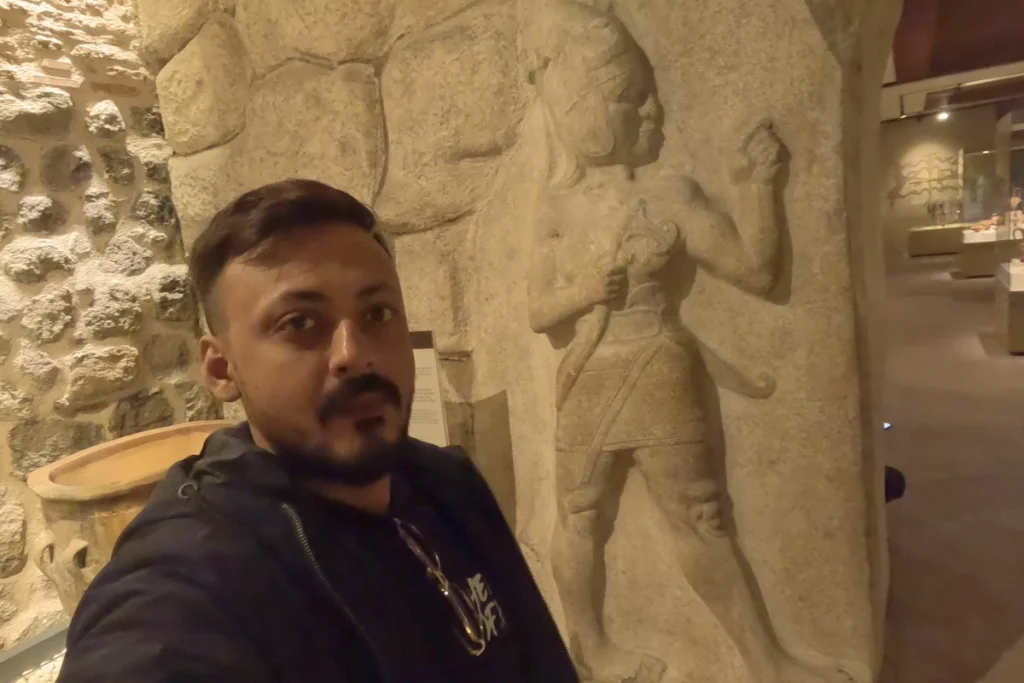
What we saw at the gate was a copy. The original is in the Museum of Anatolian Civilizations in Ankara, which we had visited the day before without realising we were looking at the thing we would later meet, in replica, at the gate it came from. The sequence was backward. We met the original first, in a museum, under controlled lighting. We met the copy second, at the gate, in the rain. The copy, standing in its original position, guarding its original door, carried more weight than the original behind glass. Context does that. The museum preserves the object. The gate preserves the meaning.
“He was called a king for sixty years. Then he was called a god. He was nearly called a woman before Puchstein defended his team’s ability to tell fur from hair. He wears a helmet that a museum 60 km away can prove was real. He stands 2.25 metres tall at a gate named after the first mistake anyone made about him, guarding a door that no longer opens, in a capital whose empire ended 3,300 years ago.”
Who Is He?
The figure is a warrior. Beyond that, the identification has shifted over the decades as researchers have argued about what the carving actually represents.
When Otto Puchstein’s team excavated the gate in 1907, they found the relief on the inner left pillar and concluded it depicted a Hittite king, specifically the king who had built the gate. The logic: a large, imposing, heavily armed figure in a prominent position on a monumental gateway was presumably a ruler asserting his authority. The gate was named accordingly. The King’s Gate.
The reclassification came later, and it hinged on a single detail: the horn.
The warrior’s helmet has a curved horn projecting from the front. In Hittite religious iconography, horns on a helmet were reserved for gods. Kings did not wear horned helmets in Hittite art. Gods did. The presence of the horn moved the figure from the category of “king” to the category of “deity,” most likely a war god or a protective god stationed at the gate to guard everyone who passed through it.
Current scholarship identifies the figure as a god, possibly the Storm God Teshub, possibly his son Sharruma, possibly a specific war deity whose name has not survived. The debate about which god continues. The agreement that it is a god, rather than a king, is now standard. The gate, however, is still called the King’s Gate, because renaming a 3,300-year-old monument to correct a 118-year-old labelling error is the kind of administrative task that never reaches the top of anyone’s list.
The Gender Argument Nobody Talks About
There was a second debate about the warrior, and it is more entertaining than the king-versus-god question.
Early in the study of the relief, an American archaeologist named Miss Dodd suggested that the figure might be female, interpreting certain features of the carving as indicating a woman rather than a man. Puchstein, the excavator, rejected this interpretation with a response that has survived in the literature and deserves to be quoted for its specific flavour of early-20th-century archaeological confidence.
Puchstein wrote, approximately: “I may not be as competent as Miss Dodd in assessing the ancient Hittite gender criteria, but I cannot admit that I and my comrades would have confused fur with human hair.”
The exchange is a small artefact of its own: a disagreement about the gender of a 3,300-year-old stone warrior, conducted between an American researcher and a German excavator, preserved in the academic record, and resolved (for now) in favour of a male identification based on the musculature, the clothing, and the warrior iconography. The figure is now understood to be a male god. Miss Dodd’s suggestion did not prevail. But the fact that the question was raised, and that Puchstein felt compelled to defend his team’s ability to distinguish fur from human hair, adds a human texture to the otherwise solemn business of identifying ancient deities.
What He Is Wearing and Why It Matters
The warrior is dressed with specificity. This is not a generic figure. The sculptor rendered particular equipment with particular care.
The helmet: Conical, pointed, with wide cheek guards and a protective neck collar. A single curved horn projects from the front, marking the figure as divine. A ribbon or tassel hangs from the peak of the helmet down to elbow length.
The kilt: A short, richly patterned wrap-around skirt. The patterning is detailed, suggesting woven or decorated fabric rather than plain cloth.
The axe: Held in the right hand, raised. A ceremonial battle axe with a backward-curved blade. A tassel hangs from a cord on the handle.
The sword: Tucked into a wide belt on the left side. A short sword with a crescent-shaped grip, held in a curved scabbard.
The hair: Long, falling to the shoulders at the back.
The musculature: Defined. The chest, the arms, the legs are rendered with an anatomical attention that communicates physical power. This is a figure built for violence, carved by someone who wanted viewers to understand that the god guarding this gate could enforce the guarding personally.
The detail is the point. The sculptor was not producing a symbol. He was producing a portrait of a specific kind of warrior, equipped in a specific way, and the specificity turns out to be historically verifiable in a way that almost no ancient relief can claim.
“The museum preserves the cold, isolated facts of an ancient object behind glass, but returning to the gate restores its purpose… context doesn’t just display the artifact; it revives the god.”
The Helmet That Proves the Sculptor Was Telling the Truth
In 2002, archaeologists excavating at Şapinuva, a Hittite cult centre approximately 60 km from Hattusa, found a bronze helmet in a building designated Building D. The helmet was an offering to the Hittite Storm God, deposited alongside bronze axes, armour scales, and spearheads.
The helmet is conical, with a pointed crest, rivet holes at the neck and cheeks, and a form that matches the helmet carved on the King’s Gate warrior with a precision that stopped the archaeologists who identified the correspondence.
The carved helmet and the physical helmet are the same design. The relief was not an artistic invention. The sculptor was depicting real Hittite military equipment, accurately, in limestone, 3,300 years ago. The bronze helmet from Şapinuva is the physical object. The King’s Gate relief is the portrait of that object being worn. Together, they confirm that the sculptors of the Hittite Empire were working from life, rendering actual armour with enough accuracy that a helmet buried 60 km away as a religious offering matches the helmet carved on a god guarding a gate.
This is rare. Most ancient depictions of equipment cannot be matched to surviving physical examples, either because the equipment did not survive or because the depictions were stylised beyond verification. The King’s Gate warrior and the Şapinuva helmet are a matched pair separated by 60 km and reunited by archaeology, and the match proves that when the Hittite sculptor carved the god’s helmet, he was looking at the real thing.
The helmet is now displayed at the Çorum Archaeology Museum. The relief is in Ankara. The warrior who wears the carved version of the helmet still stands at the gate in Hattusa, in replica, guarding a door that no longer leads anywhere, wearing equipment that a museum 60 km away can prove was real.
Standing in Front of Him
The experience of standing before the warrior, even the copy at the gate, is physical.
He is larger than life. At 2.25 metres, he exceeds human height by enough to require looking up. The high-relief carving projects the figure outward from the stone, so he is not a flat image but a near-sculpture, his limbs and equipment rendered almost in the round. The effect is of a figure emerging from the gateway rather than being inscribed onto it. He is coming out of the stone, axe raised, to meet whoever approaches.
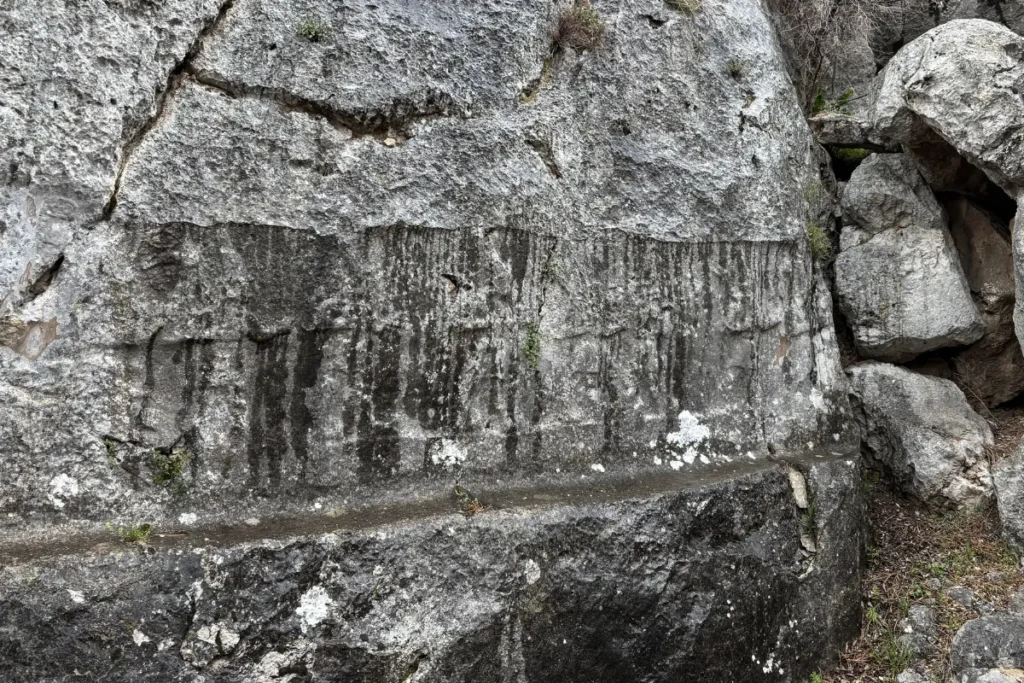
The rain, on the day we visited, added to the encounter. Water ran down the limestone. The surface darkened. The carved musculature caught the wet light. The warrior looked less like an artefact and more like a presence that the weather was failing to disturb. The Hittite capital around us was a field of foundations and reconstructed walls. The warrior was the one figure on the site who still looked ready to do his job.
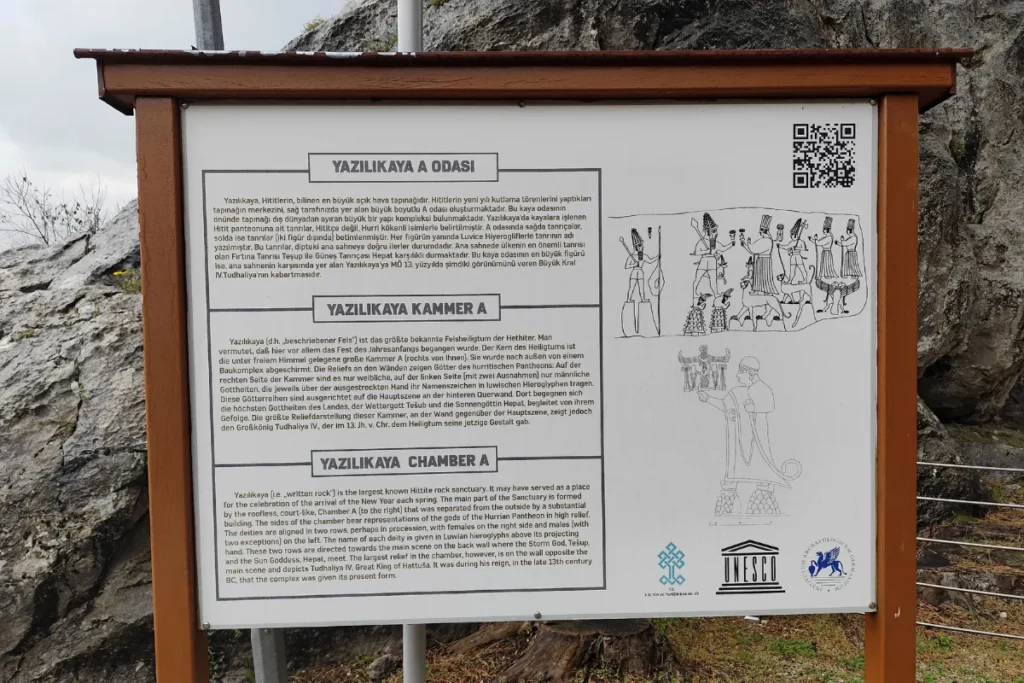
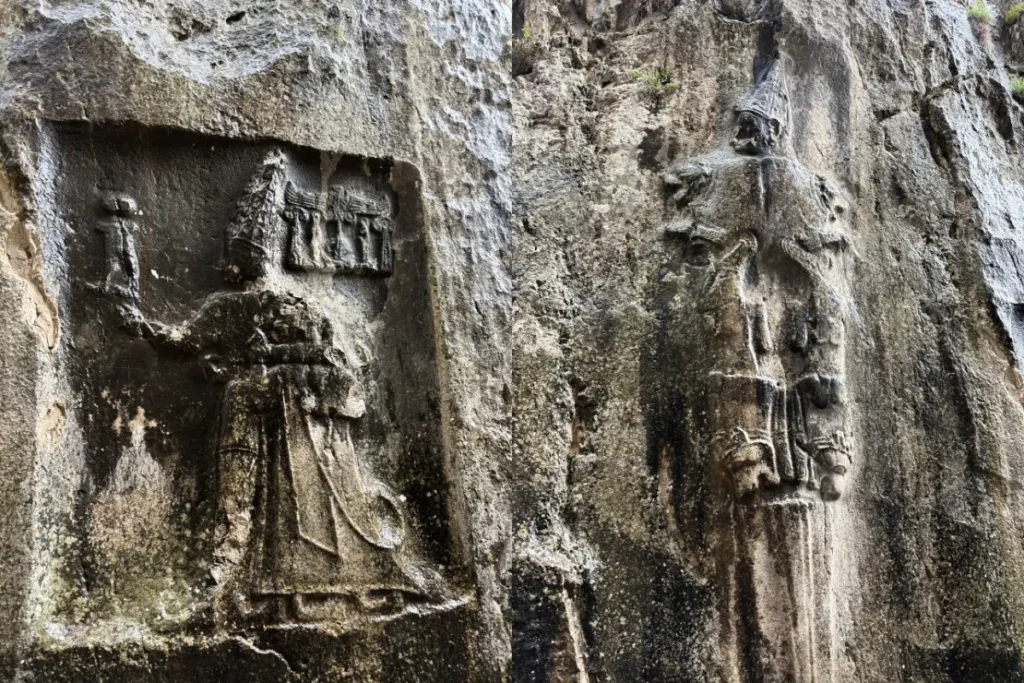
We stood in front of him for a while. He did not acknowledge us. He has a horizon to watch. He has been watching it since the Hittite Empire ruled central Anatolia and negotiated with Egypt’s pharaohs as a diplomatic equal. The empire fell around 1180 BCE. The warrior kept watching. The city emptied. The warrior kept watching. Three thousand three hundred years of other people’s history happened in front of him, and his expression has not changed, because stone does not update its expression based on current events. Visiting the site today costs TRY 360 / INR 840 / USD 10 per person (which includes access to the nearby Yazılıkaya Sanctuary), while seeing the original sculpture at Ankara’s Museum of Anatolian Civilisations costs TRY 360 / INR 840 / USD 10.
“Through all of it, the misidentifications, the debates, the relocation of the original to Ankara, the rain that ran down his carved face on the afternoon we met him, the warrior has done exactly one thing: looked at the horizon, axe raised, ready. The name on the gate is wrong. The warrior does not care. He was not carved to be correctly labelled. He was carved to guard. He is still guarding. The label is our problem, not his.”